
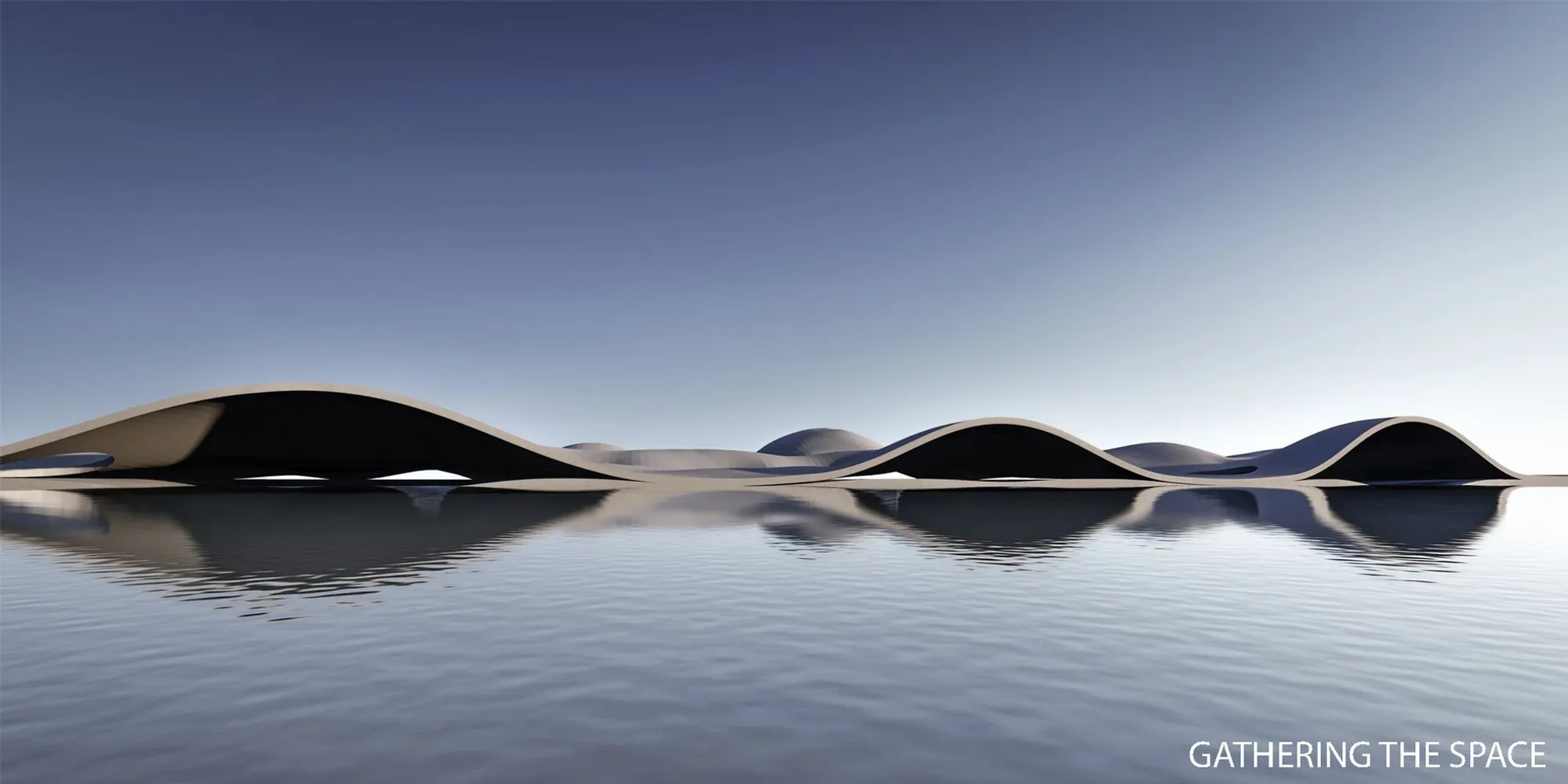
Gathering the Space: Recycled Plastic Canopies That Reshape the Shoreline
Curved planes of waste plastic create a public gathering space where architecture meets the dynamics of water, sand, and community life.


Waste plastic is rarely associated with architectural grace, yet the curved, wave-like canopies in this proposal prove that discarded material can produce genuinely compelling public space. The project deploys recycled plastic planes into sweeping, cantilevered roof forms that hover above a coastal threshold, inviting visitors to gather, perform, and simply watch the ocean. It is an argument, built in section and silhouette, that sustainability and spatial generosity are not competing ambitions.
Designed by Gülnur Aktaş and Gaye Gültekin, this Honorable Mention entry in the Athenaeum competition takes its title literally: "Gathering the Space" refers both to the physical act of collecting people under a shared canopy and to the conceptual act of assembling a new architectural context from recycled resources. The result sits at the edge of land and water, a place where the fluidity of the natural environment is echoed in the undulating forms overhead.
A Canopy That Belongs to the Horizon
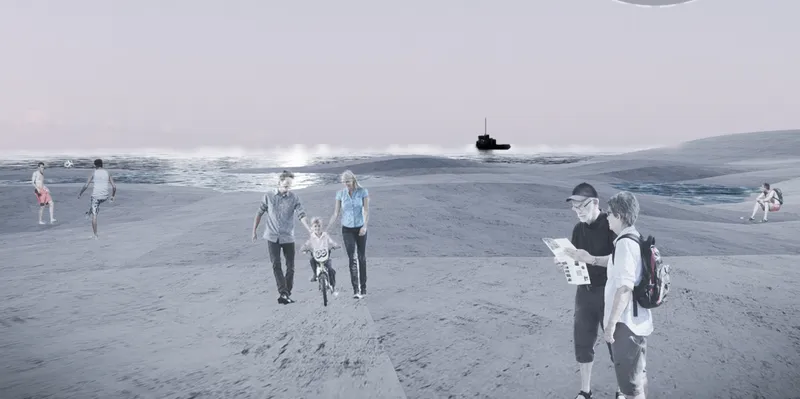
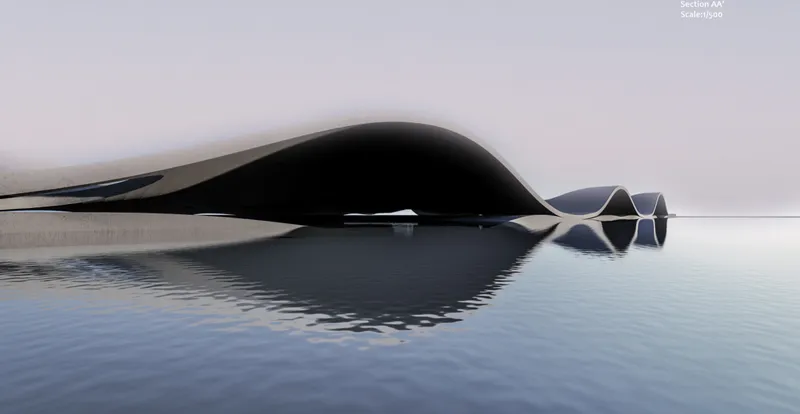
The dusk view across the sandy beach plaza establishes the project's territorial claim: a low, expansive structure that refuses to dominate the skyline. Visitors walk freely across an open ground plane that merges sand and paving, while a boat on the horizon reinforces the coastal identity of the site. From the side, the cantilevered roof reflects in calm water, revealing the cellular support system beneath. These organic, ribbed elements are the structural backbone of the design, shaped to distribute loads while minimizing material use. The reflection doubles the architecture, blurring the boundary between solid form and liquid surface.
Framing Water Through Recycled Planes
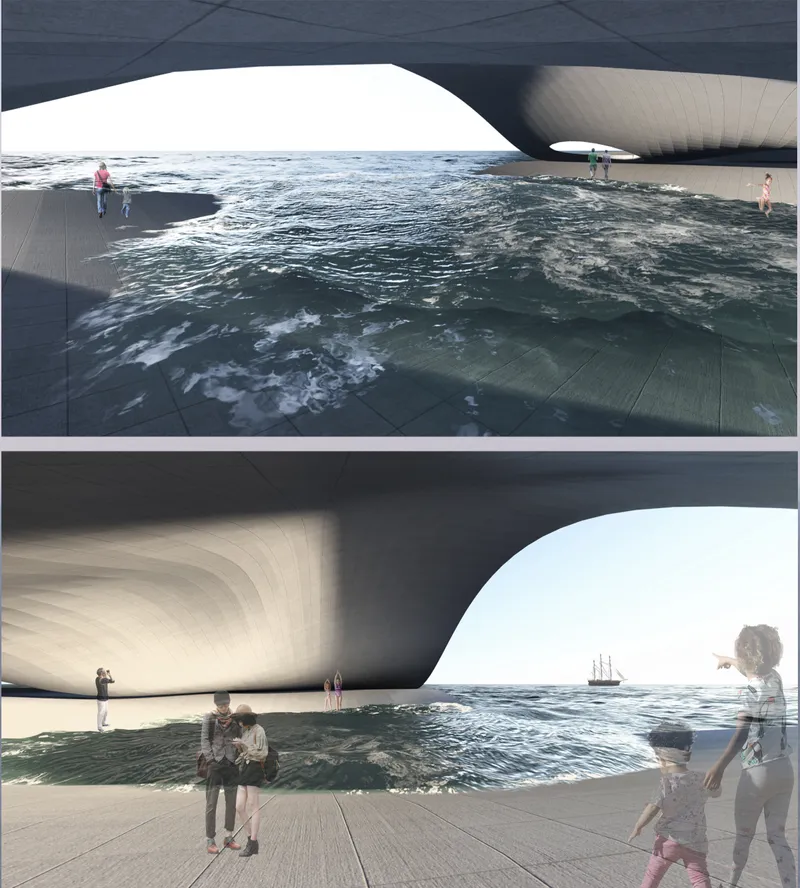
Beneath the structure, large openings punch through the canopy to frame specific views of the water beyond. The paved terrace becomes a threshold where visitors linger between interior shelter and open sky. What matters here is the material story: these curved planes are produced from waste plastics, repurposed into load-bearing surfaces that achieve both structural performance and a distinct aesthetic character. The irregularity of the openings recalls natural erosion patterns, reinforcing the designers' intent to echo the contours of water and land rather than impose a rigid geometric order.
Performance Space Under a Vaulted Ceiling
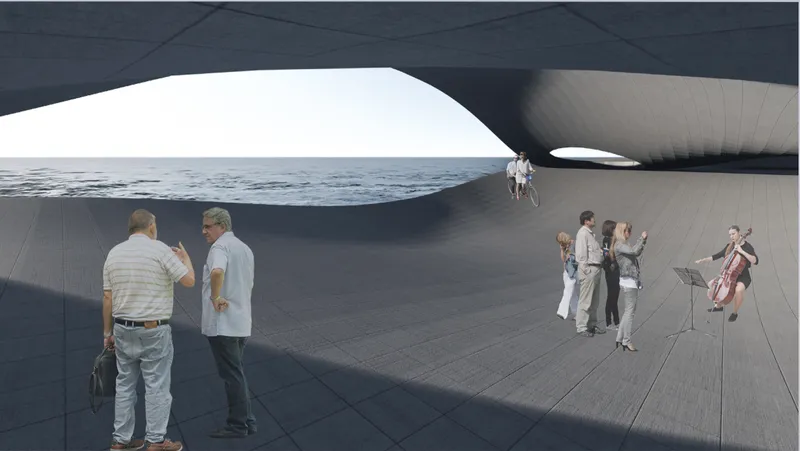
The project is not merely a shelter; it is a stage. Musicians perform beneath the vaulted ceiling as visitors gather on the dark paving, the overhead opening acting as a natural spotlight. Public inclusivity is embedded in the programme: the space encourages community gatherings, cultural exchanges, and environmental awareness without prescribing a single use. The vaulted form overhead provides acoustic containment while the open perimeter ensures the performance spills outward toward the landscape. It is a generous spatial gesture that turns infrastructure into invitation.
Arched Openings and Everyday Occupation
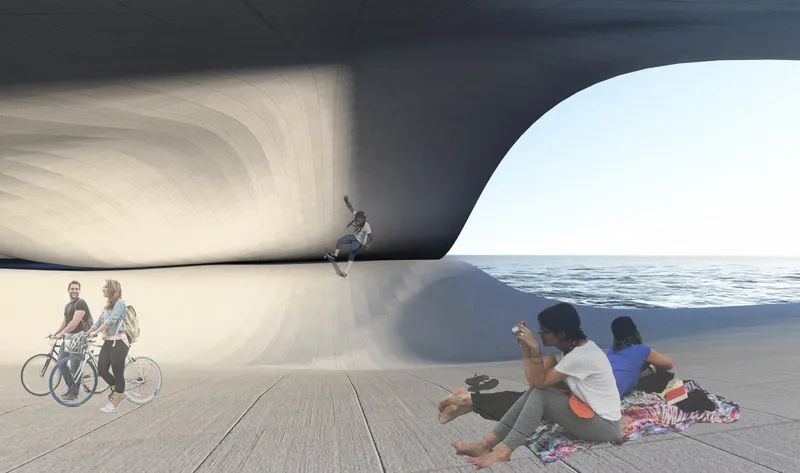
The final view captures the project at its most relaxed: visitors sit and cycle beneath arched openings, framed against ocean views, with ribbed ceiling panels visible overhead. The architecture operates at the scale of daily life, not spectacle. People occupy the space on their own terms, using it for rest, transit, or contemplation. The ribbed panels above serve a dual role, providing structural depth to the recycled plastic canopy while creating a rhythmic visual pattern that guides movement along the covered terrace. Nature's fluidity is embedded not just in the form but in the way people flow through it.
Why This Project Matters
Aktaş and Gültekin's proposal demonstrates that material innovation and spatial ambition can coexist. By building an entire public canopy from waste plastics, they challenge the assumption that sustainability demands austerity. The flowing forms are not decorative indulgences; they are the direct consequence of a material system that lends itself to curvature, and the designers exploit that property to create spaces that feel generous, open, and deeply connected to their coastal setting.
More broadly, the project reframes the role of the architect in a climate of environmental instability. Rather than retreating into hermetic enclosures, the design opens itself to the elements, collecting people and activities under a shared roof that belongs as much to the beach as to the city. It is a call for architecture that gathers rather than divides, using the least celebrated materials to build the most inclusive spaces.
View the Full Project
About the Designers
Designers: Gülnur Aktaş, Gaye Gültekin
Enter a Design Competition on uni.xyz
uni.xyz runs architecture and design competitions year-round that reward proposals with spatial conviction and real site intelligence.
Project credits: gathering the spaces by Gülnur Aktaş, Gaye Gültekin Athenaeum, (uni.xyz).



Popular Articles
Popular articles from the community


Conexión: Biophilic Design Reimagines High-Rise Living in Hong Kong
Conexión reimagines high-rise living in Hong Kong through biophilic design, green facades, shared spaces, daylight, water and nature within.

Play: Fragments of Their World
Familiar architecture becomes modular playground design, creating safe spaces where displaced children can learn, connect, imagine and play.

Hill & Cross Opera: Sculptural Opera House Architecture Shaped by Tallinn’s Landscape and Identity
Hill & Cross Opera reimagines opera house architecture in Tallinn through its sculptural hill, civic plaza, glass wave and a luminous cross.

The Ocean Hive: Sustainable Architecture for a Self-Sufficient Civilization at Sea
The Ocean Hive imagines sustainable architecture at sea, where modular habitats, algae, wave power and ocean waste sustain a growing colony.


Similar Reads
You might also enjoy these articles

Day and Night Park: A Time-Based Urban Newsstand in Beijing
A temporary urban newsstand in Beijing blending travel, light, and reading through poetic colors, compact form, and community-focused design.

Modernist Patio Renovation in El Masnou, Barcelona by Oliver Segura Arquitectura + Cebrià Arquitectura
Modernist patio renovation blending tradition and innovation with a movable pool, leveled floors, and Catalan materials in El Masnou.

Alto Residencial Coop: Cooperative Housing Development in Santiago de Compostela by Carbajo Barrios Arquitectos
A linear cooperative housing complex blending white volumes and perforated metal façades, enhancing community living, natural light, privacy, and urban integration.
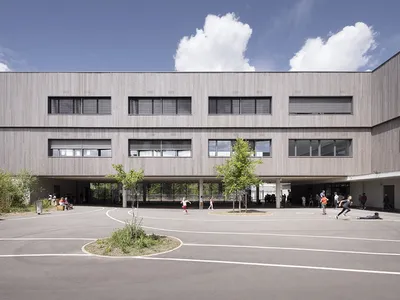
Vil Genis School by BPA ARCHITECTURE – Massy, France
Vil Genis School in Massy, France, features sustainable design, south-facing classrooms, community integration, accessible spaces, and modern educational architecture.



Comments (0)
Please login or sign up to add comments
No comments yet. Be the first to comment!