
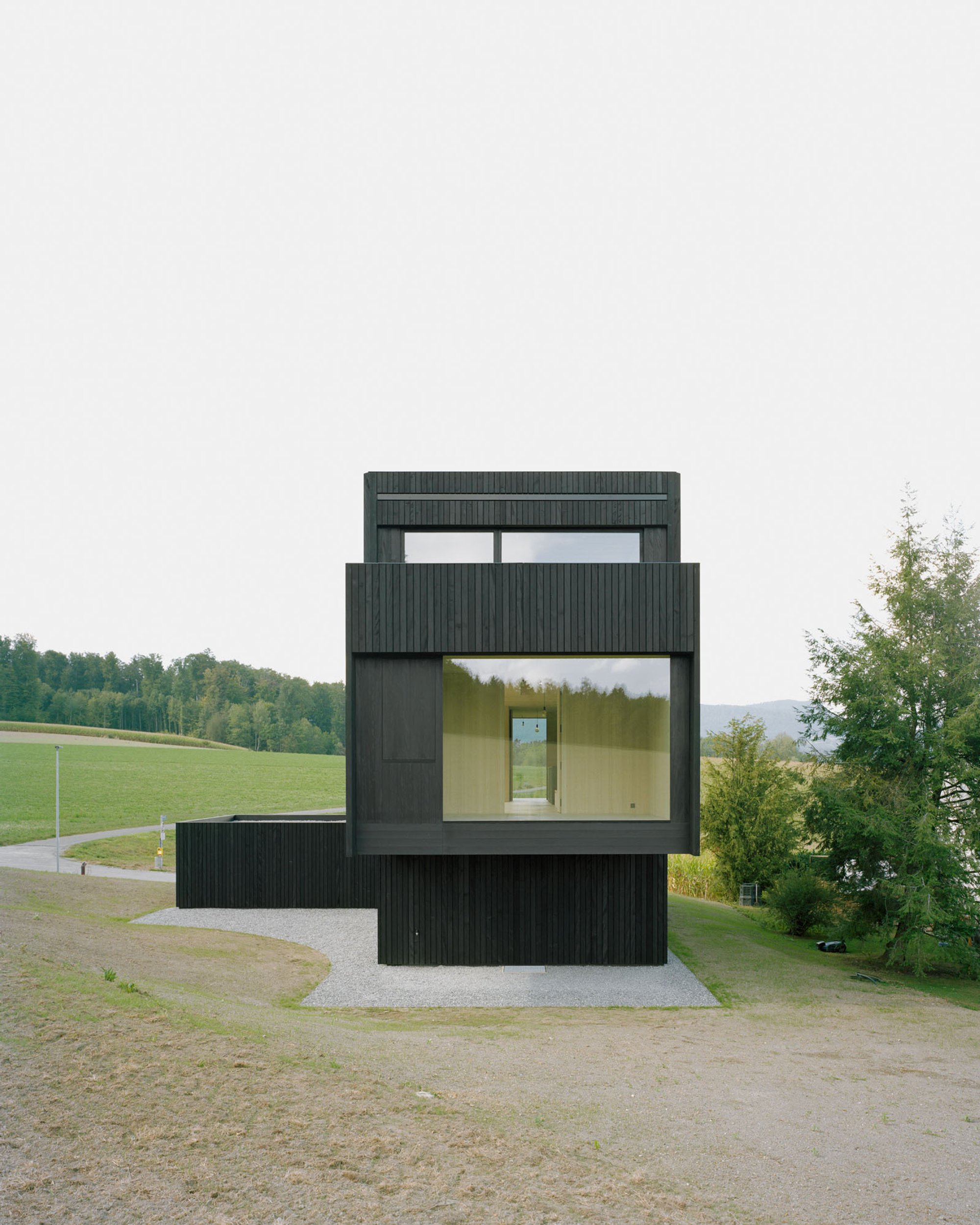
Gautschi Lenzin Schenker Architekten Plant a Cedar Tower at the Edge of Aarau's Agricultural Zone
A detached house in northern Switzerland dissolves the boundary between settlement and open landscape with unfenced edges and stacked volumes.

Most detached houses at the periphery of Swiss towns try to have it both ways: suburban comfort with a borrowed view. Gautschi Lenzin Schenker Architekten refuse that compromise in Aarau, where a replacement dwelling sits on an elevated plot that borders the agricultural zone on three sides. Instead of hedging the site with fencing or ornamental planting, the architects leave the perimeter entirely open, letting the house exist as a vertical object within a continuous field of meadow, gravel, and wildflower.
The result is a building whose presence depends less on plan than on section. A concrete plinth digs into the gentle slope to absorb the grade change, while two floors of untreated red cedar stack above it, their dark vertical boards weathering toward the greens and greys of the Jura foothills beyond. Large, yellow-tinted glazed openings punch through the cladding at precise intervals, turning the facade into a calibrated instrument for framing landscape on every side. The real design move, though, is the refusal to domesticate the ground plane. Without a garden boundary, the house reads not as a suburban property but as a solitary marker on a working agricultural edge.
A Volume That Reads as Landmark
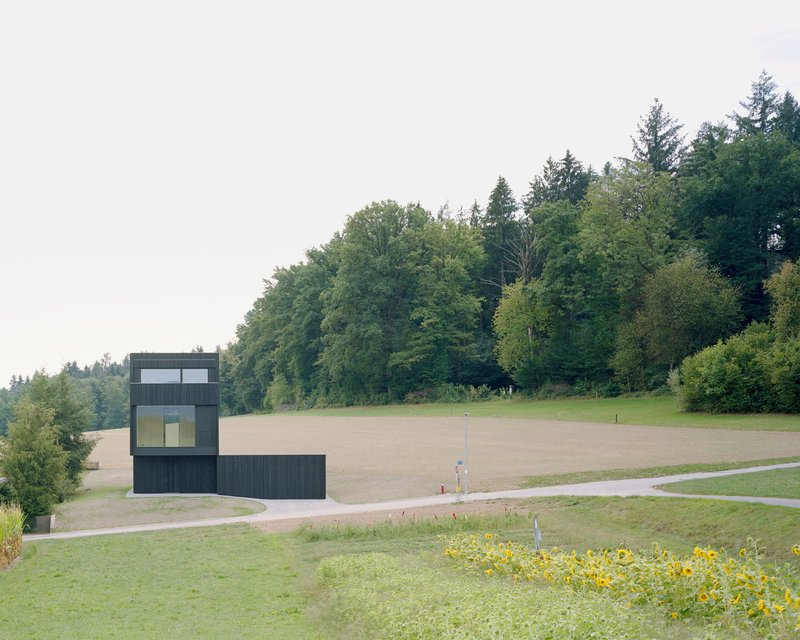
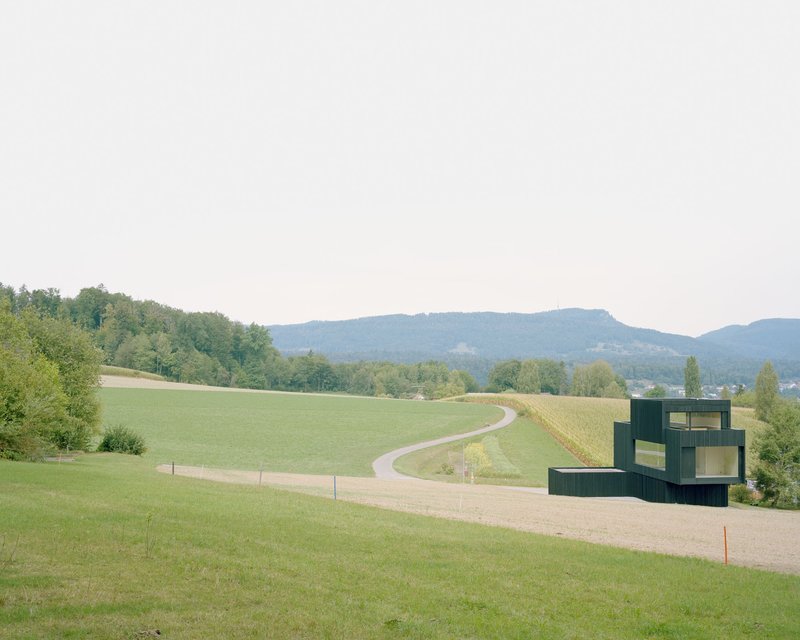
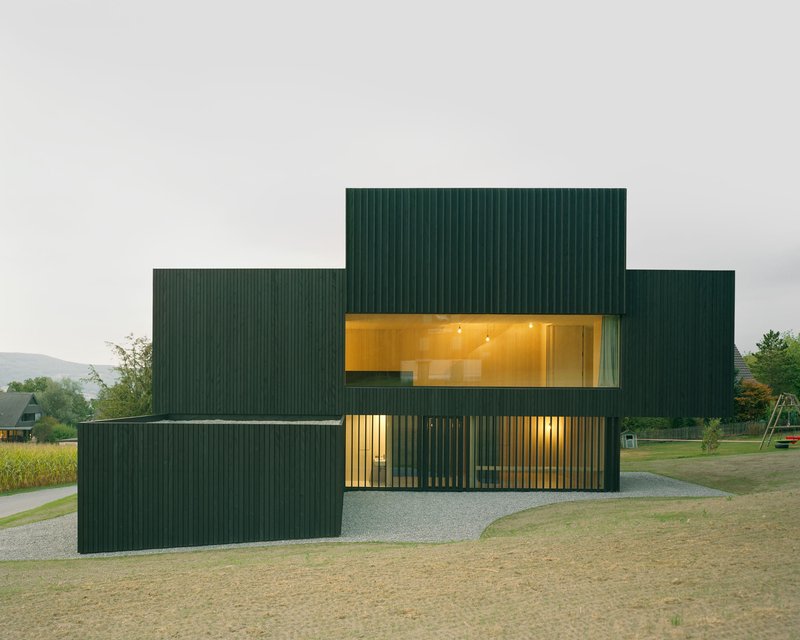
Seen from the rolling fields below, the house looks almost civic: a dark, ribbed tower with horizontal bands of illuminated glass, rising above the rooftops of the housing development it technically belongs to. The architects positioned the rectangular volume parallel to the street, which grounds it within the settlement's existing grain, but the massing reads as something apart. At dusk, ribbon windows glow like signal lights against the cedar, and the building's silhouette sharpens against the Jura skyline.
The distance shots reveal how effectively the open perimeter strategy works. Yellow wildflowers run right up to the gravel apron; the only hard edge is the road itself. The house does not claim territory so much as occupy a coordinate within the landscape.
Cedar Cladding and the Concrete Plinth
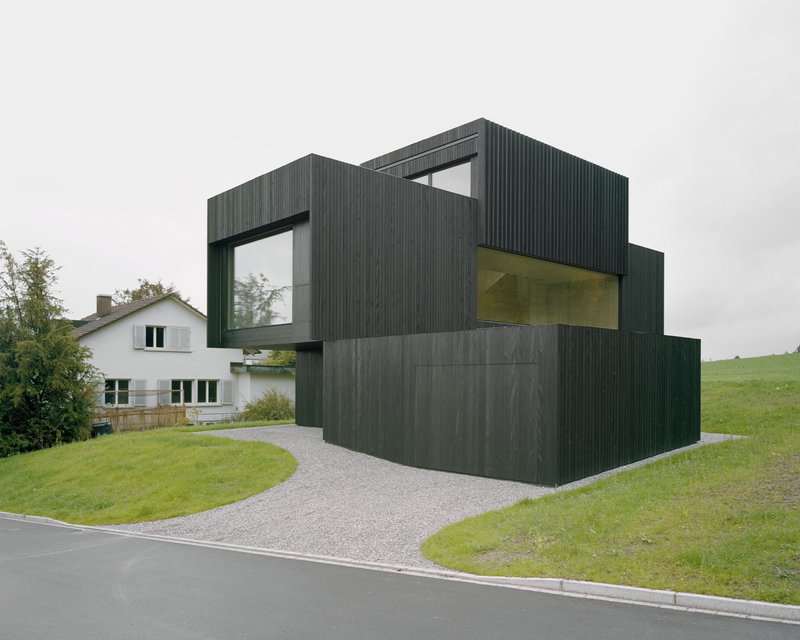
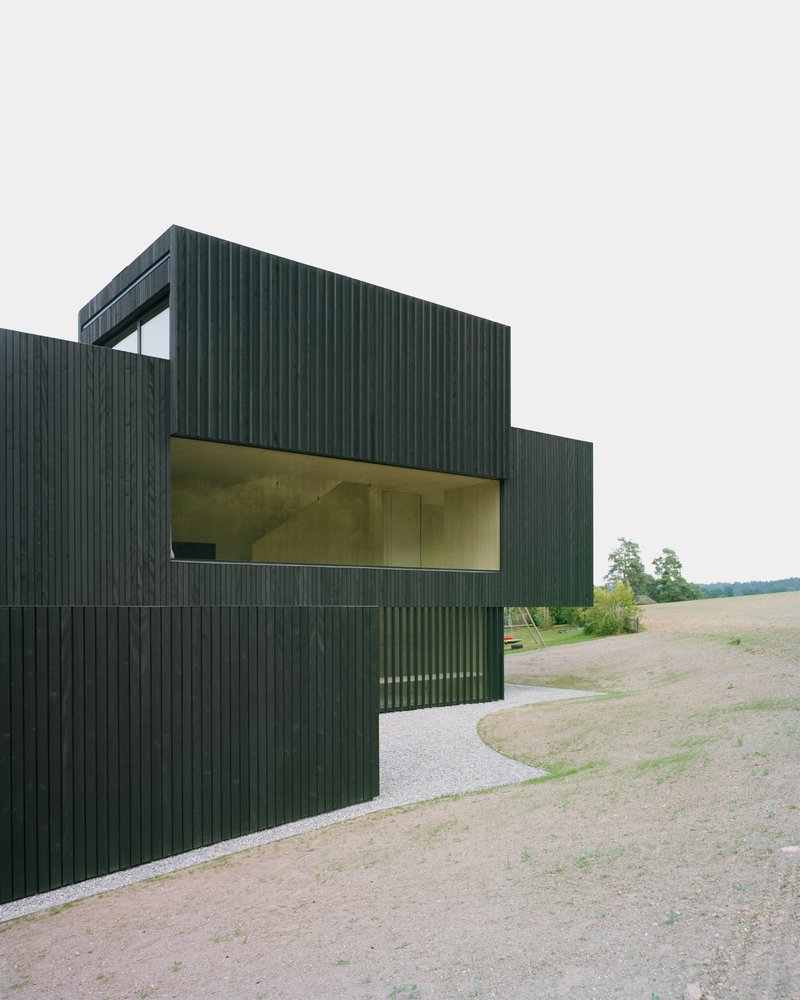
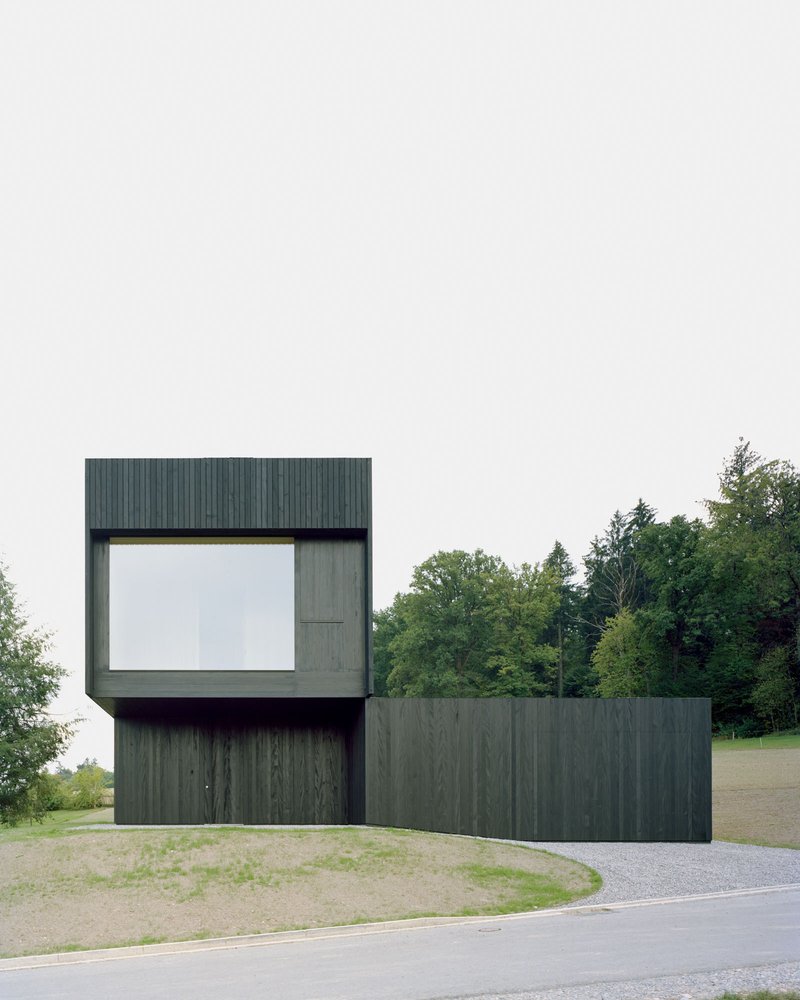
Up close, the material strategy is blunt and legible. An exposed concrete base anchors the building to the hillside, handling moisture and earth pressure where the structure meets grade. Above it, vertical red cedar boards run continuously, their untreated surface already beginning to silver. The transition between the two materials is clean: concrete stops, wood starts, no trim or flashing detail to mediate. Deep recessed window openings carve volumes out of the cladding, giving thickness to what might otherwise read as a flat screen.
The cantilevered volume at the upper level pushes this logic further, hovering above the gravel drive with a single large square opening. It is a detail that owes more to agricultural outbuildings, where functional overhangs shelter machinery, than to villa architecture.
Stacking Program on a Slope
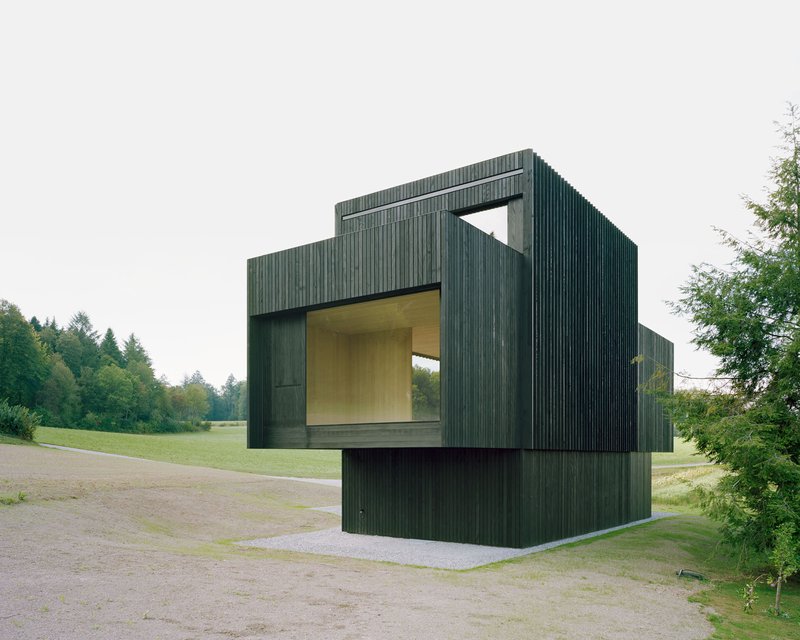
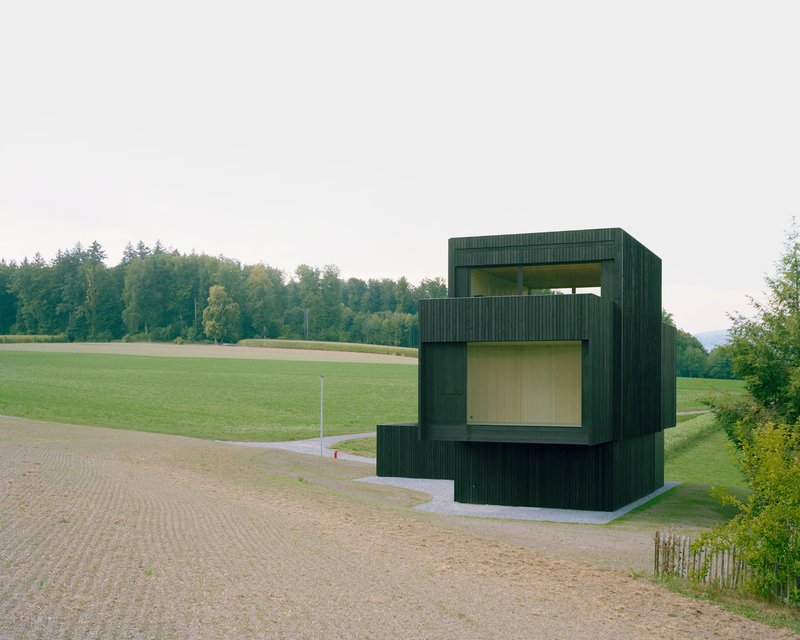
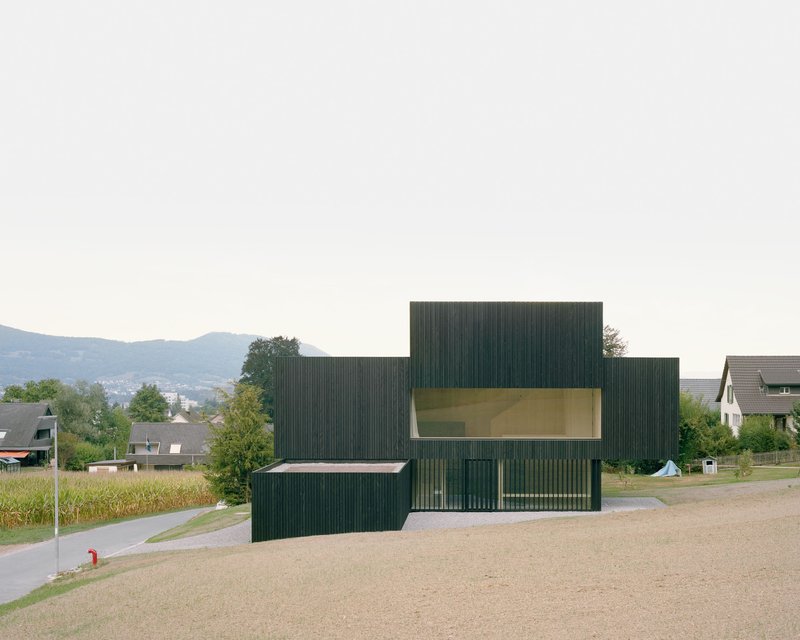
The slope gives the architects a sectional gift. Entering at street level, you arrive at the plinth, where a double-height entrance hall, garage, basement rooms, and a multifunctional space occupy the embedded concrete volume. The middle level holds four bedrooms, two bathrooms, and a sauna, with a loggia arranged in front of the children's rooms. Living, dining, and kitchen occupy the upper floor, where a ceiling offset creates a double-height dining space and zones the open plan without walls. An attic office caps the stack, oriented toward the city through generous glazing.
Reading the building from its corner elevations makes the stacking legible. Each programmatic band gets its own window rhythm: narrow horizontal slots for sleeping, tall framed openings for living, a single punched square for the office. The facade becomes a diagram of domestic hierarchy.
The Double-Height Interior and Timber Warmth
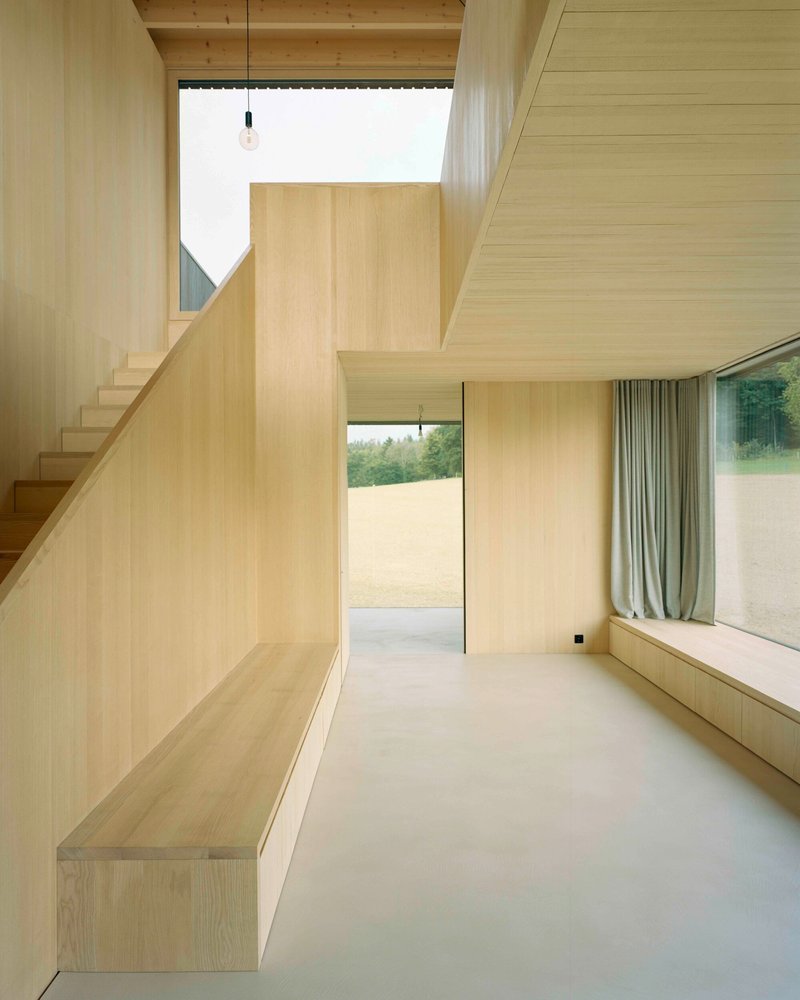
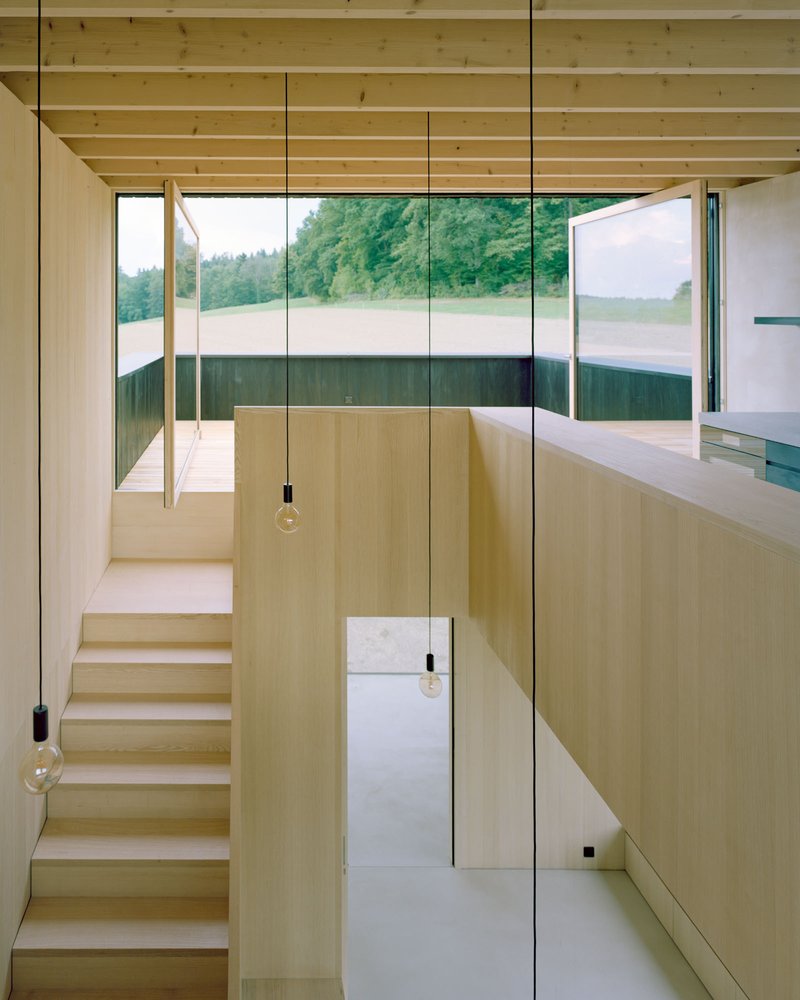
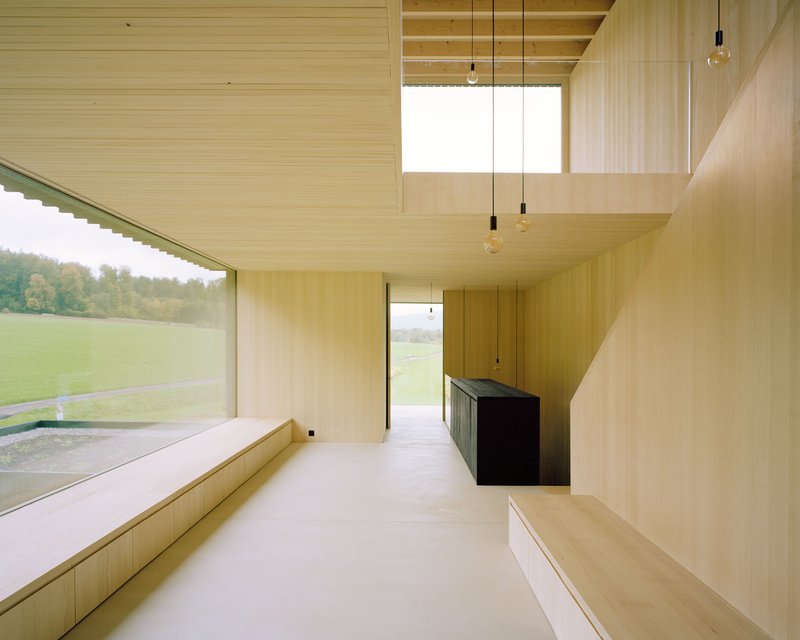
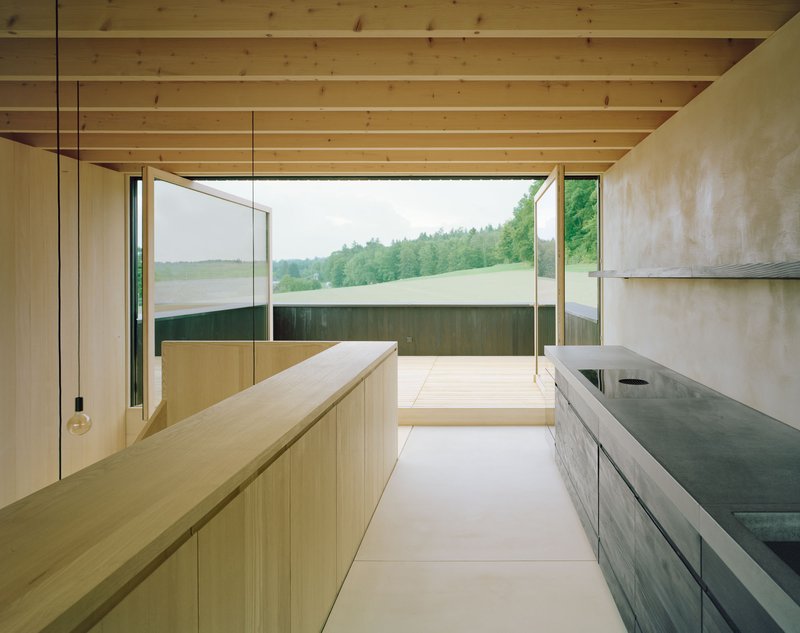
Inside, the palette shifts from the somber exterior cedar to pale plywood linings and exposed timber beams. The double-height living space is the spatial anchor: a straight staircase cuts through the void, connecting the bedroom level to the kitchen floor, while a skylight washes the timber surfaces with overhead light. Suspended pendant lights drop into the dining volume, their cables emphasizing the vertical dimension.
Full-height glazing on the forest side dissolves the wall entirely, framing a view of sloping canopy that changes character with the seasons. The room works because the ceiling offset creates two scales within one space: an intimate kitchen zone at single height, and a generous dining and sitting area that borrows the volume above.
Thresholds Between Inside and Ground
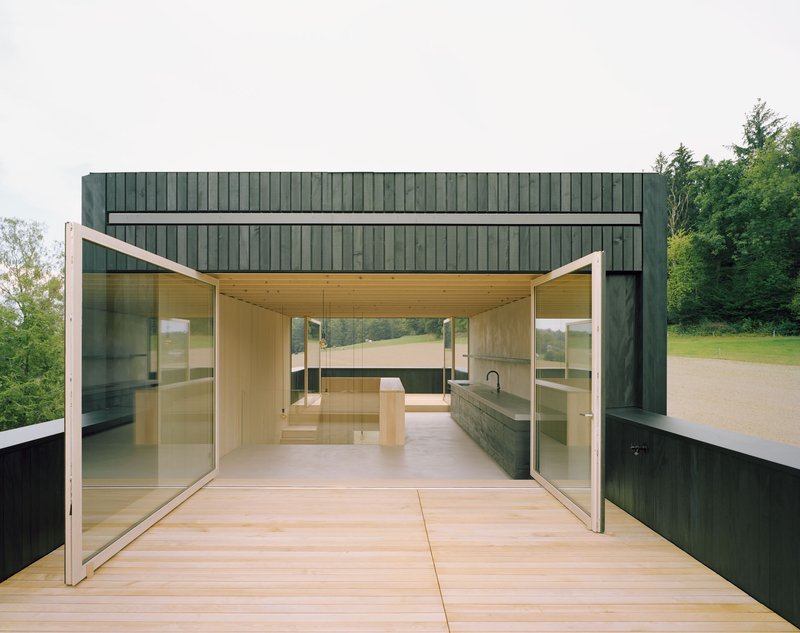
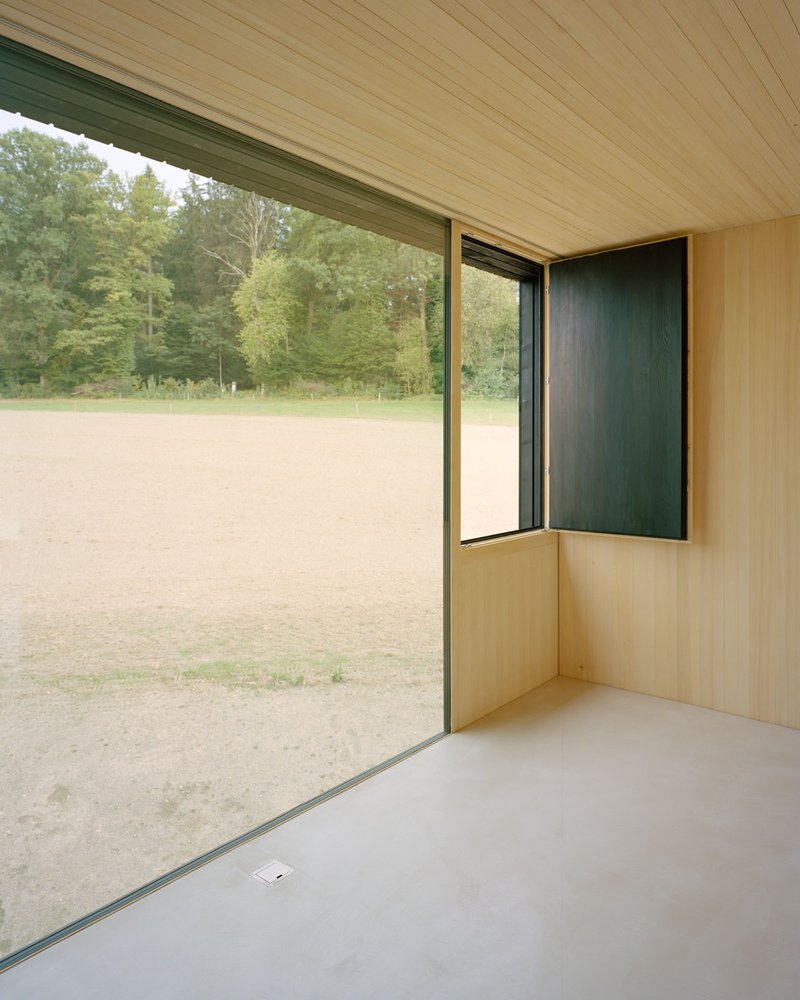
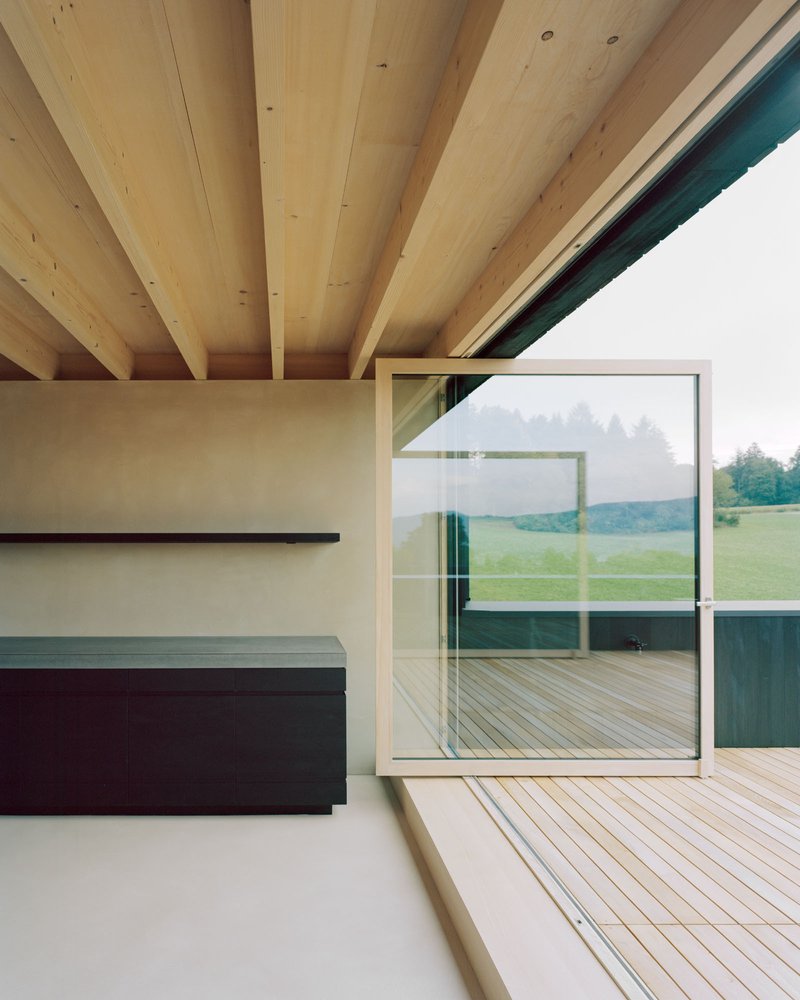
Several moments in the house test the boundary between enclosed room and open ground. Pivoting glass doors at the living level fold back to connect a light wood interior directly onto a timber deck, erasing the wall plane altogether. At the plinth level, a sliding glass door opens onto a sand courtyard framed by trees, a sheltered outdoor room carved into the hillside where the concrete base meets grade.
These thresholds matter because the house has no garden in the conventional sense. The deck and courtyard are the only curated outdoor spaces; beyond them, the meadow takes over. That makes each transition precise: you step from domestic interior to unmediated landscape with nothing in between.
Rooms for Retreat
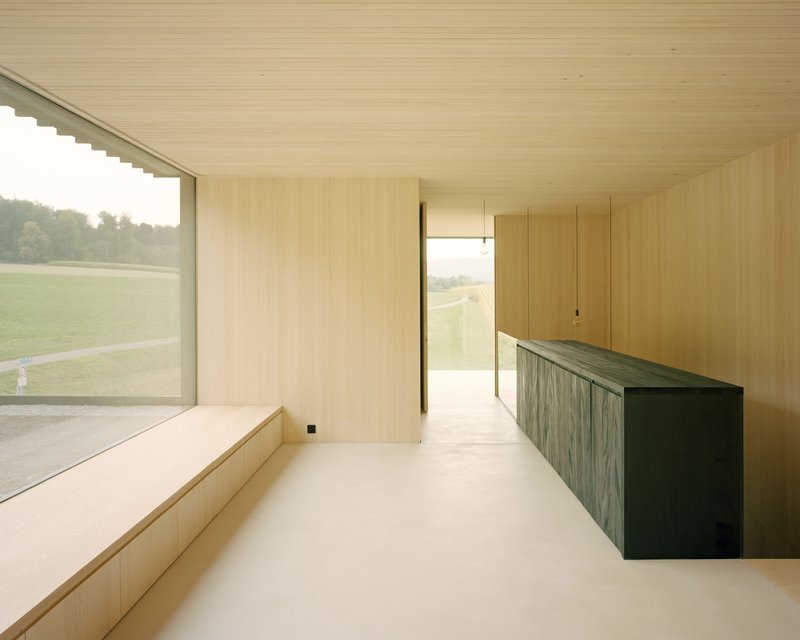
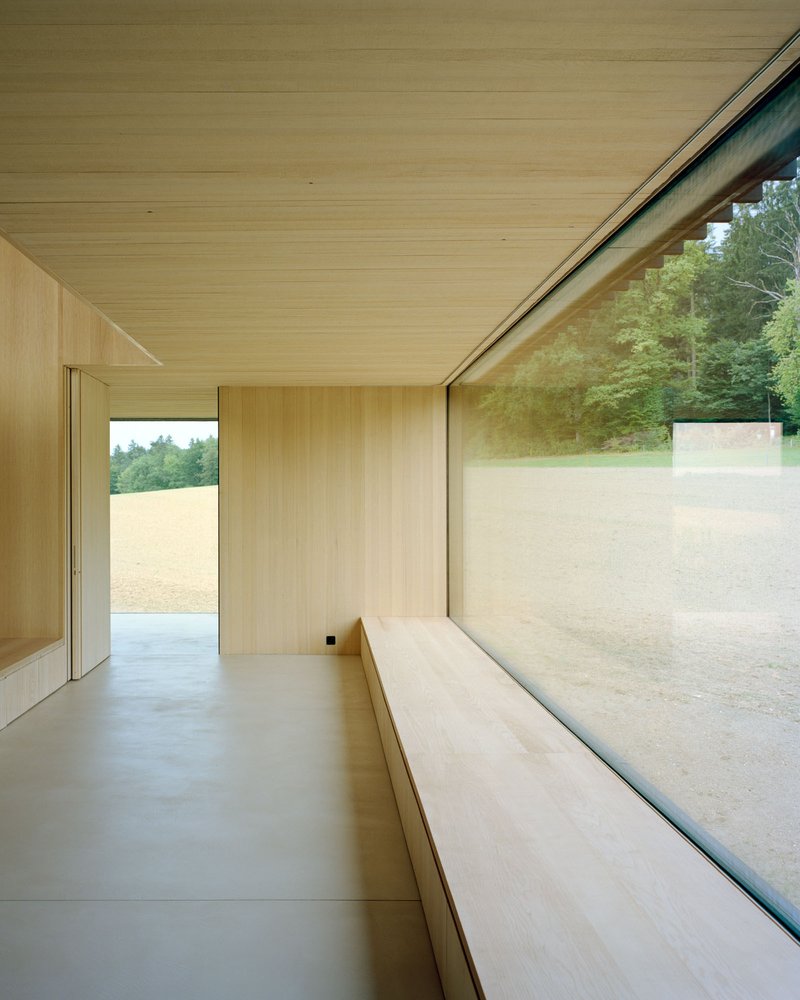
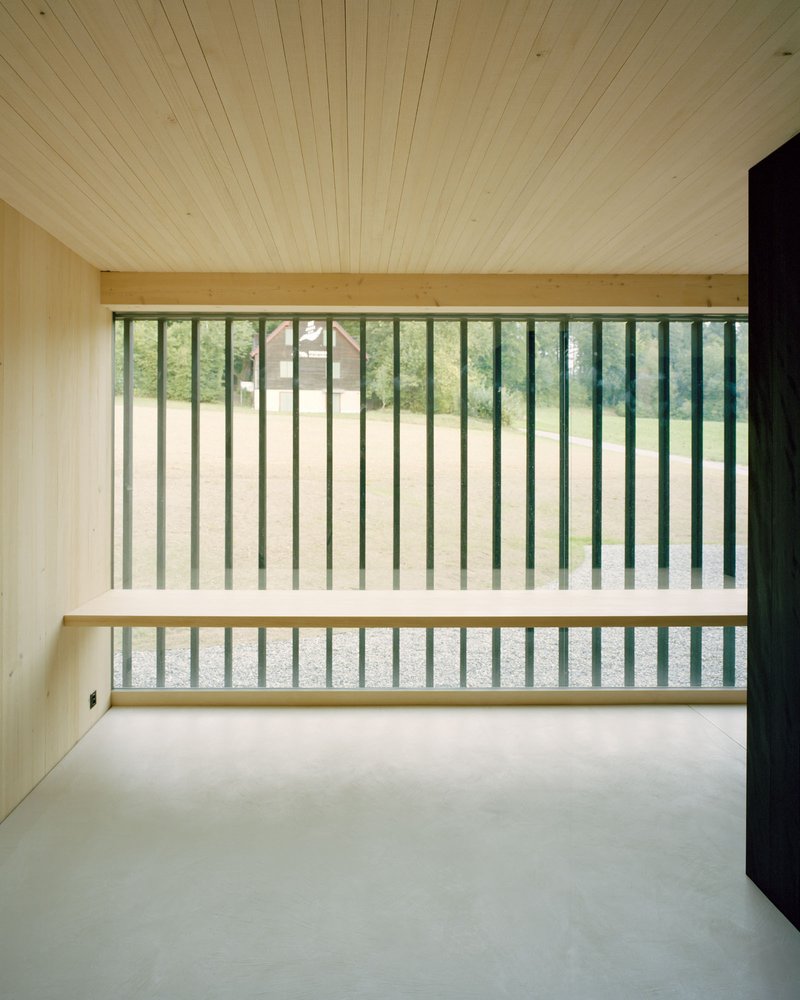
Not every room in this house demands a panorama. The bedrooms and study spaces are lined in plywood with built-in benches and dark cabinetry, calibrated for comfort rather than spectacle. Window seats run the length of continuous glazing strips, offering a place to sit and watch light move across the fields without committing to the full drama of the double-height volume upstairs.
Vertical timber louvers at the upper level filter the open landscape into slices, softening the brightness and adding a layer of privacy for the rooms behind. The attic office, with its built-in desk and seating niche, is oriented toward the city, giving the working space a different outlook from the domestic rooms below.
Circulation and Material Contrast
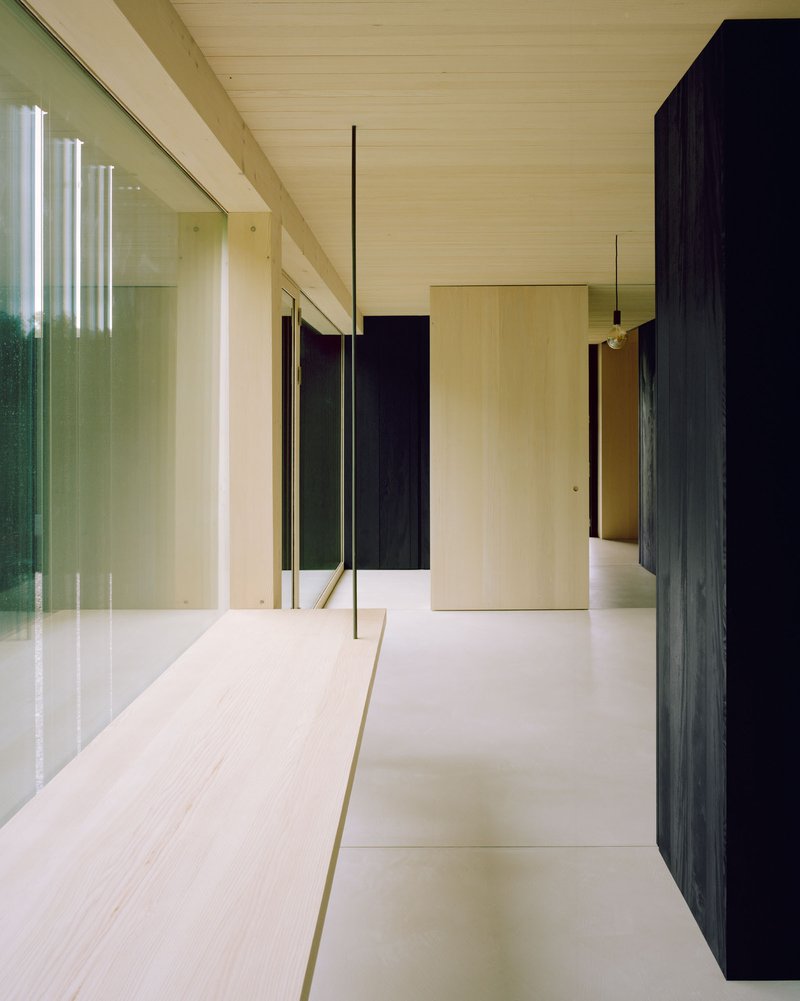
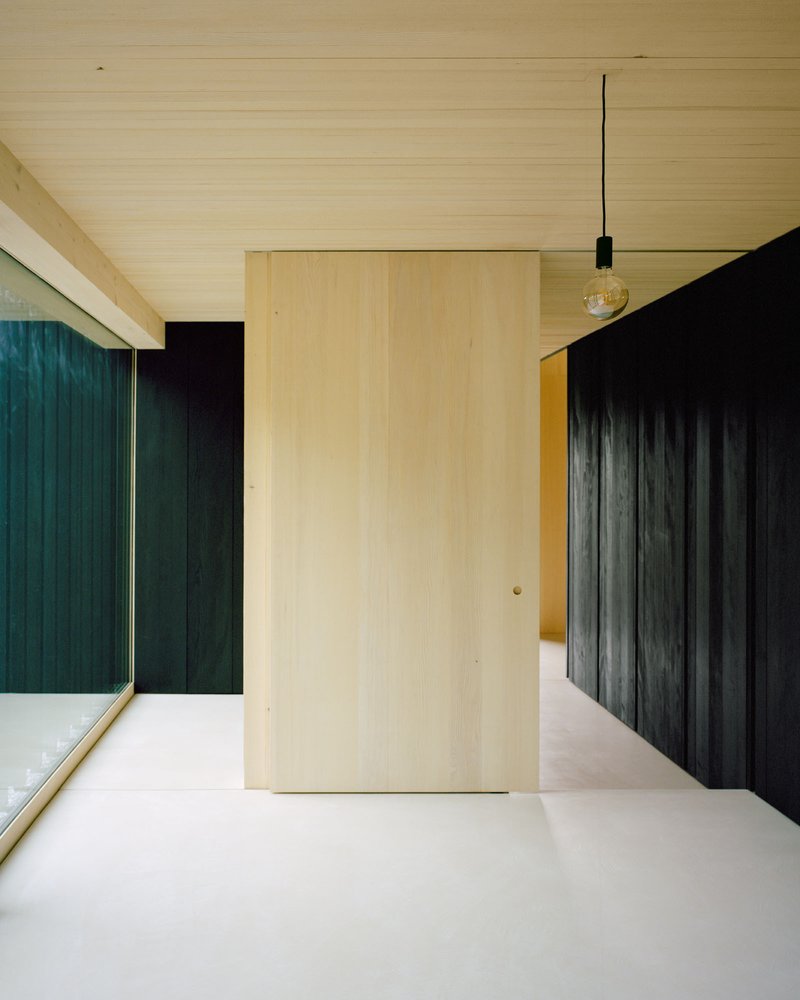
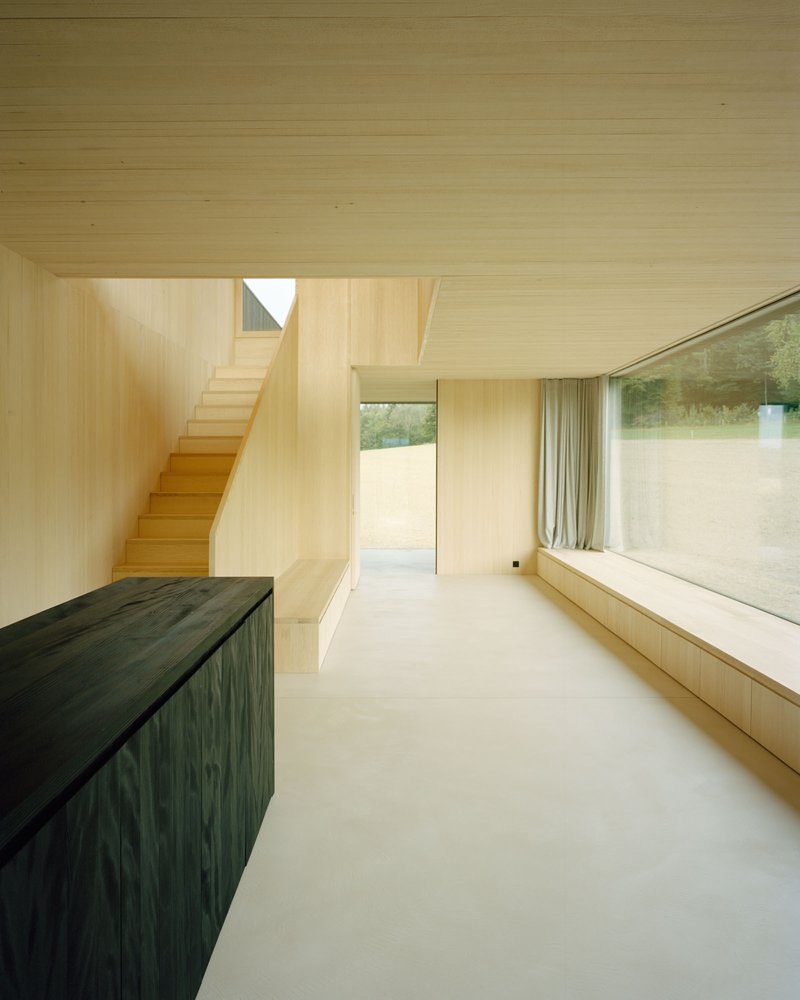
Corridors and circulation zones are treated with the same care as the main rooms, but with a deliberate shift in tone. Dark-stained timber panels line one side of a hallway, while full-height glazing on the other reflects the interior back on itself, doubling the perceived depth. Plywood sliding doors separate private rooms from shared passage, their grain running horizontal against the vertical rhythm of the exterior cladding.
A concrete floor at the living level grounds the pale timber walls and introduces the only hard, cool surface in the upper house. The contrast works: it reminds you that the building sits on a concrete plinth, and that the warmth of the cedar and plywood is a chosen layer over a more elemental structure.
Plans and Drawings
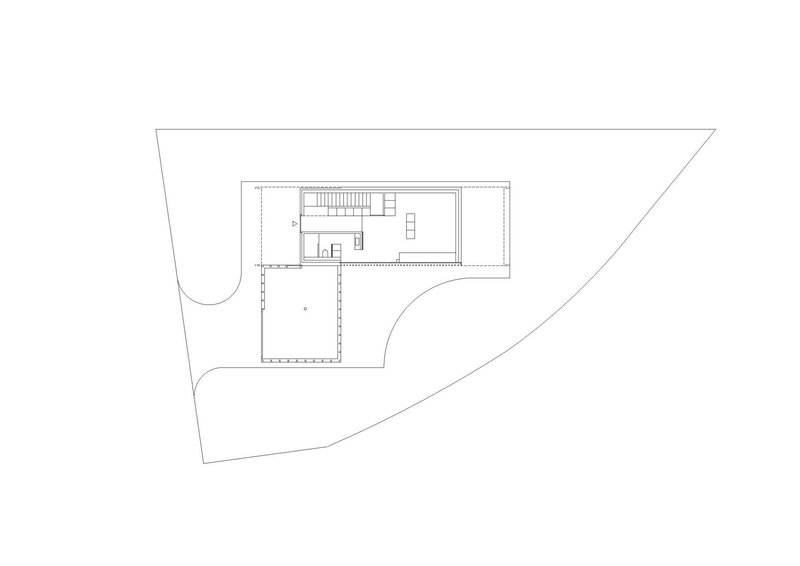
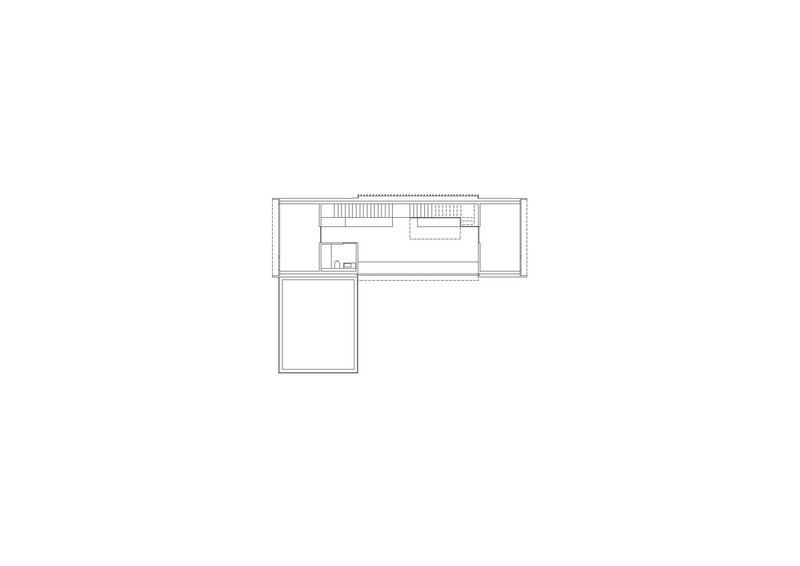
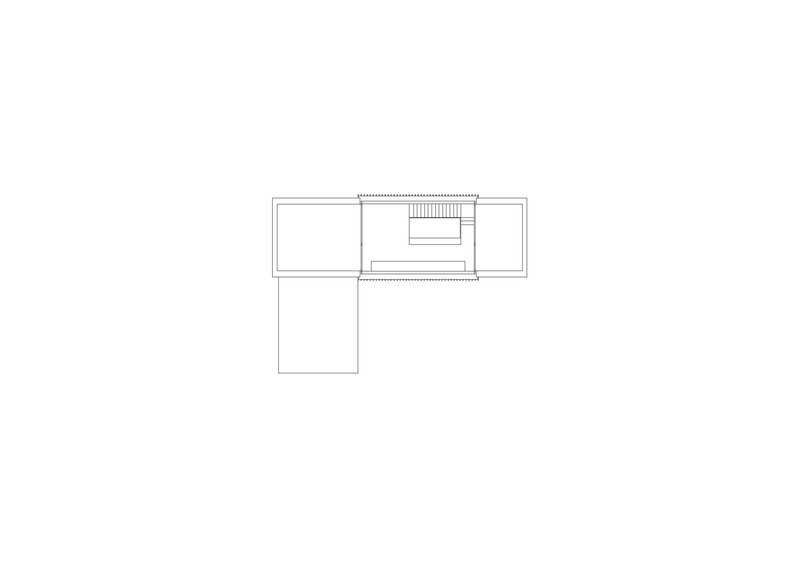
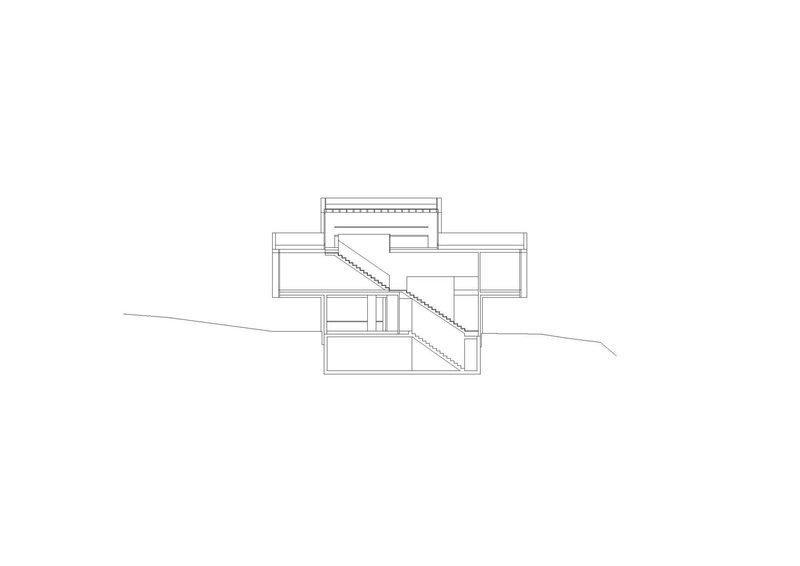
The site plan confirms the open-perimeter strategy: the L-shaped footprint, with its two wings and courtyard, sits on sloped terrain with no enclosing boundary drawn. The section is the most revealing drawing. It shows the split-level volumes connected by a diagonal stair that runs the full height of the building, linking the embedded plinth to the attic office in a single continuous movement. The floor plans reveal a compact organization with a central staircase that shifts from straight to semi-spiral as it ascends, adapting its geometry to the shrinking footprint of each successive level.
Why This Project Matters
The Swiss detached house occupies a peculiar position in European architecture. Strict planning regulations and high construction standards tend to produce buildings of technical excellence but stylistic caution. What Gautschi Lenzin Schenker achieve here is something rarer: a house that is technically precise and spatially generous, yet takes a genuine risk with its site strategy. Leaving the perimeter unfenced is a conceptual decision with real consequences. It changes how the rooms feel, how the building photographs, and how neighbors perceive the boundary between private and collective land.
The stacked section is the other lesson worth exporting. By inverting the conventional Swiss house, placing living at the top and sleeping in the middle, the architects give the most communal room the best light and the longest view. The double-height dining space, the offset ceiling, and the attic office above are all products of a sectional ambition that a single-story plan would never have delivered. For anyone working on sloped sites at the edge of settlement, this project is a compact argument for thinking vertically.
Detached House, Gautschi Lenzin Schenker Architekten, Aarau, Switzerland, 2022. Photography by Rasmus Norlander.
About the Studio
Share Your Own Work on uni.xyz
If projects like this are the kind of work you want to make, uni.xyz is a place to publish your own, find collaborators, and enter design competitions.




Popular Articles
Popular articles from the community

YOAP Architects Round a Corner in Yeongcheon with a Cylindrical Community Hub
A 197-square-meter brick and ribbed-clad tower turns a forgotten alley corner in South Korea into a public garden with a low threshold.
Ippolito Fleitz Group Identity Architects Turn Eight Floors in Shanghai into a Vertical Creative City
Publicis Groupe's new headquarters in Xintiandi reimagines the office as a courtyard-driven urban landscape stacked across eight floors.
RDTH architekti Rips Out Nearly Every Wall in a Prague Apartment and Replaces Them with Furniture
A 101-square-meter post-war flat in Prague trades rigid partitions for a single rotated furniture block, curtains, and glass concrete.
Takeshi Hosaka Architects Suspends a Concrete Cross Above a Yokohama Cemetery
A 28-square-meter burial renovation in Yokohama lifts the symbol of resurrection into the sky so mourners see it against heaven.


Similar Reads
You might also enjoy these articles

127af Flips a Tiny Bagnolet Rowhouse Upside Down with a Handcrafted Roof Extension
A 55-square-meter terraced house on the edge of Paris gains a luminous upper living floor through lightweight timber and steel.
1.61 Design Workshop Wraps a 600-Square-Meter Café in Vietnam in Sculptural Burgundy Drama
Reden Café & Bistro pairs a helical staircase, mosaic floors, and deep red interiors to rethink Vietnamese hospitality space.

The Unbound Brain: A School Shaped by Cognitive Architecture
Cylindrical learning pods radiate like neurons from a central cortex, turning the floor plan into a spatial model of human thought.
Revival Vernacular Architecture: Rammed Earth Settlements for the Sahara
A modular desert community in Mauritania that fuses passive cooling techniques with earthen construction and local craftsmanship.
Explore Architecture Competitions
Discover active competitions in this discipline




The International Standard for Design Portfolios


The Global Benchmark for Architecture Dissertation Awards


The Global Benchmark for Graduation Excellence


Challenge to design mud housing for contemporary communities
Comments (0)
Please login or sign up to add comments
No comments yet. Be the first to comment!