

Alventosa Morell Heats an Entire House in Osona with a Single Pellet Stove
A 110 square meter timber residence near Montseny Natural Park proves that rigorous bioclimatic design can replace mechanical systems entirely.

In Seva, a village in the Osona region of Catalonia pressed against the edge of Montseny Natural Park, Alventosa Morell Arquitectes completed a 110 square meter house that needs no cooling system and heats itself with a single pellet stove. That is not a marketing claim or a theoretical energy model. It is the actual performance outcome of a building whose every decision, from siting to section to material selection, serves a bioclimatic logic. GE House, designed by Marc Alventosa and Xavier Morell, is a quiet proof of concept: a small residence that treats sustainability not as an overlay of technology but as the generator of architectural form.
The project sits on a triangular plot with significant slope, bordered by two streets. Rather than reshaping the terrain, the architects surveyed the land and placed the building at its highest, flattest point, minimizing earthworks and preserving existing trees. The resulting form is deceptively simple: a linear sequence of rooms under a pitched timber roof oriented to capture southern sun, with service spaces tucked to the north beneath a flat roof. Between these two roof planes, skylights introduce daylight and drive cross ventilation. The house is legible at a glance, yet everything about it is calibrated.
The Timber Hat and the Ceramic Base
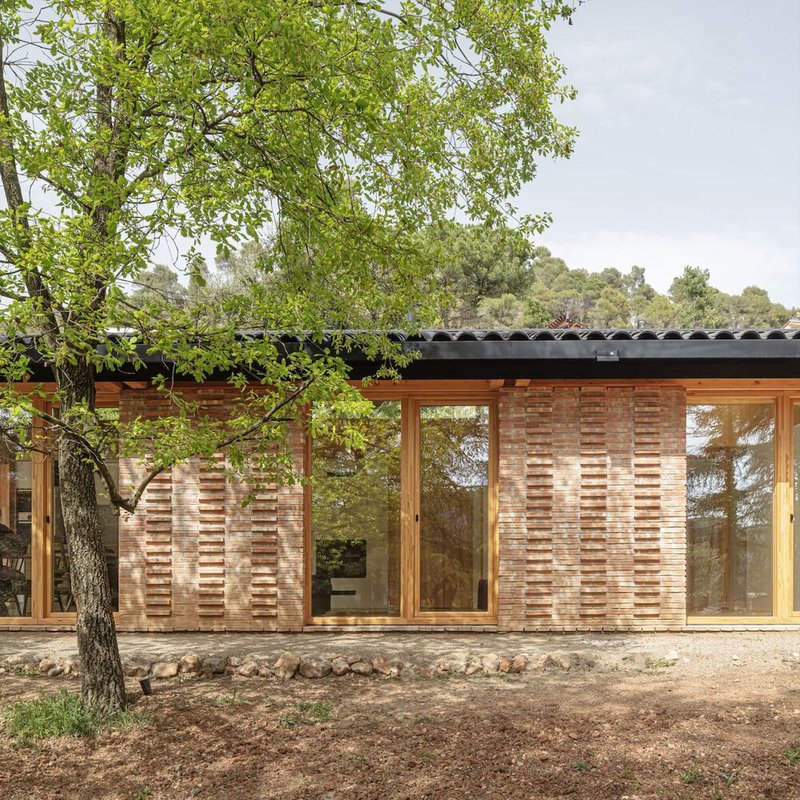
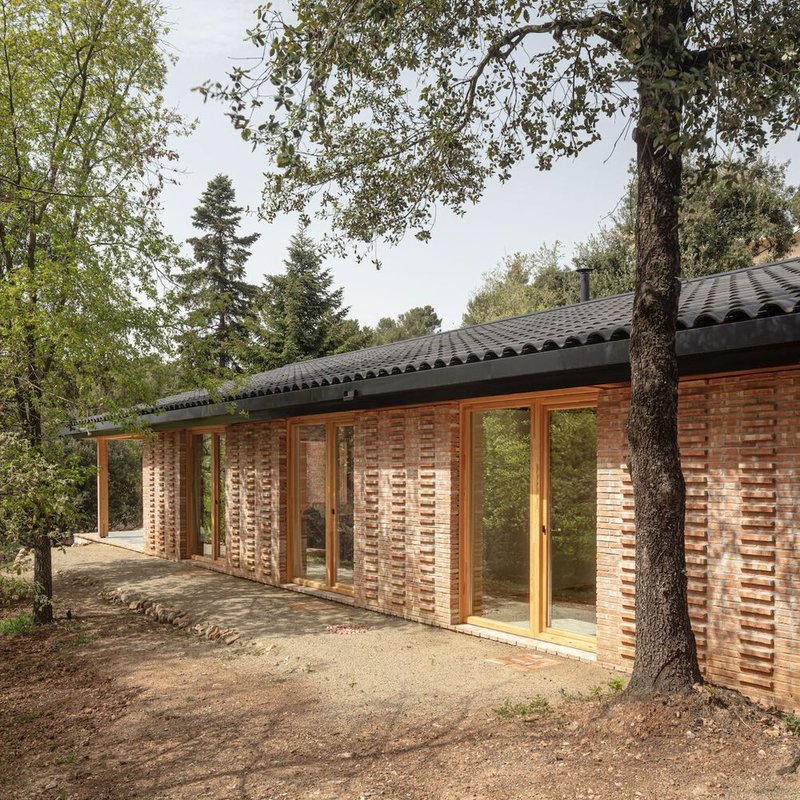
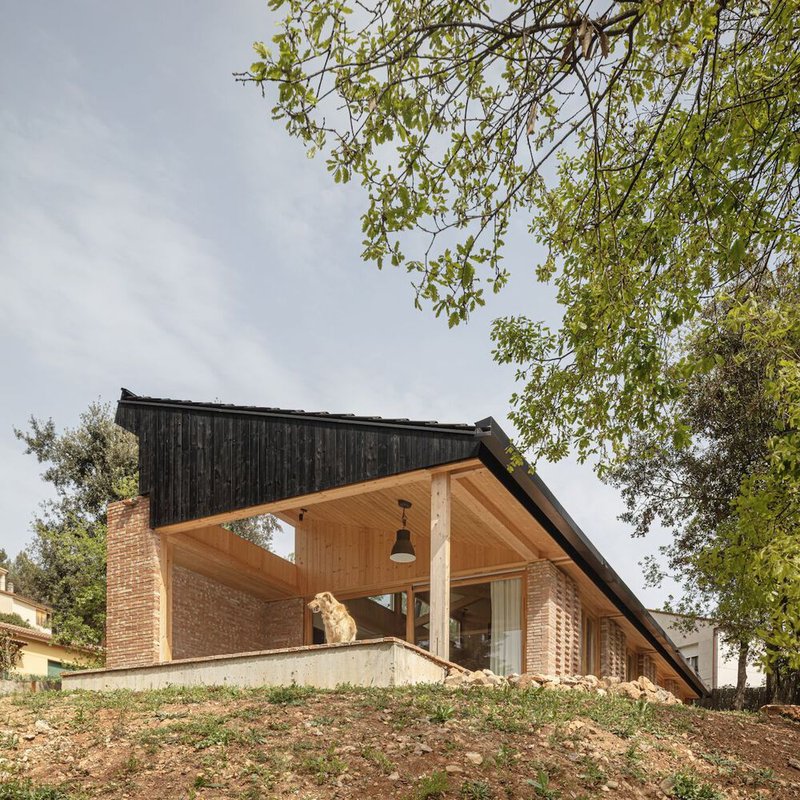
GE House reads from the outside as two distinct registers. A ceramic base, its brickwork reaching only to the window lintel height, gives the ground plane a solid, protective character. Above it floats what the architects describe as a large "hat": a ventilated black-tinted wooden facade topped with black tiles. The gap between ceramic and timber is occupied by generous glazing that opens every main room to the south-facing garden. The result is a building that feels simultaneously grounded and light, anchored to its plot yet lifted off it.
The patterned brick catches dappled light under the tree canopy, and the corrugated black roof plane hovers above, its pitch visible from below as an elegant vaulted timber soffit along the porch. The ceramics were fired with biomass, extending the project's commitment to low-carbon construction into the supply chain itself. Every visible material, from the PEFC-certified pine to the brick, was chosen to minimize embodied energy while aging well in the Catalan climate.
A Diaphanous Section
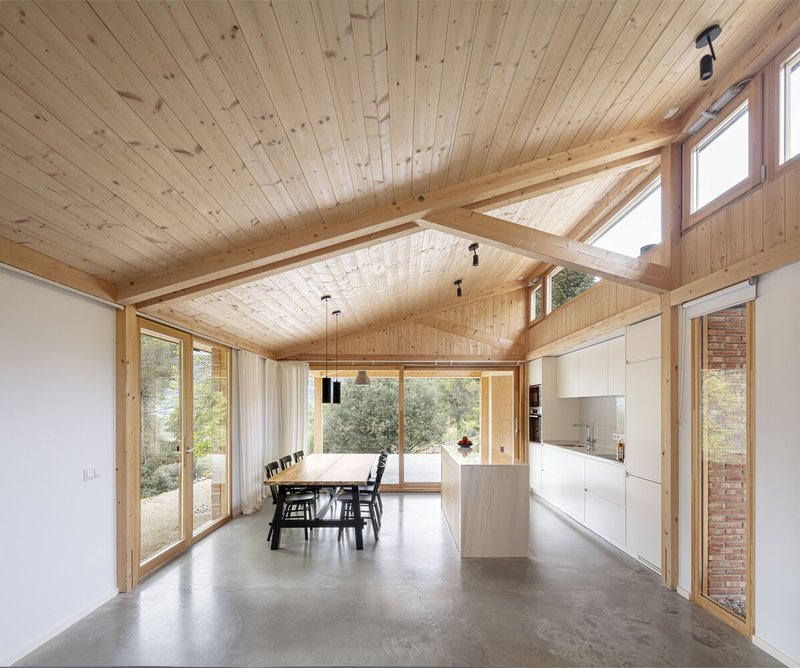
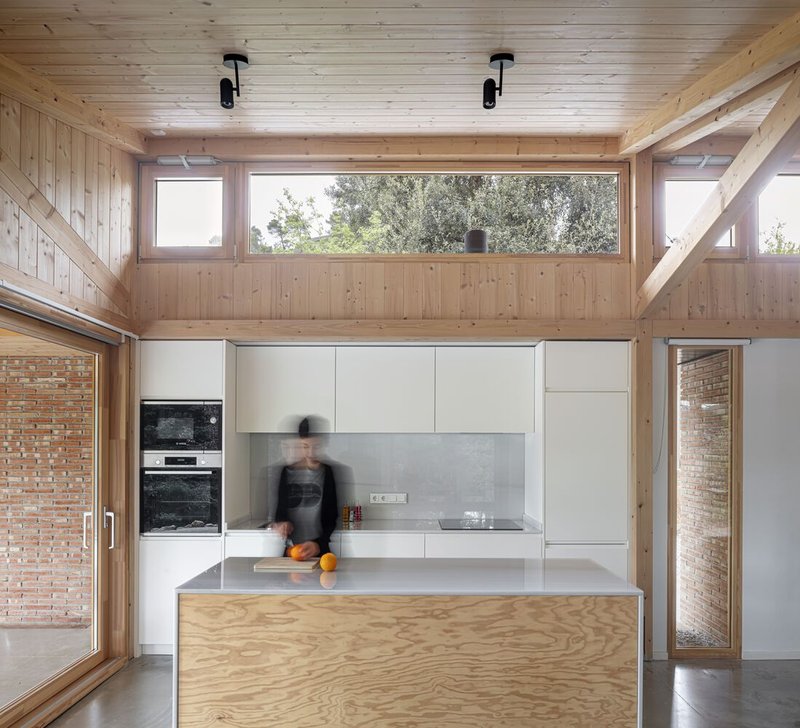
Inside, the structural system of wooden porticos generates a single diaphanous space that contains the porch, living room, dining area, kitchen, and bedrooms in succession. There are no corridors to speak of. The rooms flow into one another beneath exposed timber ceiling beams, with polished concrete floors providing thermal mass that absorbs winter sun and radiates warmth into the evening hours. The kitchen island, faced in plywood that matches the structural timber, sits beneath a clerestory window that bathes the work surface in natural light.
The inclined porticos do more than hold up the roof. They modulate rhythm and scale within the open plan, creating implied boundaries between living zones without the need for partition walls. Privacy from neighboring houses to the north is handled architecturally: the closed, flat-roofed service volume acts as a buffer, while the main spaces face only the garden and the open landscape to the south.
Passive Systems as Primary Architecture
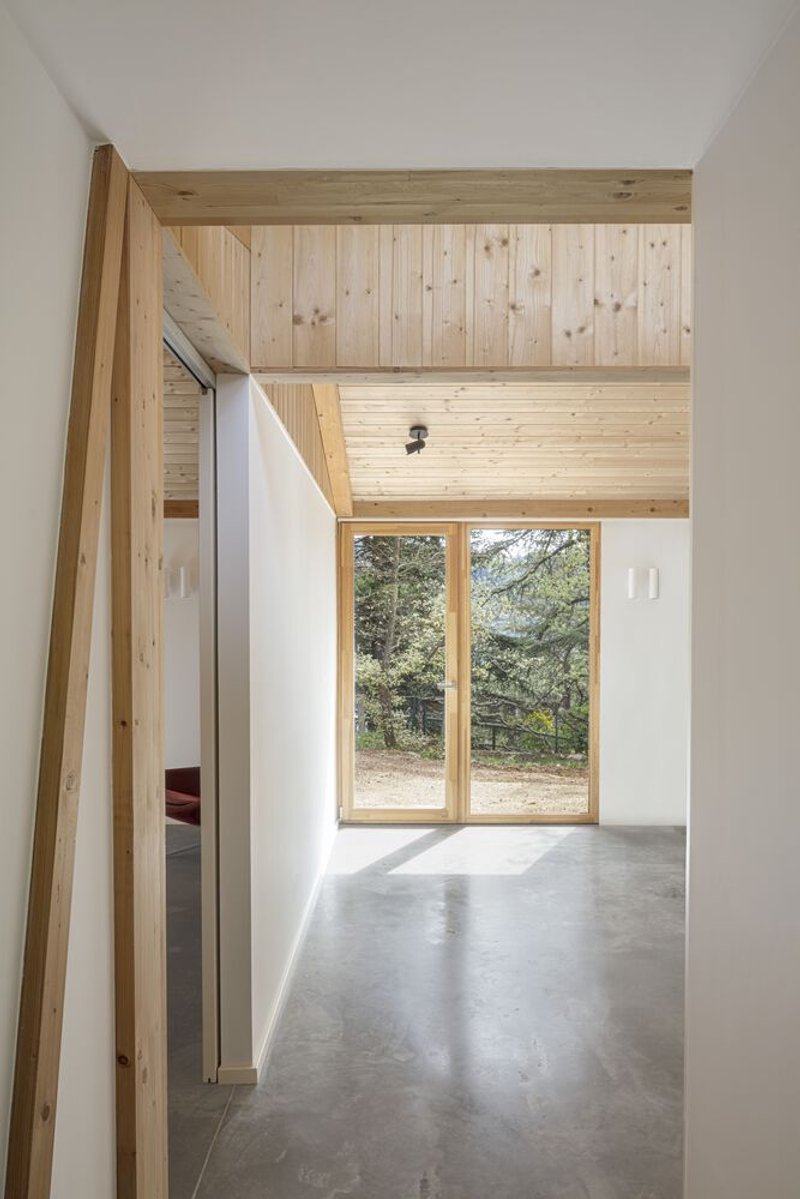
The bioclimatic strategy here is not supplementary. It is the architecture. South-facing windows are sized to capture low winter sun while remaining shaded by the roof overhang when the sun rides high in summer. Skylights positioned in the gap between the sloping and flat roofs draw warm air upward through the section, generating cross ventilation with the sliding doors on the main facade. Cellulose insulation packed into the envelope reduces heat transfer to the point where a single pellet-burning stove handles the entire heating load.
No mechanical cooling is installed. The architects have designed their way out of the problem entirely, using mass, insulation, ventilation, and shading in concert. In a moment when residential construction increasingly relies on heat pumps and smart home systems to hit energy targets, GE House demonstrates that sectional intelligence and material discipline can achieve the same result with far less complexity.
Material Honesty from Outside In
One of the project's quiet strengths is the continuity between its exterior expression and interior experience. The timber framing visible on the facade reappears inside as exposed structure. Pine covers the ceiling, frames the windows, and lines the walls. The polished concrete floor reads as a continuous ground plane from the hallway through the living spaces, and the light that enters through the south-facing glazing is the same light that warms the thermal mass underfoot. Nothing is concealed behind drywall. What you see is what heats you.
All the wood carries PEFC certification, meaning the timber supply chain is independently verified for sustainable forest management. The ceramics are biomass-fired. The insulation is cellulose. These are not exotic materials. They are conventional, affordable, and locally available. The achievement is not in sourcing rare green products but in deploying ordinary ones with precision.
Plans and Drawings
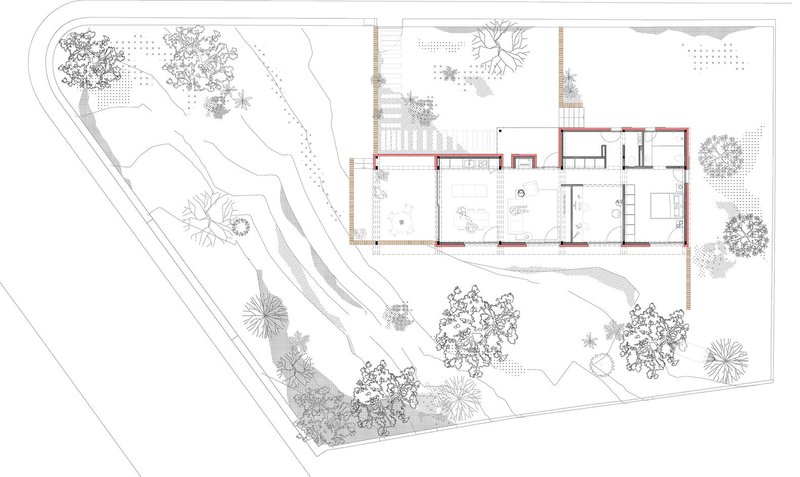
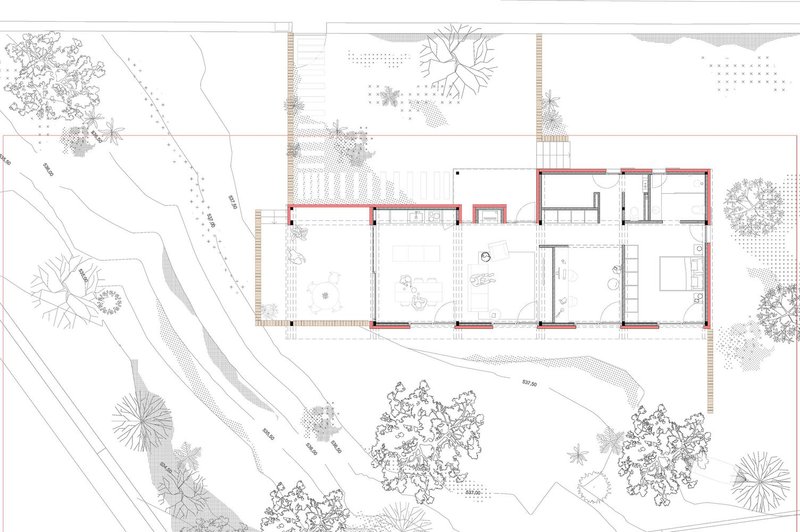
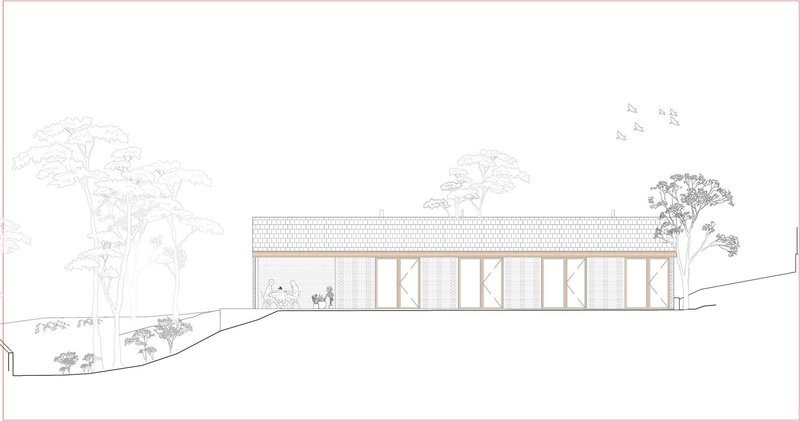
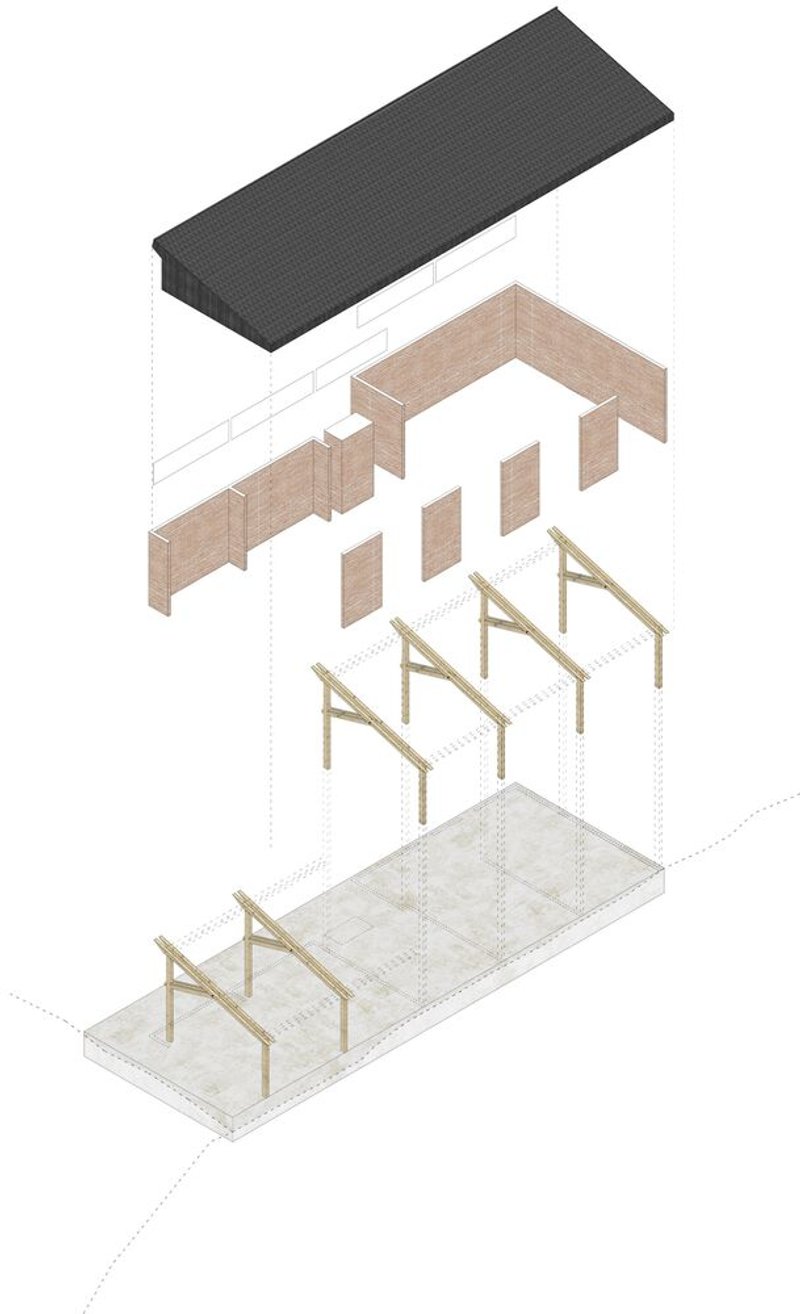
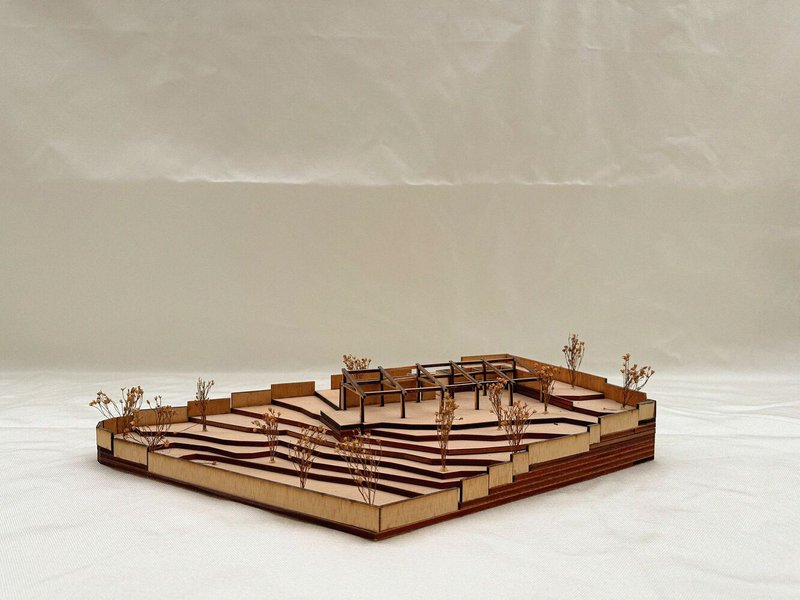
The site plan and floor plan confirm the linear logic of the house: a rectangular volume placed at the high point of the triangular lot, its long axis oriented east-west to maximize southern exposure. Rooms stack along this axis in a clear sequence, with wet and service spaces consistently pushed to the north edge. The elevation drawing shows the timber framing hovering above the tree line, and the axonometric exploded view is especially revealing. It separates the black roof, timber wall panels, structural portico frames, and concrete foundation into distinct layers, making the construction logic legible at a glance. The physical sectional model, built in layered wood, demonstrates the terraced relationship between the house and its sloping site.
Why This Project Matters
GE House is not a demonstration project or an experimental prototype. It is a modest family home on a modest budget in a small Catalan village. Its significance lies precisely in that ordinariness. The architects did not invent a new system or deploy cutting-edge technology. They applied well-understood bioclimatic principles with enough rigor and spatial intelligence to eliminate the need for mechanical cooling and reduce heating to a single stove. In a construction industry addicted to complexity, that simplicity is radical.
The broader lesson is about where sustainability actually lives in a building. It is not in the product specification sheet or the energy consultant's appendix. It is in the section, in the orientation, in the distance between a window sill and a roof overhang. Alventosa Morell have built a house that proves the most effective sustainable technology is architecture itself.
GE House by Alventosa Morell Arquitectes (Marc Alventosa, Xavier Morell), Seva, Osona, Spain. 110 m². Completed 2020. Photography by Adrià Goula.
About the Studio
Share Your Own Work on uni.xyz
If projects like this are the kind of work you want to make, uni.xyz is a place to publish your own, find collaborators, and enter design competitions.




Popular Articles
Popular articles from the community

Bernardes Arquitetura Stretches a Timber Roof Along a Reservoir's Edge in Minas Gerais
Dam House in Itaúna lets a sweeping wooden canopy dissolve the boundary between hillside terrain and open water.
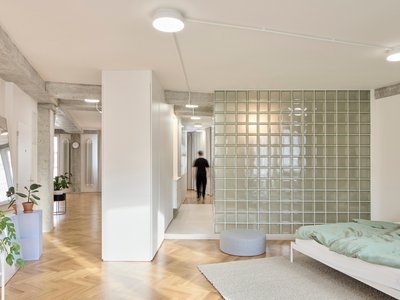
RDTH architekti Rips Out Nearly Every Wall in a Prague Apartment and Replaces Them with Furniture
A 101-square-meter post-war flat in Prague trades rigid partitions for a single rotated furniture block, curtains, and glass concrete.
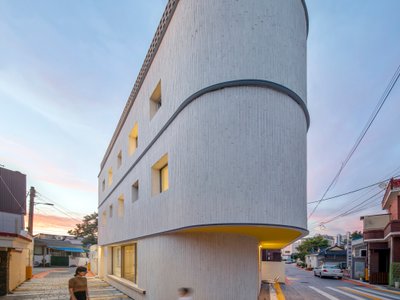
YOAP Architects Round a Corner in Yeongcheon with a Cylindrical Community Hub
A 197-square-meter brick and ribbed-clad tower turns a forgotten alley corner in South Korea into a public garden with a low threshold.

20 Most Popular Office Building Projects of 2025
From biophilic workspaces in India to net-positive energy offices in New Delhi, 20 office building projects that defined architecture in 2025.


Similar Reads
You might also enjoy these articles
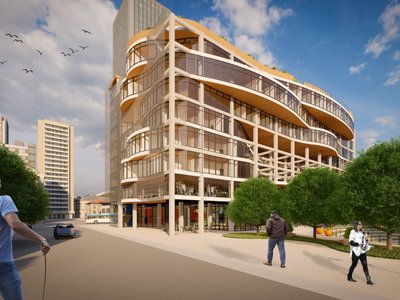
Olio Towers: A Mid-Rise for Performers That Fuses Housing, Rehearsal, and Stage
Located blocks from Houston's Theater District, this modular tower stacks living units around a central performance atrium.

Oasis: Modular Green Housing Carved into Dhaka's Urban Fabric
A shortlisted Plugin Housing entry reclaims unauthorized settlements in Dhaka with stepped concrete volumes, green roofs, and ventilation-driven design.

Black Hole: A Floating Megastructure for the Post-Physical Era
Emiliano Mazzarotto envisions a spherical, self-scaling arena where e-sports, digital hotels, and holographic stadiums replace traditional public space.
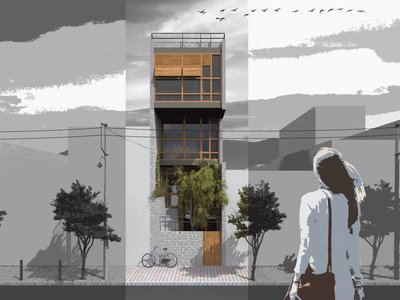
Compact & Sustainable Living in Piraeus: A Four-Level Family Home Built Around Light and Air
A narrow townhouse in one of Greece's densest port cities uses a central atrium and passive strategies to house three generations under one roof.

Explore Architecture Competitions
Discover active competitions in this discipline




The International Standard for Design Portfolios


The Global Benchmark for Architecture Dissertation Awards


The Global Benchmark for Graduation Excellence


Challenge to reimagine the Iron Throne
Comments (0)
Please login or sign up to add comments
No comments yet. Be the first to comment!