
Geleyara Goodu House by Avani Mudra Design, Bengaluru
A shared residential enclave in Bengaluru, uniting four homes around a central green, elevated plinths, minimal interiors, and collective living identity.


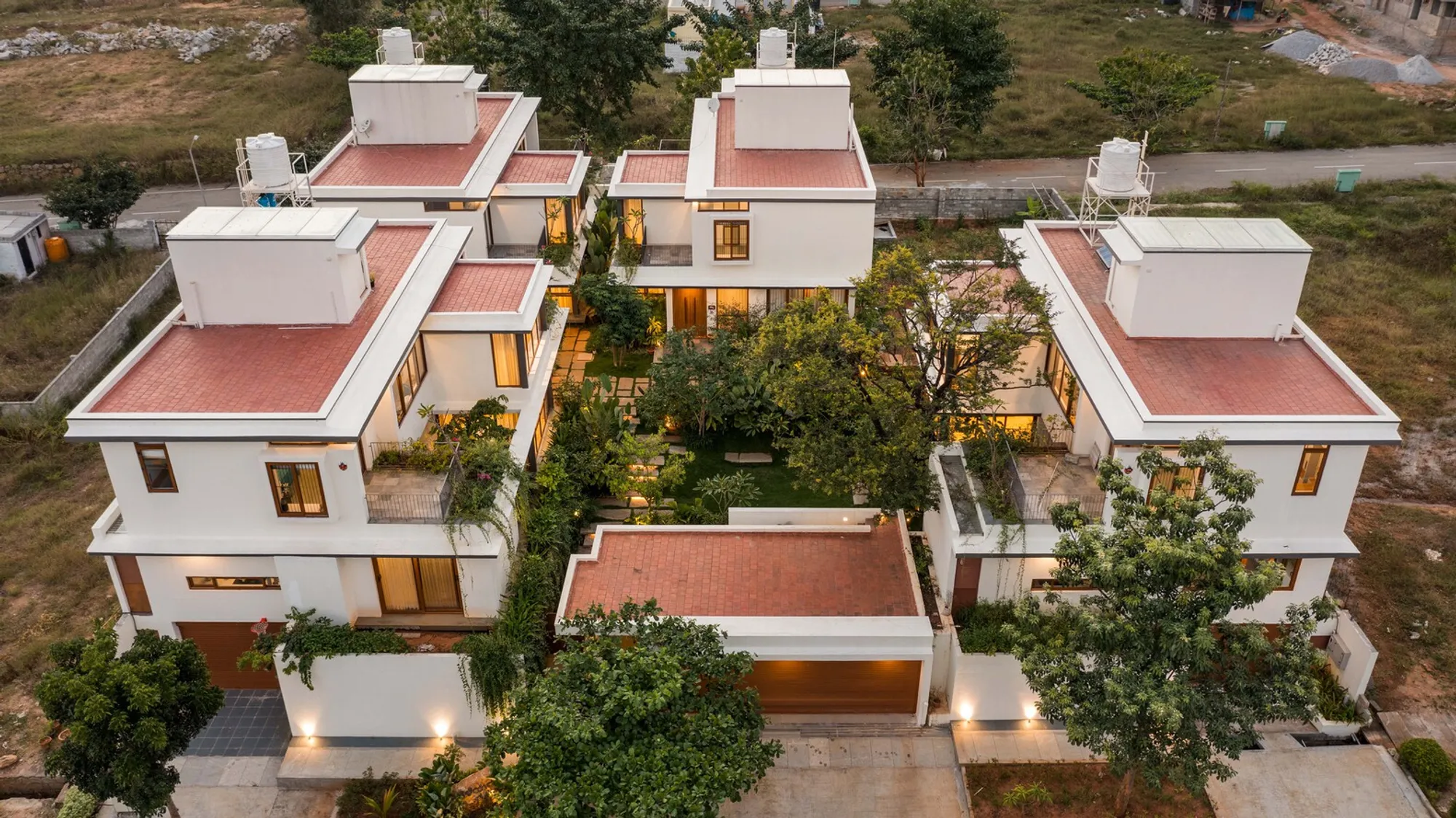
Geleyara Goodu House, designed by Avani Mudra Design, is a unique residential project on the outskirts of Bengaluru, India, conceived as a shared architectural habitat for four friends. Translating literally to “a resting nest for friends” in Kannada, the project reimagines collective living by designing four individual homes within a single unified structure, balancing privacy, community, and a strong sense of belonging.
Completed in 2023 across a built-up area of 15,000 square feet, the project occupies five contiguous plots within a gated community. Each plot measures 2,400 square feet and is positioned between two parallel roads, offering independent access while remaining visually and spatial interconnected. The central plot, anchoring the composition, contains an existing well and a mature tree, elements that became the emotional and spatial heart of the project and shaped the architectural narrative.
Site Strategy and Urban Response
Responding to the slightly contoured terrain and contextual constraints, the architects developed a layered site strategy that negotiates level differences while reinforcing unity. Independent garages are tucked into a lower level using partial fill, allowing the ground plane to rise into a high, continuous podium. This elevated plinth eliminates the need for compound walls, enhancing openness while ensuring privacy from the surrounding roads.
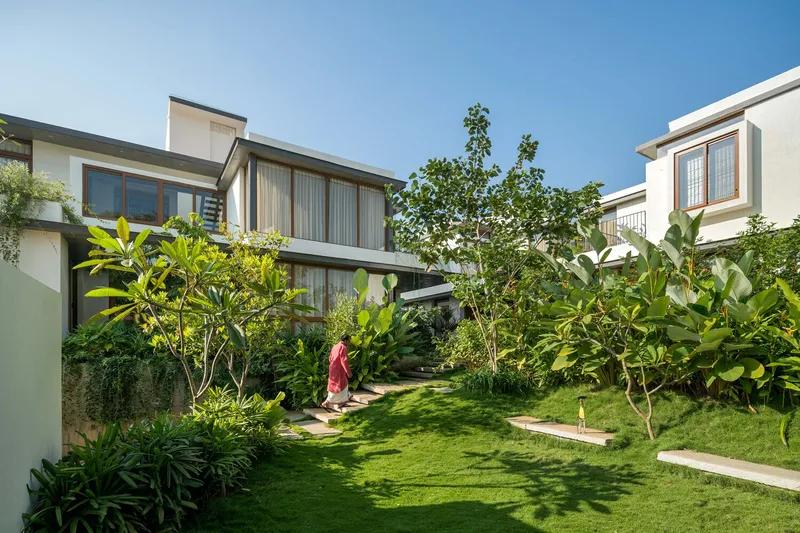
The raised datum visually binds the four homes into a cohesive ensemble and establishes a stronger visual connection with the landscape. It also creates a secure yet porous environment, allowing the residences to engage outward without compromising intimacy.
Entry Sequence and Collective Experience
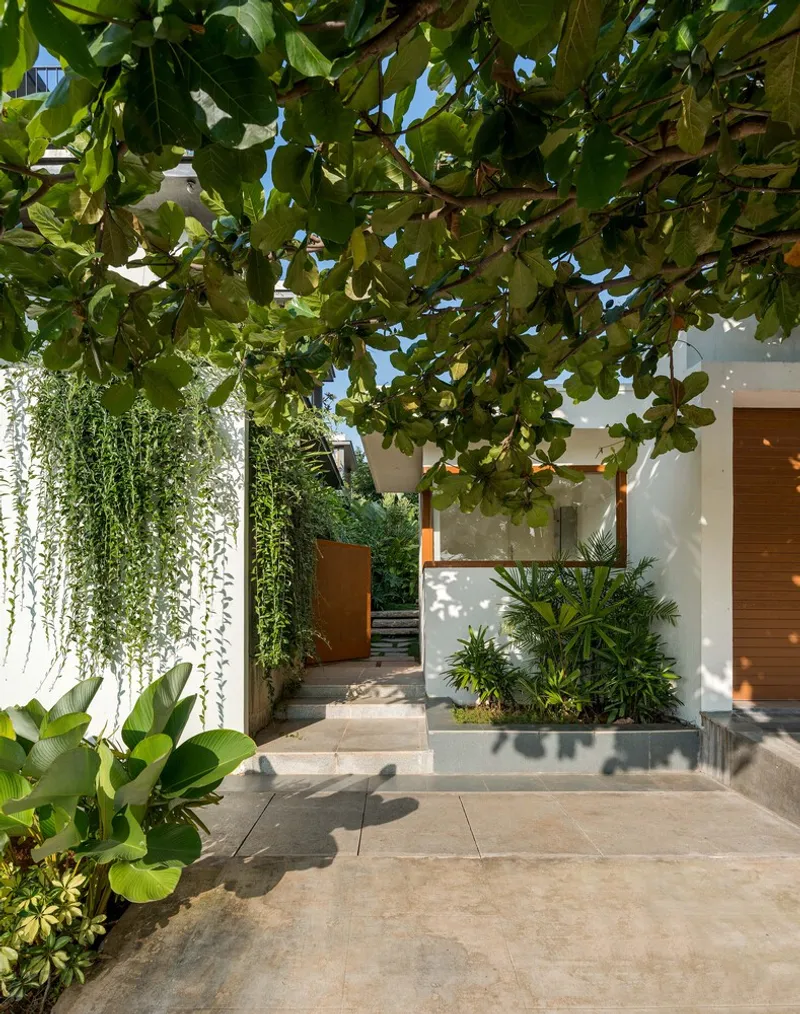
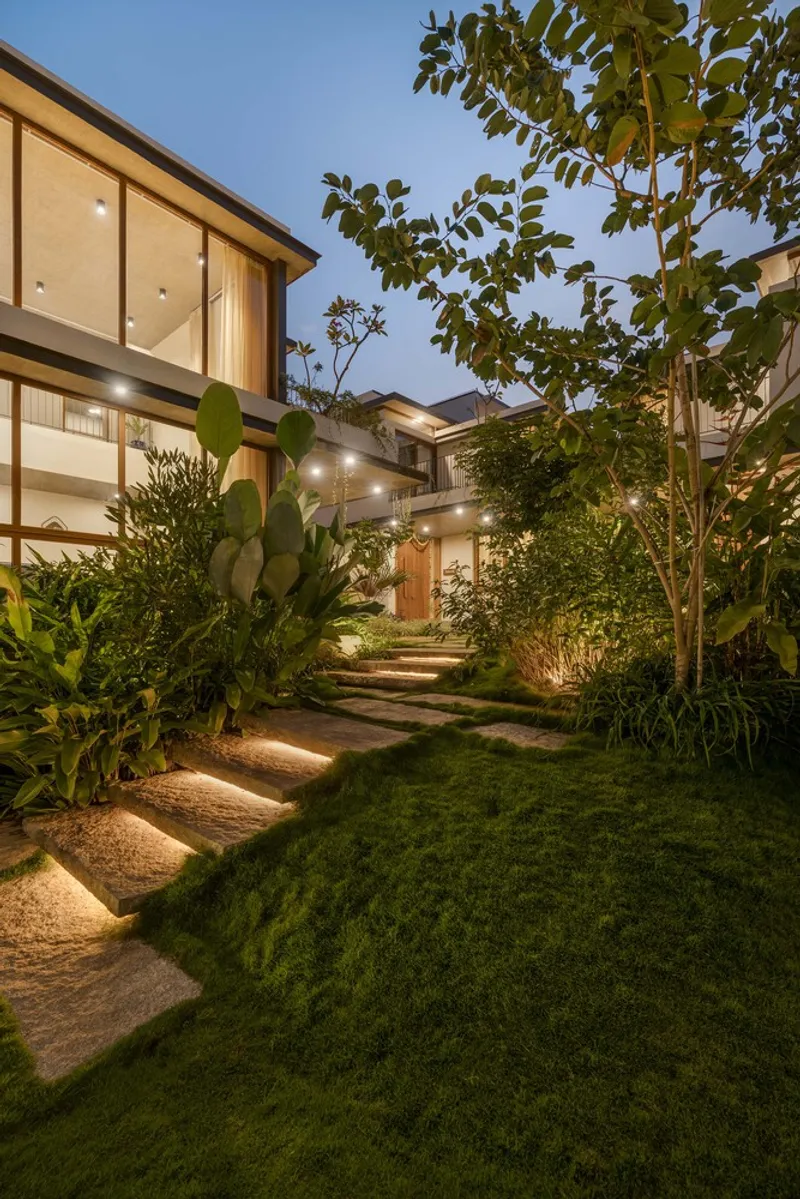
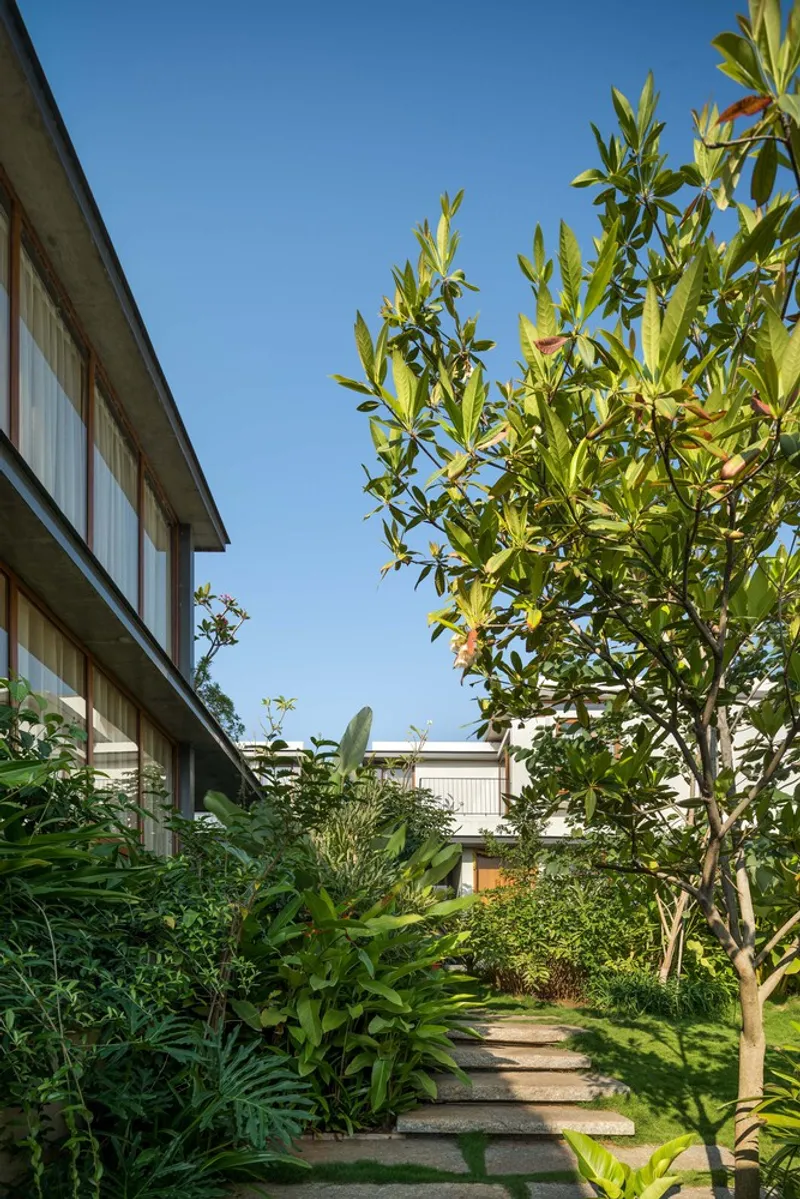
A common parking zone and a narrow, guarded entry reinforce the idea of oneness from the very first moment of arrival. The entry experience is intentionally understated and detached from the road edge. Visitors move through a sequence of gradual steps that wind through dense landscaping, building anticipation before arriving at the elevated common plaza.
This carefully choreographed approach transforms movement into experience, shifting from the public realm to a semi-private shared domain that belongs equally to all four households.
Spatial Organization and Planning Concept
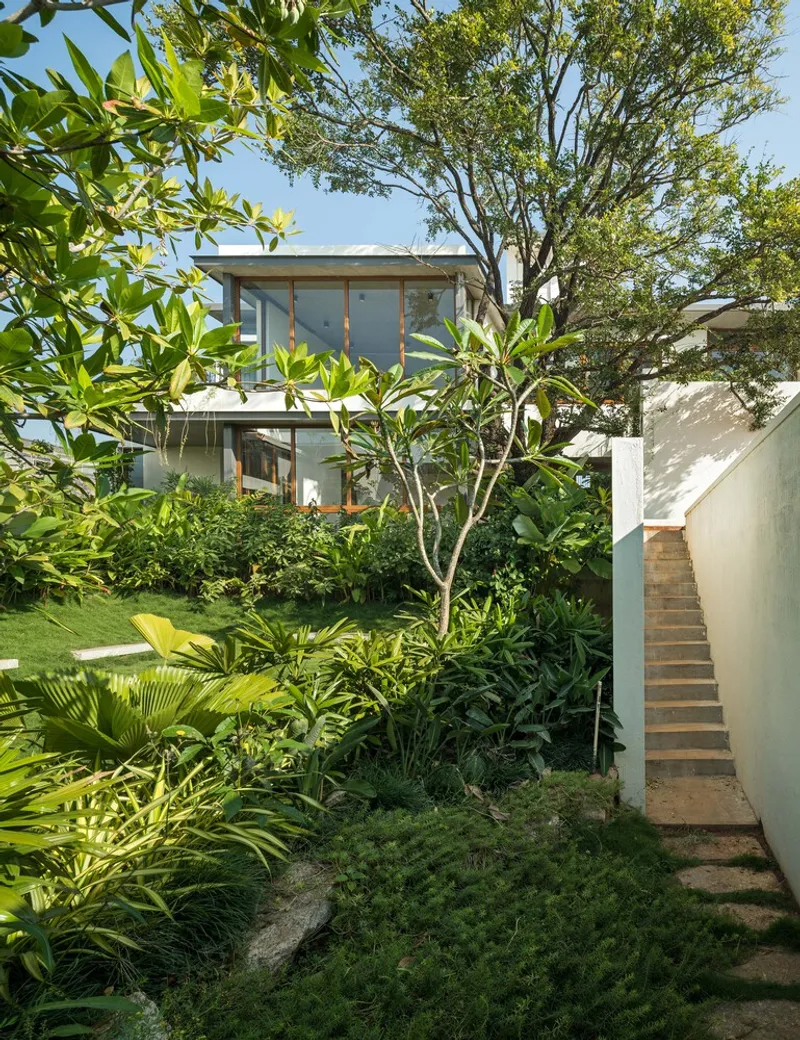
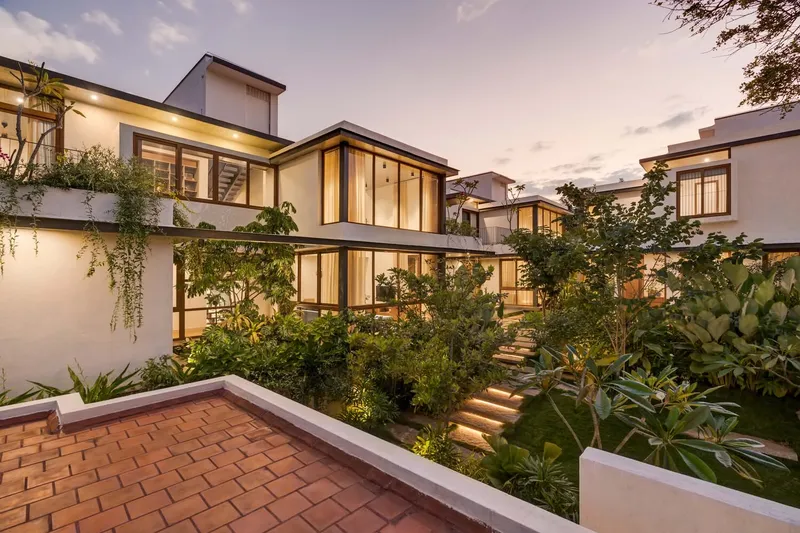
At the site-planning level, the homes are organized in concentric layers around a central common green, which acts as the project’s unifying element. Public spaces are positioned along the inner ring, opening directly toward this shared landscape, while private spaces are placed along the outer periphery.
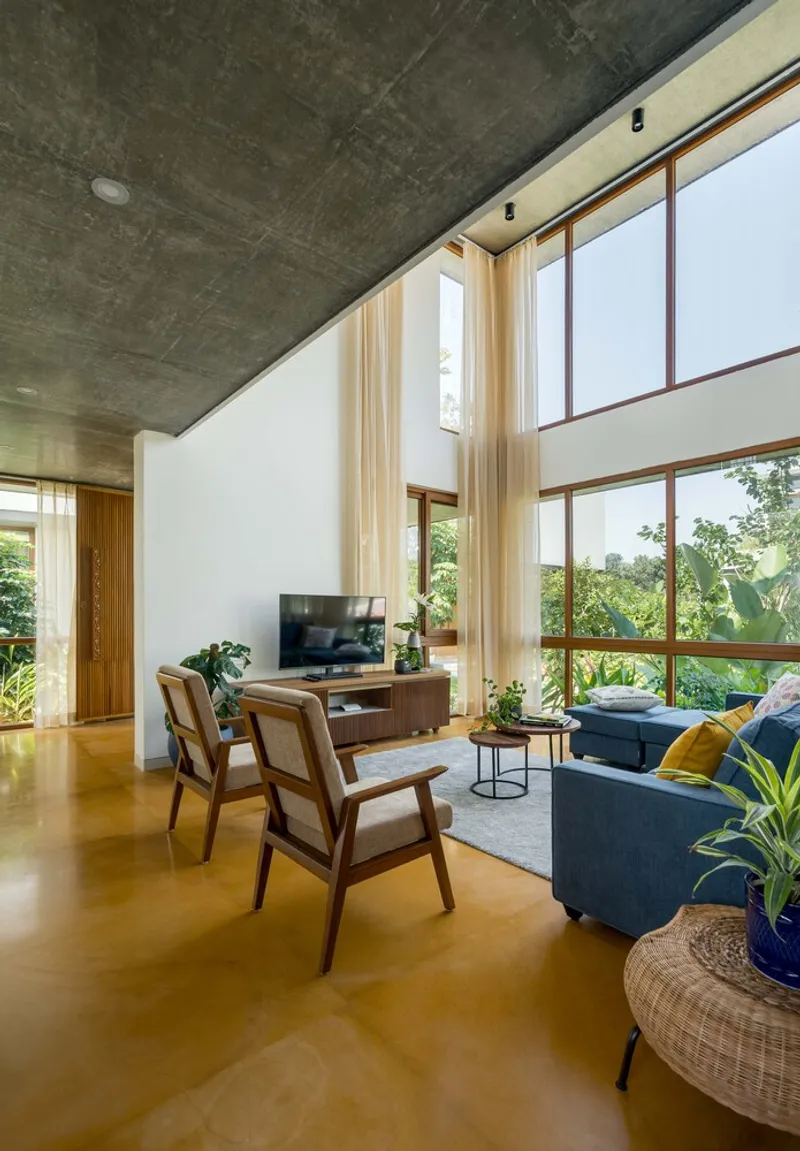
This arrangement allows the inner façades to be extensively dematerialized using large glass openings, strengthening visual continuity between homes and fostering social interaction. In contrast, the outer façades remain more solid and minimally fenestrated, providing security, privacy, and climatic control.
Each residential unit follows a simple yet flexible two-bay planning system. The ground floor accommodates living and dining spaces flanking a private internal court that visually extends toward the central green. The kitchen, staircase core, and guest bedroom occupy the secondary bay, ensuring efficient circulation and functional clarity.
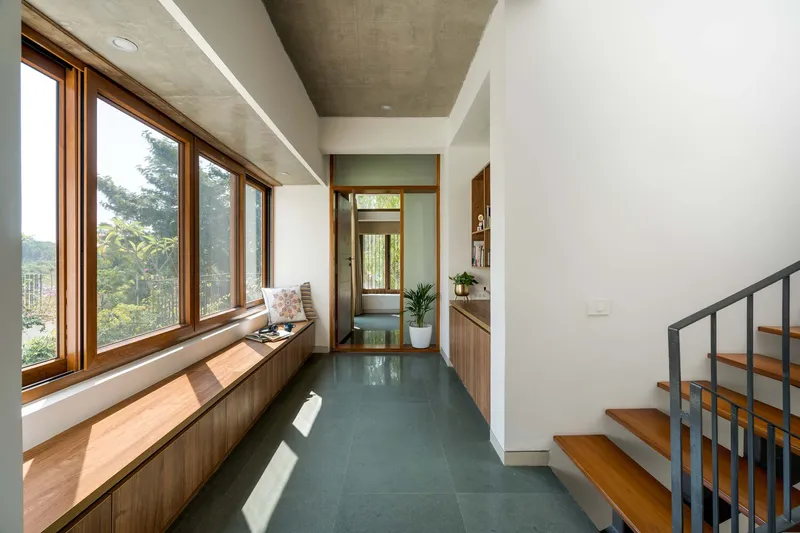
Ascending to the first floor, a vestibule functions as an informal study space with bay window seating overlooking the internal court. This transitional zone leads to two generously sized bedrooms on either side, each opening onto expansive, open-to-sky private terraces. These terraces enhance daylight, ventilation, and indoor-outdoor living while maintaining a sense of retreat.
Material Palette and Architectural Expression
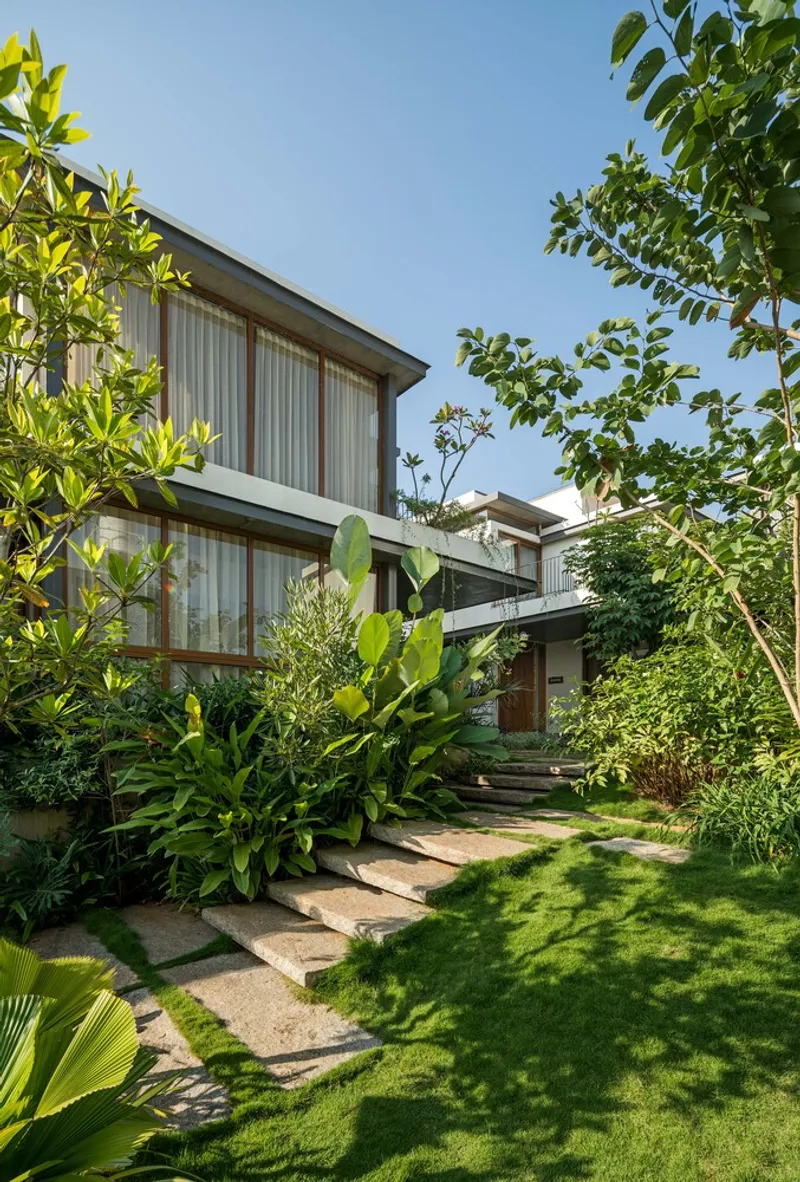
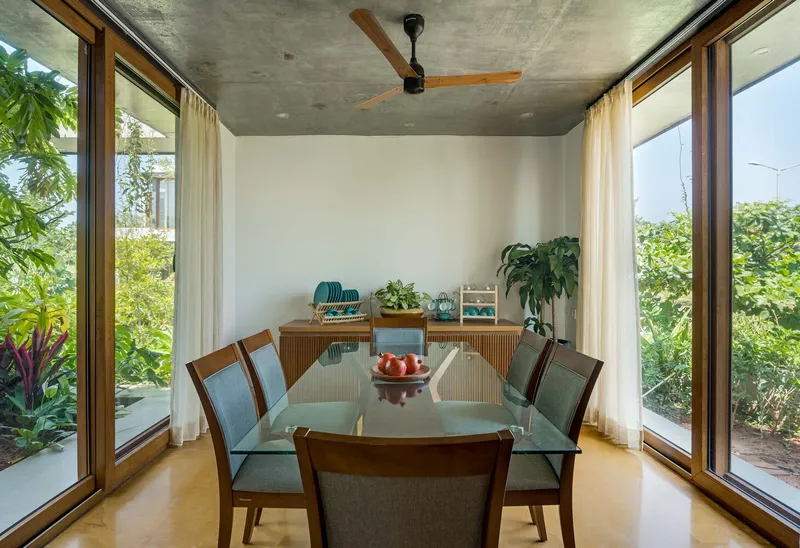
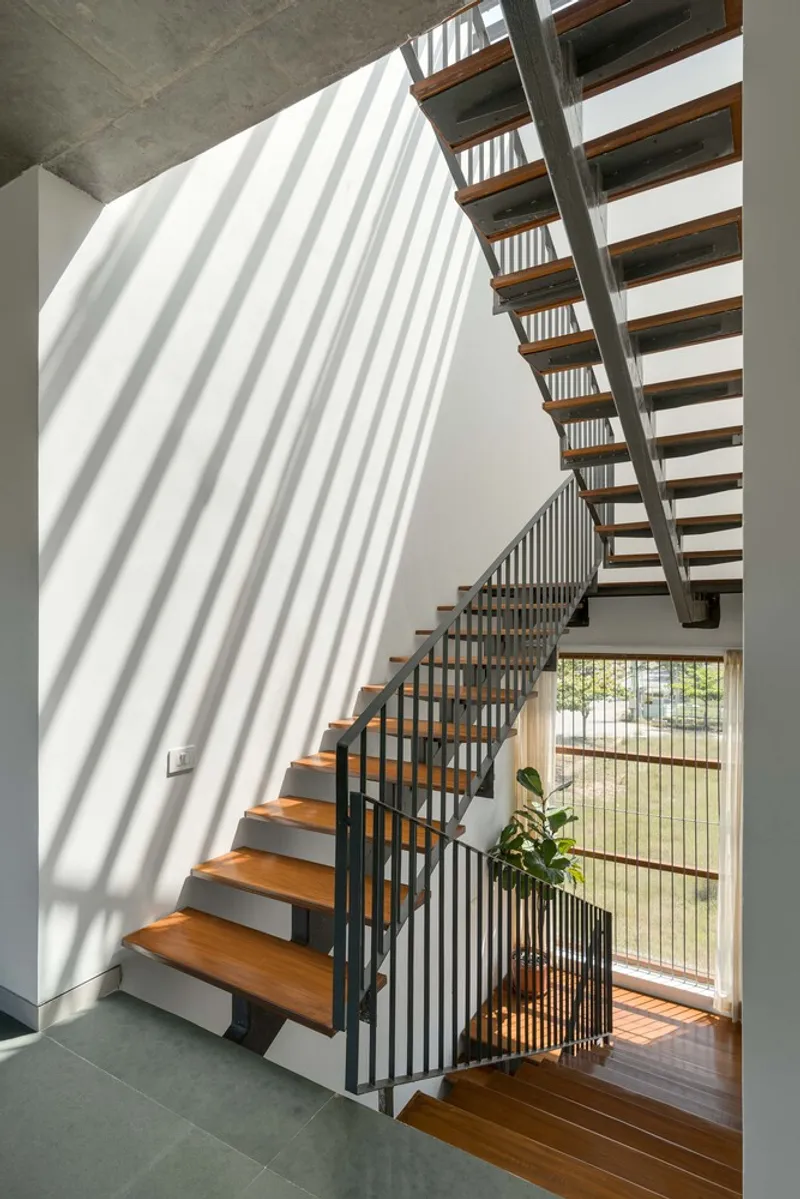
The interiors embrace a restrained, timeless material language. Kota stone and Jaisalmer stone flooring provide durability and thermal comfort, complemented by exposed cement surfaces and warm wood accents. The material palette balances robustness with softness, reinforcing the project’s understated character.
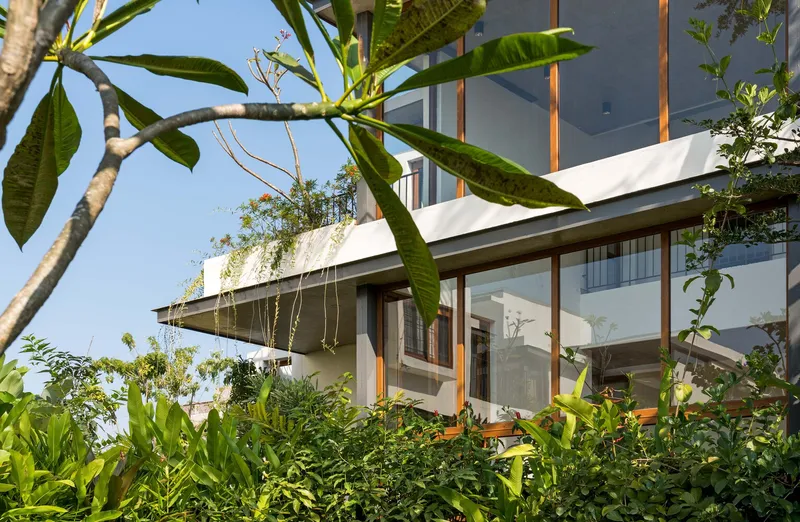
Externally, the architecture is defined by cement-plastered white walls, concrete soffits, and large wood-finish UPVC windows. These elements create a clean, contemporary façade that is both climate-responsive and visually calm. The surrounding landscape softens the massing, blurring boundaries between built form and nature.
Generous roof overhangs act as effective shading devices, reinforcing the idea of dispersed habitable spaces sheltered beneath a single, expansive parasol. This architectural gesture unifies the composition and enhances thermal performance, creating a comfortable microclimate throughout the year.
A World Within a World
Geleyara Goodu House succeeds as more than a residential project; it is a carefully crafted social environment. By weaving together architecture, landscape, and human relationships, Avani Mudra Design has created a contemporary interpretation of community living, one that allows individuality to coexist with collective identity.
All photographs are works of Shamanth Patil J




Popular Articles
Popular articles from the community


Play: Fragments of Their World
Familiar architecture becomes modular playground design, creating safe spaces where displaced children can learn, connect, imagine and play.

Co-life: Sustainable Architecture for Age-Friendly Community Living
Co-life reimagines sustainable architecture for seniors through courtyards, rammed earth, shared gardens, and spaces designed for belonging.

The Earth Pod: 3D Printed Homes for Resilient Refugee Communities
The Earth Pod reimagines refugee housing through 3D printed homes made from clay, combining resilience, self-sufficiency, and rapid shelter.

Lunar Spiral: Space Architecture Shaped by the Mathematics of the Universe
Lunar Spiral reimagines space architecture through Fibonacci geometry, lunar regolith, levitating habitats, and self-sustaining Moon living.


Similar Reads
You might also enjoy these articles


Hodi-Mandai Geram
Project Function: Preservation and revitalization of the Intangible heritage and socio-spatial identity of the Hodi by Housing, Cultural Memory Center, Sacred Grove, landscape, local tourism economy


Olio Towers: A Mid-Rise for Performers That Fuses Housing, Rehearsal, and Stage
Located blocks from Houston's Theater District, this modular tower stacks living units around a central performance atrium.

Oasis: Modular Green Housing Carved into Dhaka's Urban Fabric
A shortlisted Plugin Housing entry reclaims unauthorized settlements in Dhaka with stepped concrete volumes, green roofs, and ventilation-driven design.

Black Hole: A Floating Megastructure for the Post-Physical Era
Emiliano Mazzarotto envisions a spherical, self-scaling arena where e-sports, digital hotels, and holographic stadiums replace traditional public space.


Explore Housing Competitions
Discover active competitions in this discipline



Challenge to reimagine the Iron Throne


Photograph architecture without architects


Illustrate the lost glory of Angkor Wat - Render Challenge


Design challenge to reuse E-waste
Comments (0)
Please login or sign up to add comments
No comments yet. Be the first to comment!