
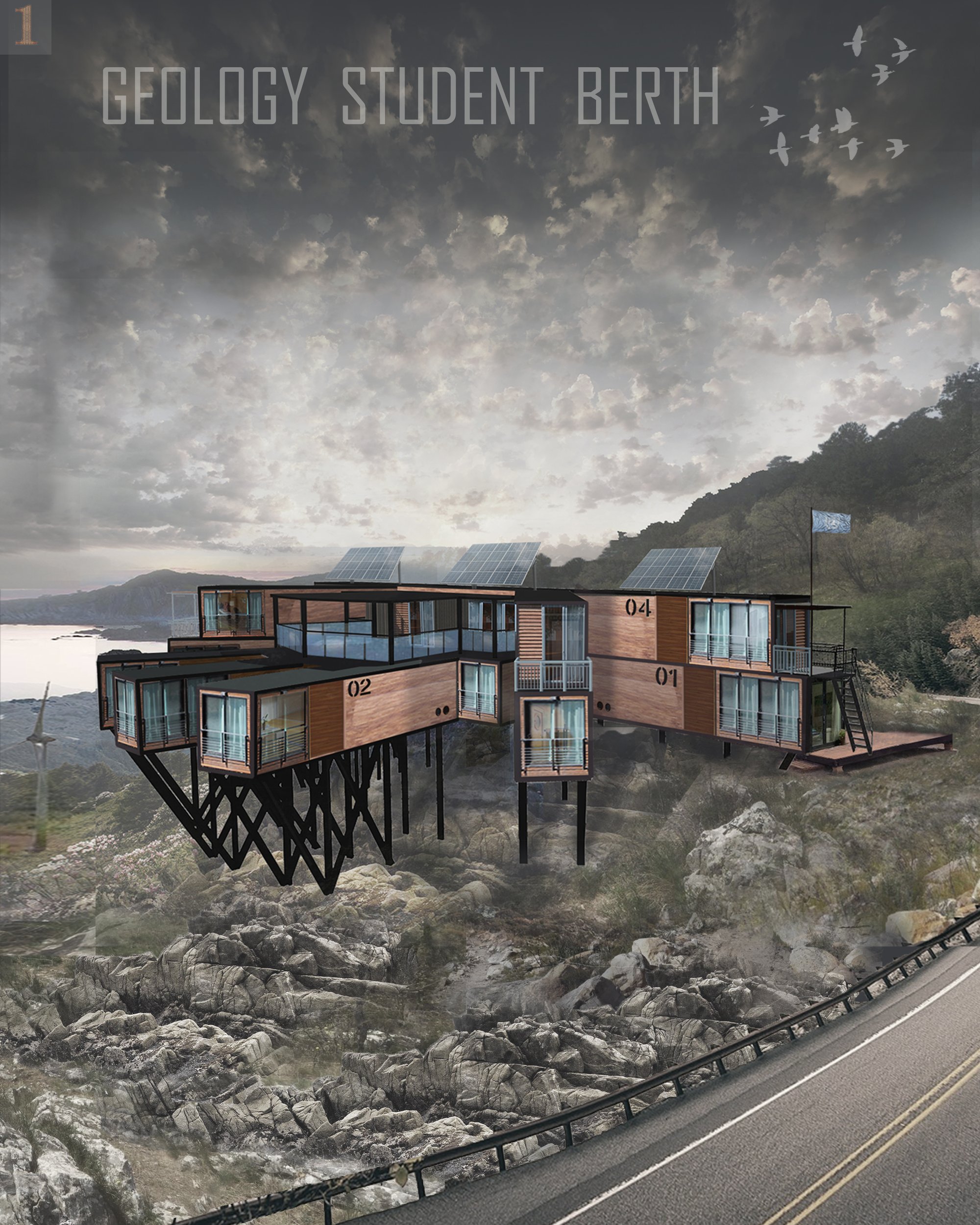
GEOLOGY STUDENT BERTH
The facility was designed to provide temporary housing for geology students during student internships and is located in a mountainous area in the southern part of the Crimean Peninsula. Easily erected structures ensure a careful introduction into nature, economy and environmental friendliness of production using alternative energy sources.

Location
Russia. Crimea. Southern part of the Crimean peninsula. The city of Laspi, equidistant from the cities of Yalta and Sevastopol.
The proximity of a large sea trade port of Sevastopol allows to give a second life to sea containers without high costs for their transportation to a new location, which, decomposing, have lost their efficiency and are stored in the port territory in the form of numerous waste. The potential for the sale of sea containers in construction saves time for construction; money for the construction, lease of land and the subsequent use of the object; the territory occupied by the object. Containers are highly modular and mobile for typical objects.
Large Russian universities related to geology and geophysics often organize field student internships in Crimea, including international programs for the exchange of experience between students. Students sometimes have to live in tents and travel for a long time, since research sites are often located far from comfortable apartments.
Also, the Crimean peninsula attracts tourists with its nature, and you don't always want to stay near the coast, but you want to be closer to nature, untouched by man. The Crimean peninsula is known for its pristine nature, mighty rocks and romantic meadows, restless sea and smooth lakes. In one of the picturesque places, the object under consideration is presumably located near the Laspinsky pass along the 67H-13 highway, which connects the 67K-1 highway (Sevastopol-Foros) and settlements.
On a hill, there is a hostel for geology students for the period of student practice and economy housing for tourists, in the free from internships, working autonomously, thanks to alternative energy sources - a paradise for lovers of untouched nature and at the same time an ideal place to study it.
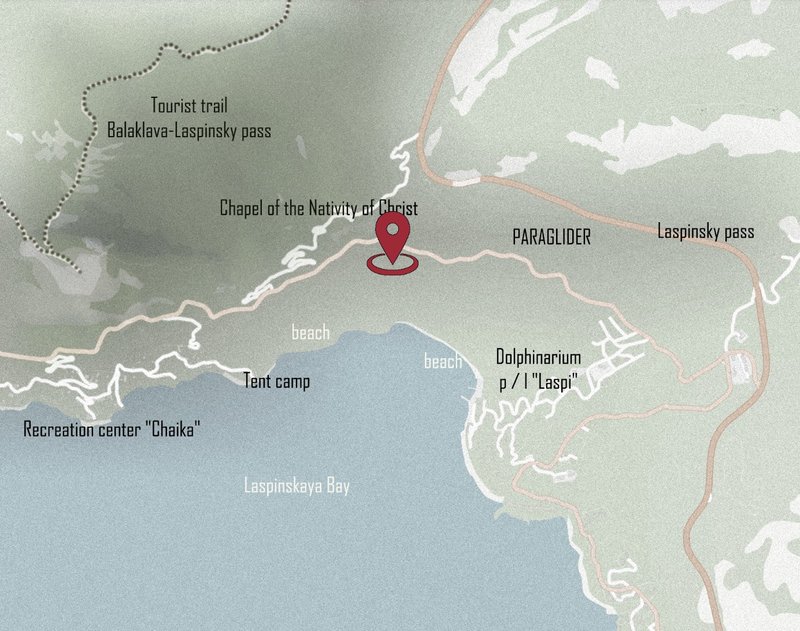
Picture 1 Location of the object with indication of points of attraction for tourists
Concept
- careful integration of the object into the natural landscape
- alternative energy sources (separate existence, independent electricity service, use of septic tanks and wells)
- rental of premises by tourists during a period free from student internships
- hostel for geology students during the internship
Idea of the image
The idea of the project was formed from the images of the flexures of rocks, the sunrise over the sea surface and the tools used by geologists during the work. The object fits neatly into the natural landscape also thanks to the finishing materials - wood, glass, metal.
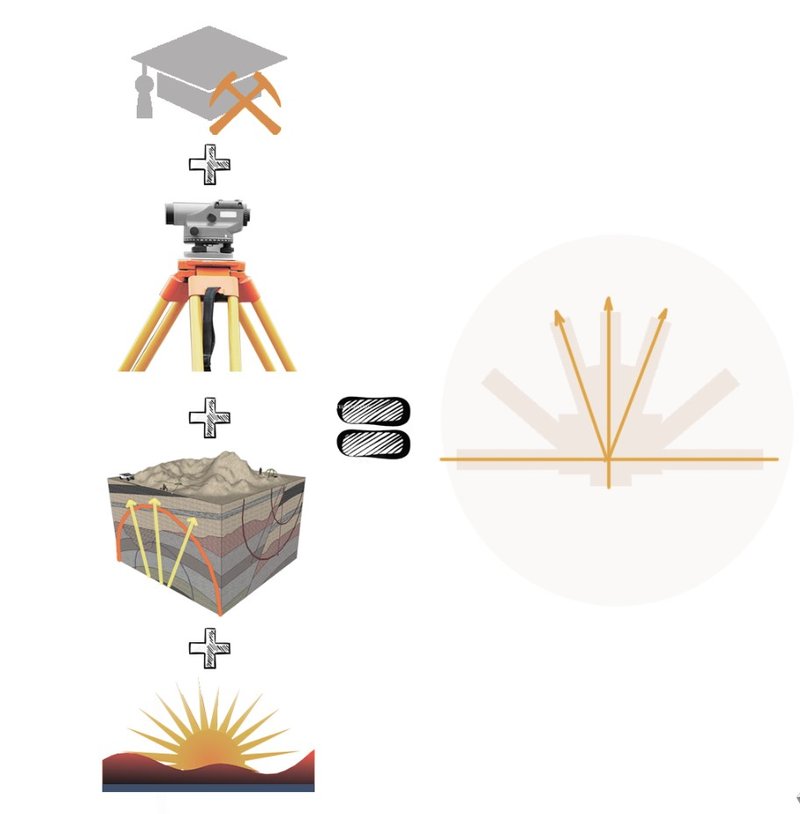
Picture 2 Shaping. Idea
Design and material selection criteria
The location of the object is supposed to be on a stone slope, which makes it possible to minimize the cost of land work and use rocks as a reliable foundation. The difference in height, which is almost 5 meters, is compensated by the structure of metal supports of the "I-beam" shape with ramps of 50 - 70 degrees for greater stability and exclusion of premature deformation of the supports.
For a comfortable stay in metal containers, eco-friendly wood facing materials are provided to avoid overheating in the summer and loss of heat in the winter. At the ends, small terraces with a canopy are organized, which occupy an eighth of the length of the container with a metal fence. Glazing - warm double-glazed unit.
Since the structure is remote from large cities and towns, we propose to organize a separate existence of the facility with the installation of alternative energy sources (solar panels, wind generators), provide for the sewerage system with the arrangement of septic tanks and utility sites for the operation of utilities, and provide the facility with clean mountain water and through wells with an electric heater.
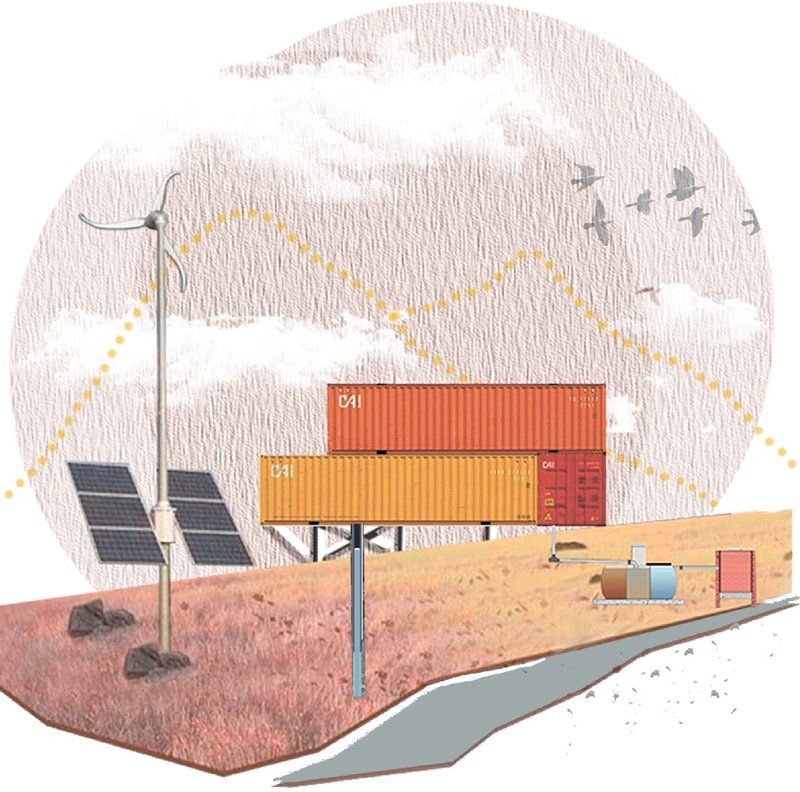
Picture 3 Scheme of providing the facility with engineering structures for autonomous existence
Integration into the environment
As mentioned earlier, one facility consists of 15 shipping containers and can accommodate a maximum of 20 residents, as one container cannot accommodate more than 3 people. It is located on a hill and exists autonomously. The project provides for the possibility of placing several such objects, interconnected by pedestrian and transport links. The area under the wind generators allows you to increase their number.
Thus, a complex of several dormitory buildings is formed. An area for quiet recreation, parking and utility areas has been organized, and the area itself is conducive to nature walks. A guest parking is required near each building.
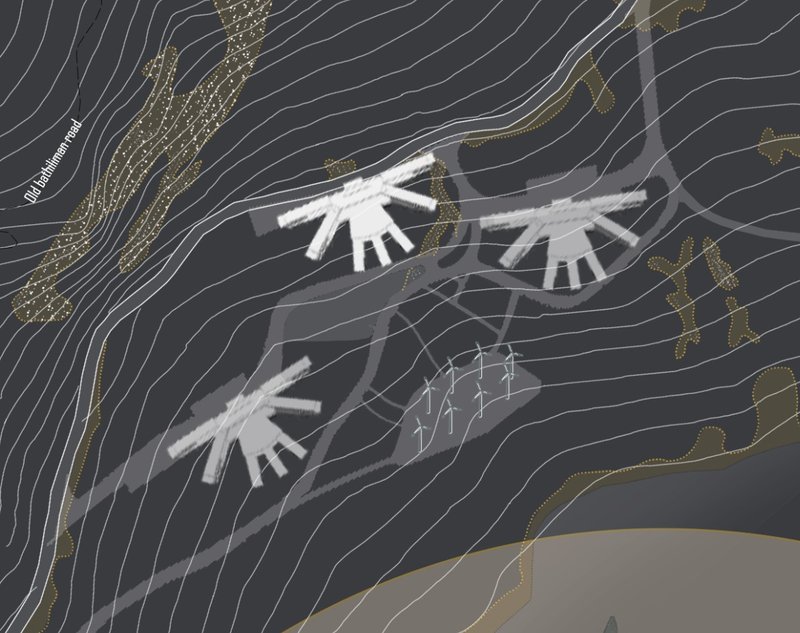
Picture 4 General plan
Layout
One object is an independent unit - a hostel. Consists of 15 containers (40 feet x 8 feet x 8 feet 6 inches), with a maximum of 2 floors. It is proposed to place solar panels on the roof.
Distribution of containers: 8 containers for housing; 4 containers for distribution function - halls, hallway, stairs, utility rooms; 3 containers - cafe, lounge, workshop.
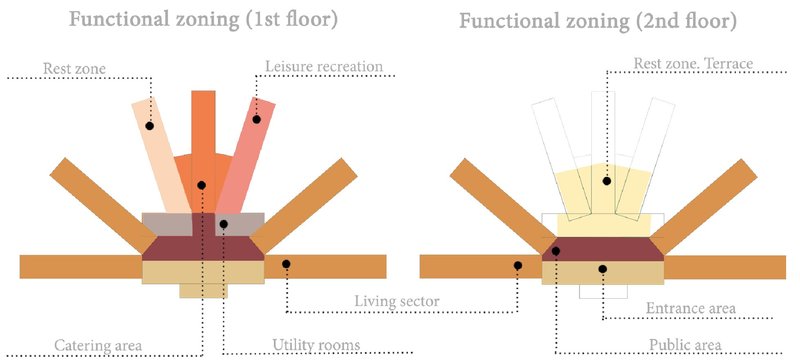
Picture 5 Functional zoning
Accommodation containers can be of three types: double, triple, and one family room. A bathroom, a small kitchen area, a sleeping area, and a work area are provided in each living room. The second floor has a covered terrace for relaxation, solar panels are installed on the roof, and external stairs are provided for the second floors.
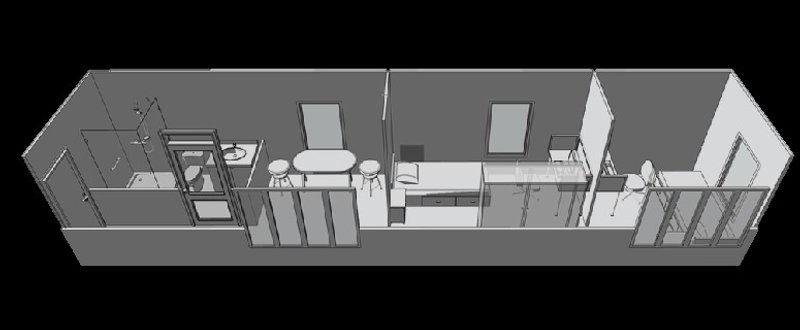
Picture 6 An example of a typical layout of one living room for two people
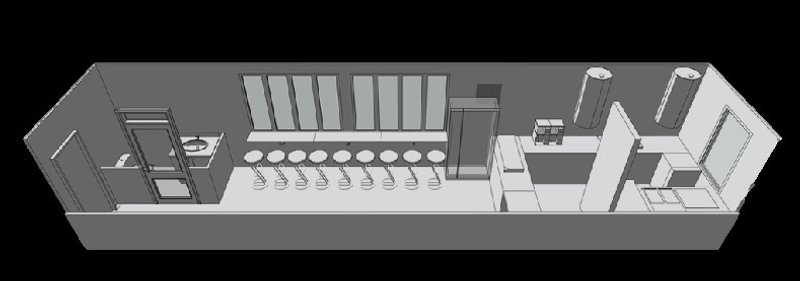
Picture 7 Layout of a public area - cafe



Popular Articles
Popular articles from the community

IDIN Architects Wraps a Hua Hin Hotel Around a Private Courtyard to Escape the City
Dusit D2 Hua Hin turns an urban infill site in Thailand's family vacation heartland into a self-contained resort through courtyard planning.
BLDUS Turns a 250-Square-Foot Screened Porch into a Pine Forest Temple in East Hampton
A gabled cedar pavilion mimics the rhythm of surrounding pines, anchoring a 1990s wooded home to its hollow in Long Island.
Johnston Architects Reimagines the Methow Valley Hay Barn as a Small-Town Library in Winthrop
A 7,300-square-foot timber library channels the region's agrarian vernacular to serve a rural Washington community of 400 year-round residents.
Constanti Architects Builds a Fortress of Privacy in Nicosia with House 345
A concrete and timber residence in Cyprus reinterprets the traditional introverted courtyard house for a new urban landscape.


Similar Reads
You might also enjoy these articles

The Rhythm of Seasons
A Farmers' Market Connecting Nature and the City

More Than a Building-Designing a Living System
More Than a Building-Designing a Living System
Base Beyond
DESERT COMPOUND ARID: TOURISM OF ABSENCE AND ABUNDANCE


Explore Conceptual Architecture Competitions
Discover active competitions in this discipline




The Global Benchmark for Architecture Dissertation Awards


Challenge to design public laboratory
Comments (1)
Please login or sign up to add comments
Очень интересно, спасибо за статью!