
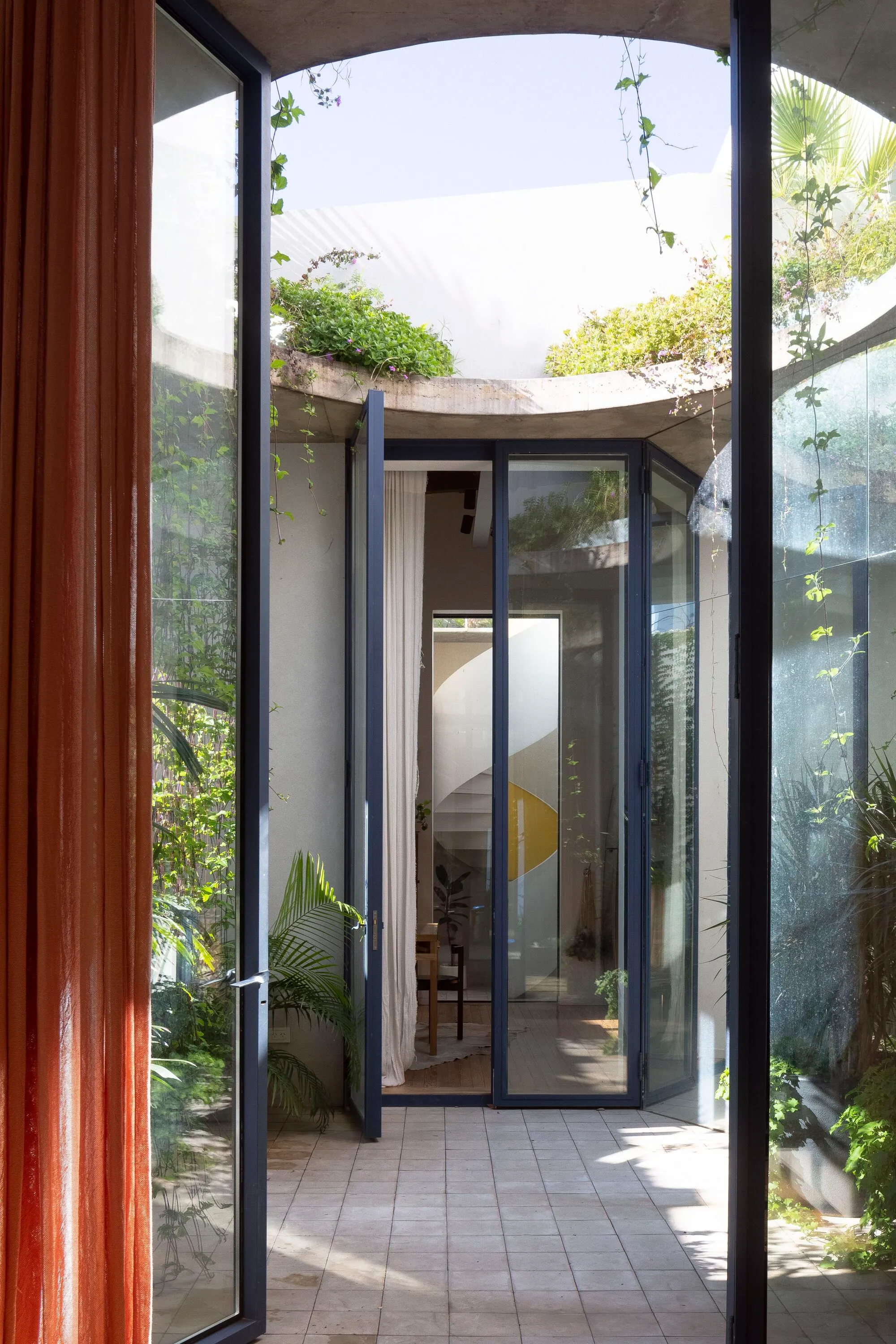
Giusto Van Campenhout Carves Light and Garden into a Buenos Aires Chorizo House
A 115 m² renovation in Buenos Aires subtracts walls and floors from a century-old immigrant typology to let nature back in.


The Casa Chorizo is one of the most persistent residential typologies in Buenos Aires. Developed at the turn of the twentieth century to house waves of immigrants, the form is deceptively simple: a string of rooms arranged in enfilade along an exterior corridor, each room dedicated to a single function. The layout made sense for dense urban lots and large households, but decades of subdivision and neglect have left many of these houses feeling airless and dark. Giusto Van Campenhout, working with a team that included Marcos Asa on construction and technical development, took on a 115 m² example in Buenos Aires and chose not to demolish it. Instead, the studio's strategy was surgical: subtract material until the original bones could breathe again.
What makes this project genuinely interesting is that the act of renovation here is framed as removal rather than addition. The architects peeled away partitions, punched openings, and introduced planted courtyards where solid floor and roof once sat. The result is a house that feels significantly larger than its footprint, threaded with pockets of greenery that blur the line between interior and exterior. It is a quiet argument that in Buenos Aires's dense fabric, the most radical architectural move is often to take something away.
The Street and the Shell
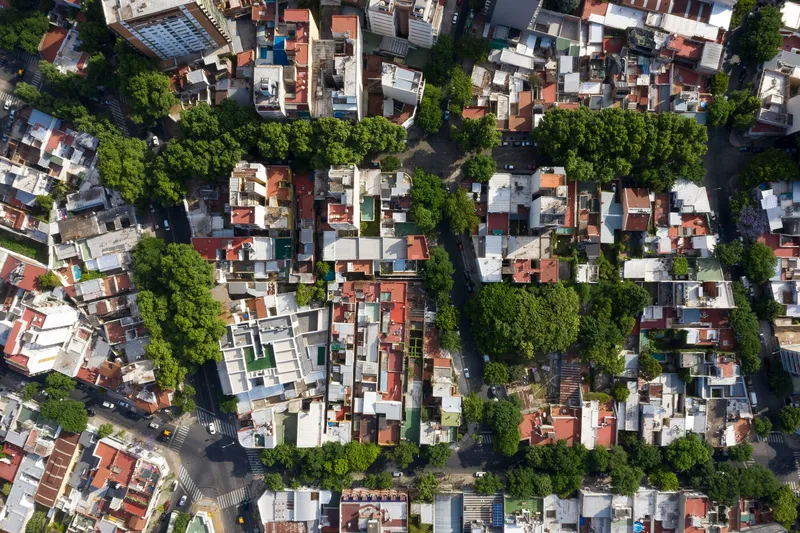
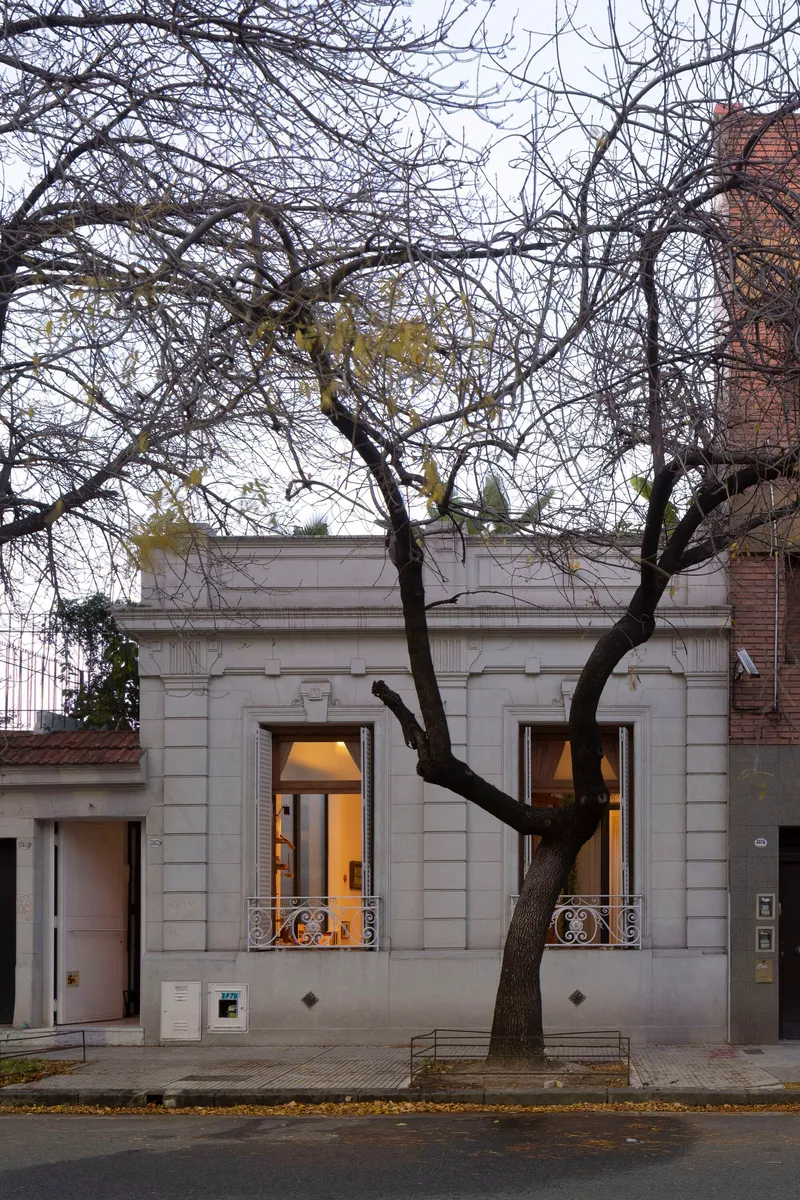
From the air, the project disappears into a sea of terracotta rooftops and mature trees. That anonymity is the point. Buenos Aires is a city where the block interior is as important as the street front, and Casa Chorizo's pale stone facade, with its pair of tall windows and minimal ornamentation, signals nothing unusual. The house belongs to its neighborhood in form, height, and materiality.
At street level, a warm glow spills through the windows at night, hinting at the depth of the plan behind. The wrought iron balcony railing is left intact, a period detail the architects respected rather than stripped. This restraint at the perimeter is essential to the strategy: everything dramatic happens inside.
Courtyards Carved from the Plan
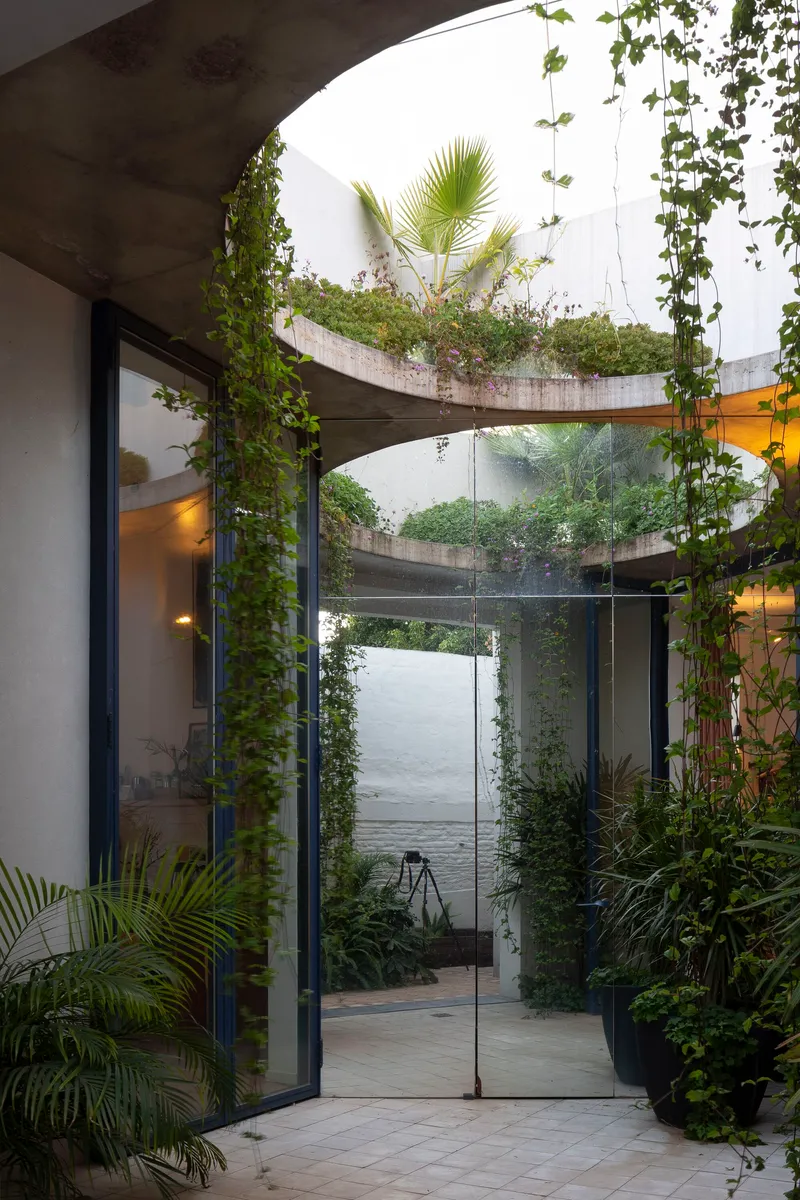
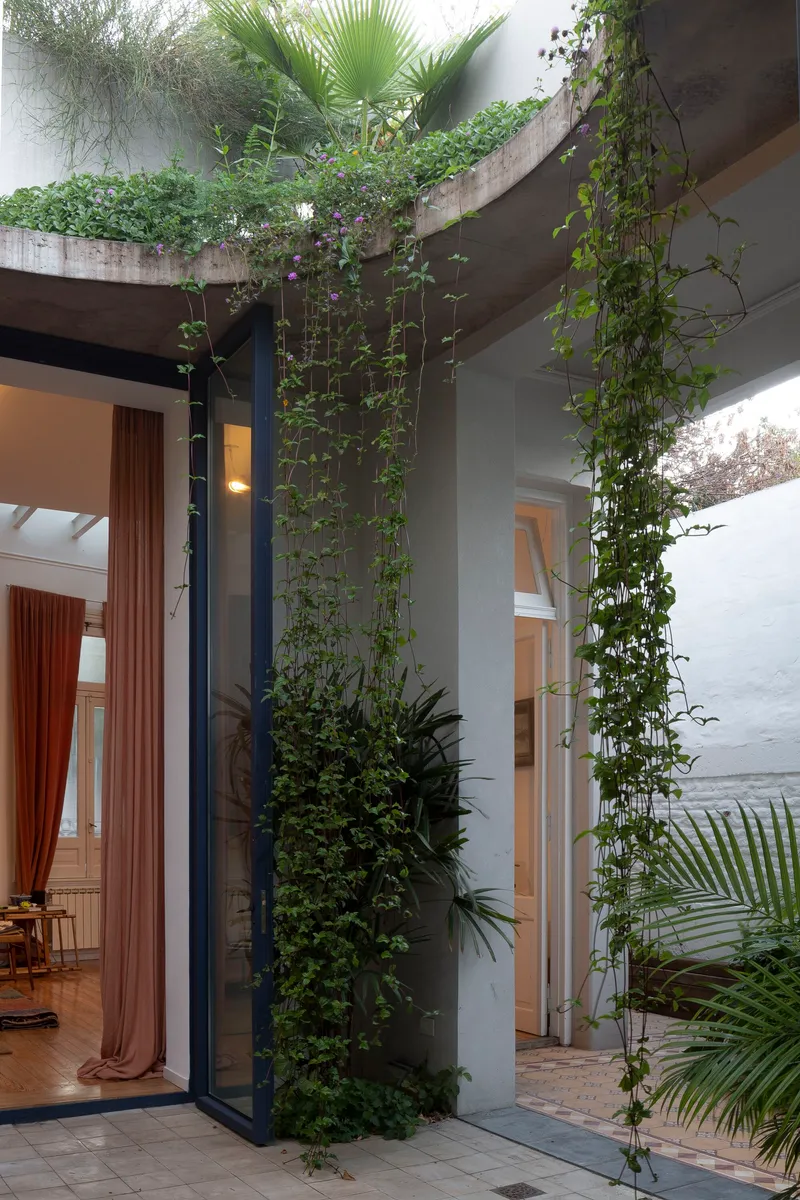
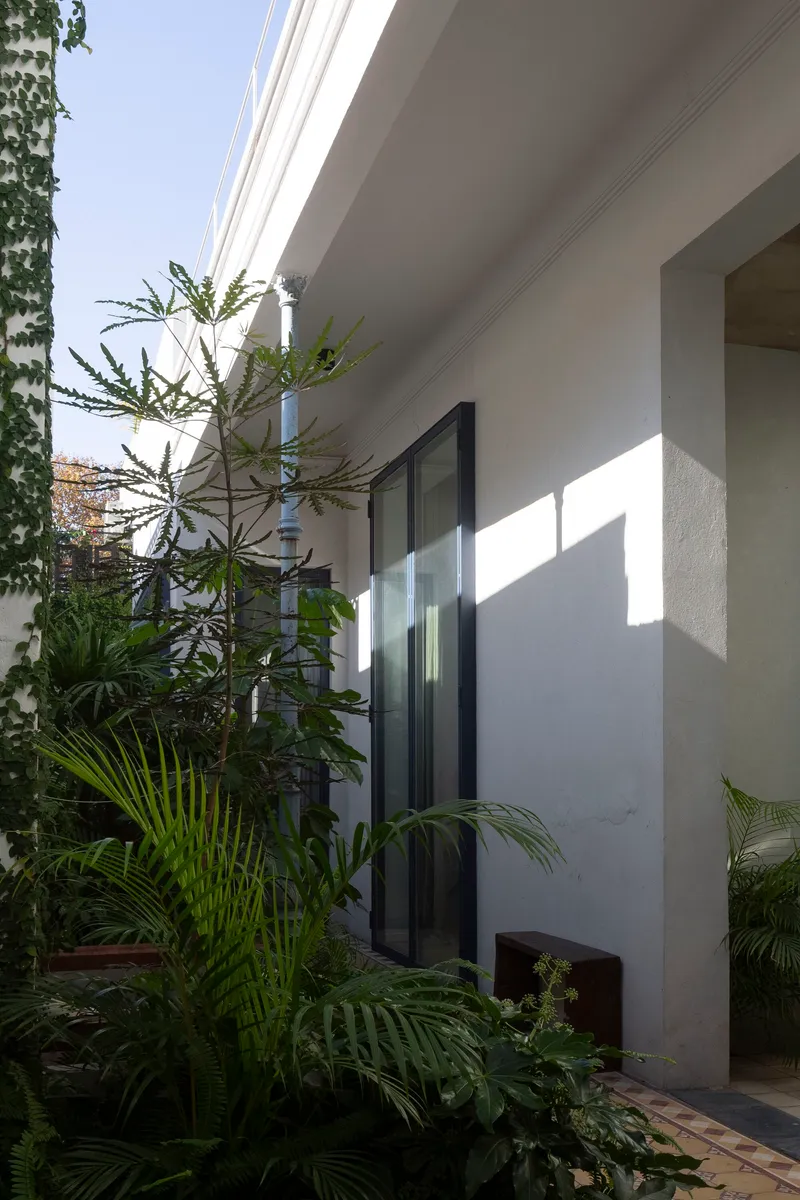
The most striking intervention is the series of interior courtyards that replace what were once continuous rooms. Spiraling concrete planters, cast in place, rise from ground level and wrap upward along the walls, hosting climbing vines and potted palms. These are not decorative planters dropped into a corner. They are structural landscape elements that define the spatial character of each void.
At dusk, the white walls catch residual light and the greenery reads almost as wallpaper, dense and layered. The exterior terrace extends this planted logic to the back of the lot, where sliding glass doors dissolve the threshold entirely. What the original typology treated as a corridor for circulation, the renovation treats as a garden for dwelling.
Thresholds and Transparency
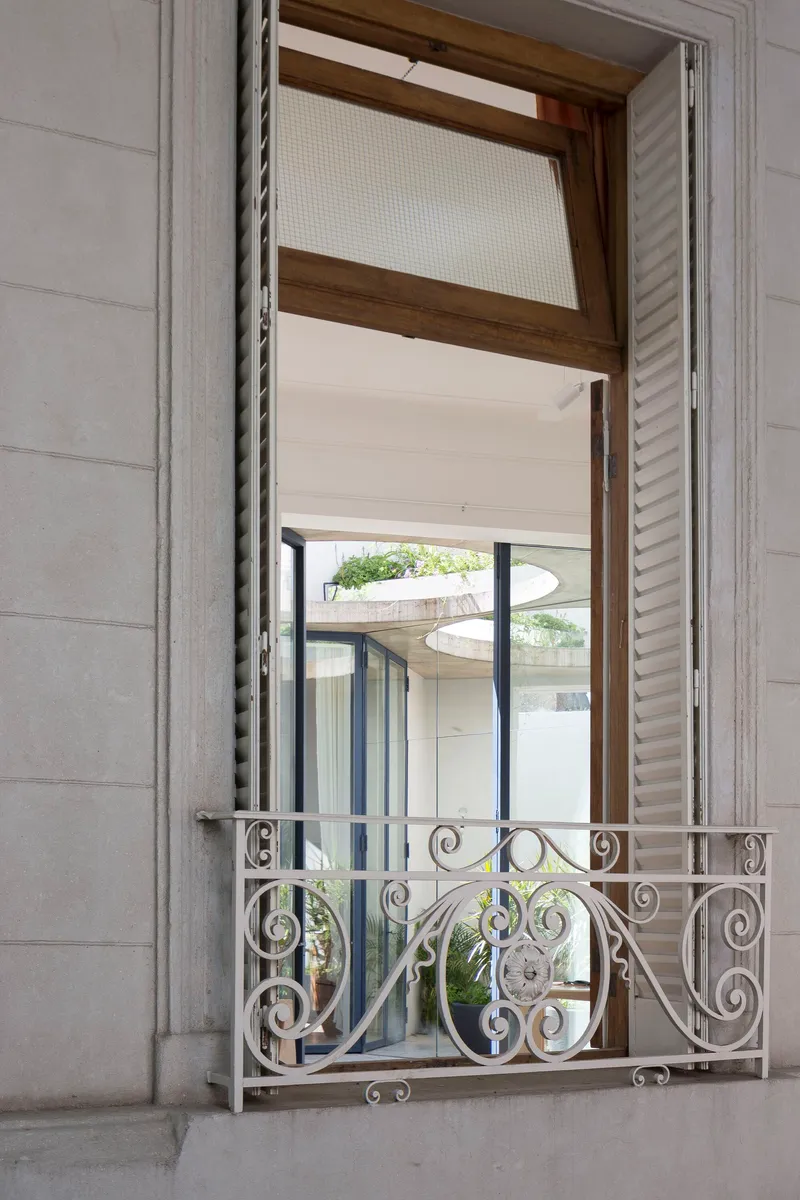
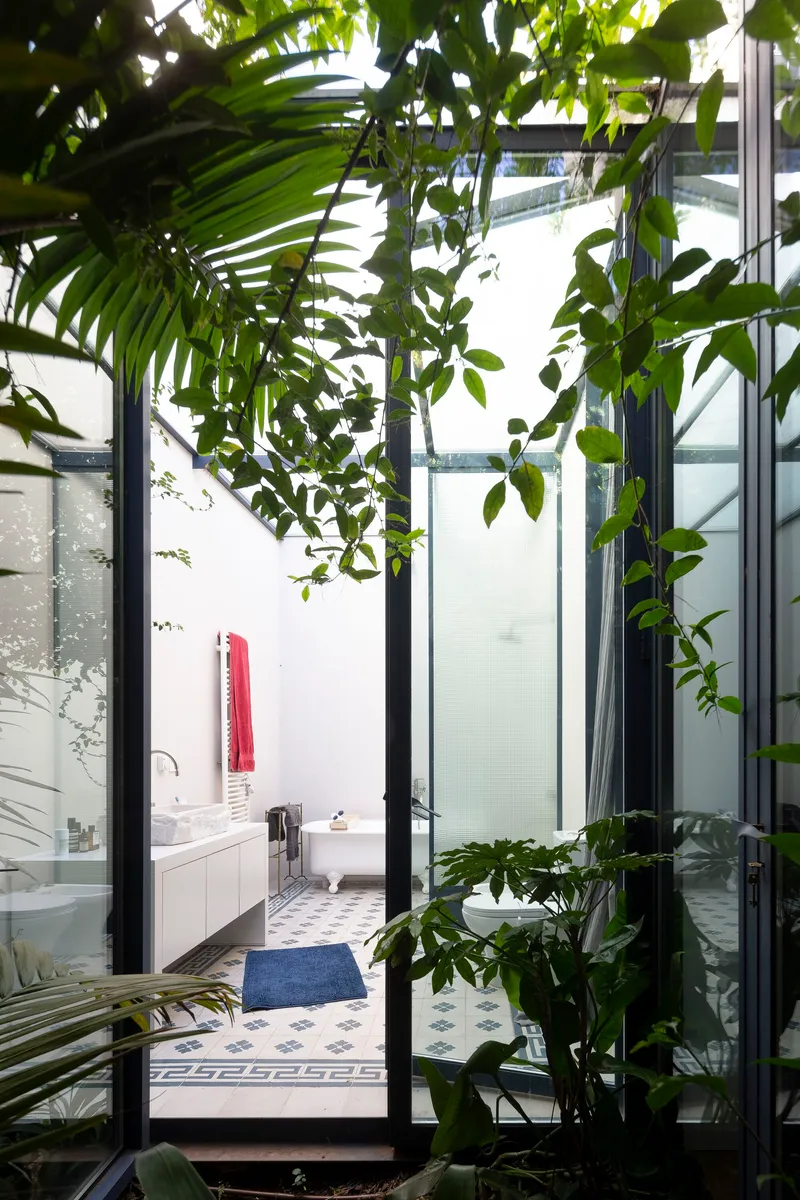
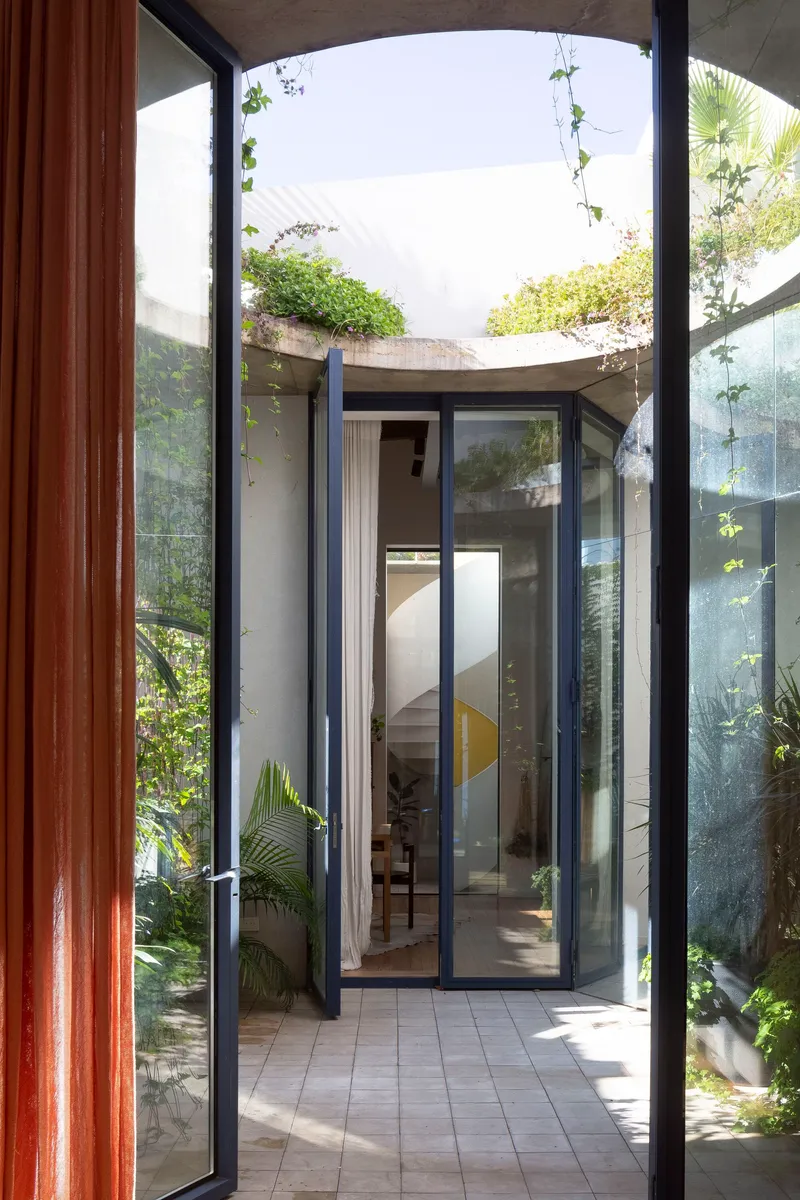
The enfilade logic of the original Chorizo House stacked rooms one behind the other, connected by doors along a side corridor. Giusto Van Campenhout preserves this linear sequence but replaces solid walls with glass, turning each transition into a moment of transparency. Through the ornamental wrought iron balcony, you look past the window frame into a planted courtyard. Through a glass door, hanging vines filter dappled sunlight into a bathroom. Through another opening, curved concrete planters overhead frame a narrow passage thick with tropical foliage.
Each threshold is calibrated differently. Some are fully glazed, floor to ceiling. Others retain masonry and introduce glass only at the point where light is needed most. The effect is cinematic: the house reveals itself sequentially, and every room borrows depth from the courtyard beside it.
Living Spaces and Honest Materials
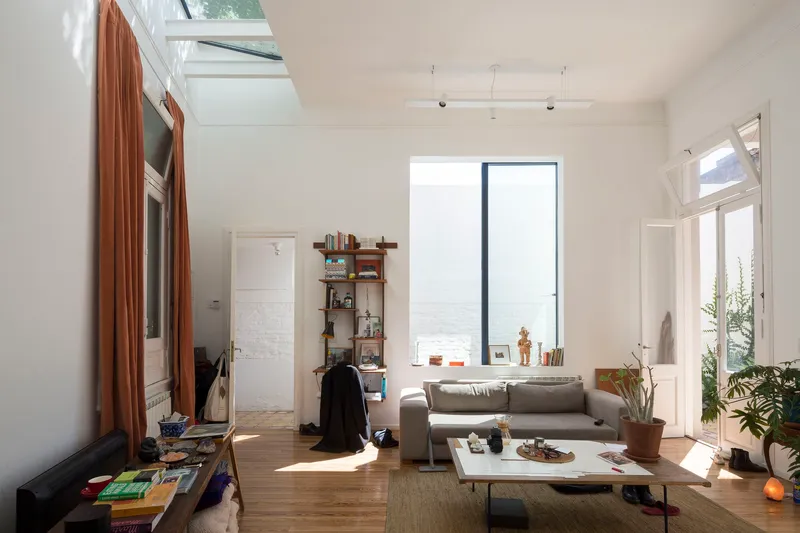
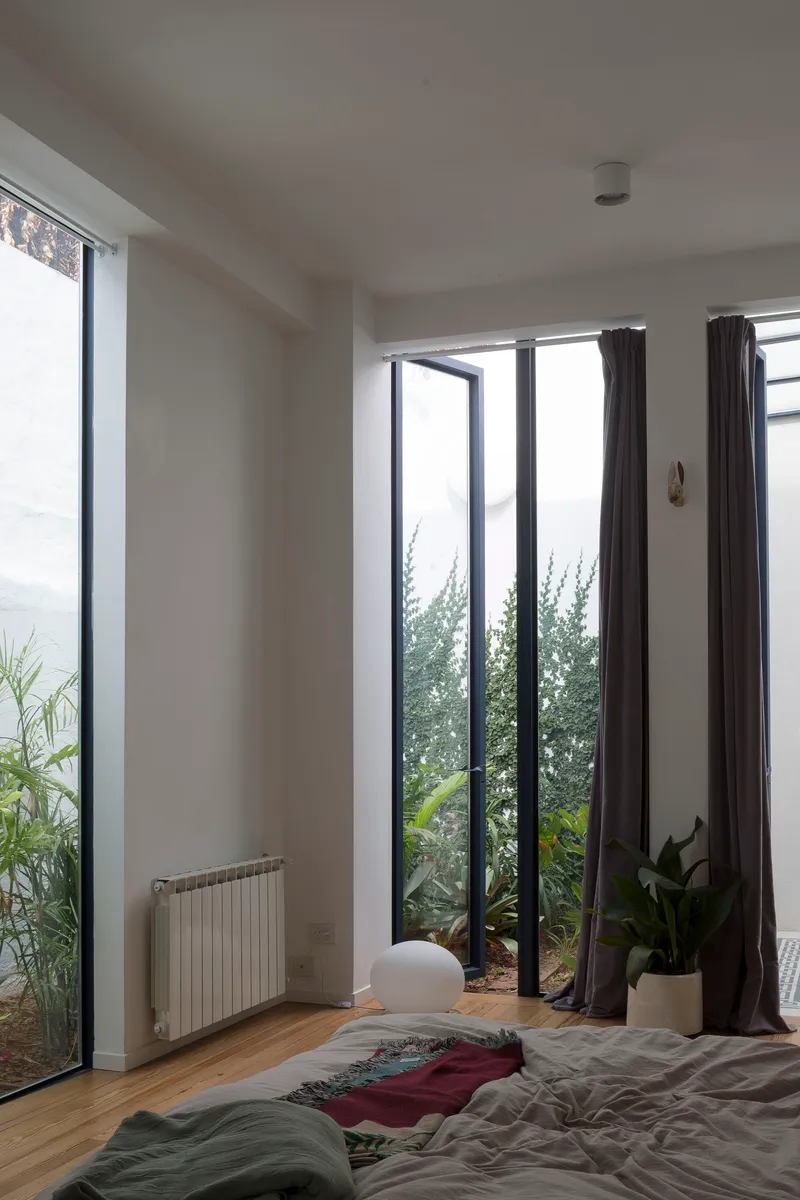
The principal rooms are exercises in restraint. Timber flooring runs through the living room and bedroom, warm against white walls. In the living room, a single tall window frames a view of open sky, and the scale of the opening makes the room feel taller than it is. The bedroom pairs floor-to-ceiling glazing with a planted lightwell, so waking up means waking up to green.
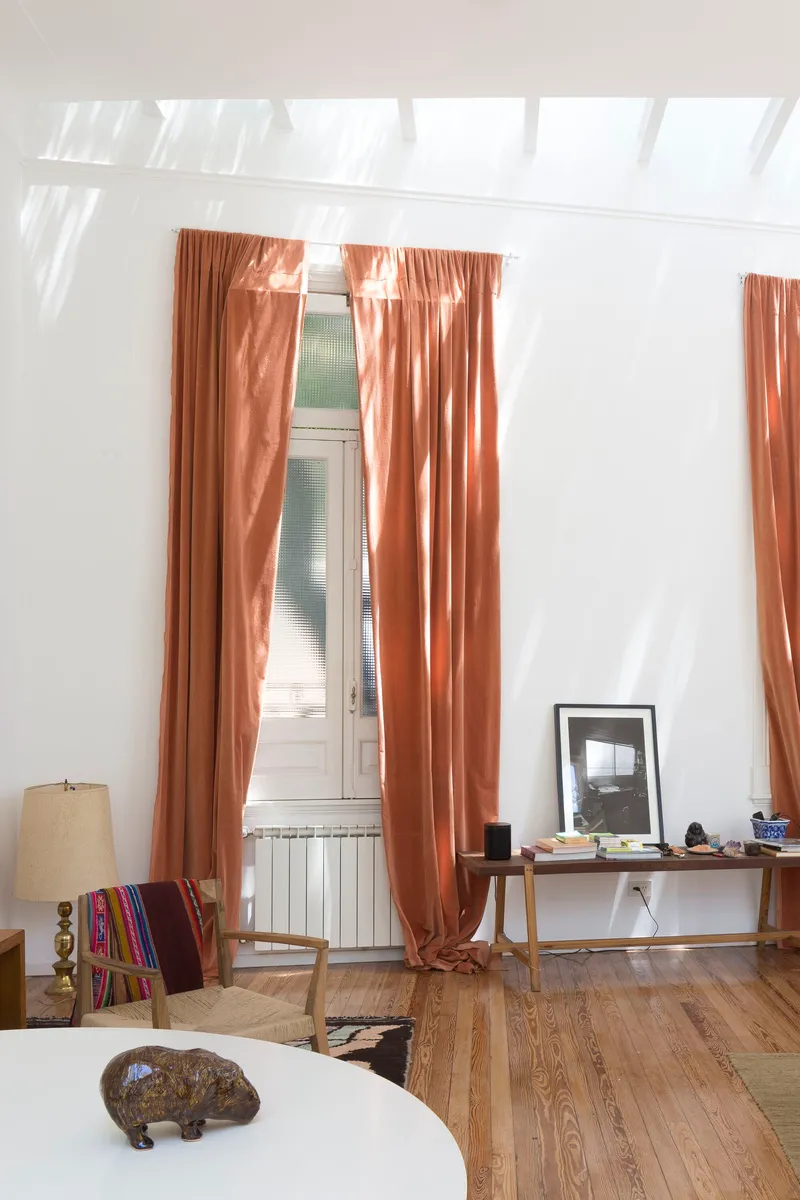
Upstairs, a room with terracotta curtains sits beneath a sloped skylight ceiling that casts sharp, moving shadows across the floor throughout the day. The color of the curtains picks up the roofscape of the neighborhood, a small detail that anchors this interior to its context. Nothing here is gratuitous. The material palette is tight: oak, white plaster, concrete, glass, and fabric. Each surface does work.
The Kitchen as Connector
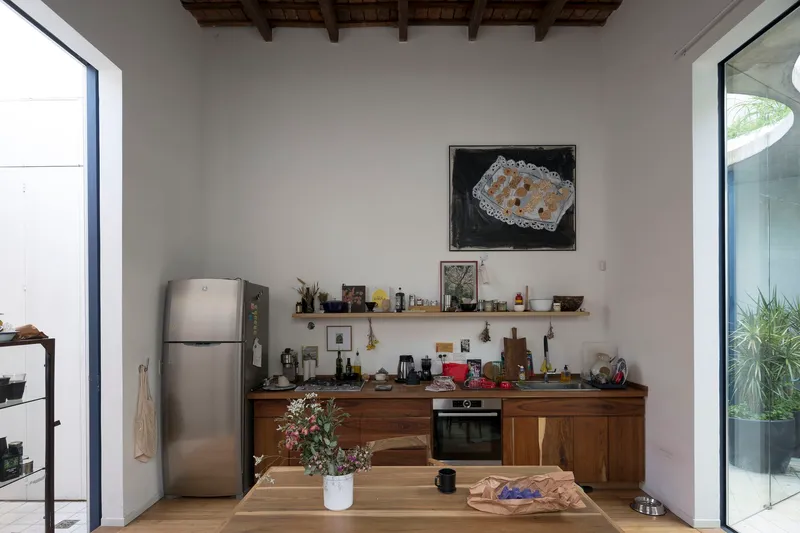
The kitchen is the social hinge of the plan, flanked by planted courtyards on both sides. Exposed timber beams run overhead, revealing the original ceiling structure, while walnut cabinetry lines the walls below. The openings to left and right ensure that the room never feels enclosed, even though it sits deep inside a narrow lot.
This double exposure is smart climatic strategy as well. Cross ventilation passes through the kitchen from courtyard to courtyard, reducing reliance on mechanical cooling in Buenos Aires's humid summers. The courtyards function as thermal buffers, shading the interior while admitting indirect light.
Plans and Drawings
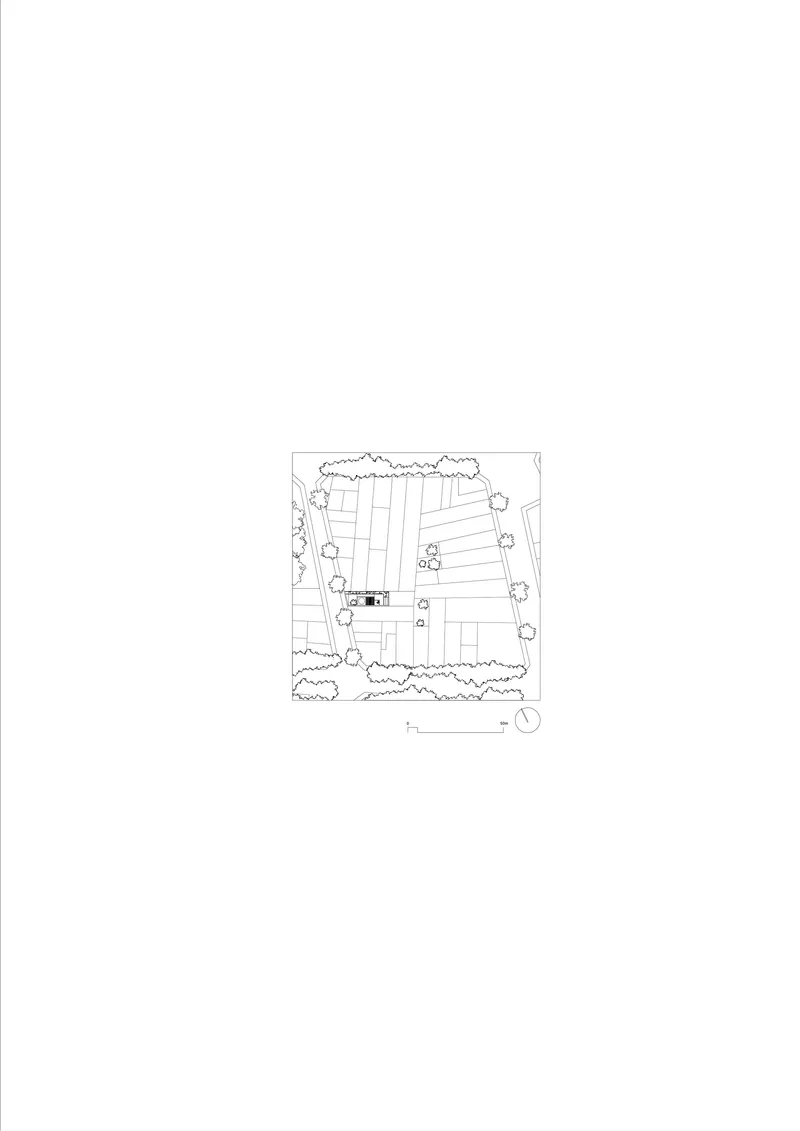
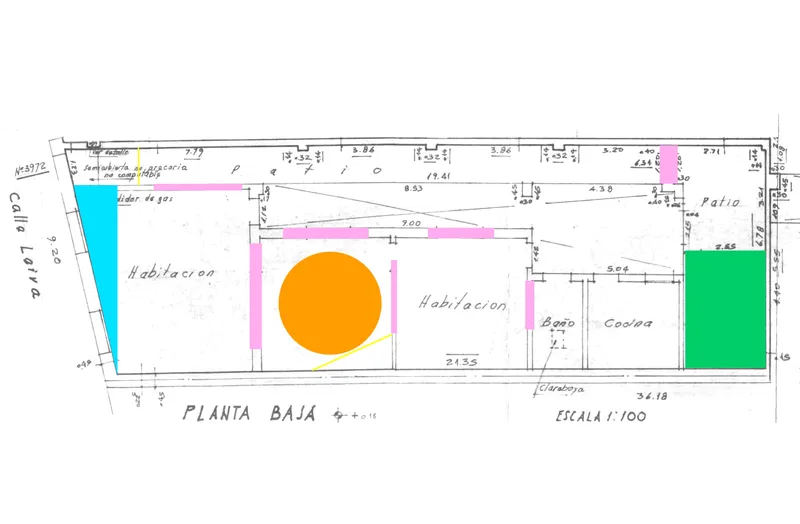
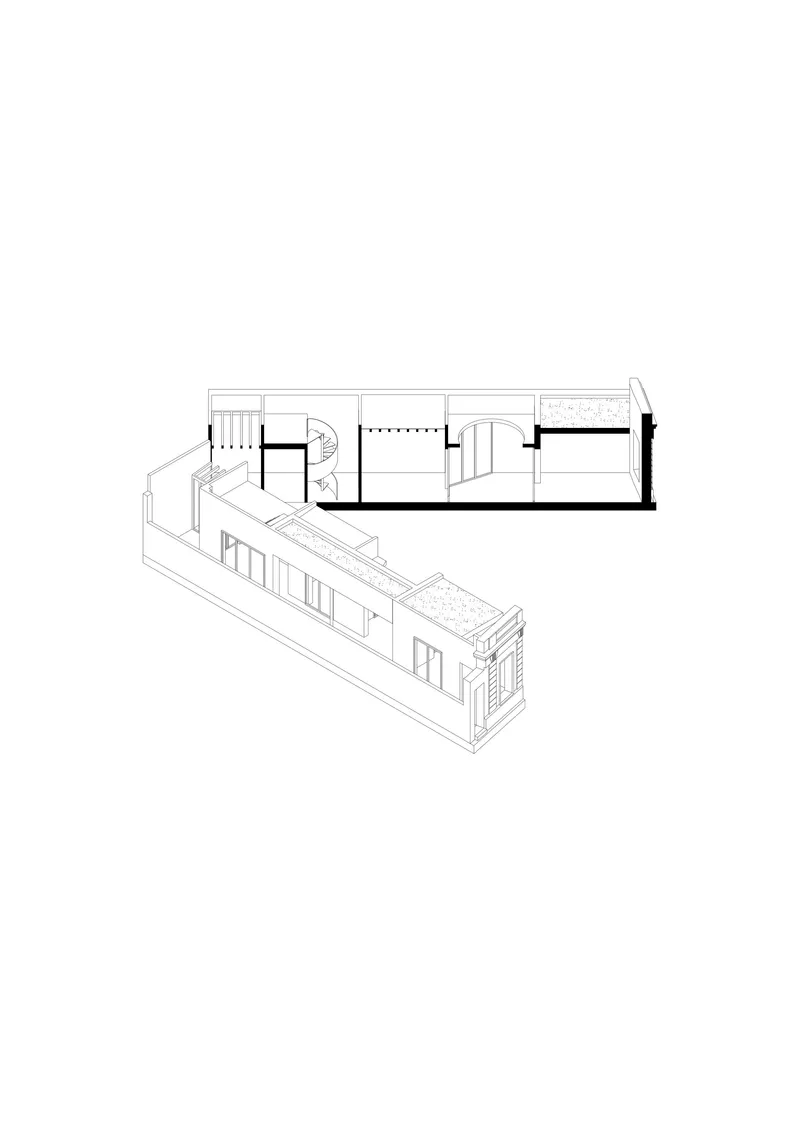
The site plan confirms the project's deep, narrow lot, typical of Buenos Aires's residential blocks. The floor plan, color-coded by function, reveals how the two habitation spaces and kitchen are separated by the carved-out courtyards, each void precisely positioned to deliver light to the rooms on either side. The axonometric makes the linear logic legible in three dimensions, showing the extended wing and the partitions that subdivide the volume without sealing it.
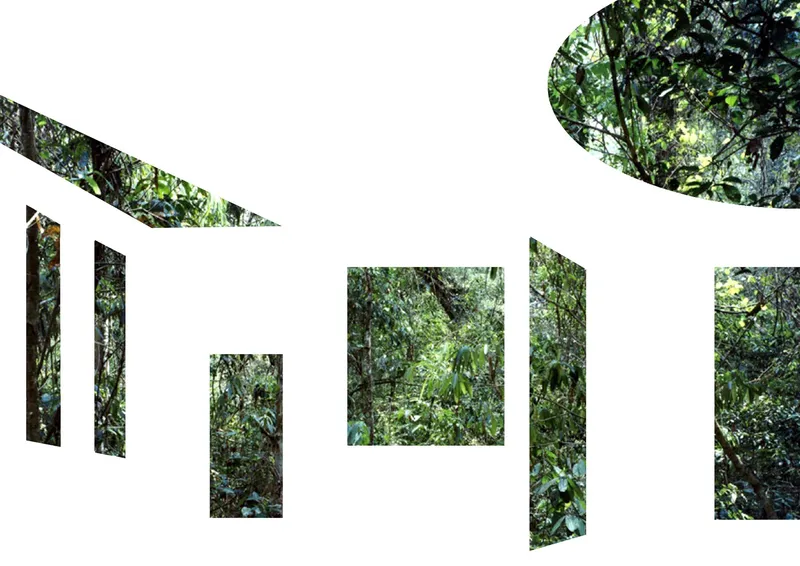
The elevation diagram is perhaps the most poetic drawing of the set. Cutout shapes in the white surface reveal dense tropical foliage behind, a literal illustration of the design premise: architecture is what remains after you subtract enough to let the garden through.
Why This Project Matters
Buenos Aires has thousands of deteriorating Chorizo Houses embedded in its residential fabric. The default developer response is demolition and replacement with a spec apartment building, erasing both the typology and the grain of the block. Giusto Van Campenhout demonstrates that the opposite approach, keeping the structure and subtracting strategically, can produce a contemporary house that is more spatially generous, more climatically responsive, and more connected to its neighborhood than anything built from scratch on the same footprint.
The deeper lesson is about economy of means. At 115 m², this is a small house. But because the architects treated every subtraction as an opportunity to introduce light, air, and vegetation, the experience of inhabiting it exceeds its dimensions. The Chorizo House was invented to organize the lives of newcomers arriving by the thousands. A century later, this renovation proves that the typology still has room to grow, not by adding, but by carefully taking away.
Casa Chorizo House by Giusto Van Campenhout. Buenos Aires, Argentina. 115 m². Completed 2018. Construction and technical development by Marcos Asa. Team: Nelson Van Campenhout, Santiago Giusto, Dario Graschinski. Photography by Javier Agustín Rojas.
About the Studio
Share Your Own Work on uni.xyz
If projects like this are the kind of work you want to make, uni.xyz is a place to publish your own, find collaborators, and enter design competitions.



Popular Articles
Popular articles from the community


The Ocean Hive: Sustainable Architecture for a Self-Sufficient Civilization at Sea
The Ocean Hive imagines sustainable architecture at sea, where modular habitats, algae, wave power and ocean waste sustain a growing colony.

Play: Fragments of Their World
Familiar architecture becomes modular playground design, creating safe spaces where displaced children can learn, connect, imagine and play.

Riyadh For All: Intergenerational Urban Design for Active Aging in Rabat
Riyadh For All reimagines urban design in Rabat with intergenerational co-living, adaptive courtyards, and Moroccan cultural exchange today.

Co-life: Sustainable Architecture for Age-Friendly Community Living
Co-life reimagines sustainable architecture for seniors through courtyards, rammed earth, shared gardens, and spaces designed for belonging.


Similar Reads
You might also enjoy these articles

Bao Huynh Watercolor Atelier: A Serene Art Retreat in Hội An
Bao Huynh Watercolor Atelier in Hội An blends multifunctional art spaces, sustainable design, local materials, and family-friendly living in a serene environment.

Atelier Macri Concept Store Interior Design by CASE-REAL
Atelier Macri store features a "ko" counter, walnut wood details, cork displays, blending retail, gallery, and seamless customer experiences.

Manuel Vargas Izquierdo Stadium and High-Performance Sports Center: Architectural Excellence in Jalpa de Méndez
The Manuel Vargas Izquierdo Stadium blends sustainable design, inclusive sports facilities, and cultural-inspired architecture, revitalizing Jalpa de Méndez’s public spaces.

KAKR Buluh Awar Hall: Revitalizing Community and Ecology Through Bamboo Architecture
Community built bamboo hall revitalizes Buluh Awar village, empowering youth, restoring ecology, celebrating vernacular craftsmanship through sustainable architecture and culture.




Comments (0)
Please login or sign up to add comments
No comments yet. Be the first to comment!