
Good Evening Life: Brick Courtyards and Covered Walkways Redefine Elderly Living
A residential complex for aging residents uses interconnected wings, shaded verandas, and landscaped courtyards to foster dignity and community.


Most elderly care facilities are designed around efficiency: corridors linking rooms, centralized dining, controlled movement. Good Evening Life works from a fundamentally different premise. It asks what it would mean to design a residential complex where the spaces between buildings matter as much as the buildings themselves, where shade, ground texture, and the rhythm of brick columns create an environment that invites slow, deliberate inhabitation rather than passive containment.
Designed by Ashish Kelkar as an entry to the Social Room competition, the project proposes a cluster of interconnected residential wings organized around landscaped courtyards. The architecture reads as a small village rather than an institution, with pitched tile roofs, exposed brick facades, and generous covered corridors that dissolve the line between indoors and out. The result is a spatial framework that treats aging not as a condition to be managed but as a phase of life deserving of richly layered environments.
A Village, Not a Facility
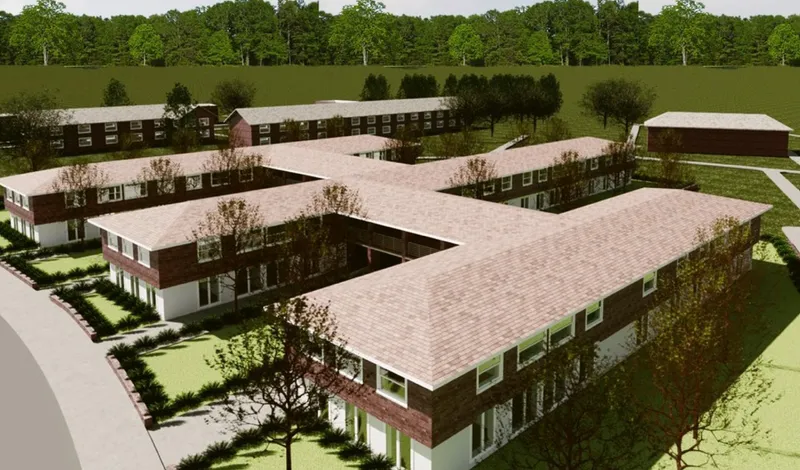
The aerial rendering makes the organizational logic clear. Residential wings radiate outward from a series of enclosed courtyards, their pitched roofs creating a varied roofscape that avoids the monotony of institutional blocks. The plan works like a collection of houses gathered around shared gardens, each wing sized modestly enough to feel domestic. Trees punctuate the spaces between buildings, and the courtyards they define become social rooms in themselves: protected from wind, shaded, and visible from surrounding corridors and rooms.
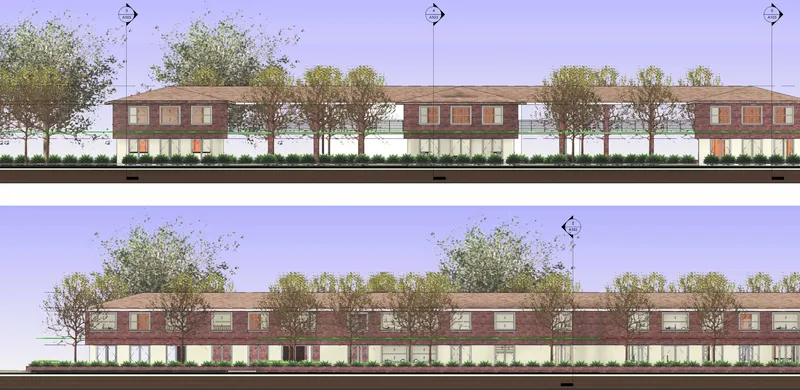
The elevation drawing reinforces this village sensibility. Two-story brick volumes stand side by side with generous separation, allowing trees and street lighting to inhabit the gaps. There is no monumental facade, no single front door. The architecture presents itself as a neighborhood, with entry points implied rather than declared. For residents transitioning from independent homes, this spatial familiarity is not decoration; it is a form of care.
Brick Columns and the Art of the In-Between


The covered corridors are the project's strongest architectural move. Thick brick columns define a rhythm of shade and light along outdoor walkways wide enough for a wheelchair, a walker, or two people strolling side by side. These are not mere circulation routes. They function as social infrastructure, places where chance encounters happen because the architecture makes lingering comfortable. One rendering shows a staff member assisting a resident in a wheelchair while others pass nearby; the corridor accommodates all of this without feeling crowded.
The veranda rendering pushes this idea further. Dark brick columns frame views of the courtyard while timber flooring underfoot signals a shift from public to semi-private territory. Elderly visitors sit and talk beneath the covered ceiling, their posture relaxed in a way that speaks to the scale of the space. The columns are spaced generously enough to avoid claustrophobia but closely enough to provide a sense of enclosure and security. It is a careful calibration, the kind that separates thoughtful design from generic planning.
Courtyards Framed by Mature Trees and Elevated Bridges
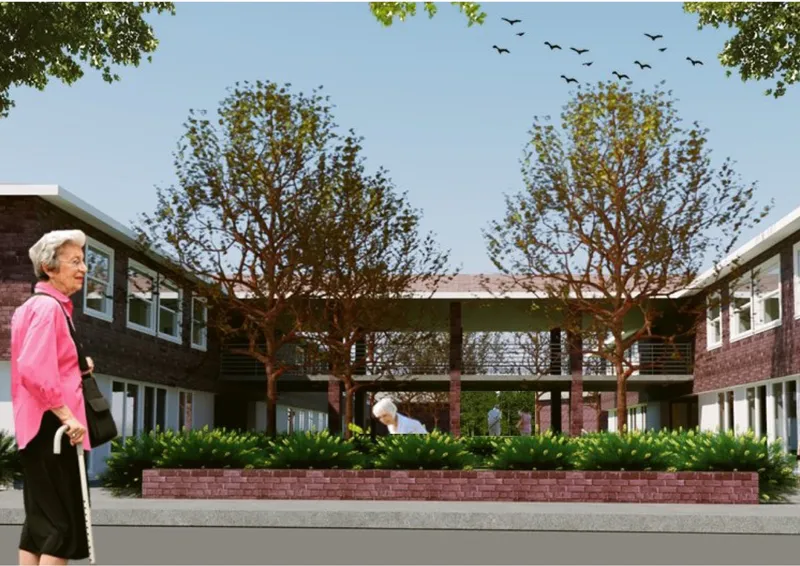

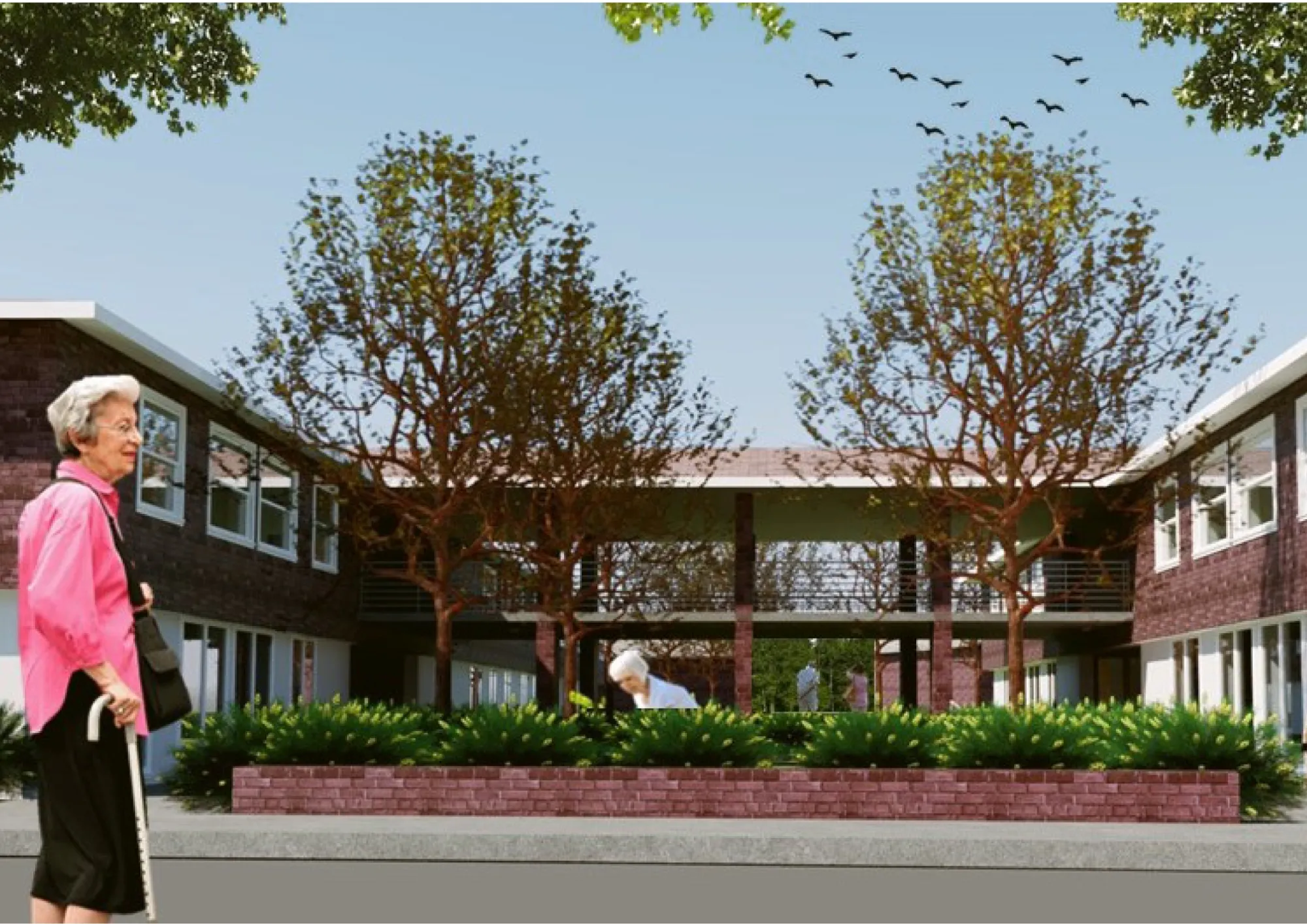
The courtyard view, framed by two mature trees with an elevated walkway bridge spanning above, captures the project's spatial ambition. The ground plane belongs to gardens and brick planter beds; the upper level connects wings via a lightweight bridge that adds visual interest without dominating the scene. For residents who can manage stairs or a ramp, the bridge offers a different vantage point on the courtyard below. For those who remain at ground level, it provides something to look at, a presence of activity overhead that prevents the courtyard from feeling empty.
The street-level view of the brick residential buildings, with residents walking in daylight and birds in the sky, captures an aspirational normalcy. People move freely. The scale is low and approachable. There are no fences or clinical signage. The architecture communicates belonging rather than containment, a distinction that matters enormously when you are designing for people who have already lost much of their autonomy.
Communal Dining as Social Anchor
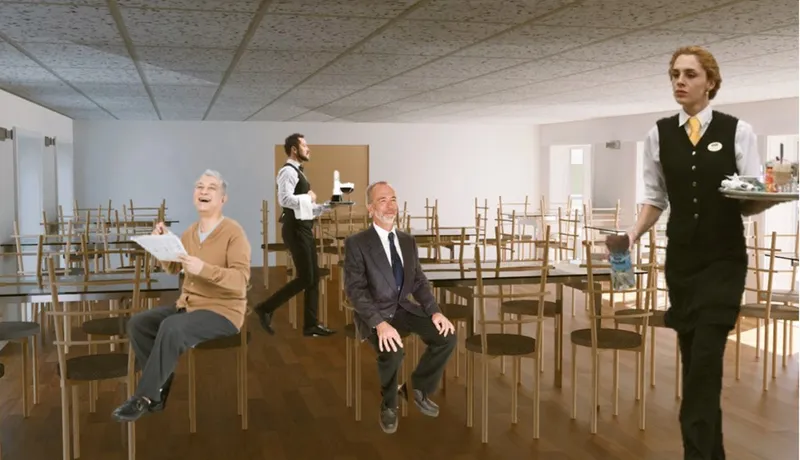
The dining hall interior reveals a warm, well-proportioned room where suspended ceiling tiles modulate acoustics and light wood chairs are arranged in rows that allow staff to circulate easily. The space is neither too grand nor too intimate; it sits at the scale of a village hall or a large family gathering, reinforcing the project's consistent commitment to domestic familiarity. Mealtimes in elderly care are often the primary social event of the day, and a dining room that feels welcoming rather than cafeteria-like can meaningfully affect well-being.
Why This Project Matters
Good Evening Life succeeds because it refuses the false choice between efficiency and warmth. The plan is legible, the circulation is clear, and the material palette of brick, tile, and timber is durable and low-maintenance. But none of these practical virtues come at the expense of spatial generosity. Covered corridors, shaded courtyards, and elevated walkways create a layered environment where residents can choose their level of engagement with others, moving from solitude to sociability without ever leaving familiar ground.
At a time when elderly populations are growing worldwide and institutional care is under scrutiny, projects like this one from Ashish Kelkar offer a compelling alternative. The architecture does not patronize its residents or romanticize aging. It simply provides the spatial conditions for a dignified daily life: shade when the sun is too strong, company when solitude weighs too heavily, and a place that looks and feels like home.
View the Full Project
About the Designers
Designer: Ashish Kelkar
Enter a Design Competition on uni.xyz
uni.xyz runs architecture and design competitions year-round that reward proposals with spatial conviction and real site intelligence.
Project credits: Good Evening Life by Ashish Kelkar Social Room (uni.xyz).




Popular Articles
Popular articles from the community


Hill & Cross Opera: Sculptural Opera House Architecture Shaped by Tallinn’s Landscape and Identity
Hill & Cross Opera reimagines opera house architecture in Tallinn through its sculptural hill, civic plaza, glass wave and a luminous cross.
EW PARK: Sustainable Architecture Reimagines the Future of Urban Parking
EW PARK reimagines city parking as a modular wooden tower combining automation, solar energy, electric mobility, and adaptable urban design.

AL-JANNAH: Sustainable Architecture and Permaculture for Afghan Widows
AL-JANNAH uses sustainable architecture and permaculture to create resilient oasis of housing, learning, work and renewal for Afghan widows.

Co-life: Sustainable Architecture for Age-Friendly Community Living
Co-life reimagines sustainable architecture for seniors through courtyards, rammed earth, shared gardens, and spaces designed for belonging.


Similar Reads
You might also enjoy these articles

The Musturak Paradise: Senior Living Architecture for a Connected Future in Temara, Morocco
The Musturak Paradise reimagines senior living architecture in Temara via private homes, social spaces, culture, community, and shared care.

The Leaf Center: Cultural Center Architecture for Social Integration in Amsterdam
Cultural center architecture becomes a bridge at The Leaf Center, connecting international students with Amsterdam through art and exchange.

Conexión: Biophilic Design Reimagines High-Rise Living in Hong Kong
Conexión reimagines high-rise living in Hong Kong through biophilic design, green facades, shared spaces, daylight, water and nature within.

Wander to Wonder: Modular Playground Design for Children in Kutupalong Refugee Camp
Wander to Wonder uses modular playground design to create flexible, imaginative play spaces for children in Kutupalong refugee camp.





Comments (0)
Please login or sign up to add comments
No comments yet. Be the first to comment!