

Green Diary House: Architecture That Heals by Remembering
A therapeutic building for dementia care weaves memory loops, sensory cues, and Korean agrarian heritage into a spatial journey of rediscovery.


What if a building could remember on behalf of the people living inside it? Green Diary House proposes exactly that: an architecture of empathy, where corridors trigger tactile memories, cyclic pathways reinforce familiar patterns, and a tree growing through a central void stands as a quiet metaphor for the slow return of identity. Designed for individuals with dementia and memory-related conditions, the project refuses to treat care architecture as mere containment. Instead, it constructs a spatial narrative rooted in Korea's agrarian past, translating communal rhythms, manual labor, and deep family traditions into a contemporary therapeutic framework.
The project is the work of designers Leila Noori, Seyed Eteraf, Erfan Daei, and Mohamad Javanmard, submitted as an entry to the Mnemonic competition on uni.xyz. The brief asked participants to rethink how architecture can engage with memory, and Green Diary House answers with a building that does not isolate its residents in artificial environments but integrates into the urban fabric, bridging the gap between clinical care and the comfort of lived experience.
A Corridor That Carries You Back in Time
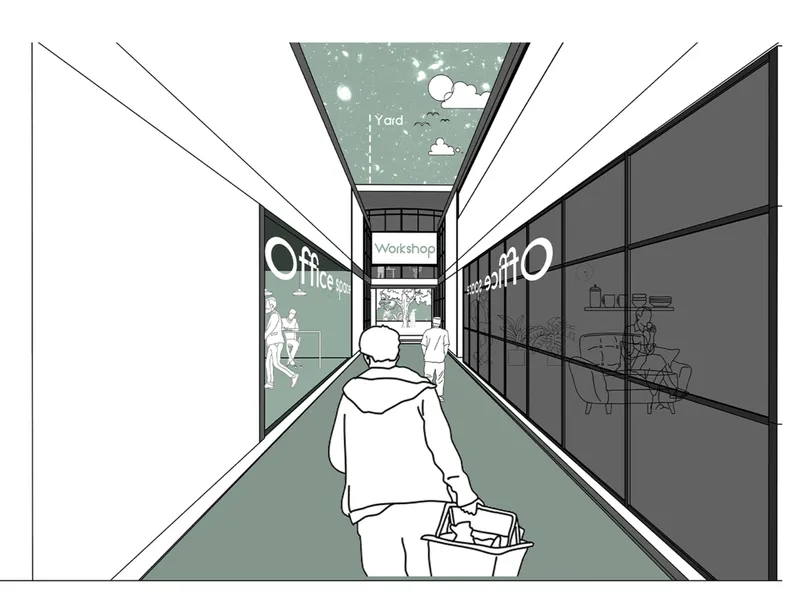
The perspective drawing reveals the sensory richness of the interior circulation: a glazed corridor floods with natural light from a skylit yard above, while a figure carrying tools moves through a space that feels more like a familiar workshop passage than a clinical hallway. This is not accidental. The designers describe their approach as "narrative architecture," where textures, views, and even smells are curated to elicit recognition. Rough surfaces recall childhood tactility; views into planted yards echo the agricultural landscapes of Korea's communal past. The poetic fragments woven into the design rationale, including a patient's memory of a rough bedsheet triggering a childhood recollection, find literal expression in the material palette.
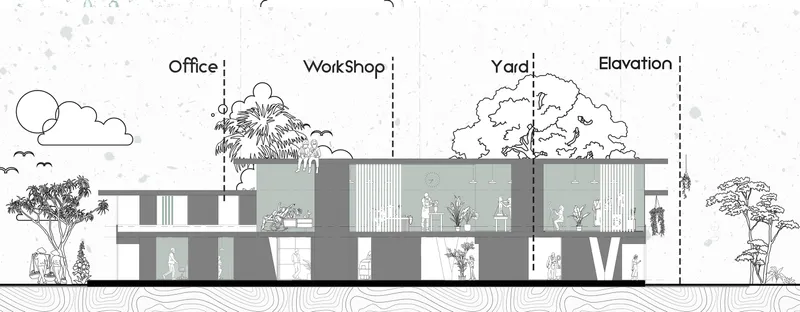
The sectional elevation clarifies how these experiential qualities are organized programmatically. Office zones, workshops, and open yards are distributed across two stories, with clear zoned separation between therapeutic activity spaces and service infrastructure. This split respects residents' autonomy: workshops provide purposeful engagement and agency, while support areas remain accessible without intruding. The spatial path guides residents through a symbolic journey from professional identity (the workshop) to personal grounding (the yard), structuring daily life around meaningful repetition rather than empty routine.
The Void at the Center: A Tree as Anchor
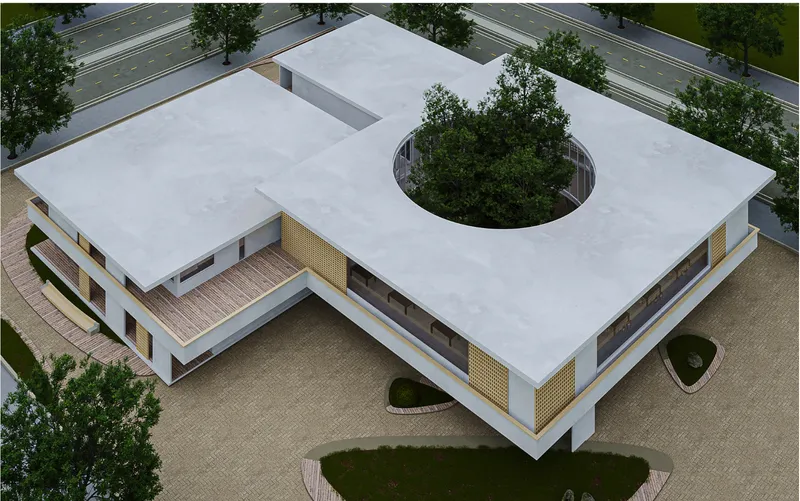
Seen from above, the building's white flat roof is punctuated by a circular courtyard opening, its edges precise, the planted trees below visible through the aperture. This central void is the figurative and literal heart of Green Diary House. The designers describe it as a space "where nature, memory, and healing meet." A tree grows upward through the opening, marking the passage of seasons and offering a living symbol of resilience and rediscovery. For residents navigating cyclical pathways through gardens, courtyards, and workshops, the void acts as a consistent landmark, reducing spatial confusion while reinforcing orientation.
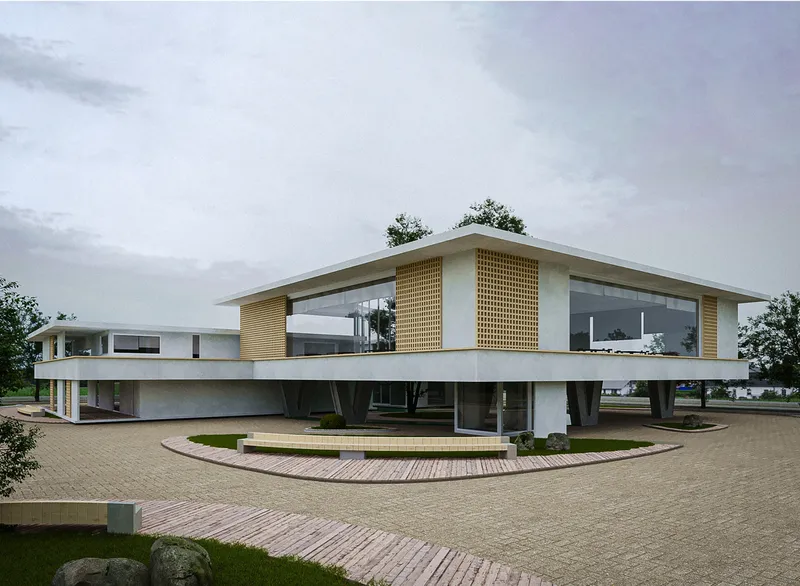
The exterior view at ground level reveals the structural logic supporting this gesture: the upper volume is elevated on pilotis, its facade articulated with latticed timber screens that filter light and modulate privacy. The piloti strategy creates an uninterrupted green corridor at ground level, echoing historical agricultural layouts and promoting what the designers call "landscape continuity." This open ground plane strengthens the bond between resident and nature, offering a calm, grounded atmosphere before one even enters the building. The lattice screens are more than ornamental; they establish a threshold between the urban context and the therapeutic interior, softening the boundary rather than erasing it.
Living Under the Canopy: Ground Plane as Healing Garden
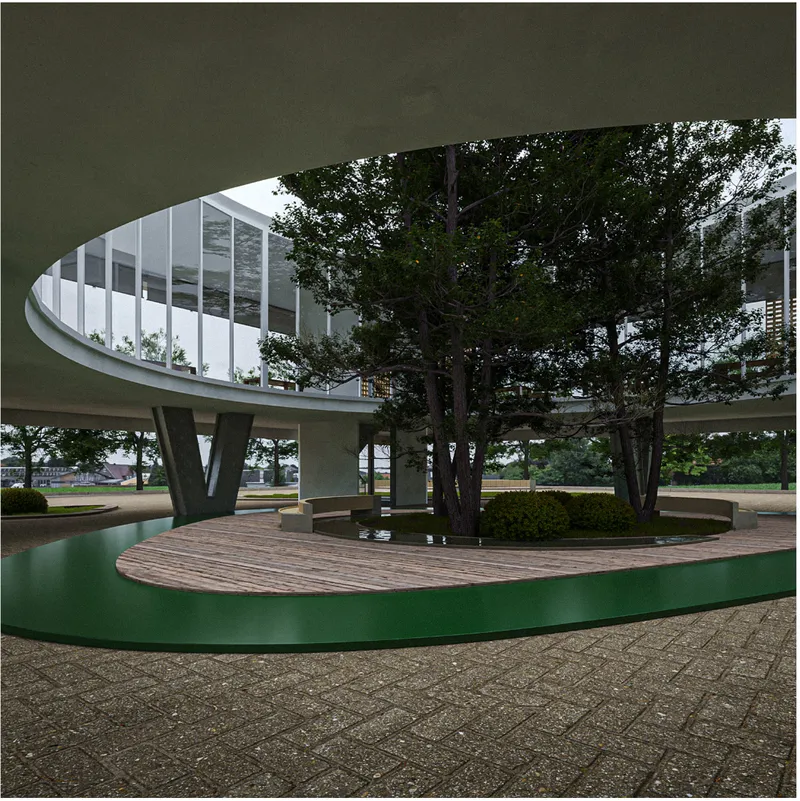
Beneath the cantilevered upper floor, trees grow through a curved, green-edged timber deck, their canopies reaching toward the light of the courtyard void above. This undercroft is not leftover space; it is a deliberately designed zone where the memory loop pathway begins. The layout promotes cyclic movement through recognizable spaces, helping dementia patients navigate by recalling familiar patterns rather than relying on signage or wayfinding cues they may not process. The organic curve of the deck, the warmth of the timber, the presence of living trees: all of these sensory anchors work together to create an environment that feels known, even on a first visit.
Water, Vines, and the Intimacy of Narrow Space
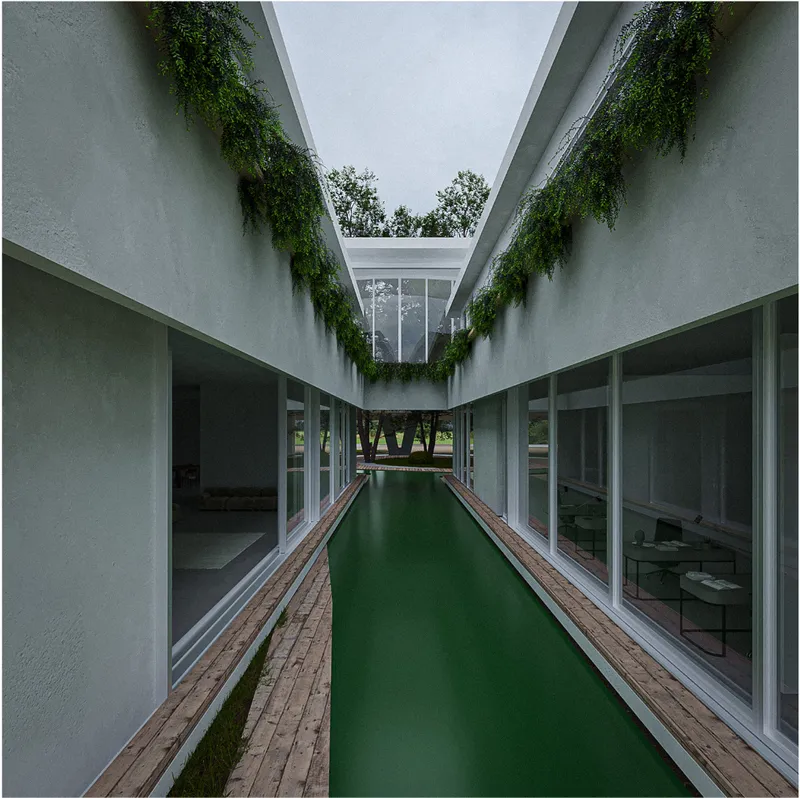
A narrow courtyard flanked by glazed walls and draped with cascading vines introduces a linear green water feature that runs its full length. The compression of space here is deliberate: tight proportions amplify sensory input, making the sound of water, the texture of stone, and the scent of vegetation unavoidable. For someone with diminished cognitive processing, this concentration of stimuli can cut through confusion and reestablish presence. The vines overhead soften the hard geometry of the glazing, while the water feature provides an auditory thread that residents can follow as a navigational cue, linking this courtyard to adjacent circulation paths.
A key innovation across all these spaces is the project's conscious refusal to isolate its residents. Unlike dementia villages that construct entirely artificial environments, Green Diary House integrates into the urban fabric. The glazed walls of this courtyard do not hide the city; they frame it. Residents are not sheltered from complexity but are given the sensory tools to engage with it on their own terms. This decision reflects a nuanced understanding of dignity in care: belonging means remaining connected, not being removed.
Why This Project Matters
Dementia care architecture often defaults to one of two extremes: sterile clinical environments that prioritize safety over humanity, or themed villages that simulate normality at the cost of authenticity. Green Diary House refuses both. By grounding its design in the specific cultural memory of Korea's agrarian communities, by using material texture and spatial rhythm as therapeutic instruments, and by keeping the urban context legible rather than erased, it proposes a third path. Care architecture can be honest, culturally rooted, and sensorially rich without becoming patronizing.
What Noori, Eteraf, Daei, and Javanmard have achieved is a compelling demonstration that spatial design is not secondary to medical care; it is a form of care itself. The memory loop pathway, the central void with its growing tree, the sensory compression of the narrow courtyard: these are not decorative ideas. They are instruments of orientation, identity, and emotional grounding. For a competition centered on the relationship between architecture and memory, Green Diary House delivers a response that is both poetic and operationally precise, proving that empathy, when given architectural form, can become genuinely therapeutic.
View the Full Project
About the Designers
Designers: Leila Noori, Seyed Eteraf, Erfan Daei, Mohamad Javanmard
Enter a Design Competition on uni.xyz
uni.xyz runs architecture and design competitions year-round that reward proposals with spatial conviction and real site intelligence.
Project credits: Green Diary House by Leila Noori, Seyed Eteraf, Erfan Daei, Mohamad Javanmard Mnemonic (uni.xyz).


Popular Articles
Popular articles from the community


LT2A and OPEN Architectes Thread a Brick and Glass High School Through a Wooded Belgian Campus
In Braine-l'Alleud, a 3,000 m² wing for Collège Cardinal Mercier pairs pale brick with a glazed colonnade, deferring to a small chapel and a dense wood.

Jaramillo Van Sluys Arquitectura and Urbanismo Turn a Demolished Registry Lot in Quito into an Orchard Plaza
In Quito's Centro Histórico, a 2,800 m² plaza exposes the San Agustín convent wall and redraws its lost Augustinian orchard in volcanic stone.

Cube Design Draws an Ecological Corridor Between Two Shenzhen Hills with the Nankai Building
Beside Shenzhen's container docks, the Nankai Building pairs stacked balconies with a climbing green screen to connect two hillsides across its height.

GROUP A Strips a 1969 Rotterdam Harbor Headquarters to Its Frame and Wraps It in Timber Louvers
In Rotterdam's M4H harbor district, Ferro Offices reuses a 1969 frame, adds one timber storey and reaches BREEAM-NL Outstanding.

Similar Reads
You might also enjoy these articles


Vereda Arquitetos Renovates a 40-Square-Meter Apartment Inside Niemeyer's Copan Building
A compact unit in São Paulo's most iconic residential tower gets a material overhaul that pairs exposed concrete with bold blue Formica.

Shakur's House: Exposed Brick as an Interior Organiser in a 168 m² Mashhad Residence
Brick moves indoors in this Mashhad residence, where masonry walls, glass partitions and teal planes sequence a compact home without closing it off.

Day and Night Park: A Time-Based Urban Newsstand in Beijing
A temporary urban newsstand in Beijing blending travel, light, and reading through poetic colors, compact form, and community-focused design.

Modernist Patio Renovation in El Masnou, Barcelona by Oliver Segura Arquitectura + Cebrià Arquitectura
Modernist patio renovation blending tradition and innovation with a movable pool, leveled floors, and Catalan materials in El Masnou.

Explore Ageing-Well Design Competitions
Discover active competitions in this discipline

Challenge to reimagine the Iron Throne

Photograph architecture without architects

Illustrate the lost glory of Angkor Wat - Render Challenge

Design challenge to reuse E-waste
Comments (0)
Please login or sign up to add comments
No comments yet. Be the first to comment!