

Green Eye Vision: A Vertical City in Dubai Built for Flying Cars and Green Façades
A speculative mixed-use tower integrates flying mobility platforms, energy-generating pedestrian bridges, and responsive solar skins for Dubai's 2050 agend


What if a skyscraper could double as a city, a power plant, and a landing pad for flying cars all at once? Green Eye Vision is a concept tower for Dubai that refuses to treat sustainability, density, and speculative mobility as separate problems. Instead, it stacks them into a single organic structure: offices, apartments, hotel rooms, entertainment zones, vertical gardens, solar façades, and yes, flying car parking platforms, all wrapped in an architectural skin that generates energy while shading itself from the desert sun.
Designed by Alessandro Cece, Ayda Hajjaj, and Farah Abbas Moh'd Hashim Alsharif, the project takes Dubai's 2050 sustainability agenda as its starting point and pushes it toward a genuinely speculative conclusion. The tower is conceived as a vertical city, one that reduces automobile dependence by promoting walkability and public transit connections while simultaneously preparing for a transportation paradigm that doesn't fully exist yet. It's ambitious, unapologetically futuristic, and grounded in real environmental performance strategies.
An Organic Lattice Against Dubai's Rigid Skyline
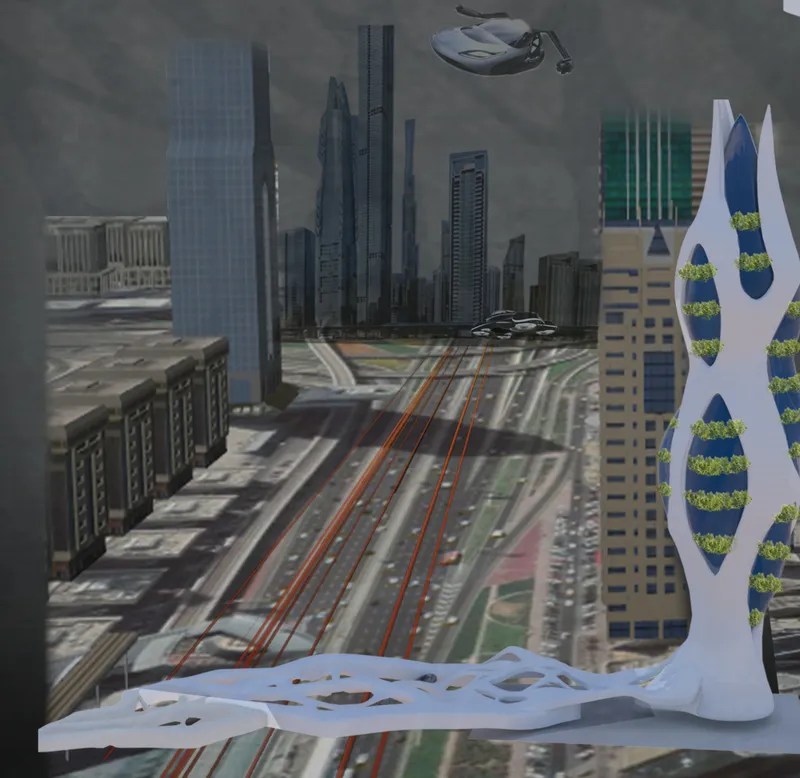
The physical model reveals the tower's fundamental tension: a white lattice structure, curving and organic, standing in deliberate contrast to the rectilinear glass towers of a typical Dubai skyline. Planted elements climb the form, signaling that this is not merely a structural envelope but an ecological one. Transit rails visible at the base hint at the pedestrian bridge connecting the building to Dubai's metro line, a bridge embedded with sensors that generate electricity from footfall. The model makes clear that the designers are thinking about the tower as infrastructure, not just architecture.
Stepped Planters and Cascading Green as Inhabited Landscape
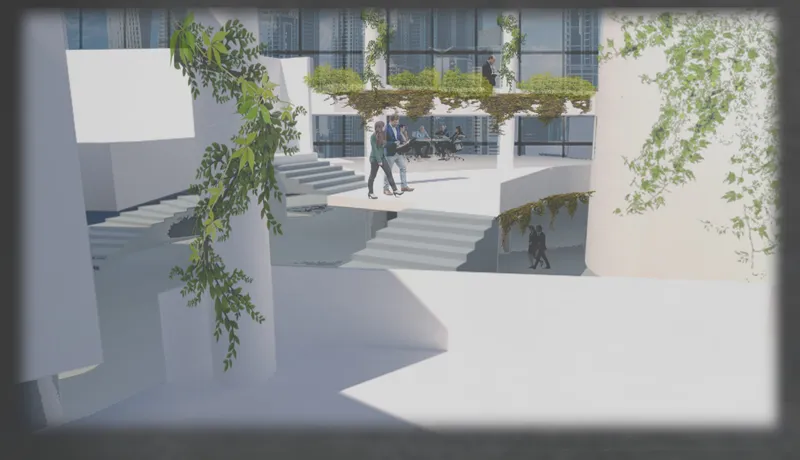
The sunlit courtyard rendering is where the project's ecological ambitions become spatial. Stepped planters cascade greenery across multiple levels, and figures populate the terraces at various heights, suggesting that these are not decorative garden beds but genuinely occupied public zones. Light pours into the space from above, filtered through the building's responsive skin of aluminum panels and retractable cloth materials that adapt based on sun exposure. The result is an interior climate that feels both sheltered and open, a difficult balance to achieve in Dubai's extreme heat.
The vertical gardens are not afterthoughts bolted onto a conventional floor plan. They are woven into the circulation, creating what the designers describe as a dynamic layering of public space that can be explored from both inside and out. Nature here is structural, programmatic, and atmospheric all at once.
A Perforated Bridge Connecting Towers and Transit
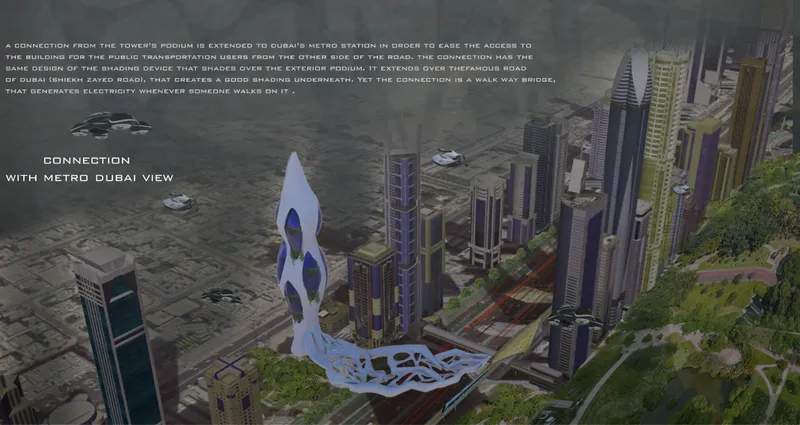
Seen from above, the white perforated bridge structure reads as both connective tissue and urban landmark. It links the tower to the surrounding dense skyline, reinforcing the project's insistence that a vertical city cannot function in isolation. The perforation pattern does double duty: it allows wind and light to pass through, reducing structural load while creating a distinctive visual identity against the flat rooftops below. The bridge's connection to the metro system is the project's most pragmatic move, anchoring a speculative vision to an existing piece of urban infrastructure.
Retail Concourse as Green Interior Urbanism
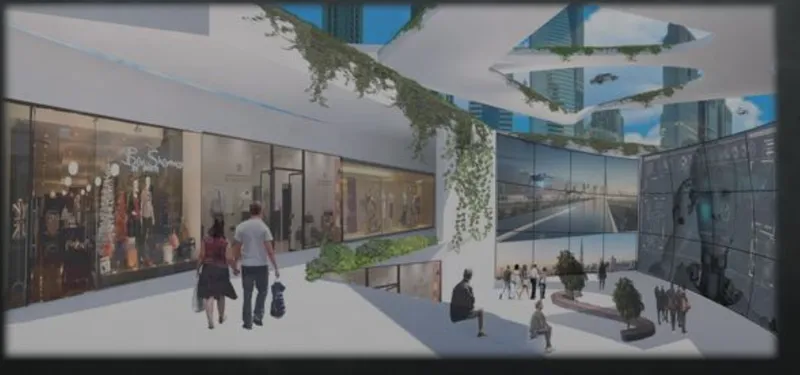
The interior view of the multi-level retail concourse shows overhead greenery hanging above pedestrians as they move through the space. It's a deliberate inversion of the typical Dubai mall experience, where conditioned air and artificial lighting dominate. Here, the planting is integrated into the ceiling structure, softening acoustics and air quality while signaling a different kind of commercial environment. Multiple levels are visible, reinforcing the densified model that stacks mixed-use programs vertically for efficiency and accessibility.
Flying car parking platforms, visible at various levels of the tower in other views, feed directly into zones like this one: office-specific landing areas and mixed-use inner parking decks transition seamlessly into inhabited space. The designers are betting that future mobility will demand exactly this kind of spatial flexibility, where arriving by air is as mundane as stepping off an escalator.
Why This Project Matters
Green Eye Vision could easily be dismissed as science fiction, but its value lies in the seriousness with which it treats speculative technology as a design driver rather than a marketing gimmick. The flying car platforms are not ornamental; they shape floor plans, circulation, and structural logic. The energy-generating pedestrian bridge is not a footnote; it redefines the tower's relationship to the city's transit network. Each futuristic element has a spatial consequence, and that discipline elevates the project beyond mere rendering spectacle.
For Cece, Hajjaj, and Alsharif, the project is also a provocation aimed at Dubai's own stated ambitions. If the city is serious about its 2050 sustainability agenda, what does that look like at the scale of a single building? Green Eye Vision answers with a tower that is equal parts vertical farm, transit hub, solar power station, and neighborhood. It may never be built in this form, but it offers a coherent framework for thinking about what density, ecology, and mobility could become when they are designed as a single integrated system.
View the Full Project
About the Designers
Designers: Alessandro Cece, Ayda Hajjaj, Farah Abbas Moh'd Hashim Alsharif
Enter a Design Competition on uni.xyz
uni.xyz runs architecture and design competitions year-round that reward proposals with spatial conviction and real site intelligence.
Project credits: Green Eye Vision by Alessandro Cece, Ayda Hajjaj, Farah Abbas Moh'd Hashim Alsharif.


Popular Articles
Popular articles from the community


Tsunami Convergenics: Turning Catastrophic Ocean Forces into Underwater Housing Infrastructure
A speculative underwater settlement off the coast of Onagawa, Japan, treats tsunamis and typhoons as energy sources rather than threats.
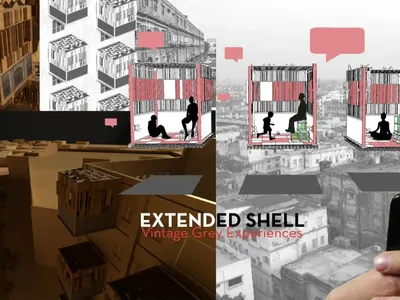
Extended Shell: Retrofitting Kolkata's Balconies as Living Urban Thresholds
A modular retrofit system recovers the social and environmental intelligence of Kolkata's historic verandas for contemporary Park Street residents.

Cloaked Colonization: A Mobile Underwater Habitat That Moves Like a Fish
Micah Abaya's shortlisted EHC Pacific entry reimagines ocean settlement as a dispersed network of self-sustaining architectural organisms.

Singing Woman: An Opera House That Performs Before the Curtain Rises
Ovidiu Cristian Pavel's conceptual opera house translates Estonia's choral identity into a sculpted waterfront landmark facing the Baltic Sea.

Similar Reads
You might also enjoy these articles

Shakur's House: Exposed Brick as an Interior Organiser in a 168 m² Mashhad Residence
Brick moves indoors in this Mashhad residence, where masonry walls, glass partitions and teal planes sequence a compact home without closing it off.

Day and Night Park: A Time-Based Urban Newsstand in Beijing
A temporary urban newsstand in Beijing blending travel, light, and reading through poetic colors, compact form, and community-focused design.

Modernist Patio Renovation in El Masnou, Barcelona by Oliver Segura Arquitectura + Cebrià Arquitectura
Modernist patio renovation blending tradition and innovation with a movable pool, leveled floors, and Catalan materials in El Masnou.

Alto Residencial Coop: Cooperative Housing Development in Santiago de Compostela by Carbajo Barrios Arquitectos
A linear cooperative housing complex blending white volumes and perforated metal façades, enhancing community living, natural light, privacy, and urban integration.

Explore Future City Competitions
Discover active competitions in this discipline

Challenge to design locus for the upliftment of human rights

Design challenge to reuse E-waste
Comments (0)
Please login or sign up to add comments
No comments yet. Be the first to comment!