
Green Prison: A Self-Sustaining Mini-Town That Redefines Incarceration
Reinforced concrete, timber screens, and biometric security replace bars and fences in a rehabilitative correctional campus.


What if a prison were designed so well that nobody wanted to escape? That provocation sits at the center of Green Prison, a correctional facility reimagined as a self-sustaining mini-town. Instead of razor wire and concrete yards, the scheme proposes planted courtyards, vertical timber screens, swimming pools, libraries, and art spaces, all organized around the premise that architecture can actively rehabilitate rather than merely confine.
Designed by Kirill Sidorenko, Liza Simpson, and Daniel Evans, the project is a shortlisted entry for Switching Prisons. The team argues that prison architecture is a mirror of society's attitude toward its incarcerated population, and that shifting the physical environment can shift the culture of punishment toward one of positive transformation.
Timber and Concrete: A Facade That Signals Dignity
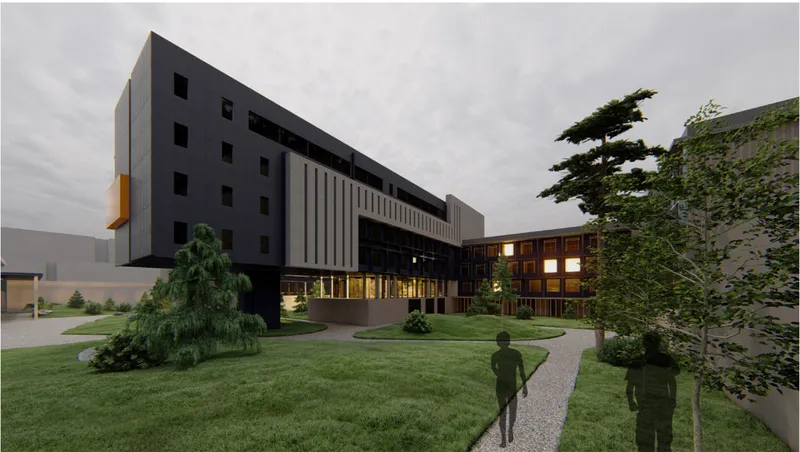
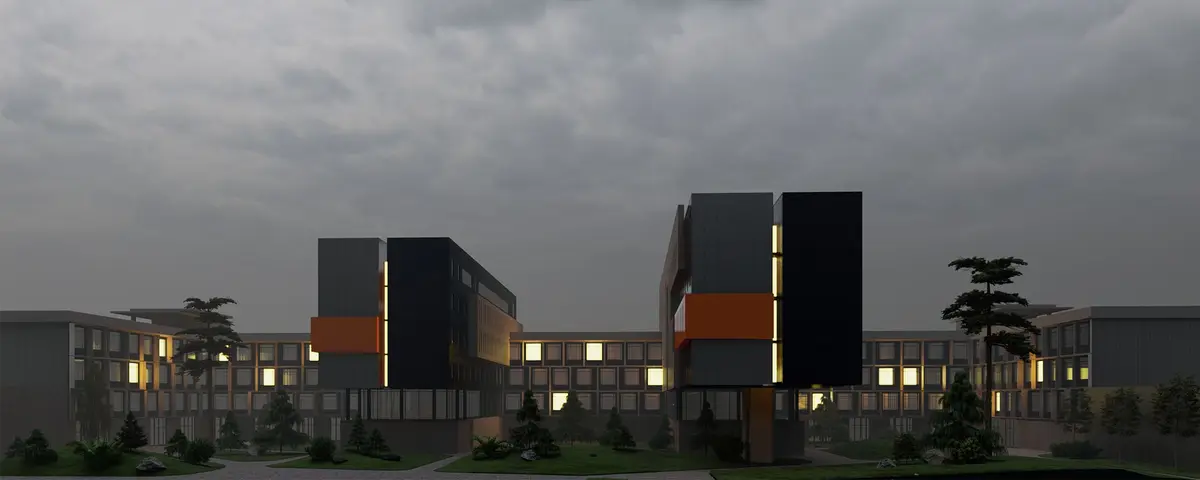
The building's exterior pairs dark cladding with a rhythmic vertical timber screen that filters light and softens the institutional character common to correctional architecture. Reinforced concrete provides the structural backbone, keeping construction costs down, while plaster and wood strip finishing lift the aesthetic far beyond the utilitarian norm. At dusk, the timber screen glows from interior lighting, giving the facade a lantern-like quality that reads more as a cultural building than a place of detention.
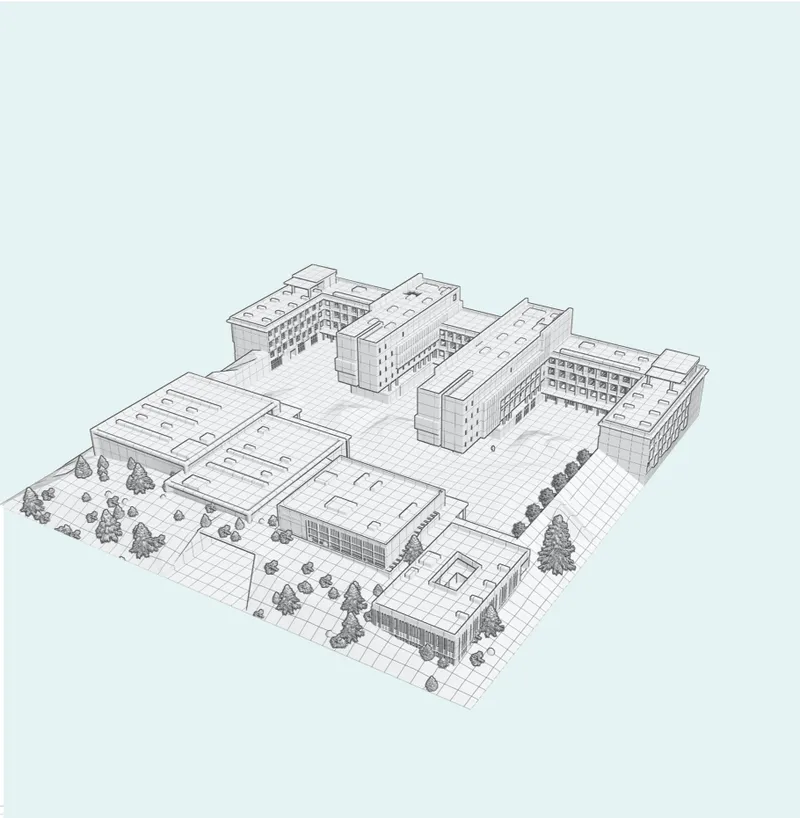
An axonometric drawing reveals the full extent of the campus: multiple building volumes set on a grid, separated by courtyards dense with planting and traversed by pedestrian pathways. The layout reads like a small neighborhood, not a compound. Green space is not decorative filler here; it is integral to the concept of a "green island of salvation" where daily routines include walking, reflection, and contact with nature.
Courtyards as Social Infrastructure

Framed by evergreen trees, the main facade's illuminated timber screen creates a visible threshold between the secure interior world and the surrounding landscape. The designers use this screen not just for aesthetics but as a passive security layer: it allows daylight and ventilation while limiting sightlines, reducing the need for aggressive perimeter fencing.
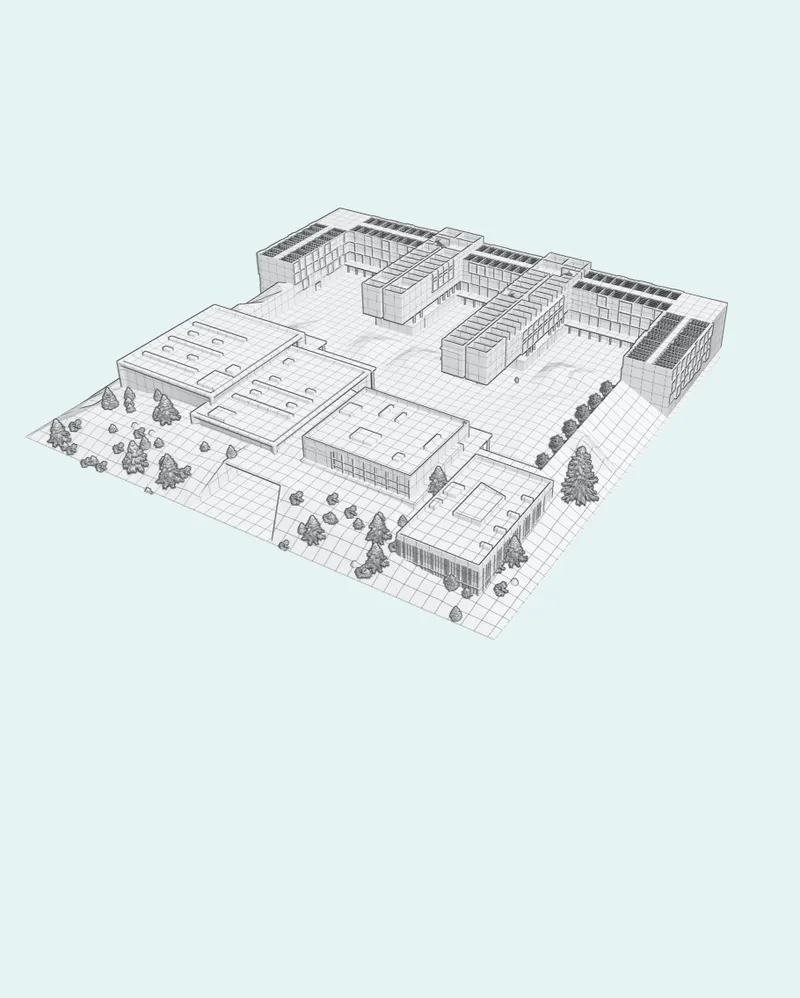
A second axonometric details how building volumes are arranged around shared courtyards planted with clusters of trees. These outdoor rooms serve multiple functions: exercise, socialization, and decompression. The spatial logic recalls campus planning in universities or co-housing developments, a deliberate strategy to normalize daily life and prepare residents for reintegration into society.
Biometric Gates and the End of Traditional Fences
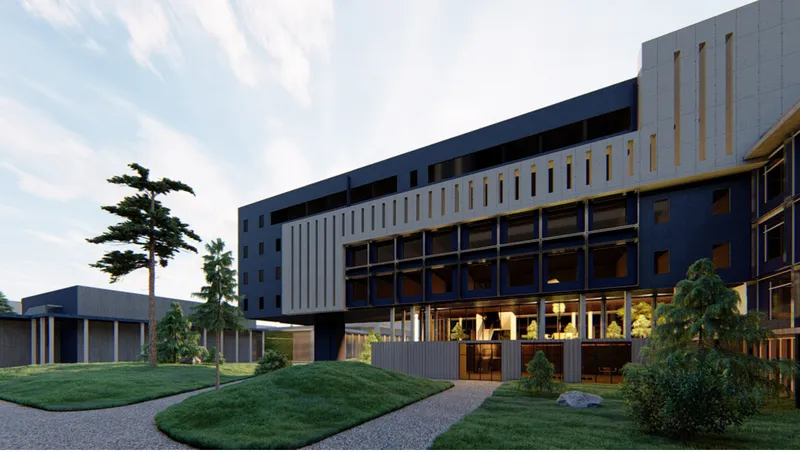
The main entrance features a glazed lobby tucked beneath a cantilevered upper volume, creating a generous threshold that avoids the oppressive airlocks typical of correctional facilities. Biometric identification replaces traditional barriers at all prison gates, an approach that streamlines movement while maintaining strict security. The cantilevered mass above communicates authority without resorting to hostile design language.
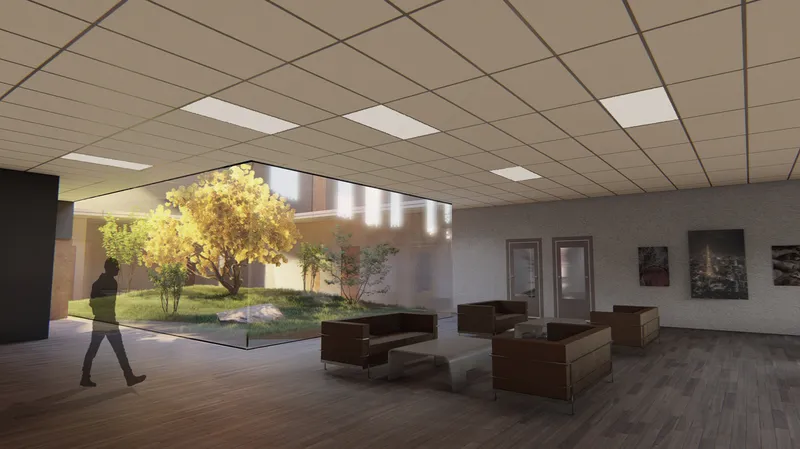
Inside, a lobby with a drop ceiling opens onto a glazed courtyard where a single tree anchors the view. A walking figure occupies the space, suggesting the kind of everyday normalcy the designers are chasing. The interior reinforces a human-centric philosophy: spaces are designed to support sports, creative expression, and education, with dedicated areas for swimming, art, and reading. Therapists and mentors are embedded in the program, accessible throughout each resident's correctional journey.
An Urban Campus, Not an Isolated Compound

The aerial view places the complex in an urban context, surrounded by existing development. Low-rise structures and planted courtyards allow the facility to sit comfortably alongside its neighbors rather than dominating them. This siting choice is deliberate: keeping correctional facilities within the urban fabric, rather than banishing them to remote locations, supports the rehabilitation narrative by maintaining proximity to the communities residents will eventually rejoin.
Why This Project Matters
Green Prison takes the position that architecture is not neutral in the process of incarceration. Every material choice, from the timber screens to the reinforced concrete frame, and every spatial decision, from the courtyard clusters to the biometric gates, carries a message about how society values the people it confines. By designing a place that prioritizes rehabilitation, employment readiness, and mental health support, the team challenges the assumption that punishment and deprivation are the only tools available to correctional systems.
What makes this entry compelling within the Switching Prisons brief is its pragmatism. The designers do not propose fantasy; they propose cost-effective construction, smart security, and spatial programs grounded in established rehabilitation research. The result is a correctional campus that looks forward, treating incarceration as a temporary condition to be resolved rather than a permanent identity to be reinforced.
View the Full Project
About the Designers
Designers: Kirill Sidorenko, Liza Simpson, Daniel Evans
Enter a Design Competition on uni.xyz
uni.xyz runs architecture and design competitions year-round that reward proposals with spatial conviction and real site intelligence.
Project credits: Green Prison by Kirill Sidorenko, Liza Simpson, Daniel Evans Switching Prisons (uni.xyz).


Popular Articles
Popular articles from the community


Jaramillo Van Sluys Arquitectura and Urbanismo Turn a Demolished Registry Lot in Quito into an Orchard Plaza
In Quito's Centro Histórico, a 2,800 m² plaza exposes the San Agustín convent wall and redraws its lost Augustinian orchard in volcanic stone.

LT2A and OPEN Architectes Thread a Brick and Glass High School Through a Wooded Belgian Campus
In Braine-l'Alleud, a 3,000 m² wing for Collège Cardinal Mercier pairs pale brick with a glazed colonnade, deferring to a small chapel and a dense wood.

Architekt Andreas Gruber Scatters 23 Dark Timber Chalets Across a South Tyrolean Forest Edge
In Molini di Tures, Amonti Chalets breaks a resort into a hamlet of gabled timber houses, with parking, storage and services pushed into the slope.

Cube Design Draws an Ecological Corridor Between Two Shenzhen Hills with the Nankai Building
Beside Shenzhen's container docks, the Nankai Building pairs stacked balconies with a climbing green screen to connect two hillsides across its height.

Similar Reads
You might also enjoy these articles


Vereda Arquitetos Renovates a 40-Square-Meter Apartment Inside Niemeyer's Copan Building
A compact unit in São Paulo's most iconic residential tower gets a material overhaul that pairs exposed concrete with bold blue Formica.

Shakur's House: Exposed Brick as an Interior Organiser in a 168 m² Mashhad Residence
Brick moves indoors in this Mashhad residence, where masonry walls, glass partitions and teal planes sequence a compact home without closing it off.

Day and Night Park: A Time-Based Urban Newsstand in Beijing
A temporary urban newsstand in Beijing blending travel, light, and reading through poetic colors, compact form, and community-focused design.

Modernist Patio Renovation in El Masnou, Barcelona by Oliver Segura Arquitectura + Cebrià Arquitectura
Modernist patio renovation blending tradition and innovation with a movable pool, leveled floors, and Catalan materials in El Masnou.

Explore Switching Prisons Competitions
Discover active competitions in this discipline

Challenge to design locus for the upliftment of human rights

Design challenge to equip cities with modern furniture

Design challenge to reuse E-waste
Comments (0)
Please login or sign up to add comments
No comments yet. Be the first to comment!