
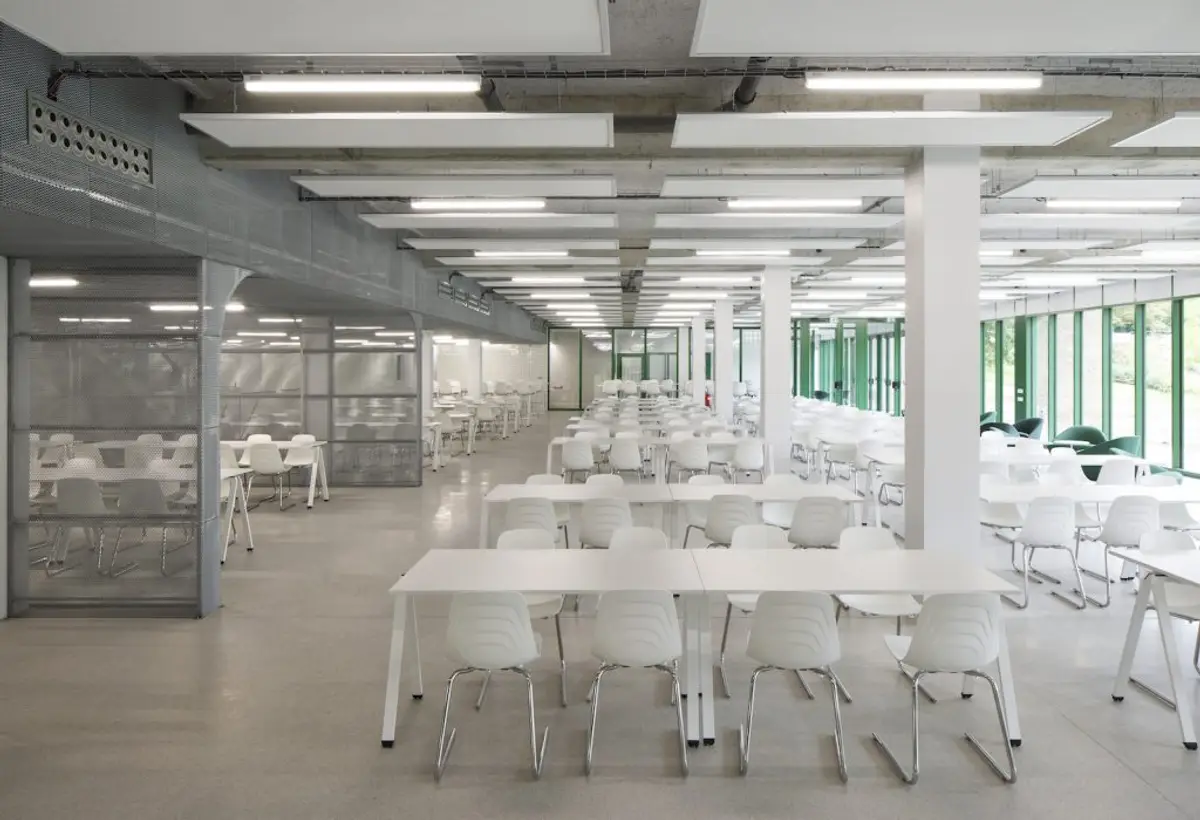
Grispello and Lebeau prioritize the economy of materials and bas-reliefs to create tactile qualities in their work
This allows them to create more with less, and results in a more textured and interesting finish

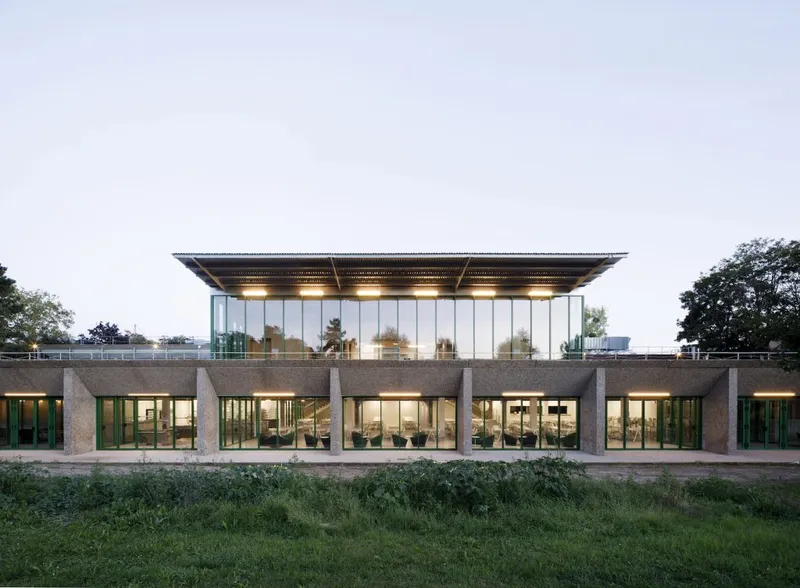 We are focusing our interest on the production rather than the sum of the building,’ says Carlo Grispello, co-founder of Graal Architecture. In their 2021 university cafeteria in Cergy‑Pontoise, this means retaining the integrity of an existing building and adding to it with an economy of means Credit: Clément Guillaume
According to Carlo Grispello, co-founder of Graal Architecture, we are currently facing a pivotal moment in which we must reconsider the traditional methods of resource production and usage. Founded in 2011 by Nadine Lebeau, Graal is a French architecture company that focuses on minimizing material usage while also considering the needs of the surrounding community and environment in each project.
 Its distinctive ‘visor’ is held up by internal beams rather than columns Credit: Clément Guillaume
Grispello cites the pandemic, climate crisis, and war in Ukraine as events that have brought attention to the way in which things are manufactured. For Graal, this means prioritizing resourcefulness above aesthetics.
This focus on sustainability is so important to Graal that even decorative elements are designed with practicality in mind. For example, the pinkish-grey concrete waves on the facade of the leisure centre in Athis-Mons, completed in 2019, serve both as a design feature and to evenly distribute the weight of the building while using minimal material.
 This opens up the interior to the surroundings and floods it with natural light Credit: Clément Guillaume
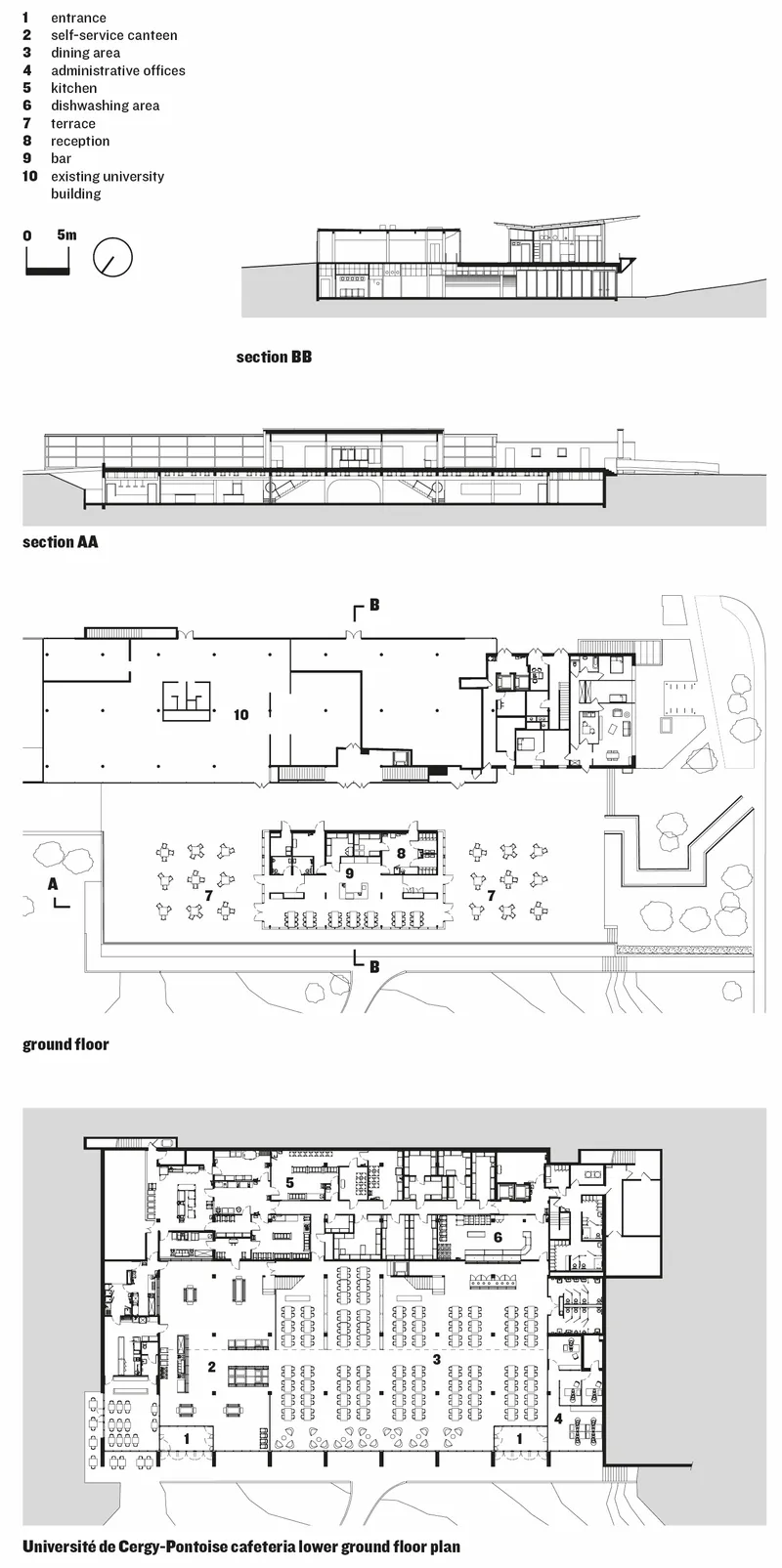
Similarly, the distinctive roof of the university cafeteria in Cergy-Pontoise, completed in 2021, is shaped like a visor and uses less material than if it were supported by columns. Instead, thick wooden beams on the interior of the building hold the roof in its angled position, resembling an opened envelope.
The cafeteria is a structure built on top of a low, rectangular building, with strips of tall windows. The design of the extension was intended to create a connection with the building below and the surrounding park, according to Grispello. The extension features floor-to-ceiling windows that bring the natural surroundings inside and gives the space a glowing, leafy appearance.
As part of their design process, Graal creates bas-reliefs, which are raised collages that combine elements of drawings and models. Grispello explains that these bas-reliefs help them to make decisions throughout the design process because they allow for a deeper understanding of how materials can create a sensation. The offices of Graal are decorated with boards featuring bas-reliefs made from a variety of materials, such as concrete and wood, which the architects can reference and use in their work.
The Graal bas-reliefs were utilized to visualize how light would flow over a block of social housing units in Paris, which is located on a narrow strip of land between an old railway station and a pedestrian street. The honey-coloured development has a matte finish similar to a wrapped package, and the top of the building resembles three steps on a staircase, lowering the roofline to prevent blocking the sun. "It is important to ensure that our buildings do not negatively affect the quality of life for existing residents," says Grispello. "New buildings are a negotiation with the people who already live in the neighbourhood."
References (1)

Popular Articles
Popular articles from the community


Cloaked Colonization: A Mobile Underwater Habitat That Moves Like a Fish
Micah Abaya's shortlisted EHC Pacific entry reimagines ocean settlement as a dispersed network of self-sustaining architectural organisms.

Opera by the Sea Estonia: Three Shells Dissolving Architecture into Tallinn's Coastline
A winning opera house proposal replaces monumental form with interconnected shells that blur the boundary between building, park and Baltic Sea.

Temporary Home for Dogs: A Reversed Zoo Rethinks Animal Shelter Architecture
In Bucharest, a sinuous corridor and freed landscape flip the logic of containment, designing a shelter that works to make itself unnecessary.

The Amber Palace Opera: A Geological Fiction Surfaces on Tallinn's Baltic Waterfront
Pierre Brillard reimagines a Baltic legend as a public landscape, opera house, and waterfront promenade rooted in Tallinn's coastal identity.

Similar Reads
You might also enjoy these articles
116 Rokeby Building, Collingwood
Sustainable Collingwood office building featuring double-skin façade, natural ventilation, rooftop amenities, and carbon-neutral design focused on wellbeing and longevity.
Contemporary Apartment Renovation in Spain: RV House by BIAN Opens Up to the Sea
A minimalist 1930s apartment in Santander is transformed into a flexible, sea-facing home through contemporary Spanish renovation.
3 Marías House: A Contemporary Mediterranean Courtyard Retreat by Bajet Giramé + Burckhardt
Mediterranean courtyard home blending traditional architecture with modern design, terracotta flooring, flexible interiors, sustainable climate strategies, and garden integration.
NZ10 Apartment by auba studio: Adaptive Reuse in Palma de Mallorca
Adaptive reuse apartment transforms bakery into light-filled home with patios, privacy layers, and wood interiors enhancing urban living experience.

Explore Interior Design Competitions
Discover active competitions in this discipline


Challenge to design luxury tourism on rails

Challenge to reimagine the Iron Throne

Photograph architecture without architects

VR headsets Storefront design competition
Comments (0)
Please login or sign up to add comments
No comments yet. Be the first to comment!