
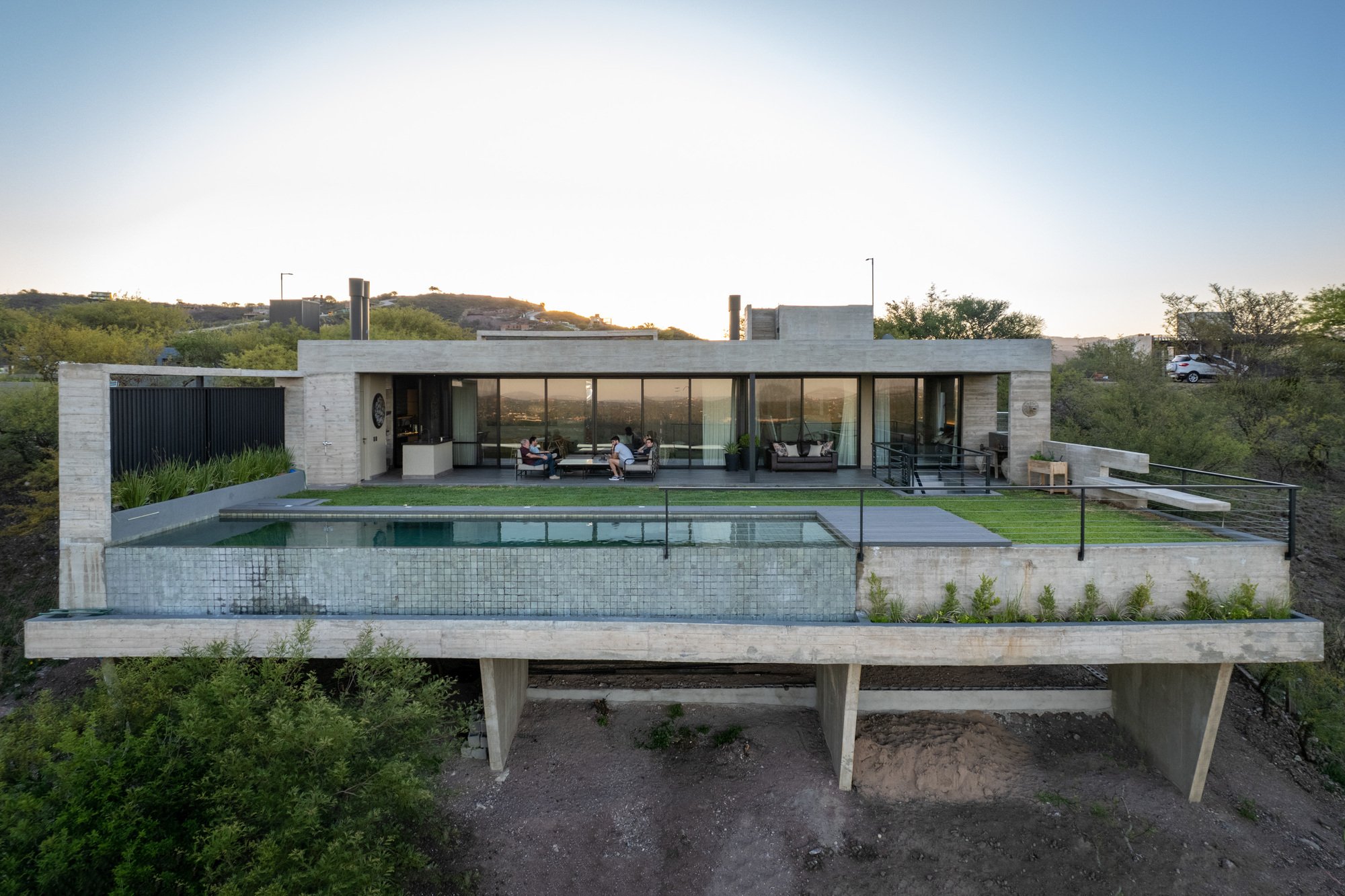
Grupo Eisen Suspends a Concrete Platform over an Argentine Hillside to Frame City Views
A single-level house at the foot of the Sierras Chicas near Córdoba floats above native scrubland, trading terraced slopes for a cantilevered plane.

The conventional response to a sloping lot is terracing: carve the hillside into steps, stack program vertically, and accept that half the rooms will face a retaining wall. Grupo Eisen, led by architects Mariano Alvarez and Martín López Bravo, rejected that formula entirely for PMV House in La Calera, Argentina. Instead they extended a single concrete platform out from the eastern slope of the Sierras Chicas, suspending habitable space above the natural ground while preserving the native vegetation beneath. The result is a 250 square meter house that reads as an apartment in plan but delivers panoramic views of Córdoba and the green plain that stretches east toward the horizon.
What makes this project worth studying is the clarity of its structural proposition. A reinforced concrete frame, stiffened by vertical screens, holds a single slab in the air. Everything the client asked for, including living spaces, bedrooms, a gallery, a pool, and a garden, sits on that one level. There is no split-level compromise, no sunken living room, no stair-heavy section. The ground slopes away beneath the house and the program stays horizontal, which means every room opens onto a continuous longitudinal gallery with uninterrupted sightlines to the landscape.
The Suspended Platform
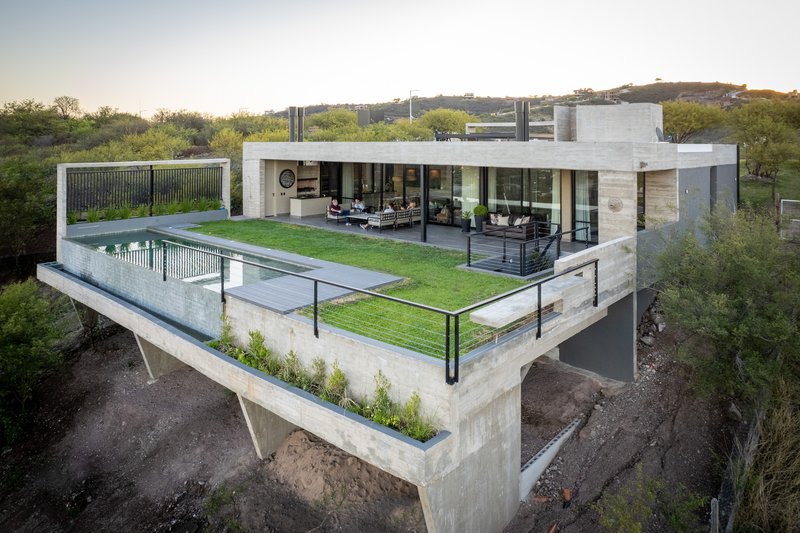
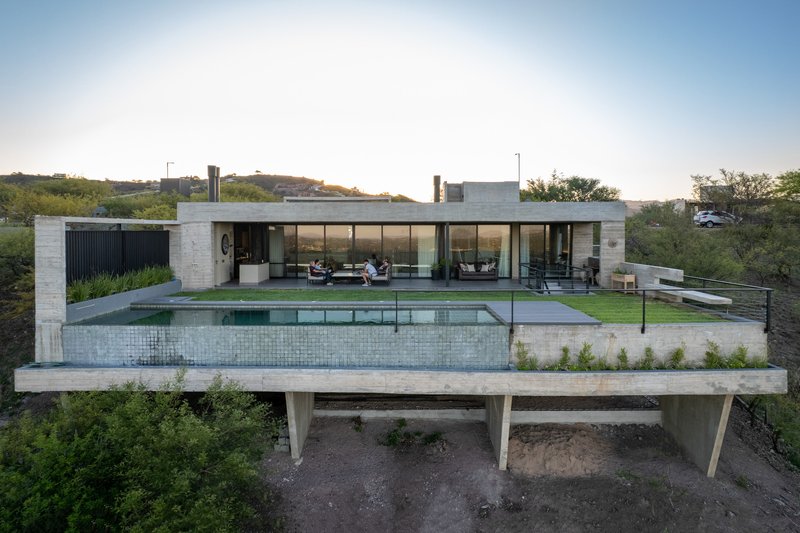
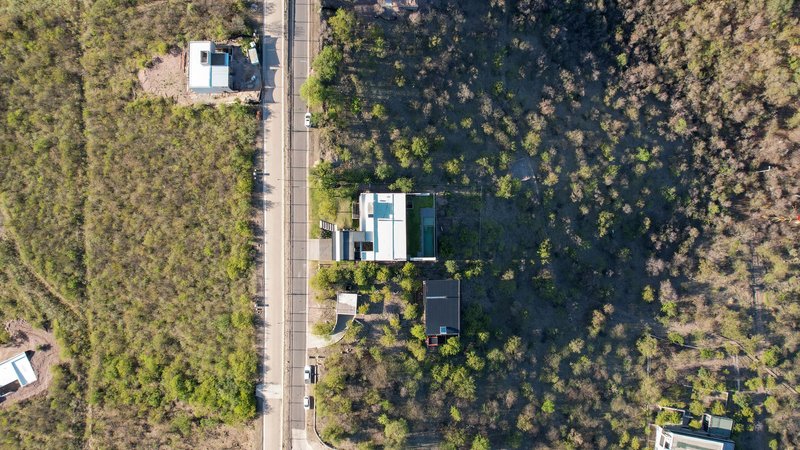
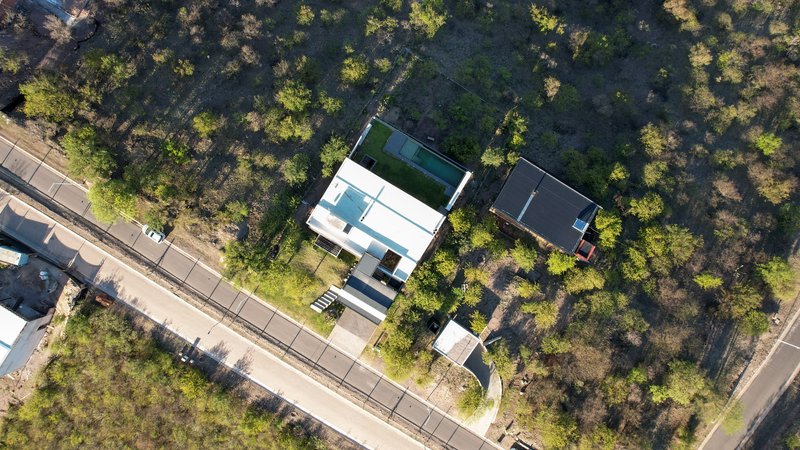
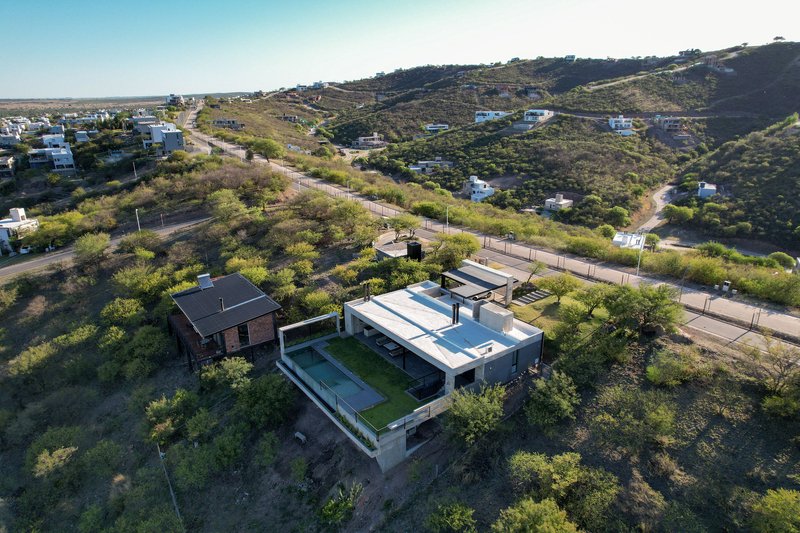
Seen from downhill at dusk, the house reveals its structural logic. The platform rests partly on leveled natural ground at the uphill side and partly on a suspended concrete structure that cantilevers over the slope. The native scrubland passes beneath the slab undisturbed, so the building's footprint on the earth is smaller than the plan it supports. Drone views confirm how the rectangular volume sits lightly within a sparse field of trees and hillside roads, an elevated object rather than an excavated one.
The decision to suspend rather than terrace has environmental merit as well. Stormwater continues to flow along its natural path, root systems remain intact, and the microclimate underneath the slab stays shaded and cool. It is a strategy that treats topography as something to hover above rather than something to reshape.
Arrival and Entry Sequence
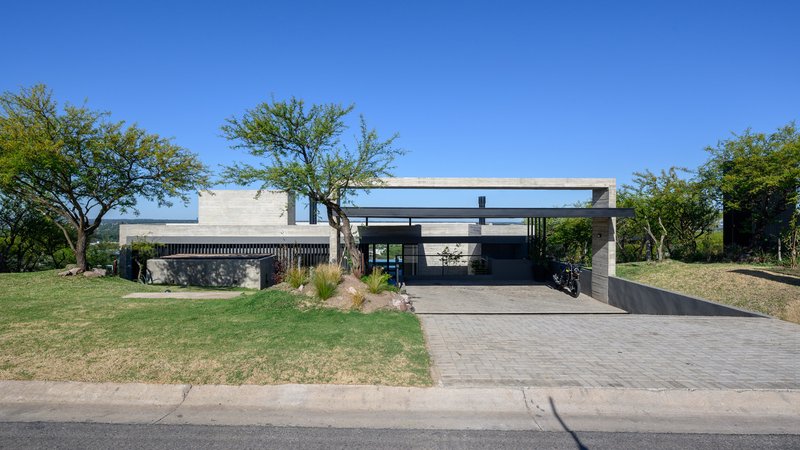
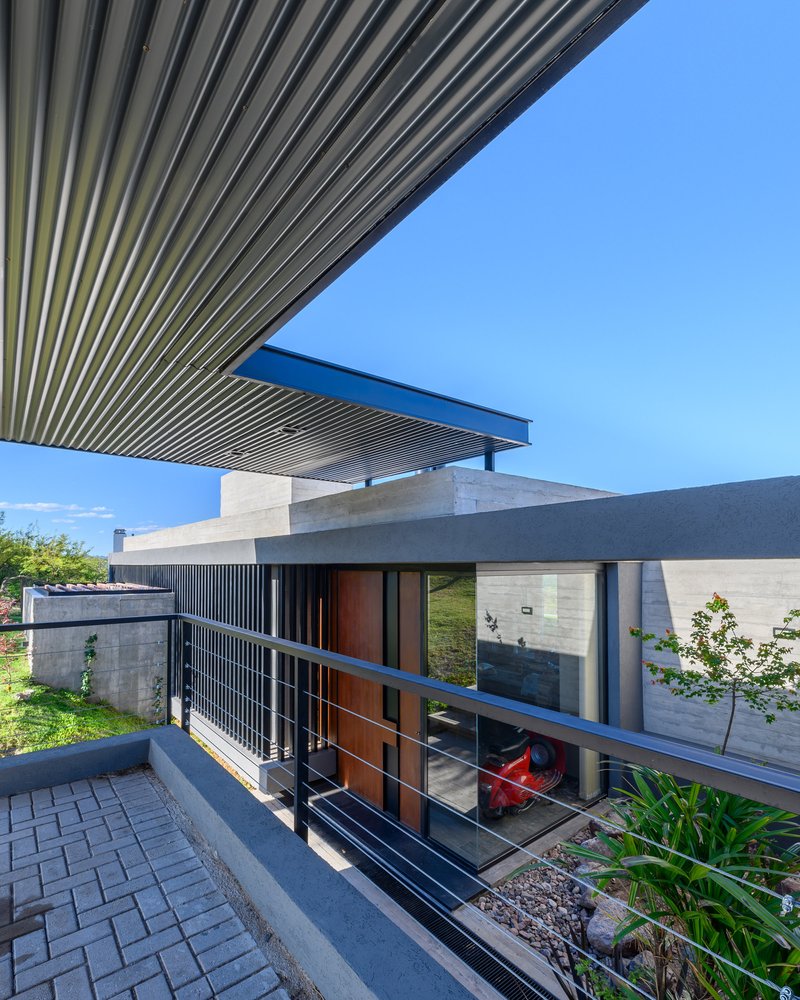
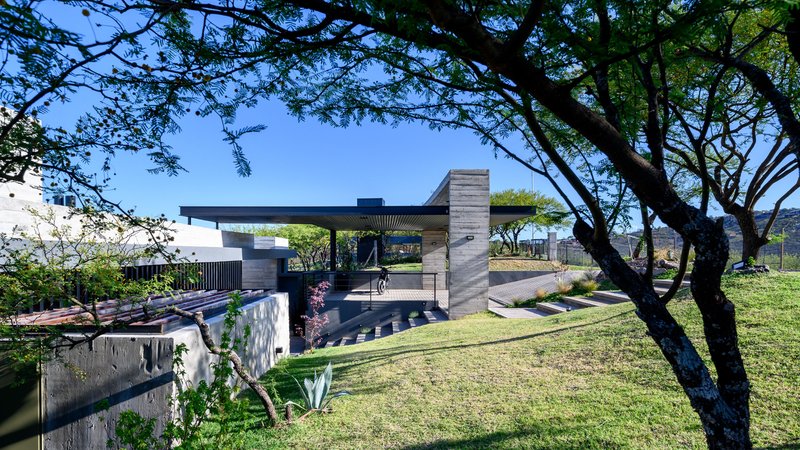
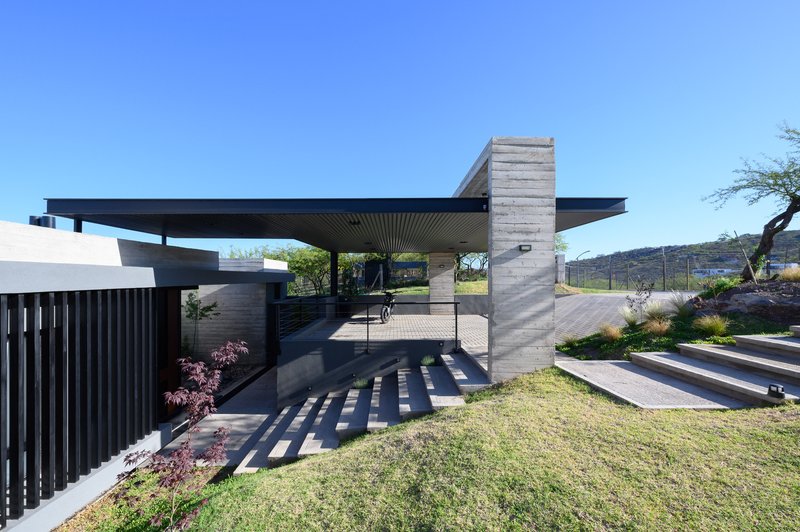
From the street the house presents a restrained face: flat roof planes, board-formed concrete columns, and a vertical slat screen that filters views and light. The entry approach is a stepped pathway that moves beneath a cantilevered roof, compressing the visitor's field of vision before releasing it into the interior. Mature trees frame the facade and soften the concrete, while planted beds along the driveway mediate between paved surface and landscape.
The slatted canopy over the glass-fronted entry does double duty. It shades the glazing from high summer sun while still admitting low winter light, a passive strategy that avoids mechanical complexity. The canopy also establishes the material palette early: timber, concrete, and steel, each honest about its role.
The Longitudinal Gallery
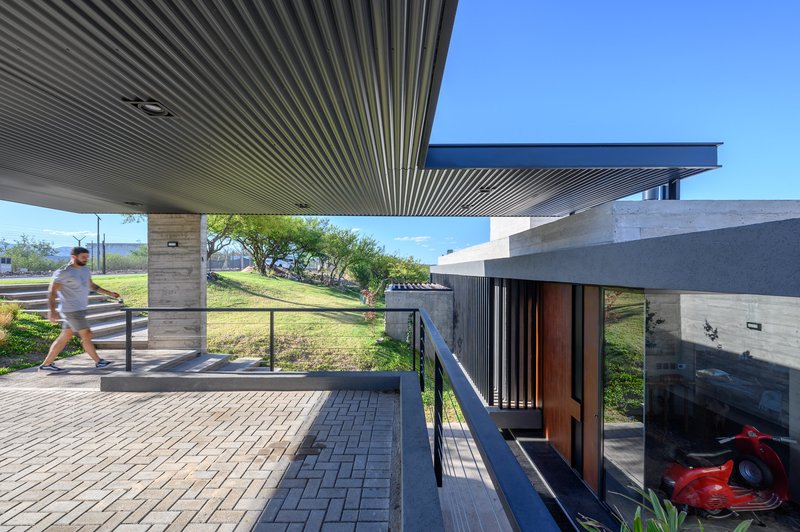
A covered gallery runs the length of the house on the view side, acting as a buffer between interior rooms and the open terrace. Board-formed concrete columns support a corrugated metal soffit, and a stone chimney anchors one end of the outdoor living area. The gallery is wide enough to function as a room in itself, and in the mild climate of Córdoba's foothills it will likely be the most inhabited space in the house for much of the year.
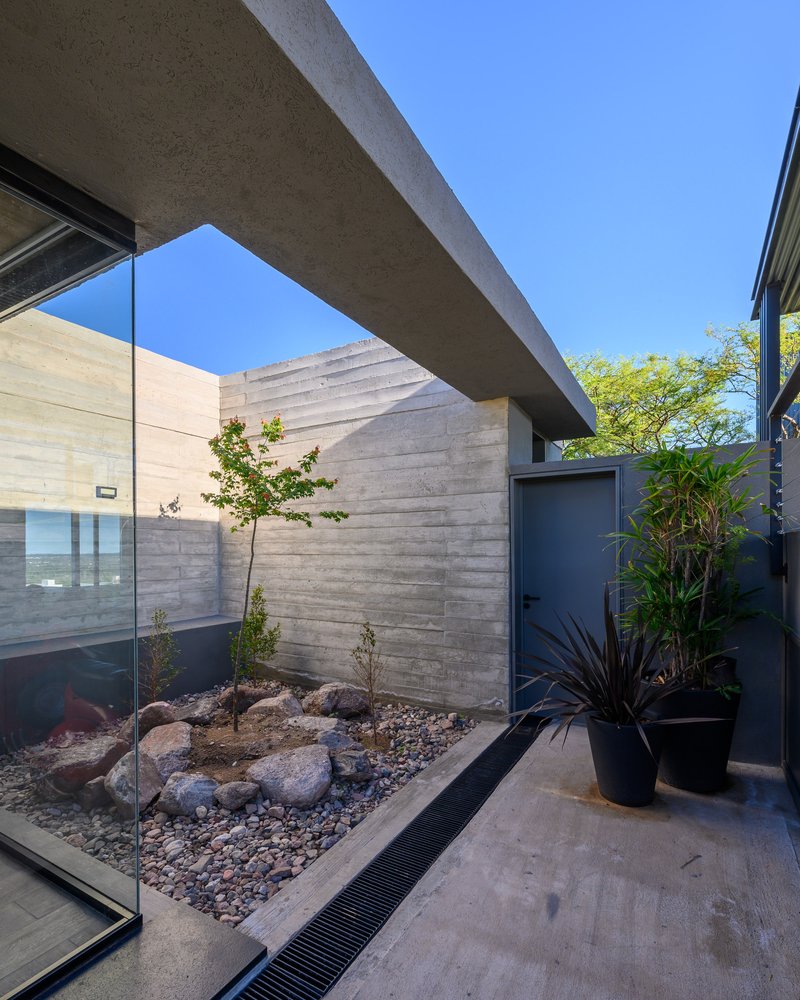
A board-formed concrete bridge spans a planted courtyard containing boulders and a young tree, connecting two volumes while admitting daylight and air into the wet areas below. These interior patios are not decorative gestures; they generate microclimates for the bathrooms and laundry room, drawing ventilation through the plan without relying on mechanical systems.
Open Living at Dusk
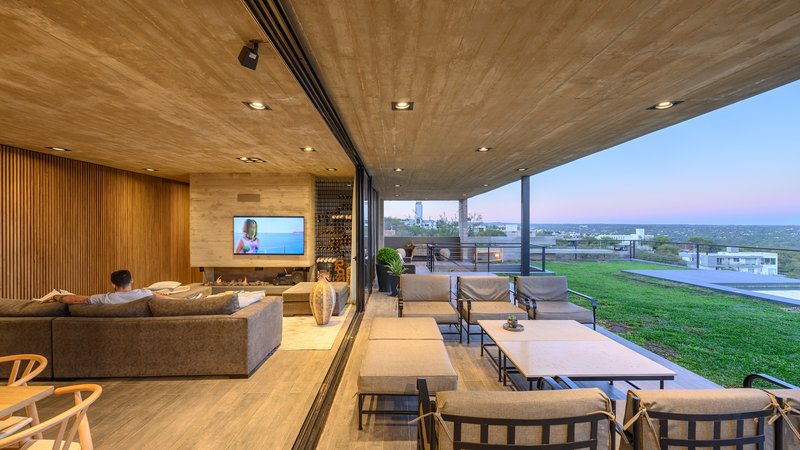
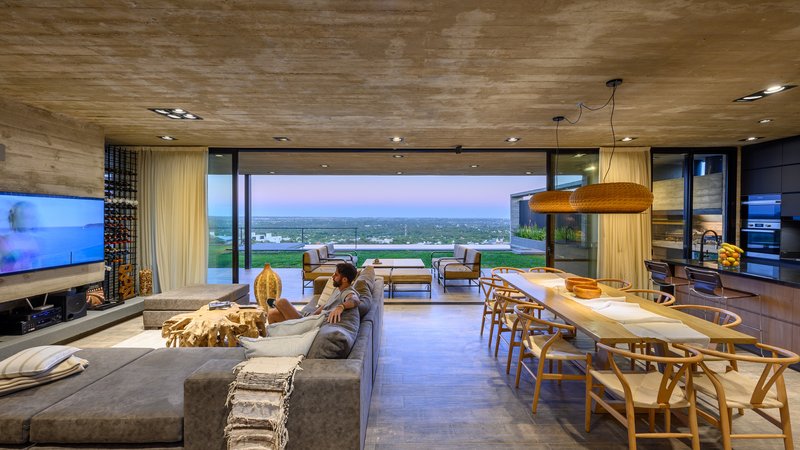
The living room, dining area, and kitchen merge into a single volume where timber-clad walls and a warm timber ceiling contrast with the raw concrete of the exterior structure. Floor-to-ceiling aluminum openings stretch wall to wall, erasing the boundary between inside and landscape. At dusk the effect is cinematic: the lawn glows green against a darkening sky, and the interior lighting turns the house into a lantern on the hillside.
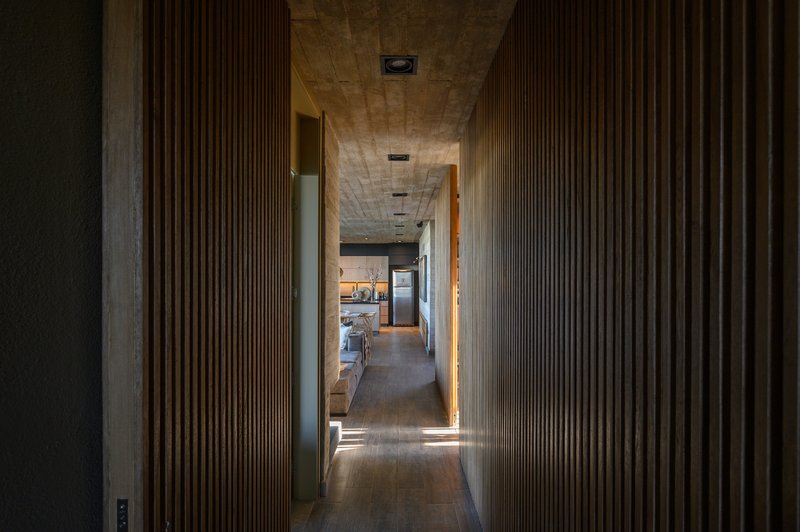
A corridor lined with vertical wood slats leads from the social zone toward the private bedrooms. The slat rhythm echoes the exterior screens and creates a visual continuity between public and private areas. Interior designer Roxana Piana kept finishes restrained, letting the architecture's material honesty carry the spatial mood rather than layering decoration over structure.
Pool Terrace and Rooftop Landscape
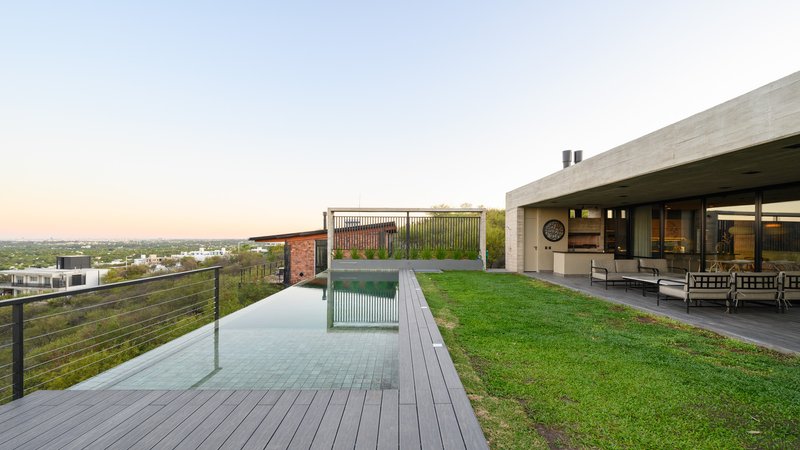
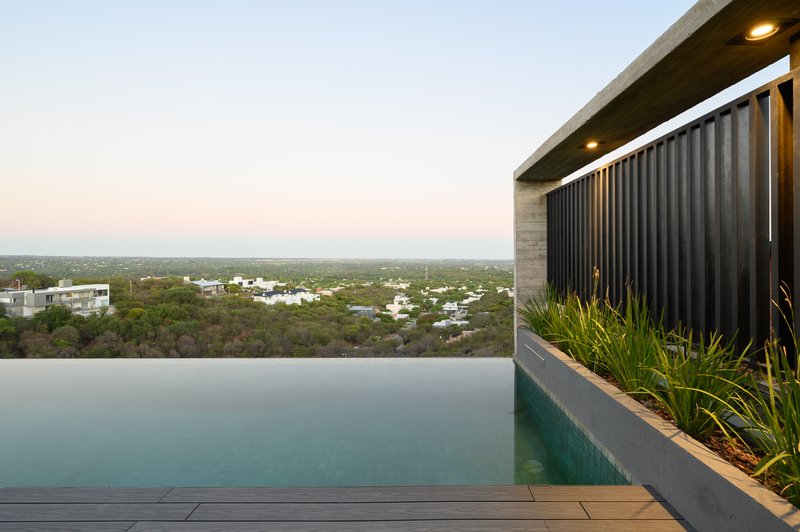
The rooftop level is divided into two zones: a lawn garden with timber deck and an infinity pool whose edge aligns with the distant hills. Vertical metal screens along the pool's perimeter offer wind protection and privacy from neighboring lots without blocking the panorama. The pool faces east to catch morning sun, a deliberate orientation that makes it usable before the afternoon heat sets in.
Top-down aerial images reveal the geometry clearly. A dark auxiliary volume anchors one side of the plan while the rectangular pool and lawn occupy the remaining open platform. The proportions are disciplined: no organic curves, no gratuitous cantilevers beyond what the program demands. The rooftop reads as a continuation of the landscape rather than a separate amenity, which is exactly the point.
Concrete, Timber, and Terrain
The material palette is deliberately narrow. Reinforced concrete handles all structural duties, and its board-formed finish gives every column and screen a directional grain that aligns with the timber ceilings and slat walls inside. Steel appears only where slenderness matters, in the canopy supports and pool screens. Glass fills the gaps between solid volumes, always stretching full height to maximize the connection between interior floor level and the horizon.
What distinguishes this palette from the generic "concrete box on a hill" trope is the relationship to terrain. The concrete is not a sculptural object dropped onto a flat site; it is a structural response to a specific slope angle and a specific view vector. The screens that stiffen the platform also define the spatial rhythm of the plan, so structure and architecture are inseparable.
Plans and Drawings
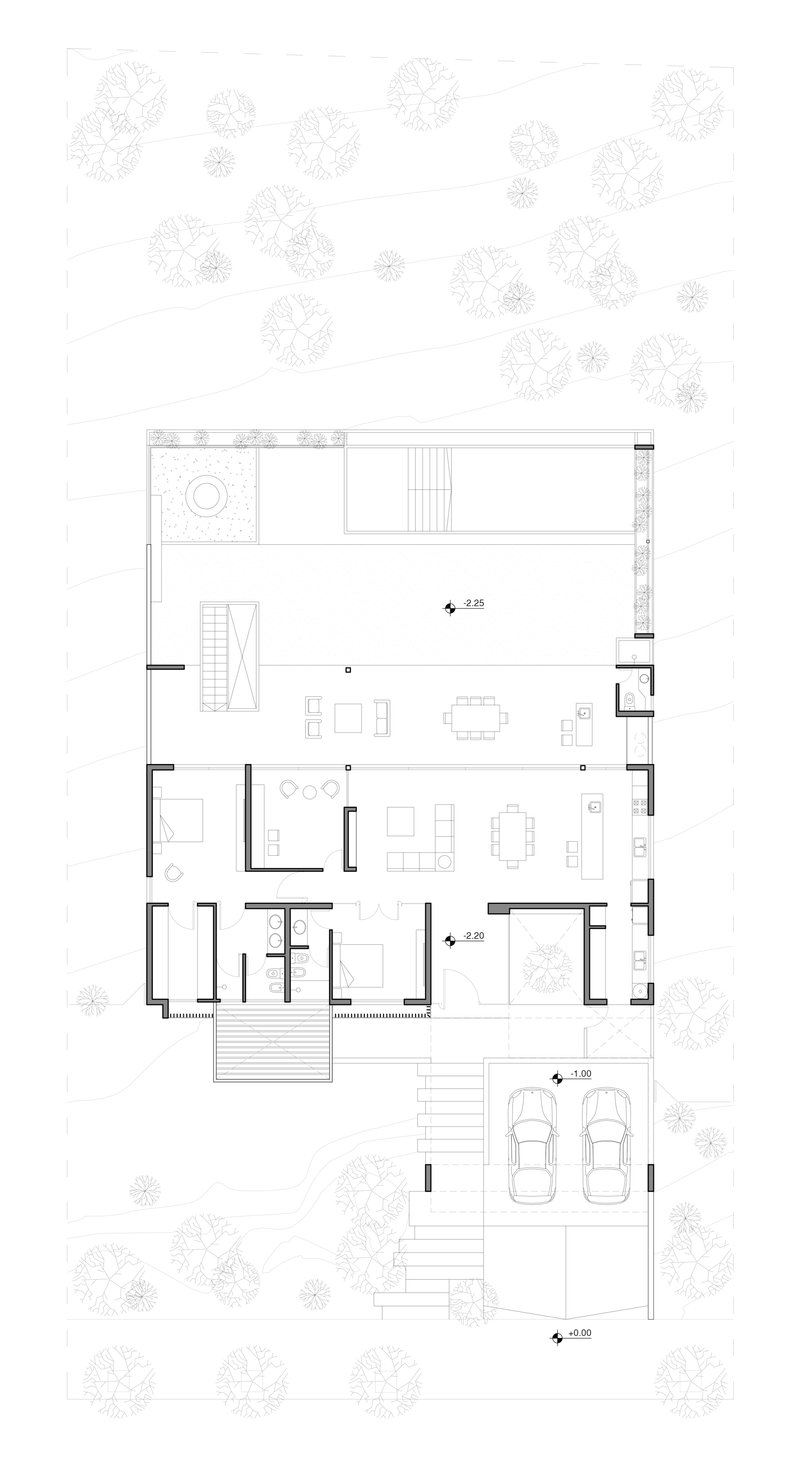
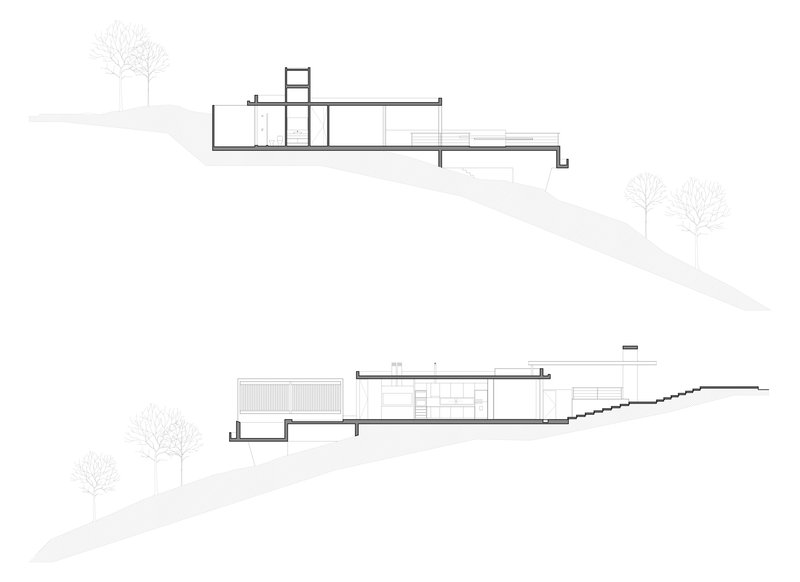
The floor plan confirms the simplicity of the organization. A succession of rooms opens onto the longitudinal gallery on the view side, while wet areas face interior patios on the opposite side. The carport sits at grade level, with the main living platform extending out over the slope. Section drawings make the suspended logic legible: the garage tucks beneath the platform at the lower end of the site, and the pool terrace sits atop the roofed volume, stacking three layers of program without ever requiring the occupant to climb more than a single flight.
The 1,182 square meter site accommodates 250 square meters of built area with generous margins. Trees shown on the plan correspond to existing specimens, reinforcing the claim that the design preserves rather than replaces the landscape. The section cuts are especially instructive: they show how the natural grade drops steeply beneath the slab, leaving a void that keeps the structure dry and the vegetation alive.
Why This Project Matters
PMV House is a useful counterargument to the reflexive terracing of hillside residential sites. By committing to a single elevated plane, Grupo Eisen eliminated retaining walls, reduced earthwork, preserved native plant communities, and delivered a plan with consistent floor-to-ceiling views in every habitable room. The trade-off is structural cost: suspending a concrete platform requires more reinforcement than cutting into a slope. But the spatial return on that investment, a house where every room faces the horizon and the landscape passes unbroken beneath your feet, is hard to achieve any other way.
For architects working on sloped sites in Latin America and beyond, this project offers a legible precedent. The decisions are readable in every photograph: suspend the slab, line the rooms along a gallery, stack the pool on top, and let the ground be ground. It is not a radical concept, but it is executed with enough discipline to prove that the strategy works at a modest domestic scale, not just in the large-span public buildings where it is more commonly seen.
PMV House by Grupo Eisen, led by architects Mariano Alvarez and Martín López Bravo, with interior design by Roxana Piana. La Calera, Córdoba, Argentina. 250 m², completed 2022. Photography by Gonzalo Viramonte.
About the Studio
Share Your Own Work on uni.xyz
If projects like this are the kind of work you want to make, uni.xyz is a place to publish your own, find collaborators, and enter design competitions.




Popular Articles
Popular articles from the community

PLATAFORMArq Folds a Concrete Roof Over the Portuguese Mountains in House #474
A 220-square-meter residence in Teixoso, Portugal, wraps board-formed concrete into an angular canopy that frames the Serra da Estrela foothills.
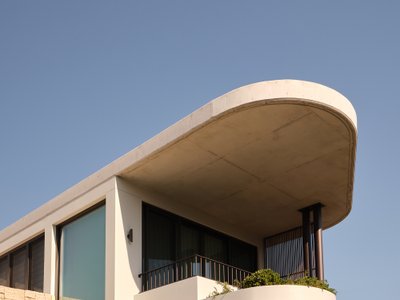
Stanton Architects Sculpts a Curving Family Home into Sydney's Inner West Fabric
Five Dock House uses cantilevers, curved concrete, and layered courtyards to carve out privacy on a tight suburban lot in Sydney.

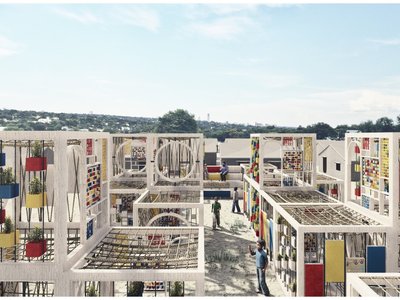
The Faith: Modular Architecture for Play, Learning, and Hope in Kutupalong Refugee Camp
A modular playground architecture project in Bangladesh where play, learning, safety, and hope rebuild childhood inside a refugee camp anew.
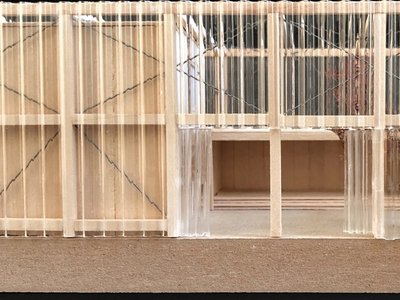
Kaffeebühnen: Coffee Shop Architecture Designed as a Civic Stage Between Vienna’s City and Park
Kaffeebühnen turns coffee shop architecture into a civic stage, linking Vienna’s park edge, urban life, warm timber yards, and coffee craft.


Similar Reads
You might also enjoy these articles
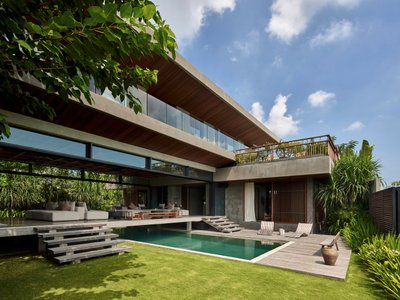
Freebird Residence by Alexis Dornier: A Tropical Modernist Sanctuary in Bali
Floating living pavilion above pool anchors H-shaped tropical villa, blending Japanese minimalism, sustainable strategies, lush landscape, and sculptural interiors.
127af Flips a Tiny Bagnolet Rowhouse Upside Down with a Handcrafted Roof Extension
A 55-square-meter terraced house on the edge of Paris gains a luminous upper living floor through lightweight timber and steel.
1.61 Design Workshop Wraps a 600-Square-Meter Café in Vietnam in Sculptural Burgundy Drama
Reden Café & Bistro pairs a helical staircase, mosaic floors, and deep red interiors to rethink Vietnamese hospitality space.

The Unbound Brain: A School Shaped by Cognitive Architecture
Cylindrical learning pods radiate like neurons from a central cortex, turning the floor plan into a spatial model of human thought.


Explore Residential Building Competitions
Discover active competitions in this discipline




The International Standard for Design Portfolios


The Global Benchmark for Architecture Dissertation Awards


The Global Benchmark for Graduation Excellence


Challenge to design mud housing for contemporary communities
Comments (0)
Please login or sign up to add comments
No comments yet. Be the first to comment!