
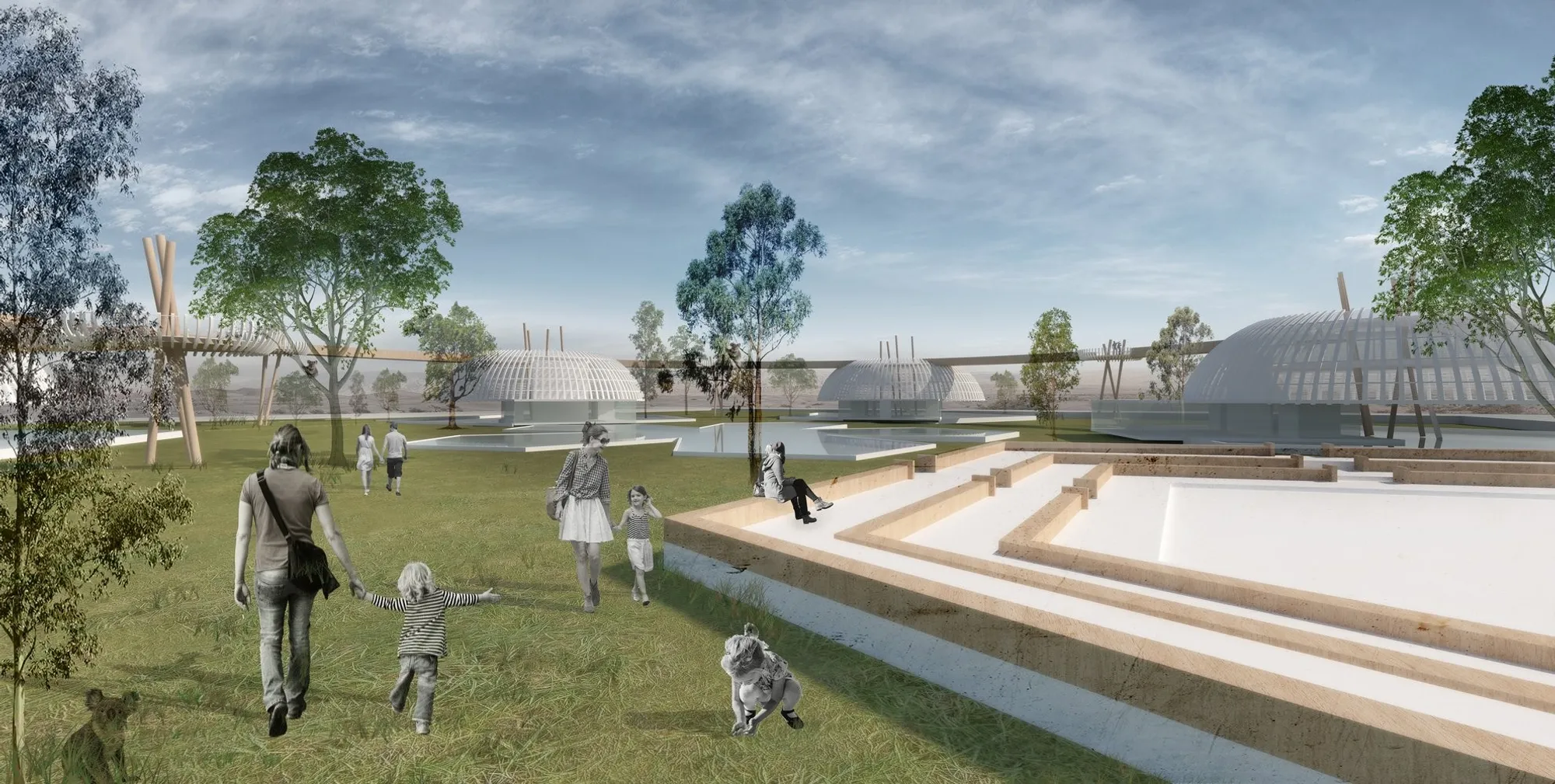
GumnHuts for Koalas: Sustainable Wildlife Architecture Rooted in Ecological Healing
An elevated wildlife rehabilitation architecture that reconnects humans, koalas, and nature through immersive ecological design.


Project by Dima AlMobarak
Shortlisted Entry of Haven 2020
In an era where climate change, urban expansion, and ecological destruction continue to threaten wildlife habitats, architecture is increasingly being called upon to serve purposes beyond shelter and aesthetics. GumnHuts for Koalas by Dima AlMobarak explores how sustainable wildlife architecture can become an active participant in ecological restoration, environmental education, and human connection with nature.
Set within the fragile ecosystem of Queensland, Australia, the proposal envisions a rescue and rehabilitation center for koalas designed not as a conventional institutional complex, but as a peaceful landscape of elevated structures, water bodies, catwalks, and communal spaces. The project transforms architecture into a medium of dialogue between species, creating a shared environment where humans and wildlife coexist without territorial conflict.
The proposal addresses one of Australia’s most urgent ecological concerns. Rapid urbanization, bushfires, and agricultural expansion have devastated koala populations and fragmented their natural habitat. Rather than imposing heavily on the landscape, the project introduces an architectural strategy that minimizes land occupation while maximizing ecological sensitivity.
Sustainable Wildlife Architecture Inspired by Nature
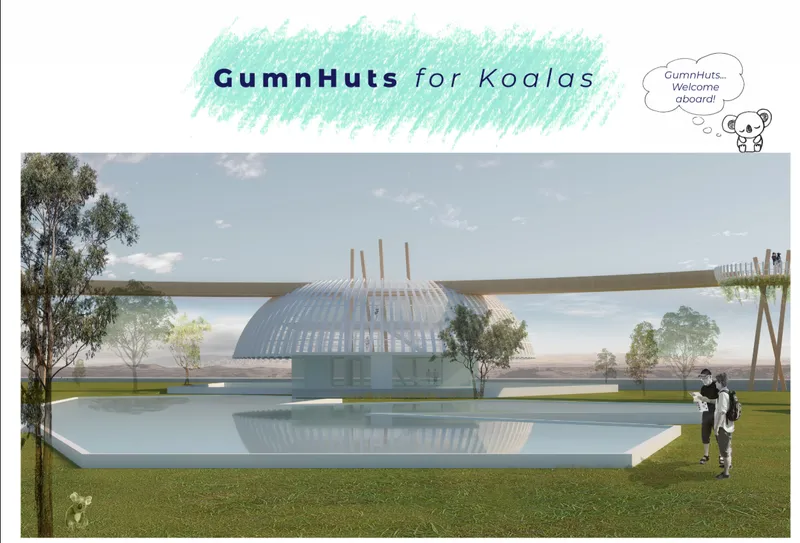
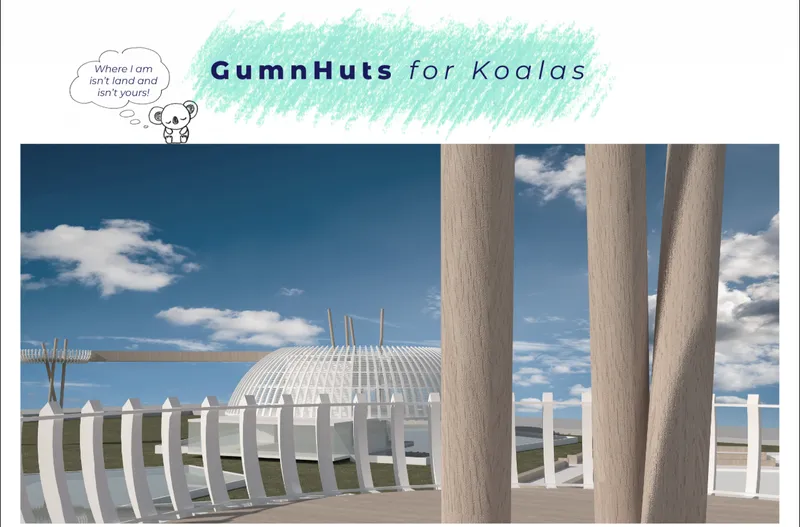
The central architectural language of GumnHuts for Koalas draws inspiration from the eucalyptus fruit, commonly known as the gumnut. This natural geometry becomes the foundation for the project’s dome-like structures, generating a formal identity deeply connected to the surrounding ecosystem.
The rounded forms create lightweight enclosures elevated above the ground plane, preserving the terrain beneath while establishing shaded, breathable environments for rehabilitation and community interaction. The project combines organic inspiration with contemporary architectural thinking, resulting in a visually soft and environmentally responsive composition.
The proposal also references Aboriginal artistic traditions and primitive shelter typologies, merging cultural memory with ecological design principles. Through these layered references, the architecture becomes both contextual and symbolic, reinforcing the relationship between people, land, and native species.
Designing Without Occupying the Land
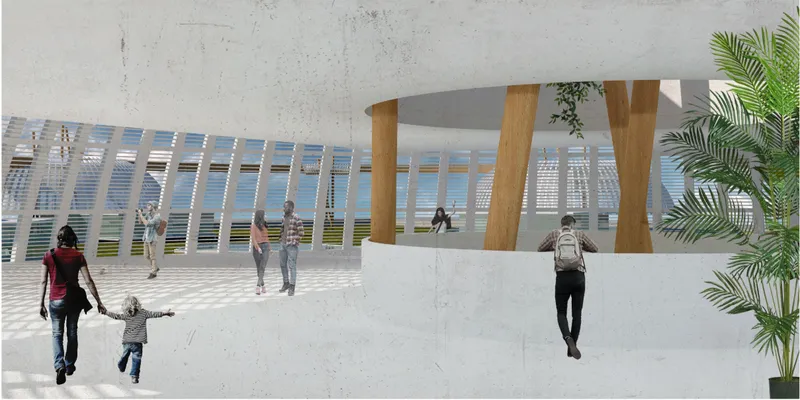
One of the most compelling aspects of the project is its commitment to minimal environmental disturbance. Instead of spreading horizontally across the site, the intervention gently lifts itself above the landscape through elevated walkways and suspended circulation systems.
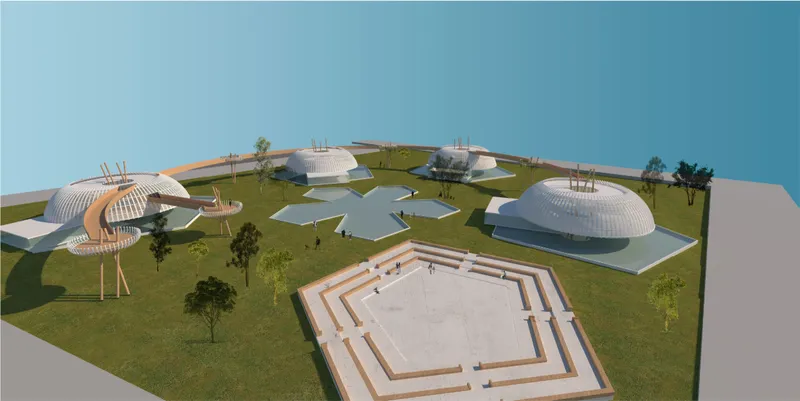
The network of catwalks and watchtowers allows visitors to navigate the site while maintaining the integrity of the terrain below. Water bodies surrounding the structures contribute to cooling, reflection, and serenity, while simultaneously strengthening the immersive atmosphere of the rehabilitation environment.
This strategy transforms movement into an experience of observation and contemplation. Visitors are not positioned as dominant spectators but as participants within a delicate ecological balance. Architecture here becomes a framework for coexistence rather than control.
The elevated circulation also creates multiple viewpoints across the site, encouraging awareness of both wildlife and landscape. The project demonstrates how sustainable architecture can reduce physical impact while increasing emotional and environmental engagement.
Architecture as a “Rendez-Vous”
At the conceptual core of the proposal lies the idea of architecture as a “rendez-vous” — a place of encounter, solidarity, and communication. Rather than functioning solely as a building, the project positions architecture as an instrument for reconnecting humans with ecological responsibility.
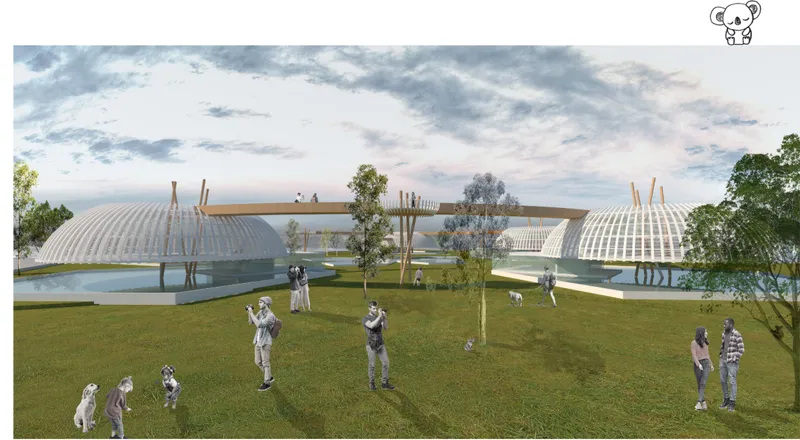
The arrangement of the GumnHuts around shared water courts creates a communal landscape where visitors, staff, and rehabilitated koalas coexist through carefully choreographed spatial relationships. Circular circulation paths, bridges, and open gathering areas establish a rhythmic spatial language inspired by natural systems.
The project asks an important question: can architecture become a channel through which empathy toward nature is cultivated?
In this proposal, the answer appears to be yes. The design rejects monumentality and instead embraces softness, openness, and interaction. The spaces encourage reflection, learning, and awareness while fostering emotional connections between visitors and the surrounding environment.
Program Organization and Ecological Function
The project organizes its program across multiple interconnected GumnHuts, each dedicated to specific functions within the rehabilitation process.
The entrance structure contains the visitor center, exhibition areas, and public educational spaces. Nearby huts accommodate research laboratories, rehabilitation facilities, staff areas, and emergency operations. Administrative spaces and communal support functions are positioned further within the site to maintain operational clarity while preserving spatial harmony.
Each structure follows a layered vertical organization:
- Ground floors remain closely connected to water and landscape.
- Upper levels accommodate rehabilitation and research functions.
- Rooftop terraces create elevated gardens and observation platforms.
This arrangement allows the architecture to operate simultaneously as infrastructure, educational environment, and landscape experience.
Importantly, the project deliberately avoids the terminology of the “museum.” Instead of preserving wildlife as objects of observation, the proposal encourages active participation and responsibility. The architecture becomes a living environment focused on present ecological realities and future environmental stewardship.
A Landscape of Learning and Healing
The project consistently frames architecture as an educational medium. Through sections, elevations, and immersive renderings, the proposal demonstrates how spatial experience can teach visitors about rhythm, structure, environmental harmony, and coexistence.
The landscape itself functions as a learning environment. Open lawns, reflective pools, elevated pathways, and tree-filled zones create a peaceful setting where visitors encounter ecological systems directly rather than through abstract representation.
This educational dimension strengthens the project’s relevance within contemporary sustainable architecture discourse. Increasingly, architecture is expected not only to reduce environmental harm but also to actively cultivate ecological awareness among communities.
GumnHuts for Koalas addresses this challenge by creating a built environment that communicates environmental values through atmosphere, movement, and spatial experience.
Reimagining Koala Rehabilitation Through Architecture
The project ultimately proposes a new typology for wildlife rehabilitation architecture. Rather than isolating care facilities from public experience, it integrates healing, education, landscape, and community into a unified ecological framework.
Its restrained architectural language, elevated circulation systems, and biomorphic geometries create an environment that feels simultaneously futuristic and deeply rooted in nature. The result is a vision of architecture that does not dominate the landscape but carefully negotiates its presence within it.
As environmental crises continue to reshape architectural priorities worldwide, projects like GumnHuts for Koalas demonstrate how ecological thinking can generate meaningful spatial experiences while addressing urgent conservation challenges.
Through sustainable design, environmental sensitivity, and symbolic storytelling, Dima AlMobarak’s proposal transforms architecture into a bridge between humanity and the natural world.



Popular Articles
Popular articles from the community


Co-Life: Senior Housing Design That Reconnects Older Adults With the City
Co-Life reimagines senior housing design through healing gardens, shared streets, workshops, and a sustainable community across generations.

The Earth Pod: 3D Printed Homes for Resilient Refugee Communities
The Earth Pod reimagines refugee housing through 3D printed homes made from clay, combining resilience, self-sufficiency, and rapid shelter.

Hill & Cross Opera: Sculptural Opera House Architecture Shaped by Tallinn’s Landscape and Identity
Hill & Cross Opera reimagines opera house architecture in Tallinn through its sculptural hill, civic plaza, glass wave and a luminous cross.

Conexión: Biophilic Design Reimagines High-Rise Living in Hong Kong
Conexión reimagines high-rise living in Hong Kong through biophilic design, green facades, shared spaces, daylight, water and nature within.

Similar Reads
You might also enjoy these articles

Eco Chapel: A Green Architecture Pavilion Designed in Symbiosis with the Forest
Eco Chapel uses green architecture to weave prayer, learning and reuse into a forest pavilion shaped by modular hexagonal canopies for life.
Kaffeebühnen: Coffee Shop Architecture Designed as a Civic Stage Between Vienna’s City and Park
Kaffeebühnen turns coffee shop architecture into a civic stage, linking Vienna’s park edge, urban life, warm timber yards, and coffee craft.
Healing Façade: Sustainable Architecture for Reforestation, Community, and Sacred Ecology in Ethiopia
Healing Façade reimagines sustainable architecture as a living wall that restores soil, catches water and renews Ethiopia's forest churches.

Urban Forest: A Vertical Ecosystem for 5,000 Workers in Singapore's Changi Business Park
Radially stacked pods and layered green decks turn a 7-acre plot into 47 acres of ecological workspace projected for 2040.

Comments (0)
Please login or sign up to add comments
No comments yet. Be the first to comment!