
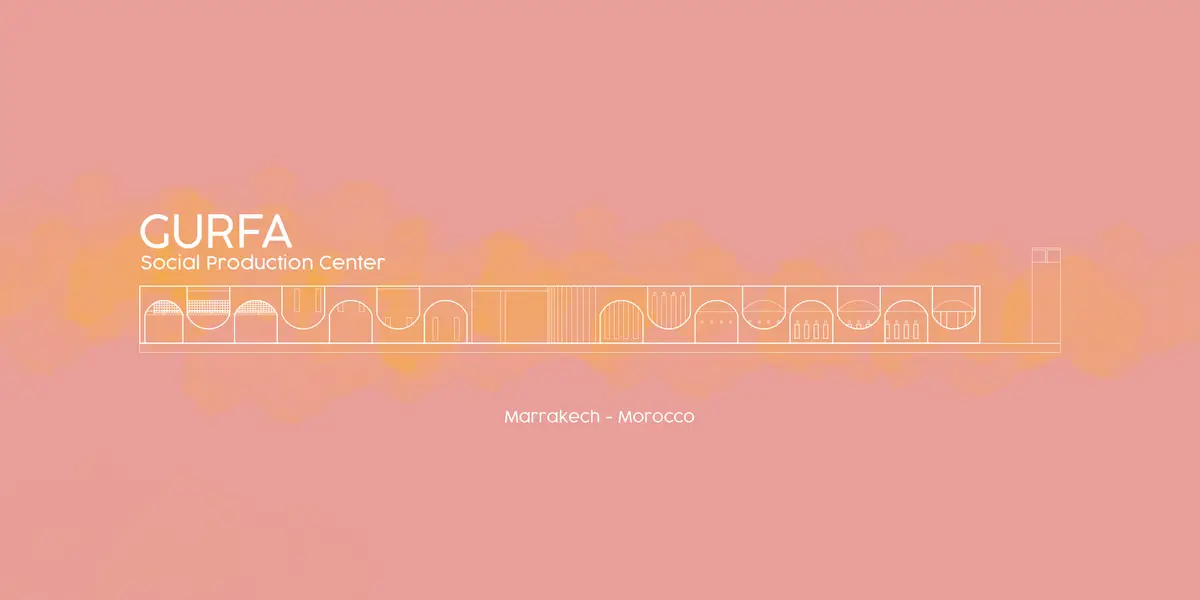
Gurfa Social Production Center
Gurfa: noun:\ (Arabic) Amount of water that can be held by handful

Culture of Marrakech
The preliminary research on the culture of Marrakech depicts a rich and diverse image of the region in terms of religions and ethnic traditions. The culture may be visioned as the blend of Berber, Arab, African and Jewish cultures. Moreover, the contemporary way of living carries the traces of rooted traditions with the integration of the modern European way of life. The city center resembles this range so that the historic Madina Streets reach out to the European-inspired new city. The old town and the inhabitants are living by authentic habits such as the bazaar culture. The bazaars of the city may be the representatives of the Moroccan culture with its cuisine, textiles, motifs, carpets, and several other local productions. Even though the background of the city holds a wide range of ethnic groups the current demographics may be described as relatively less diverse.
Gurfa: Purpose-Concept
In this sense, Gufra- the cultural production center of Marrakech aims to revitalize and highlight the socio-cultural richness of the city by enabling the users' to be a part of the production line and experience the whole process from workroom to the store. In this sense, Gurfa is designed to be a breathing architectural complex by proposing flexible spaces and open to alternative configurations so that both today's traditions and the probable future of the cultural activities are welcomed. In this sense, the relation between open and close spaces is re-considered and the transitions from inside to outside are configured to flow. The idea of creating a harmonious flow from outside to inside is also reflected through the overall functional presentation of the spaces in the sense that the alternatives of the main unit may be used for different functions in the case of the need of the users. Another key concept reflected in the complex is based on the demographic analysis of the site in which there were 3 layers visible in the vistas of the site- lake, Atlas Mountain, and the sky which sharply cuts one another- so that the 3 layers embedded in Gufra- cross-ventilation system under the ground, ground level with courtyards and grid overhang system on top of it- is inspired from this powerful image.
Climate and Environmental Conditions of the Site
In the case of needs and the user profile, the climatic conditions of the region were a challenge in the sense that the mild-Mediterranean climate is relatively considered to be hot and dry for the summers and windy and relatively rough during the winters. For the particular site of the project, the wind may not be considered as an extreme condition since the average data for the previous years' wind recorded is within the boundaries of summer breezes. However, even though the wind is not powerful at extreme levels it is relatively continuous which has created a potential for the natural ventilation of the spaces within the boundaries of passive sustainable solutions. Another igniting idea for the proposal of a passively sustained environment was related to the extreme heat conditions of the site in the sense that the used passive sustainable solutions aim to create both open and close spaces at both day-night to ensure that the interaction with the user is an endless cycle. Therefore, the passive architectural sustainable solutions used for the project create a possible future for the challenge of possible extreme architectural concepts.
Passive Environmental Techniques for Sustainability
The passive sustainable environmental techniques rely majorly on the material choice of rammed earth since it can be locally produced with environment-friendly methods and the emissivity value of the material is suitable to emit and absorb-to some extent- the unwanted heat during the day and keep the space at a moderate temperature. Another method was to create a wind corridor passing under the whole complex and having some ventilation openings at necessary spaces to increase the air quality of the indoor spaces for the users’ thermal comfort. The wind corridor takes the cool air from the northern region of the site and circulates the cool air and the exhausted air reaches the wind tower to leave the system. Moreover, the reflection pools are placed at the main courtyards in order to create a controlled microclimate with partial control of the humidity and sunray reflection.
The Program-Scenario
The program of the complex is designed in order to maximize the quality time spent by the users since the complex is placed at an isolated location- 40km by the city center- so that at any time of the day the cultural production line is in need of continuation. Therefore, Gurfa aims to propose a different set of activities for the day and night times. Due to the climatic conditions, the daytime activities are taken place in the closed, semi-closed, and open courtyard spaces containing artisan training, exhibitions, recreational activities, and education. During the night the flexible spaces allocated for the daytime activities are flown into the open bazaar area and the whole complex is utilized as a large traditional Marrakech bazaar. There are also activities and spaces provided such as the theatre area that may be working at both day and night times.
...for the Future?
Overall, Gurfa is designed to become a model for the vitalization of the culture of Marrakech by creating a cultural production center to enable both the locals and the tourists to come together and become the part of culture itself. With the use of modular units, the flow of spaces, and flexible spatial allocations the interaction of the users with the complex will decide on the future of the complex. In this sense, the Wall of Memory may be a suitable example- the users may interact with the graffiti wall which has the basis of the collage of some of the well-known street arts from Marrakech and add on top of it to change the mood of the space. Another example may be the bazaar area itself since the users' needs are the primary impact upon the use and function of the grids placed for the bazaar- so that space may find its life from the inhabitants of the space. In this sense, the future of Gurfa relies on the future of the user profile and is open up to possible outcomes since the modular-mass grid system allows the addition of new areas into the system without having heavy constructional touches.


Popular Articles
Popular articles from the community


Jaramillo Van Sluys Arquitectura and Urbanismo Turn a Demolished Registry Lot in Quito into an Orchard Plaza
In Quito's Centro Histórico, a 2,800 m² plaza exposes the San Agustín convent wall and redraws its lost Augustinian orchard in volcanic stone.

David Macias Steps a Doorless Stone and Plaster House Down a Tropical Colombian Hillside
In the humid hills of Colombia, Threshold House replaces the front door with an open void and terraces its 850 m² down the slope instead of fighting it.

Cube Design Draws an Ecological Corridor Between Two Shenzhen Hills with the Nankai Building
Beside Shenzhen's container docks, the Nankai Building pairs stacked balconies with a climbing green screen to connect two hillsides across its height.

longwave studio Reorganizes a 112 m² Tainan Apartment Around the Daily Routines of a Family and Two Cats
In Tainan, Taiwan, birch plywood, rust-red furniture and a freestanding plaster wall link arrival, storage, work and family life in one apartment.

Similar Reads
You might also enjoy these articles

Yenisei Monitoring Center: A Sun-and-Moon Sphere Anchors a Research Campus on Siberia's Great River
In Krasnoyarsk, shifting square blocks, a glazed central sphere and descending window rhythms turn river science into a public spectacle on the Yenisei.
Andretta Artist's Village: A Node-Based Masterplan That Lets the Hills Write the Plan
A cultural landscape strategy for Palampur's artist colony threads studios, residences and stages along a porous spine shaped by the Dhauladhar terrain.
Street Children Rehabilitation Center: A Brick Campus That Eases Children From Street to Safety
A low-rise courtyard campus where learning streets, uthans and shaded verandahs stage a gradual passage from street into protective, family-scale life.
The NEON Culture: A Field of Pavilions Built for the 24-Hour City
Smaran Alva spreads galleries, stages, clubs and markets across a varied site, treating light, sound and ramped movement as the real building materials.

Explore Cultural Architecture Competitions
Discover active competitions in this discipline


Comments (0)
Please login or sign up to add comments
No comments yet. Be the first to comment!