

H&P Architects Wrap a Vietnamese House in Perforated Brick to Fuse Living with Agriculture
A 270 square meter home in Mao Khe, Vietnam, uses layered terracotta screens and rooftop gardens to resist the erasure of farmland by urbanization.


Mao Khe sits on the edge of one of northern Vietnam's largest coal mines, about 120 kilometers from Hanoi. For decades, the town's identity was shaped by extraction: slag heaps, coal dust, gray and white concrete dwellings repeating down every lane. As new urban districts push into surrounding agricultural land, the households that once farmed those plots are left with neither crop nor clear purpose. H&P Architects saw this condition not as a backdrop but as the design brief itself. Their response is a house that refuses to separate dwelling from growing, wrapping every inhabited level in perforated brick screens that breathe, filter light, and support a vertical landscape from ground to roof.
What makes this project worth studying is not the brick screen alone, which has become a near-default move in tropical Vietnamese architecture, but the way the entire section is organized around productive planting. Courtyards, suspended planters, rooftop beds, and interior tree wells turn a modest 270 square meter footprint into something closer to a micro-farm than a conventional home. The architects designed the reinforced concrete frame as a standardized, expandable module: two storeys now, three if needed, adaptable for education, health, or community use. It is a prototype dressed in terracotta, and it carries a quiet argument that the future of Vietnam's peri-urban towns does not have to look like the gray sprawl already there.
A Warm Signal in a Gray Neighborhood


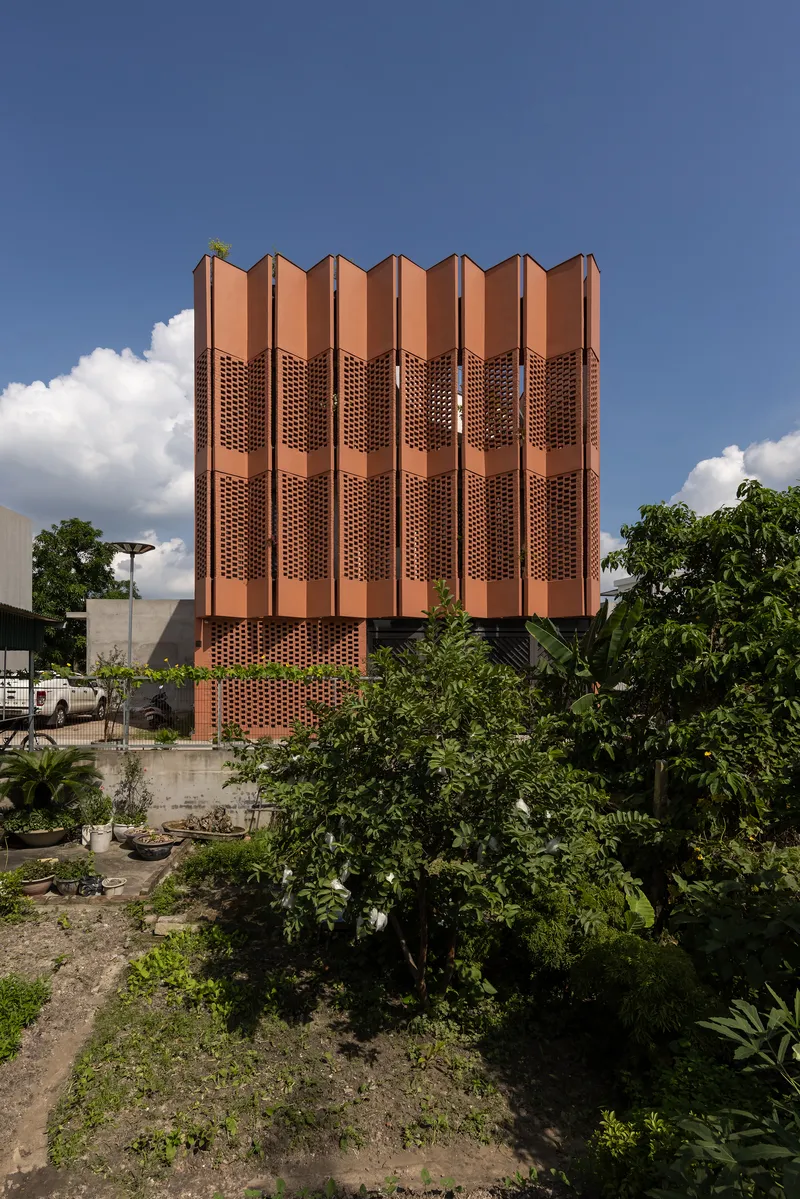
From the air, the house registers as an unmistakable warm block among a sea of pale rooftops and corrugated metal. Red brick is a deliberate provocation here: slag, coal, mud, and soil are the familiar materials of Mao Khe's mining heritage, so the terracotta cladding reads as both locally grounded and visually foreign at once. The stepped upper floors create a zigzag parapet that catches late afternoon light in a way that flat roofs around it simply cannot.
At street level, the facade is more approachable than its aerial silhouette suggests. Young trees soften the base, and the corrugated copper-toned panels on one face give way to the finer grain of the perforated brick screen on the other. The house announces itself without shouting, relying on material warmth rather than formal gymnastics.
Perforated Brick as Climate Device
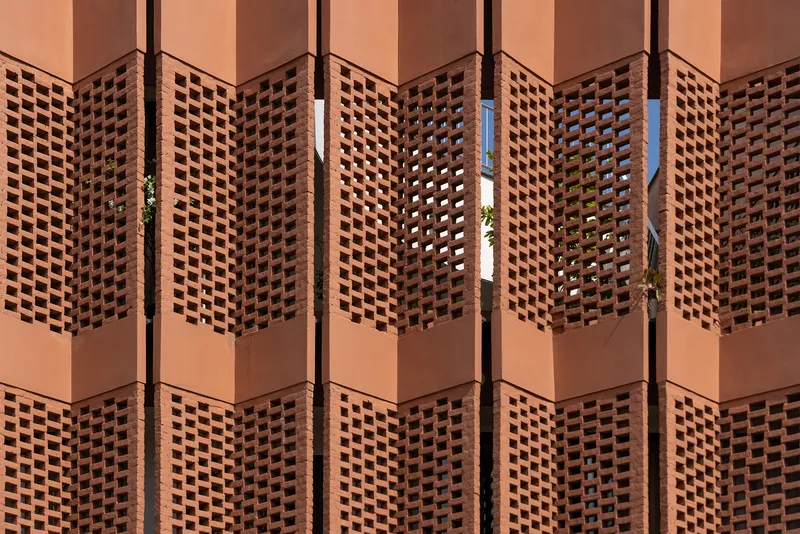


The rectangular perforations in the brick screen are not decorative filler. Oriented east-west, the house faces significant solar heat gain on both long elevations, so the double-skin brick wall acts as a first line of defense: admitting breeze, scattering direct sun into dappled patterns, and screening rain from operable windows behind. At dusk, the backlit panels glow from within, turning the climate strategy into an unintentional lantern effect that marks the house in the neighborhood.
Close up, the craftsmanship of the screen becomes legible. Exposed cladding joints and slight variations in the terracotta color give the surface a handmade texture that mass-produced curtain walls cannot replicate. The lattice panels repeat in warm sunlight with enough regularity to feel systematic, yet enough irregularity to feel alive.
Courtyards That Grow Food


The central courtyard is the engine of the house. A curved perforated wall wraps a raised planting bed, a tree in a copper vessel, and a paved floor that doubles as a rainwater collection surface. Water captured on the roof is cycled down to irrigate these beds, creating a closed loop that makes the courtyard productive rather than ornamental. The curved geometry is unusual for a house this size; it softens what could be a harsh brick box and creates pockets of shadow that shift throughout the day.
A second, smaller courtyard enclosed by curved brick walls casts dappled shadows onto its paving, functioning as a light well that pulls ventilation through the section. The steel staircase threading between these outdoor rooms connects ground-floor kitchen and lounge to the upper-floor bedroom and studio, ensuring that every vertical move passes through planted space.
Vertical Circulation as Spatial Event
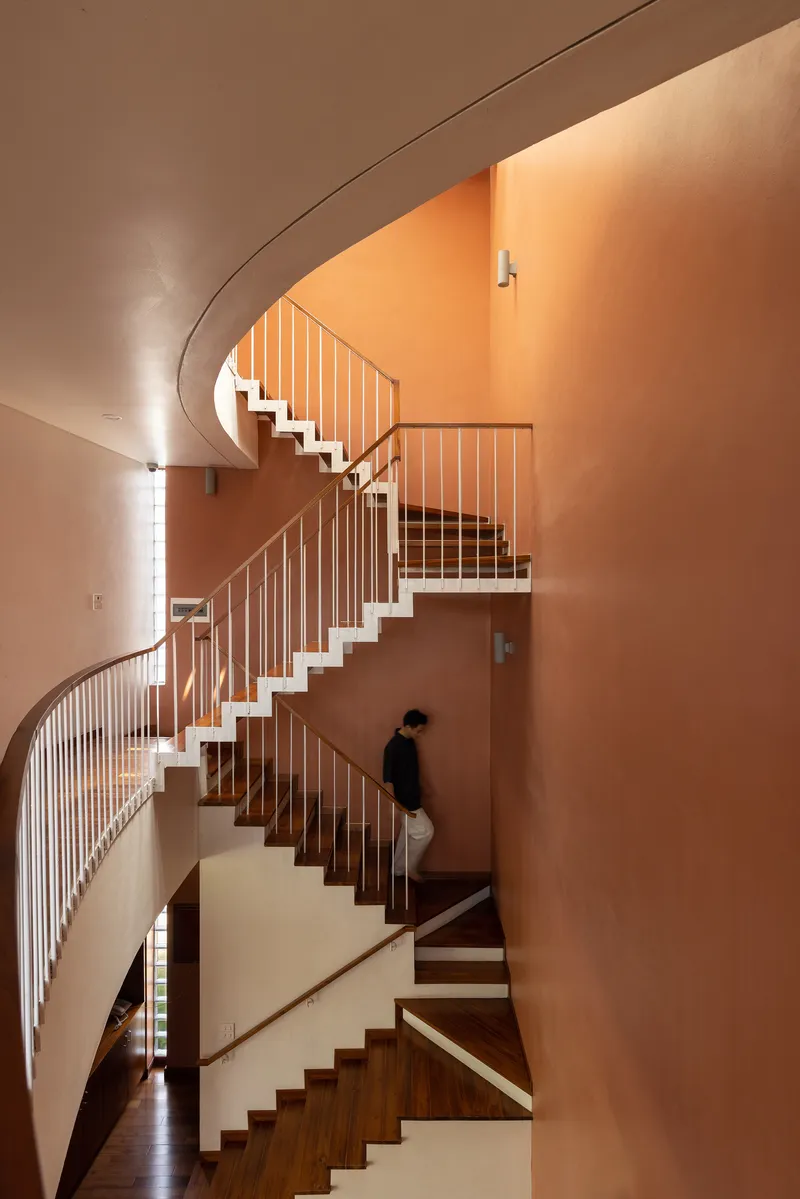
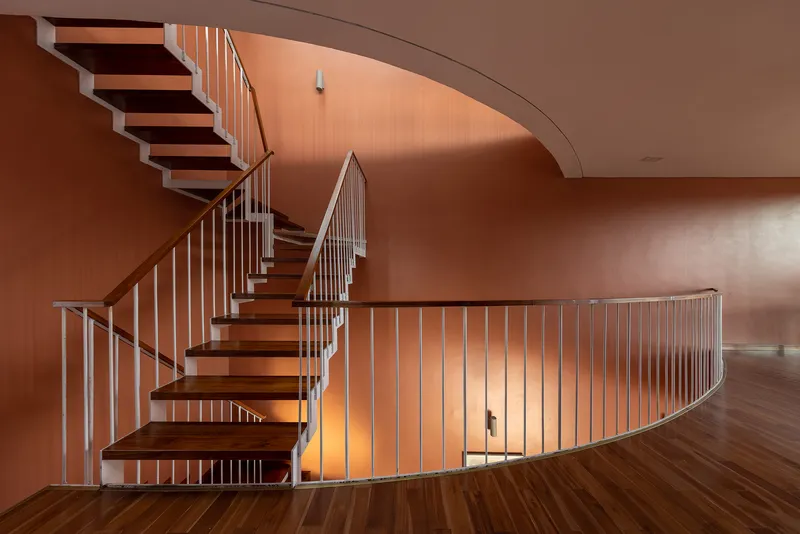
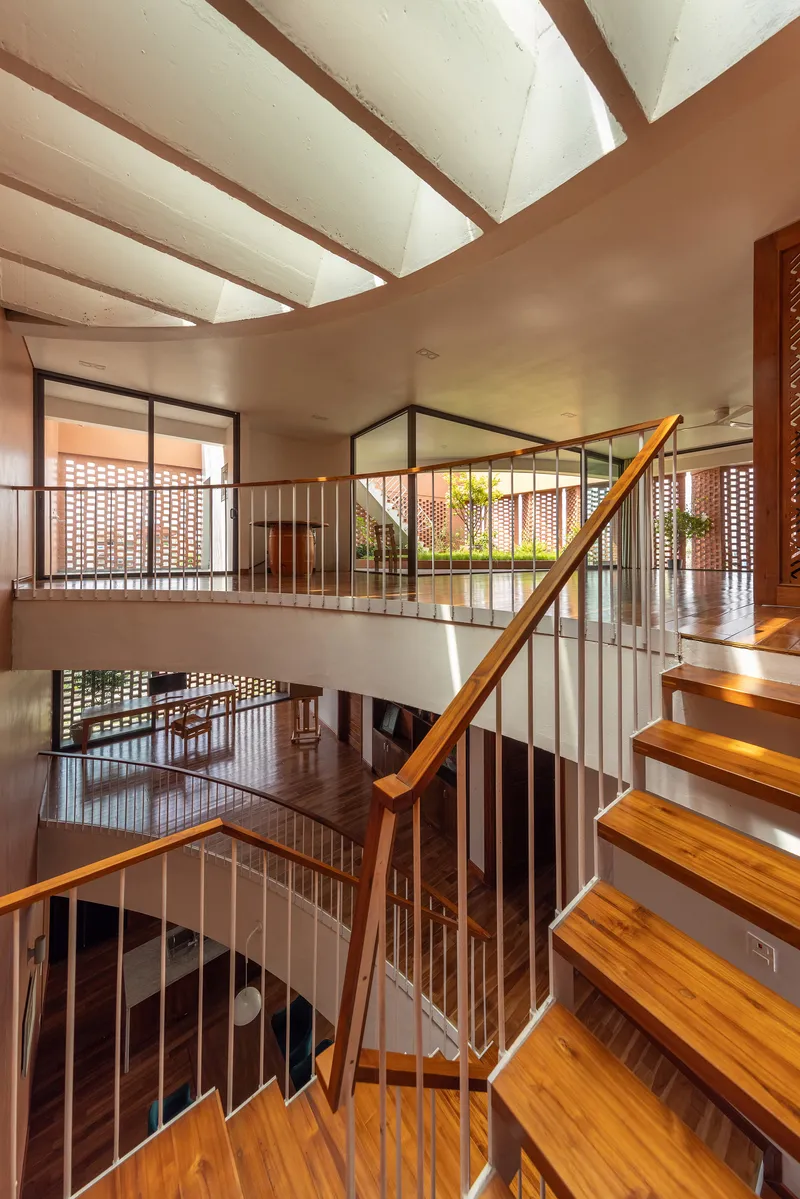
The spiral staircase is arguably the most photogenic element, but it earns its drama. Wrapping around an open courtyard void, it stacks timber treads on a steel frame with slender vertical balustrades that echo the rhythm of the brick perforations outside. A figure descending past the terracotta walls reads almost like a sectional diagram brought to life: you see every level at once, understand the relationship between interior and sky, and grasp the extra-high ceiling heights that allow suspended planters overhead.
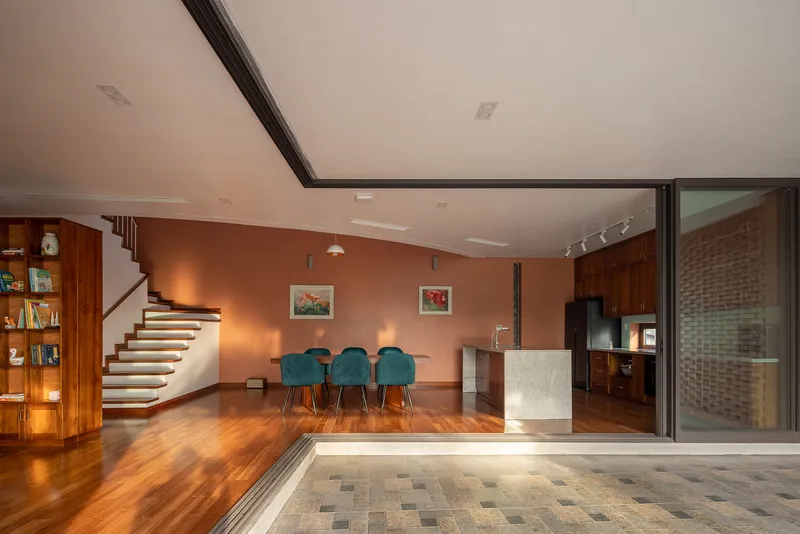
The stair is not just circulation. It is the social spine of the house, overlooking the dining area below while offering glimpses of the rooftop garden above. The floating timber treads with illuminated risers turn the evening meal into something theatrical, casting warm stripes of light across the curved terracotta walls.
Living Spaces Between Screens

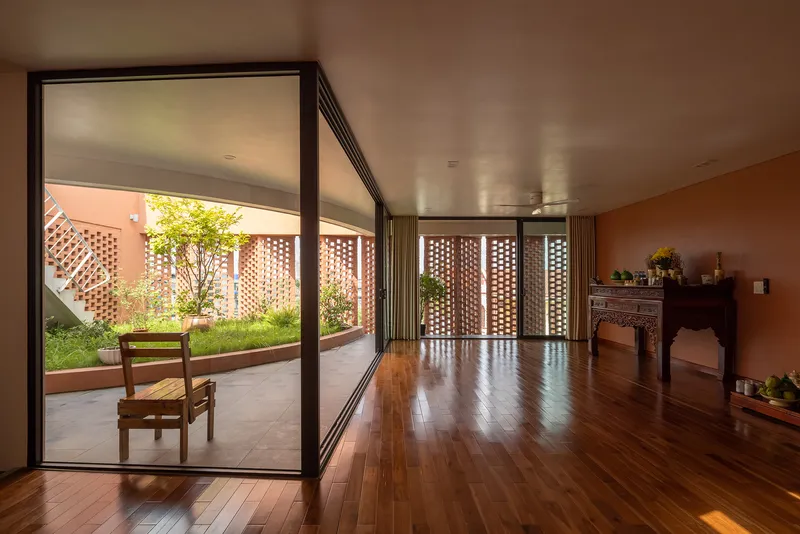

Inside, the distinction between room and garden dissolves. Timber-floored living spaces open through sliding glass doors to planted courtyards framed by lattice screens, so every seated position includes a view of greenery filtered through brick. The ground floor kitchen, bathroom, and lounge occupy a compact plan that feels larger than its 49 square meter construction footprint because the courtyards extend the usable space visually and thermally.

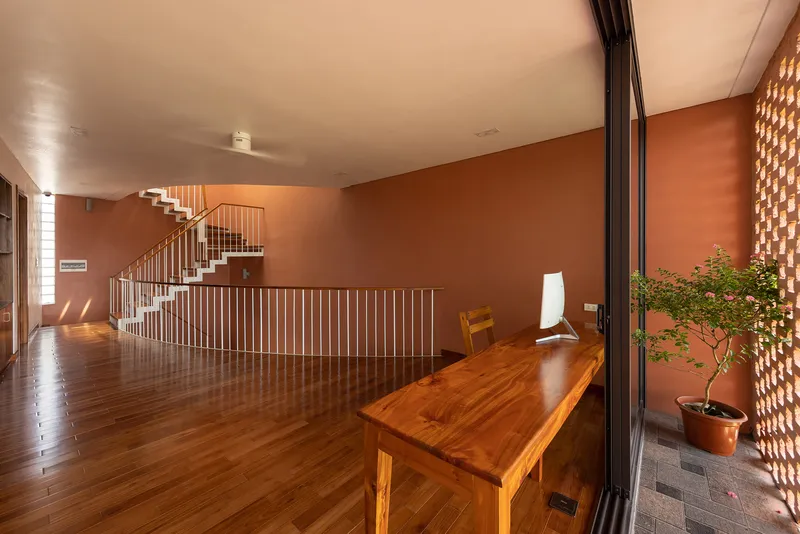
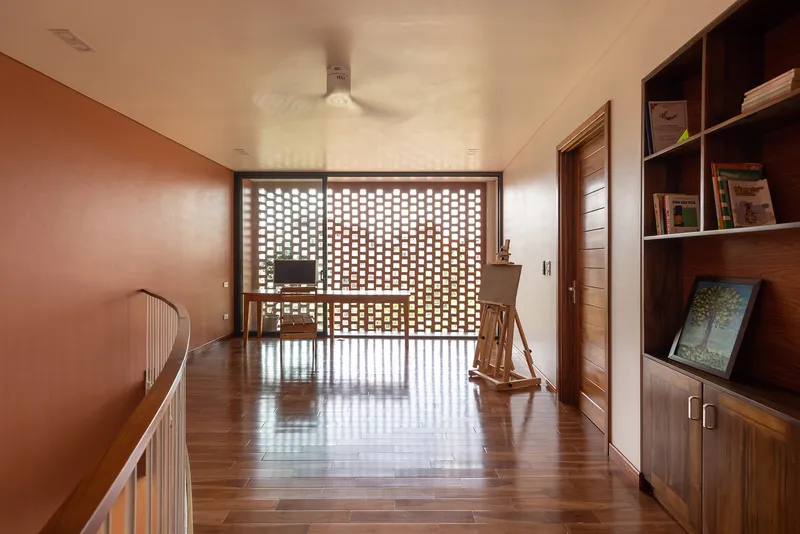
Upstairs, the program is deliberately flexible. A corridor with a timber desk beside a perforated screen wall and a potted bonsai could be a studio, a second bedroom, or additional planting area. The rocking chair at the end of an upper hallway, framed by the brick lattice, suggests a domestic calm that the section's complexity might not promise on paper. The architects planned these upper rooms to accommodate suspended planters from the extra-high ceilings, reinforcing the idea that every surface is a potential growing surface.
The Rooftop as Productive Landscape
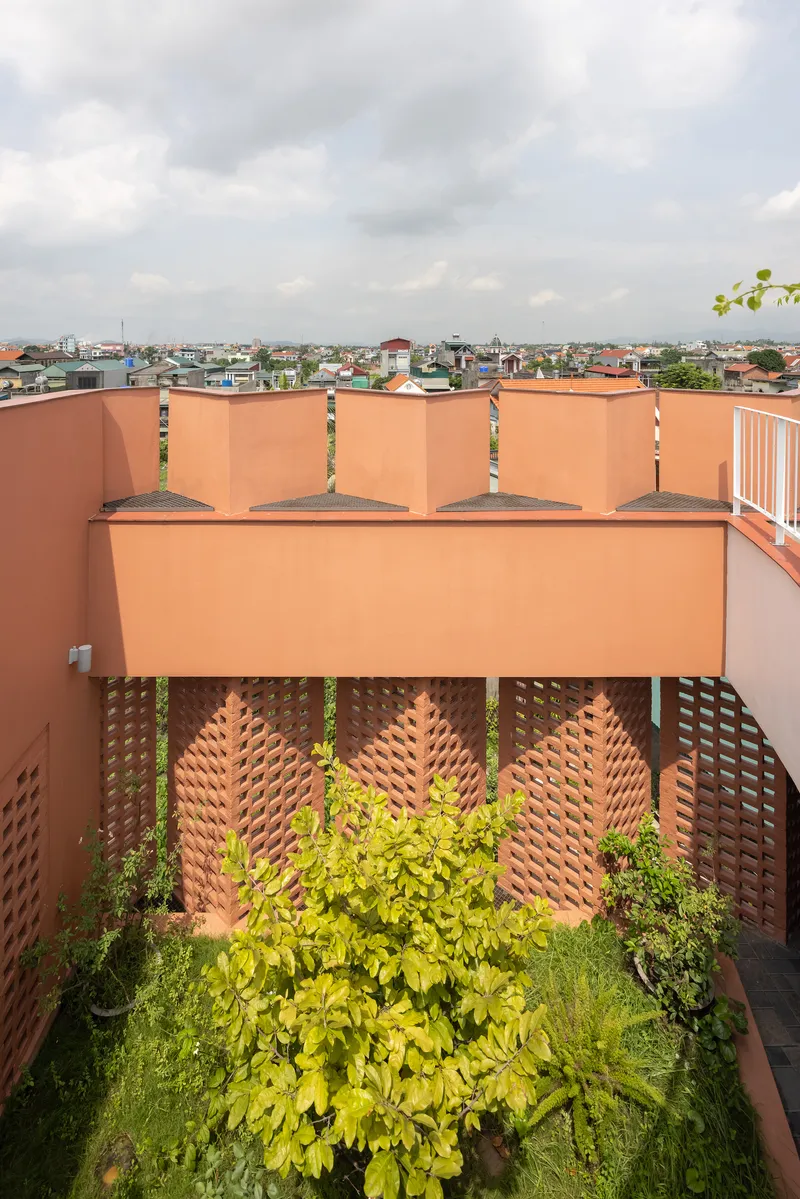
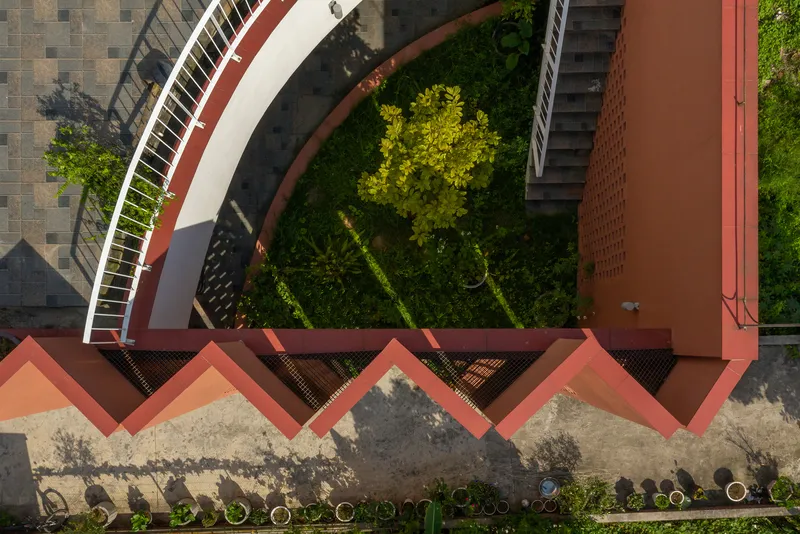

The rooftop terrace is where the agricultural thesis becomes fully legible. Planted beds line the perimeter behind the perforated brick screens, irrigated by the rainwater collection system. From here, the sawtooth parapet reads as a deliberate framing device: its zigzag geometry breaks the roofline, channels wind, and creates pockets of shade for different crops. The view outward is of the surrounding neighborhood, a useful reminder of the context this house is trying to improve.
Even in the bedrooms one floor below, the productive landscape intrudes gently. Perforated brick screen walls filter sunlight onto potted plants and a patterned floor, maintaining the continuity between inside and outside that runs from ground to sky. The house never lets you forget that it is, in part, a garden.
Plans and Drawings
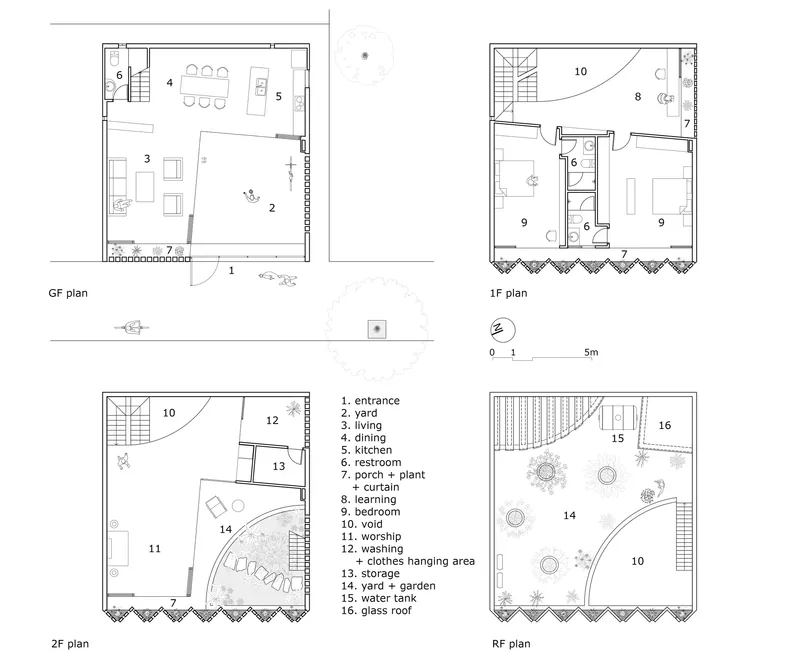


The floor plans from ground through roof reveal the clarity of the structural module: a reinforced concrete frame of columns, slabs, and stairs that organizes every level around the central courtyard void. Rooms are compact, but the labeled courtyards and planting areas nearly equal the enclosed space in total footprint. The elevation and section drawings confirm how the perforated screen operates as a second skin, standing proud of the glass line behind it and creating the cavity that drives passive ventilation.

The exploded axonometric is the most revealing drawing. It peels the house into four layers from rooftop garden down through interior spaces, showing how each level steps back or forward to create terraces and light wells. The diagram makes the expandability argument visible: add a third storey on the same frame and the proportions still hold. This is architecture designed to be replicated, not merely admired.
Why This Project Matters
Vietnam is urbanizing faster than almost any country in Southeast Asia, and the architectural casualties are not only aesthetic. When agricultural land disappears under concrete, so do livelihoods, food security, and the social structures that small-scale farming sustains. H&P Architects have been making this argument for years, but the Mao Khe house distills it into a single buildable module: a prototype that any household on the edge of an expanding town could adapt. The standardized concrete frame, the locally sourced brick cladding, and the integrated rainwater system are all deliberately low-tech, accessible to low-income communities and vulnerable areas exposed to flooding.
The real test of this project will be whether it multiplies. The architects envision clusters of these modules forming a community where living and agriculture coexist, creating local jobs and partial self-sufficiency. That ambition may sound utopian, but the house itself is convincingly pragmatic: warm, well-ventilated, productive, and handsome enough to win a National Architecture Award. If the perforated brick screen is the move that catches your eye, the growing beds behind it are the move that matters.
Creative Usage of Bricks & Earth by H&P Architects, Mao Khe, Vietnam. 270 m², completed 2024. Photography by Le Minh Hoang.
About the Studio
Share Your Own Work on uni.xyz
If projects like this are the kind of work you want to make, uni.xyz is a place to publish your own, find collaborators, and enter design competitions.


Popular Articles
Popular articles from the community

Tsunami Convergenics: Turning Catastrophic Ocean Forces into Underwater Housing Infrastructure
A speculative underwater settlement off the coast of Onagawa, Japan, treats tsunamis and typhoons as energy sources rather than threats.

Manzana Morphosis: Stretching Barcelona's Grid into a Living Landscape for 2050
A radical reworking of the Eixample manzana turns density into a tool for generous public space, vertical ecology, and environmental performance.
Opera by the Sea Estonia: Three Shells Dissolving Architecture into Tallinn's Coastline
A winning opera house proposal replaces monumental form with interconnected shells that blur the boundary between building, park and Baltic Sea.

The Amber Palace Opera: A Geological Fiction Surfaces on Tallinn's Baltic Waterfront
Pierre Brillard reimagines a Baltic legend as a public landscape, opera house, and waterfront promenade rooted in Tallinn's coastal identity.

Similar Reads
You might also enjoy these articles

Bao Huynh Watercolor Atelier: A Serene Art Retreat in Hội An
Bao Huynh Watercolor Atelier in Hội An blends multifunctional art spaces, sustainable design, local materials, and family-friendly living in a serene environment.

Atelier Macri Concept Store Interior Design by CASE-REAL
Atelier Macri store features a "ko" counter, walnut wood details, cork displays, blending retail, gallery, and seamless customer experiences.

Manuel Vargas Izquierdo Stadium and High-Performance Sports Center: Architectural Excellence in Jalpa de Méndez
The Manuel Vargas Izquierdo Stadium blends sustainable design, inclusive sports facilities, and cultural-inspired architecture, revitalizing Jalpa de Méndez’s public spaces.

KAKR Buluh Awar Hall: Revitalizing Community and Ecology Through Bamboo Architecture
Community built bamboo hall revitalizes Buluh Awar village, empowering youth, restoring ecology, celebrating vernacular craftsmanship through sustainable architecture and culture.

Explore Producing Earthen Bricks Competitions
Discover active competitions in this discipline

Challenge to reimagine the Iron Throne

Photograph architecture without architects

Illustrate the lost glory of Angkor Wat - Render Challenge

Design challenge to reuse E-waste
Comments (0)
Please login or sign up to add comments
No comments yet. Be the first to comment!