
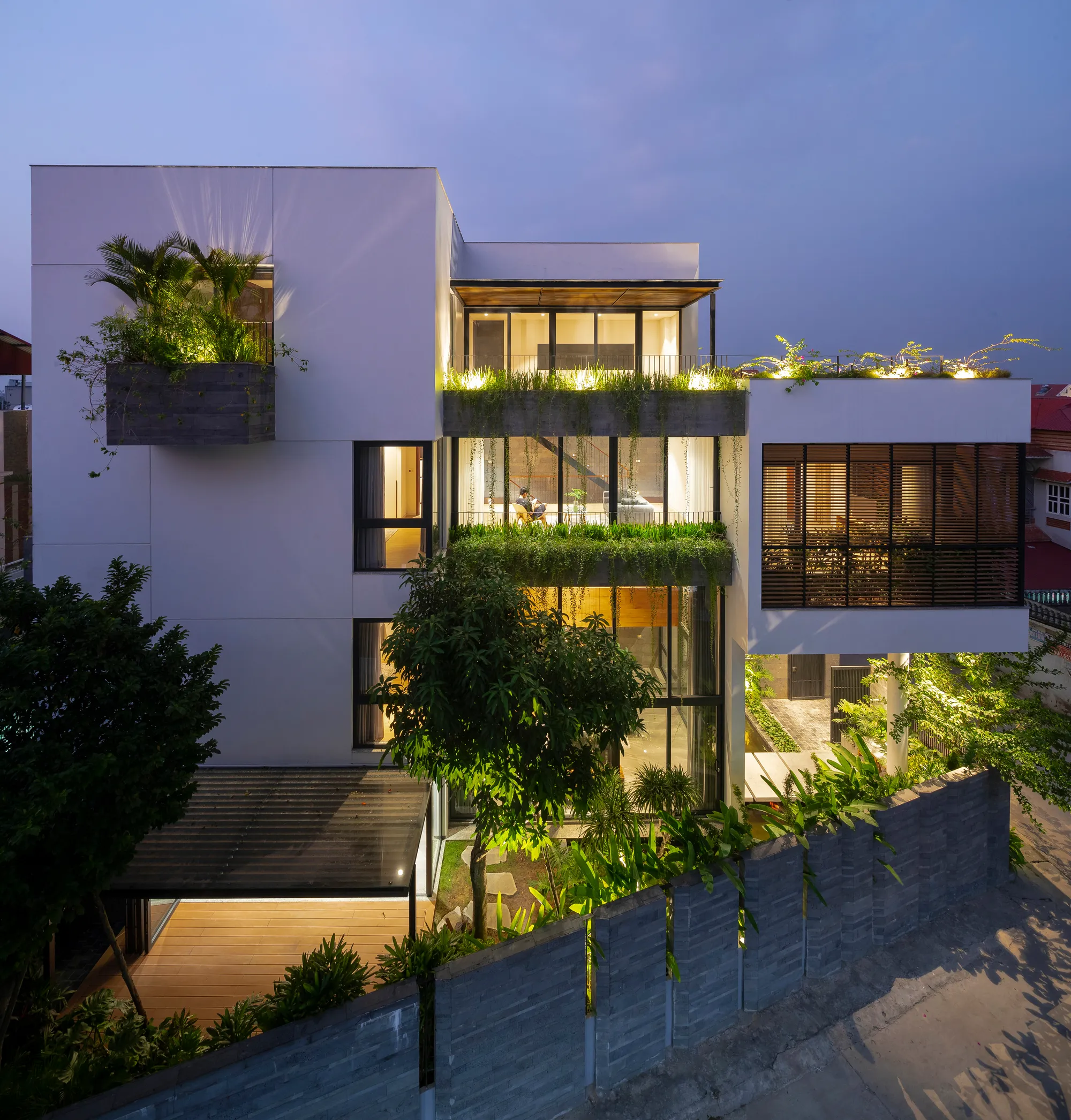
HA&A Design Stack a Terraced Green House for Two Children in a Urbanizing Vietnamese Village
TB House layers planted concrete volumes, interior courtyards, and timber screens to bring nature indoors as a village edges toward city life.


Somewhere between countryside calm and the encroaching grid of Vietnamese urbanization, a young couple decided to build a house for their children. Not a house that would merely shelter them, but one that would teach them something about light, air, and growing things. HA&A Design, led by architect Vũ Ngọc Hậu, delivered TB House: a 400-square-meter stack of planted terraces, open courtyards, and timber-screened volumes that reads less like a single dwelling and more like a vertical garden with rooms tucked inside it.
What makes TB House genuinely interesting is its refusal to treat vegetation as decoration. The greenery here is structural to the experience of the house. Cascading planters, interior courtyards with koi ponds, rooftop terraces edged in foliage: every floor negotiates between enclosed domestic space and open planted zones. The architects oriented the building so that its primary open surface runs front to back, aligning with prevailing winds and the sun's arc. The result is a house that breathes passively in a tropical climate while stacking enough density to hold its ground as the village around it thickens.
A Street Presence Built from Layers
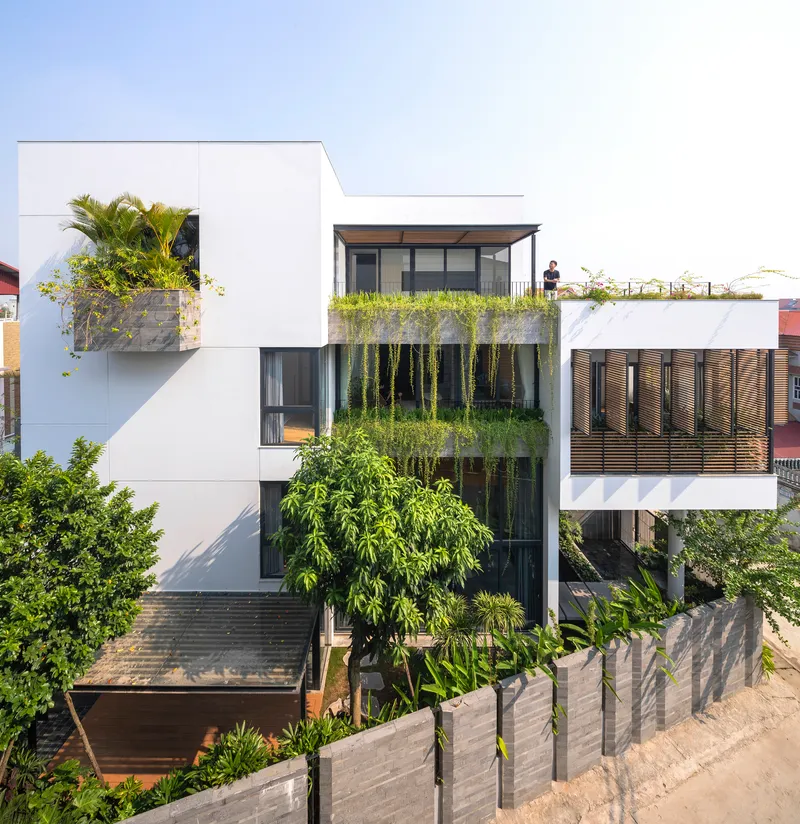
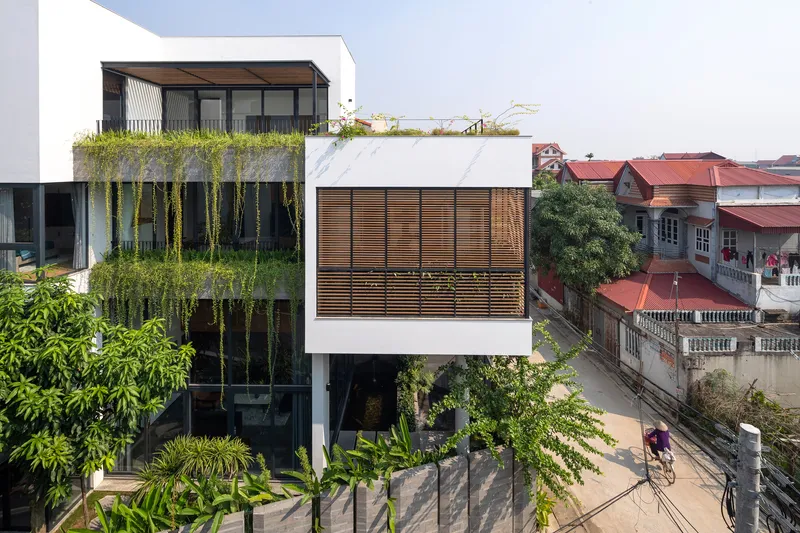
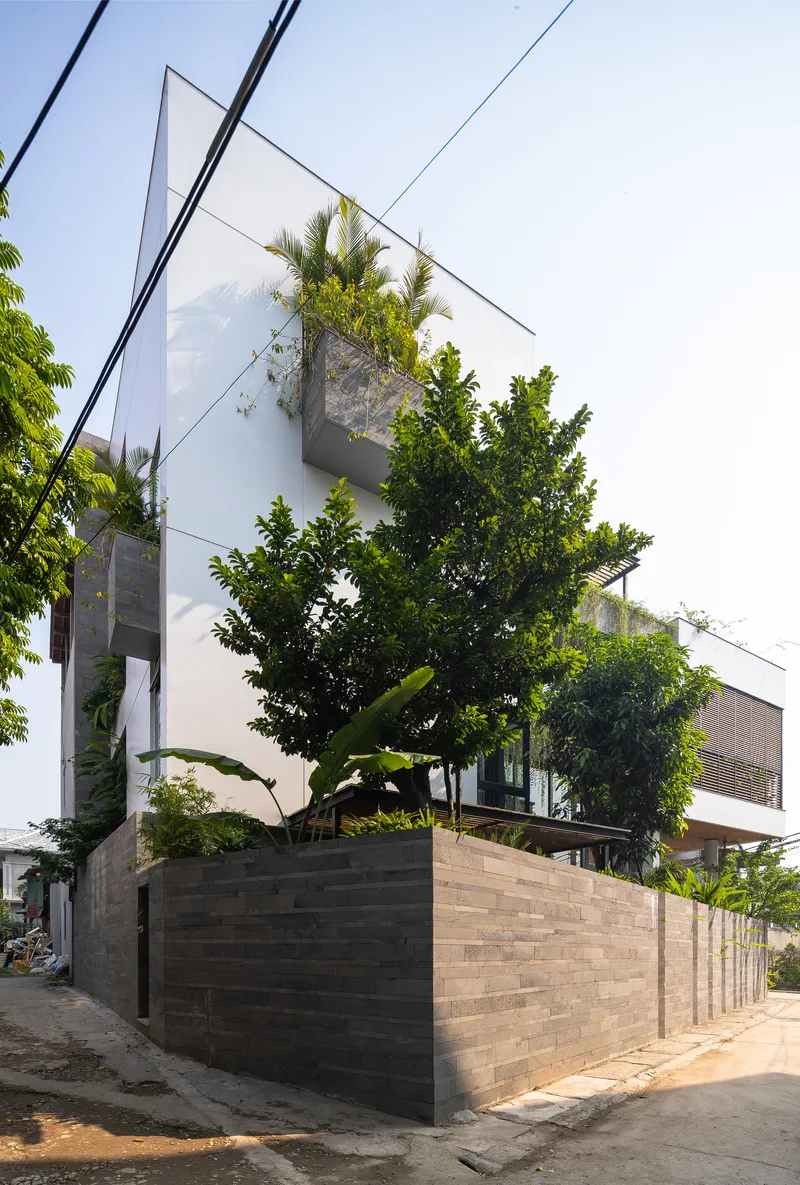
From the street, TB House presents itself as a series of horizontal layers: concrete boundary walls, timber slat screens, planted terraces overflowing with palms and trailing vines, and white stucco volumes stepping back at each level. The composition avoids the flat, defensive facades typical of Vietnamese urban houses. Instead, it creates depth. Cyclists pass below a building that feels generous to the public realm, its greenery spilling over edges and softening the hard materials beneath.
The horizontal timber cladding and angled louvers do real work here, filtering harsh afternoon sun while maintaining visual permeability. Raised planter boxes push mature trees above the roofline, giving the house an almost geological quality, as if it were a hillside carved into habitable terraces rather than a building assembled from parts.
Boundary and Entry
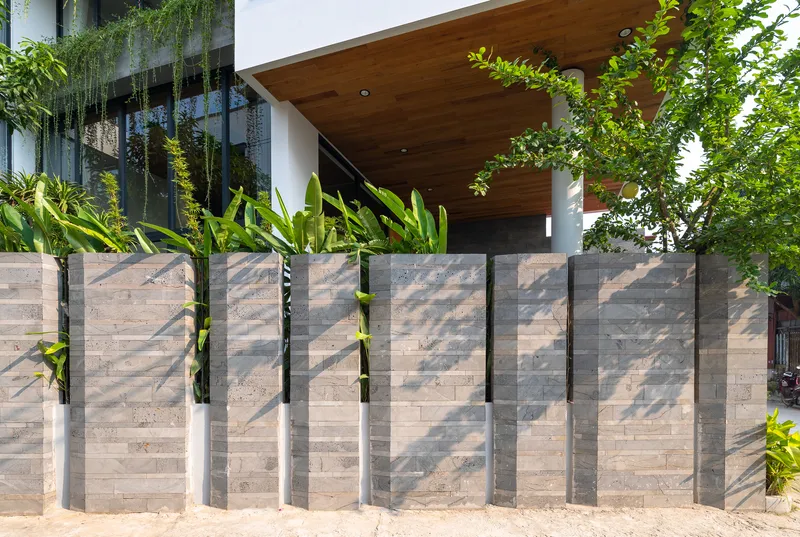
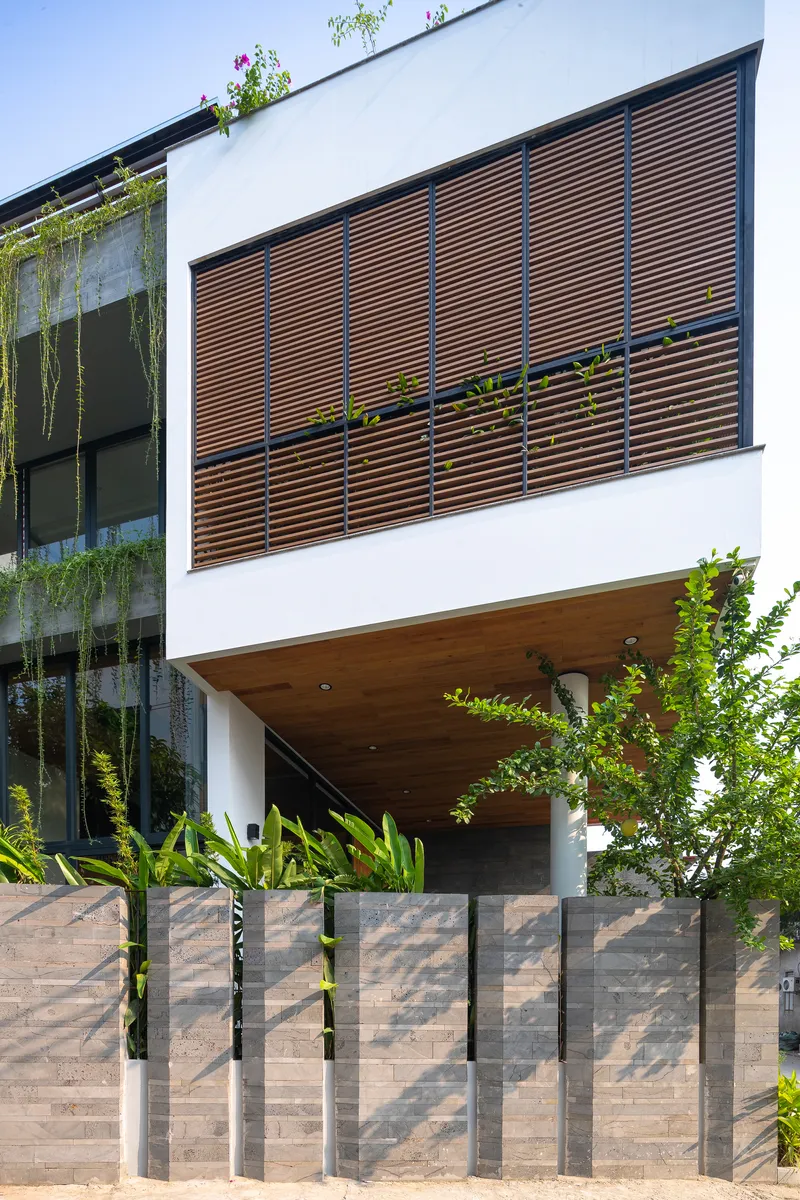
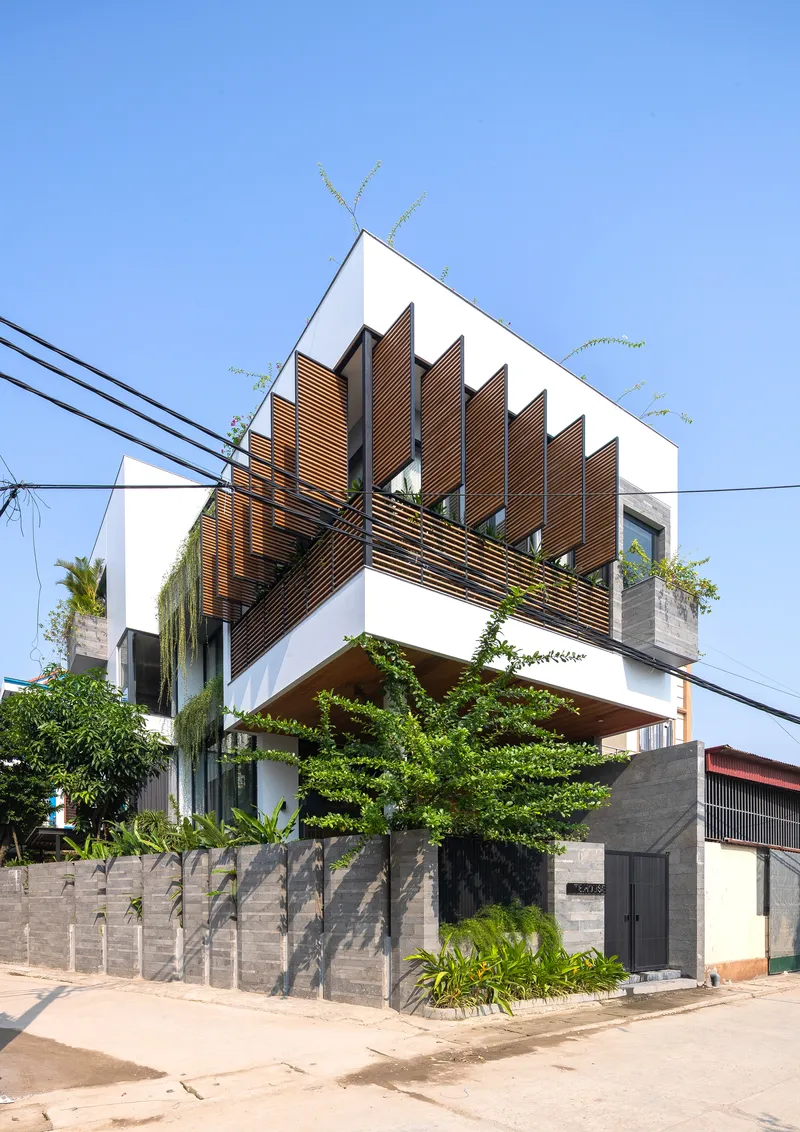
The transition from street to interior is calibrated through material changes. A concrete boundary wall with vertical steel fins casts rhythmic shadows beside planted beds, marking the property line without sealing it off entirely. The entry sequence passes beneath a timber canopy and through a stone-clad gate, materials sourced locally and deliberately left rough to contrast with the smoother surfaces inside.
Corner views reveal how the architects layered these thresholds. Angled timber louvers shade the upper balconies, creating a gradient of privacy that increases as you move upward. The fence, the gate, the canopy, the louvers: each layer peels away a degree of exposure, so that by the time you reach the interior, the street feels like a distant proposition.
The Double-Height Living Core
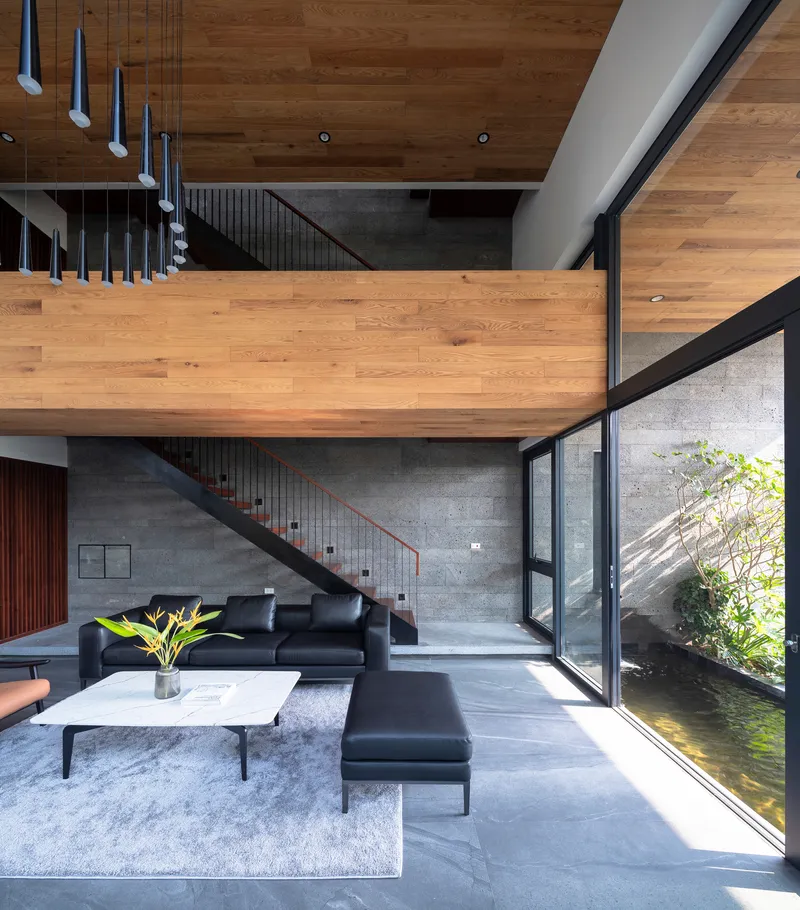
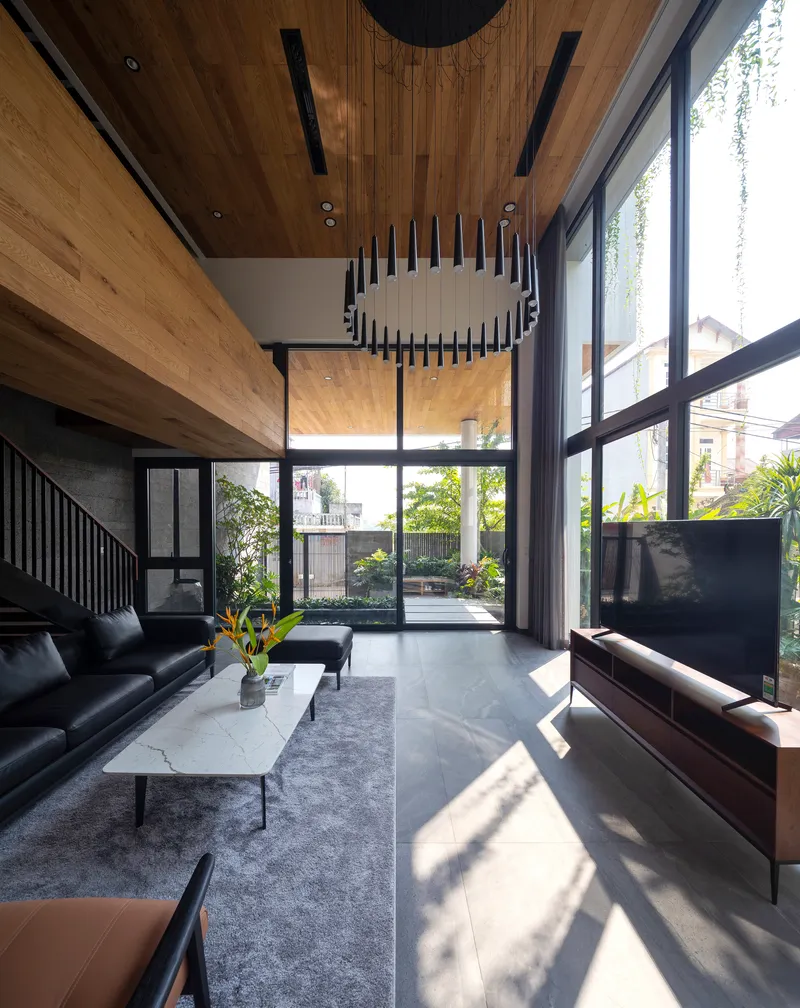
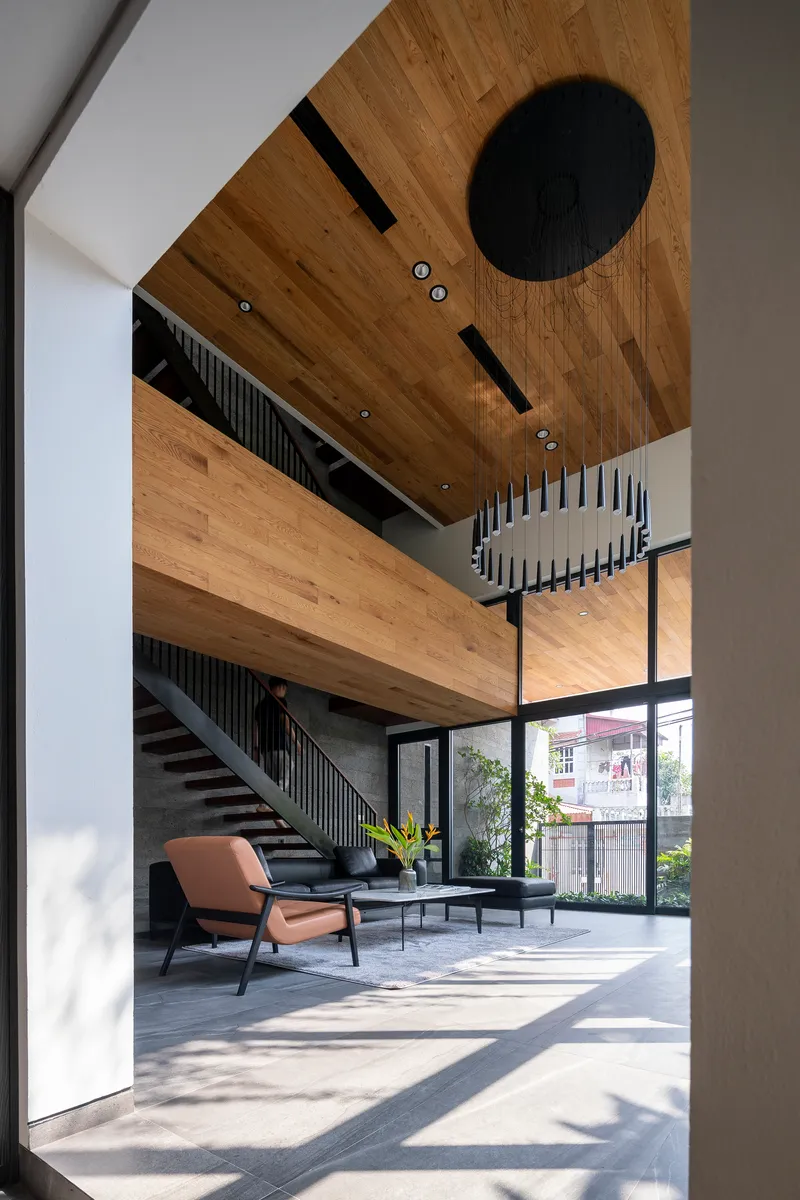
The heart of the house is a double-height living room that functions as an indoor clearing. A timber-clad ceiling warms the volume overhead, while a concrete staircase and a floating timber bridge cut across the space at the upper level. One wall opens entirely through floor-to-ceiling glazing onto an interior courtyard and koi pond. The room doesn't need to be large to feel expansive; its proportions and connections to adjacent spaces do that work.
A circular pendant light hangs in the void, catching afternoon sun that pours through the courtyard-facing glass. The bridge above is more than circulation. It's a viewing platform, a place to look down into the living room or across to the garden. For children growing up in this house, that bridge would be a stage, a hiding spot, a world.
Courtyards and Water
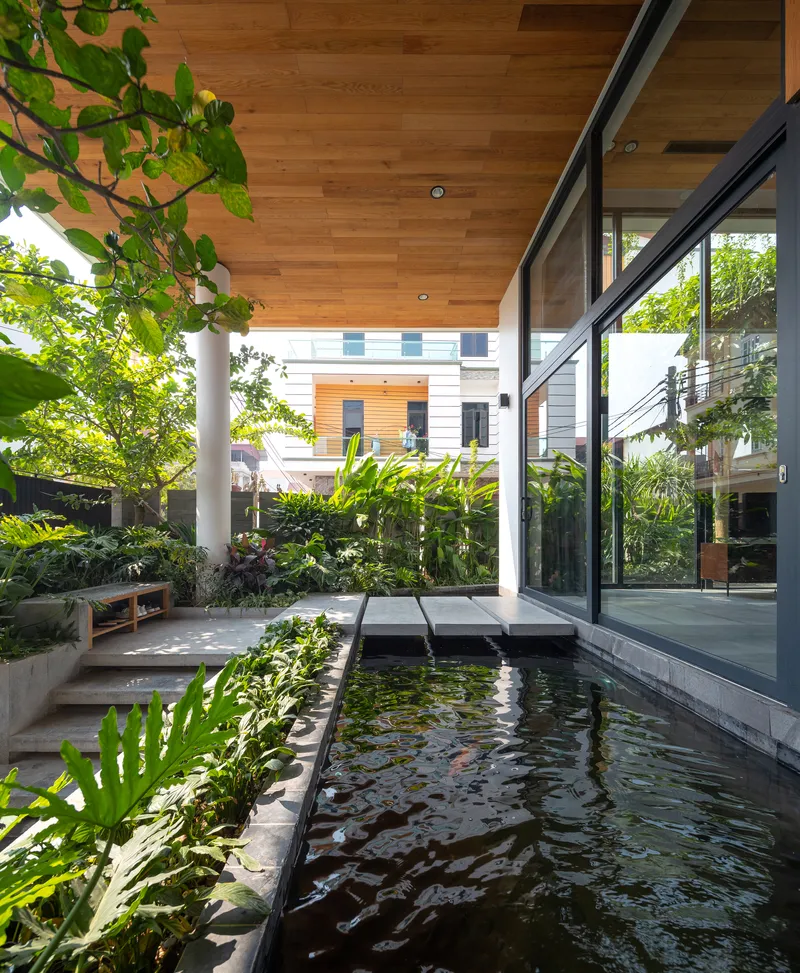
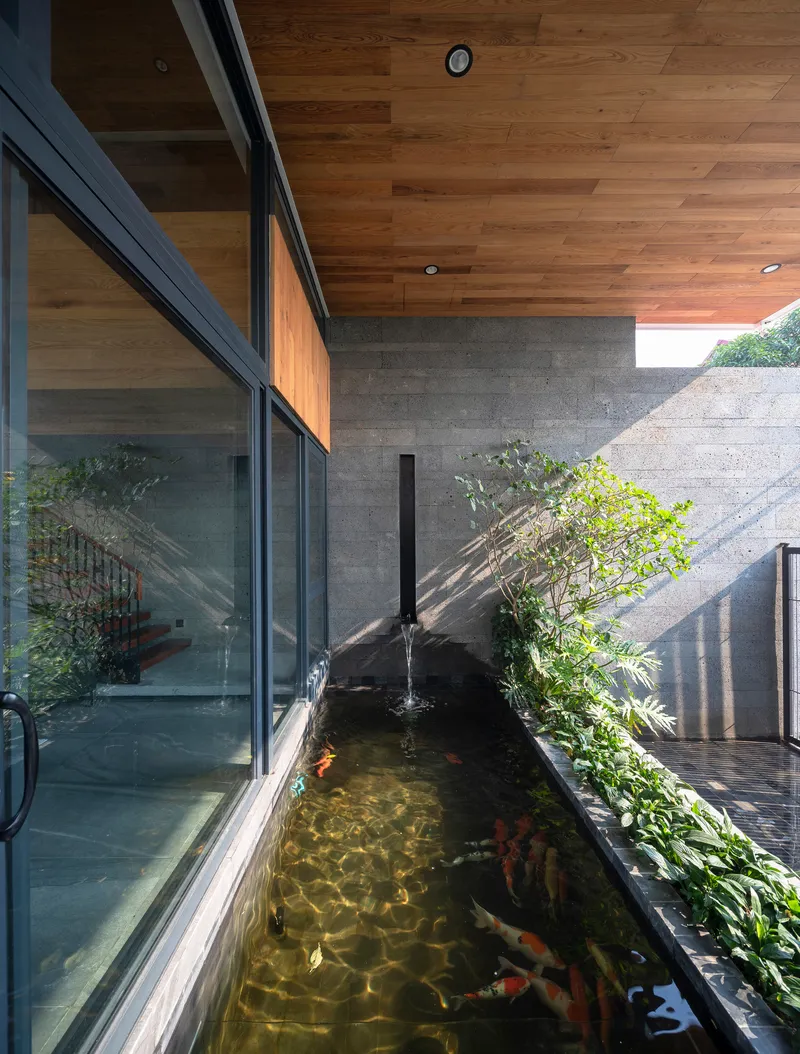
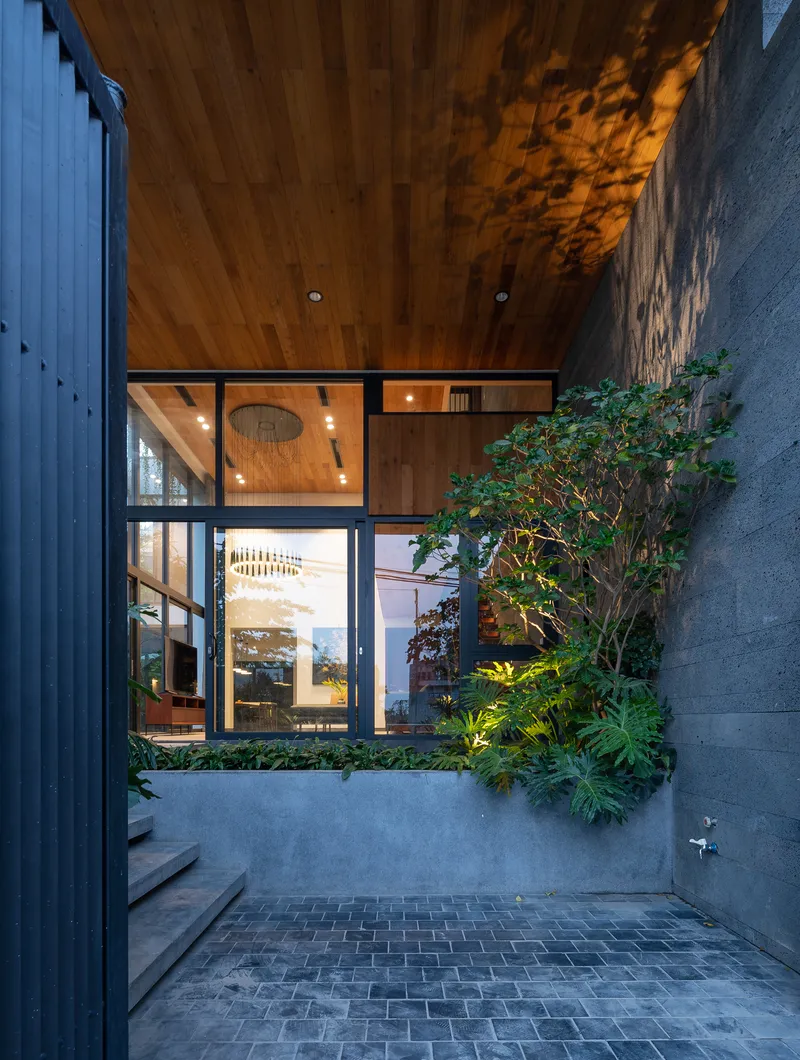
TB House carves courtyards into its mass at multiple levels, and nearly all of them involve water. The covered courtyard on the ground floor centers a koi pond beneath a timber ceiling, with glass walls opening to a planted garden beyond. A fountain jet disturbs the surface of the water, introducing sound as a counterpoint to the visual stillness. The architects understand that in a tropical climate, the combination of water and airflow doesn't just look good; it cools.
At dusk, the courtyard spaces transform. Soft uplighting catches the underside of timber soffits and the surfaces of planted beds edged in slate paving. The house becomes its own landscape, interior and exterior conditions so intertwined that the distinction loses meaning.
Planted Facades and Vertical Ecology
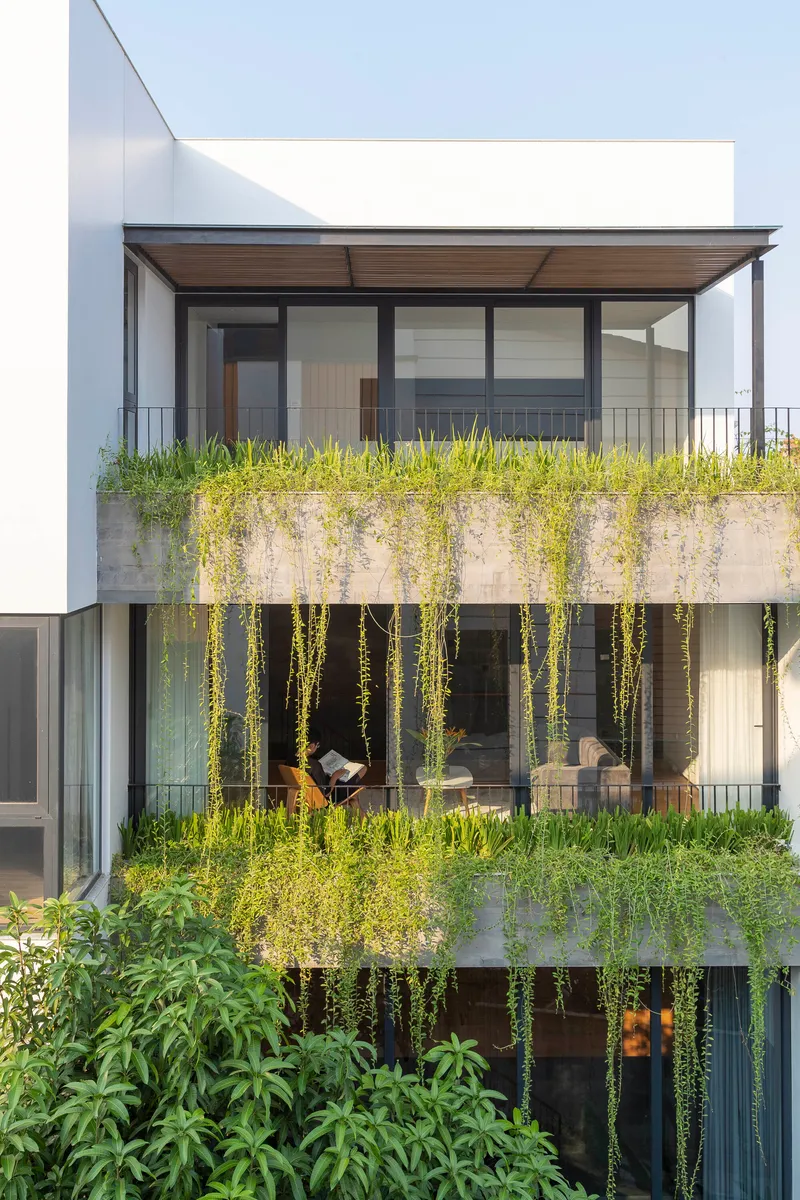
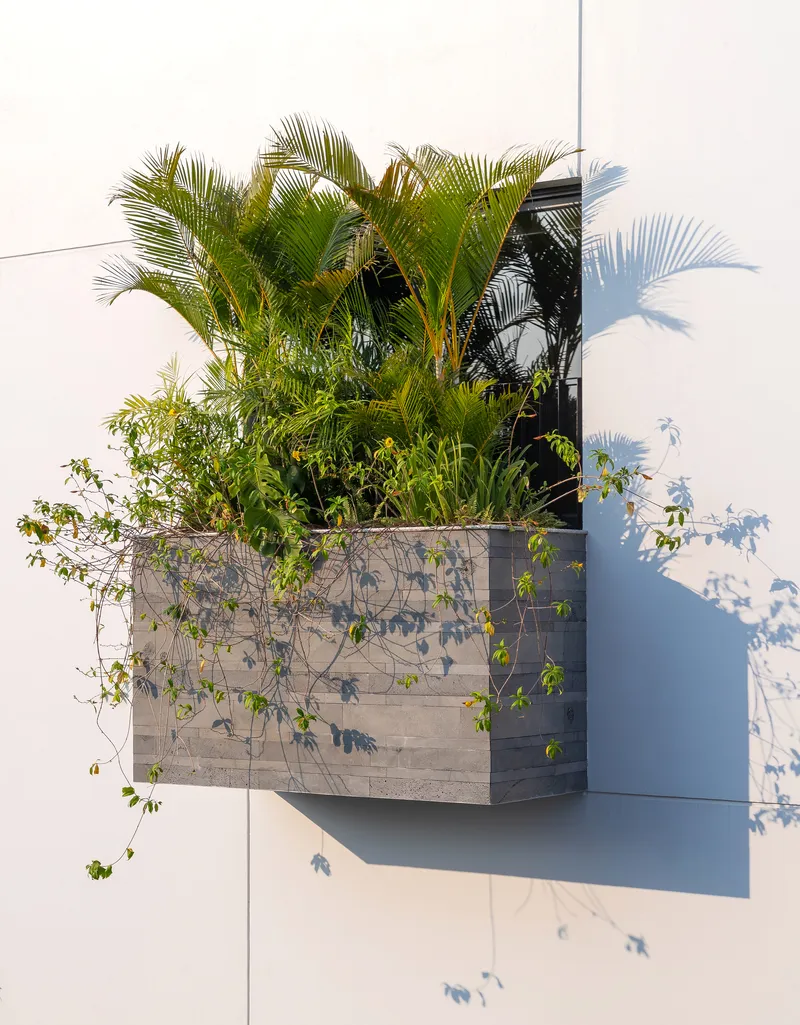
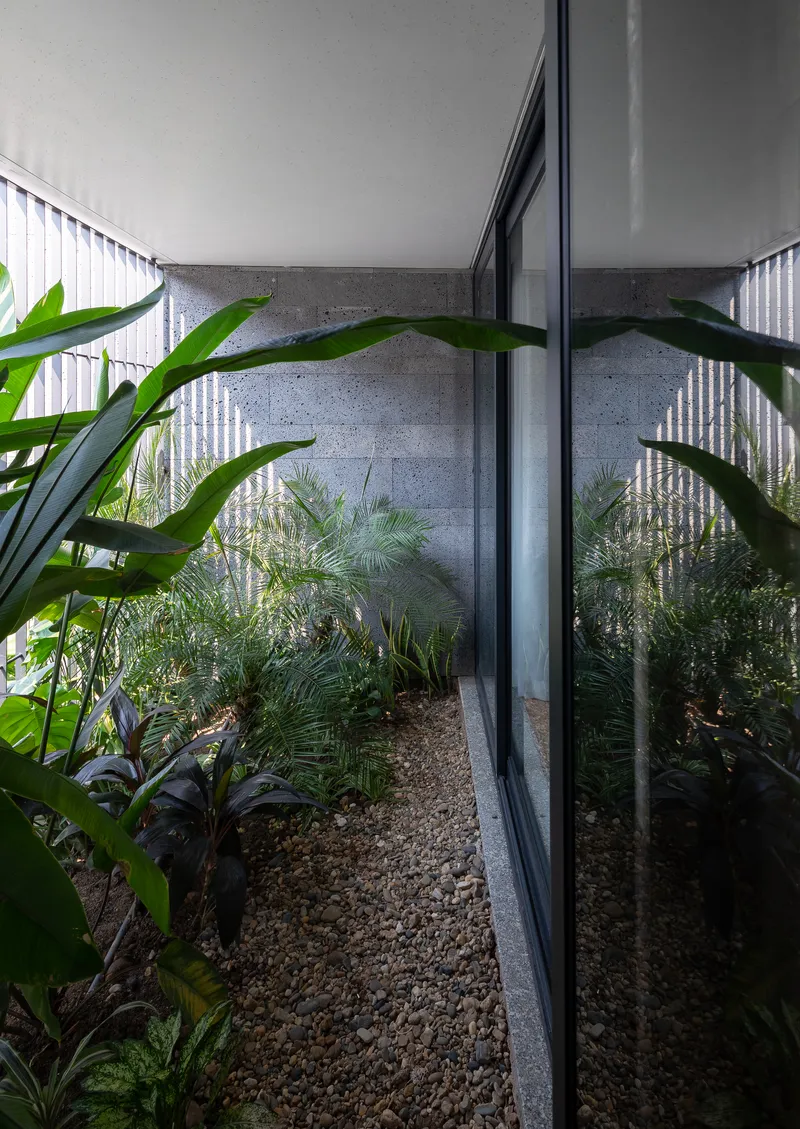
The planted terraces are not afterthoughts bolted onto a finished structure. They are integral to the building's section, with stacked concrete planters built into each floor slab. Cascading greenery spills over multiple levels, creating a living skin that shades the facade, absorbs rainwater, and provides habitat. Narrow planted courtyards wedged between concrete walls use corrugated screening and tropical foliage to filter light into deeper floor plates.
The effect from the street is cumulative. Where a neighboring house might present a blank wall, TB House offers a wall of green punctuated by concrete and timber. It's an argument that density and ecology aren't opposed, that even a modest urban lot can sustain a genuine vertical garden if the architecture commits to it from the start.
Interior Materiality and Light
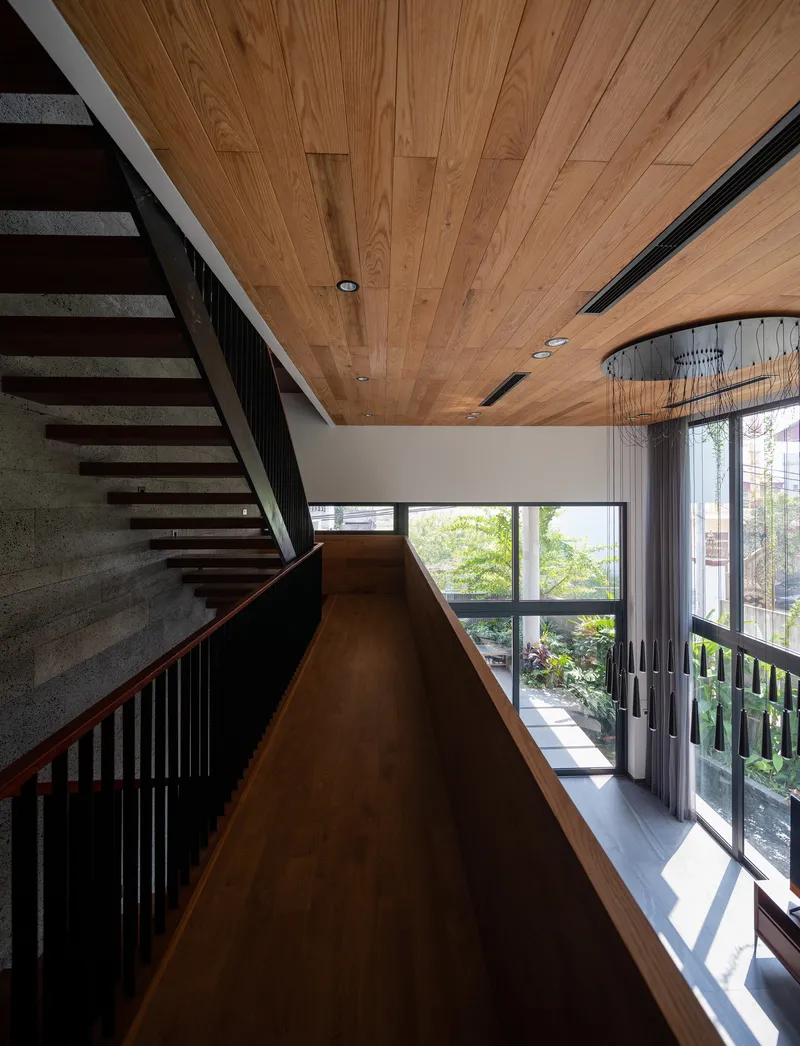
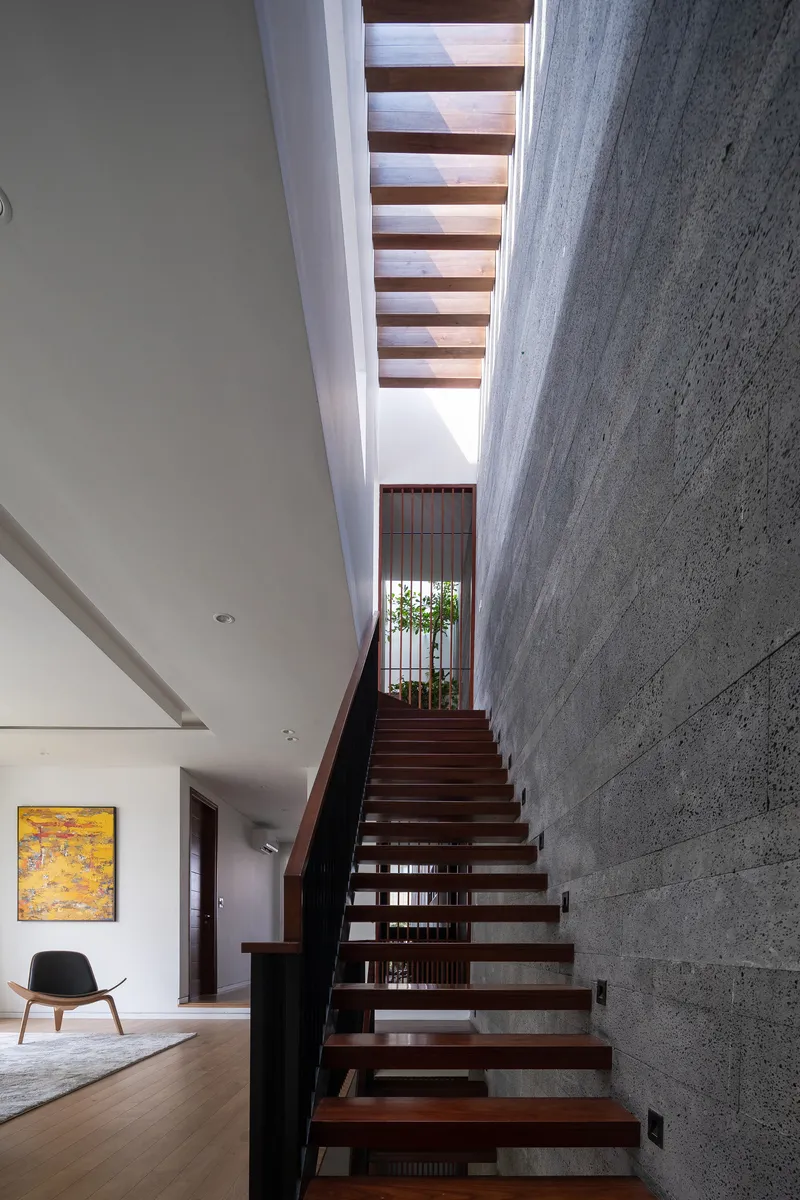
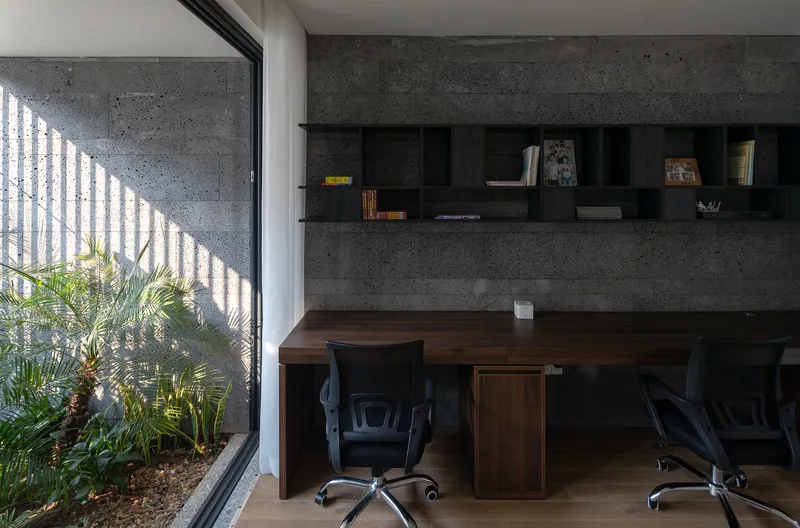
Inside, the material palette stays restrained: board-formed concrete, timber cladding, vertical wood screens, and local stone. The architects let light do the decorating. Open-tread staircases sit beside raw concrete walls with skylights above, pulling sun deep into the section. Vertical wood screens filter daylight into landings and hallways, casting striped shadows that move through the day.
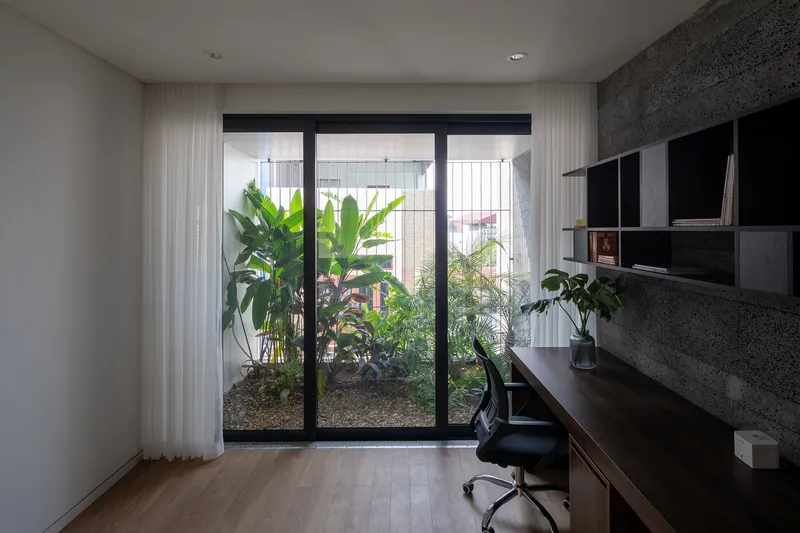
Workspaces and home offices open directly onto planted lightwells, blurring the line between desk and garden. A walnut desk sits against concrete wall shelving while filtered sun falls through the foliage of a courtyard just beyond the glass. The message is consistent throughout: no room in this house is more than a glance away from something green and alive.
Twilight and the Illuminated Section
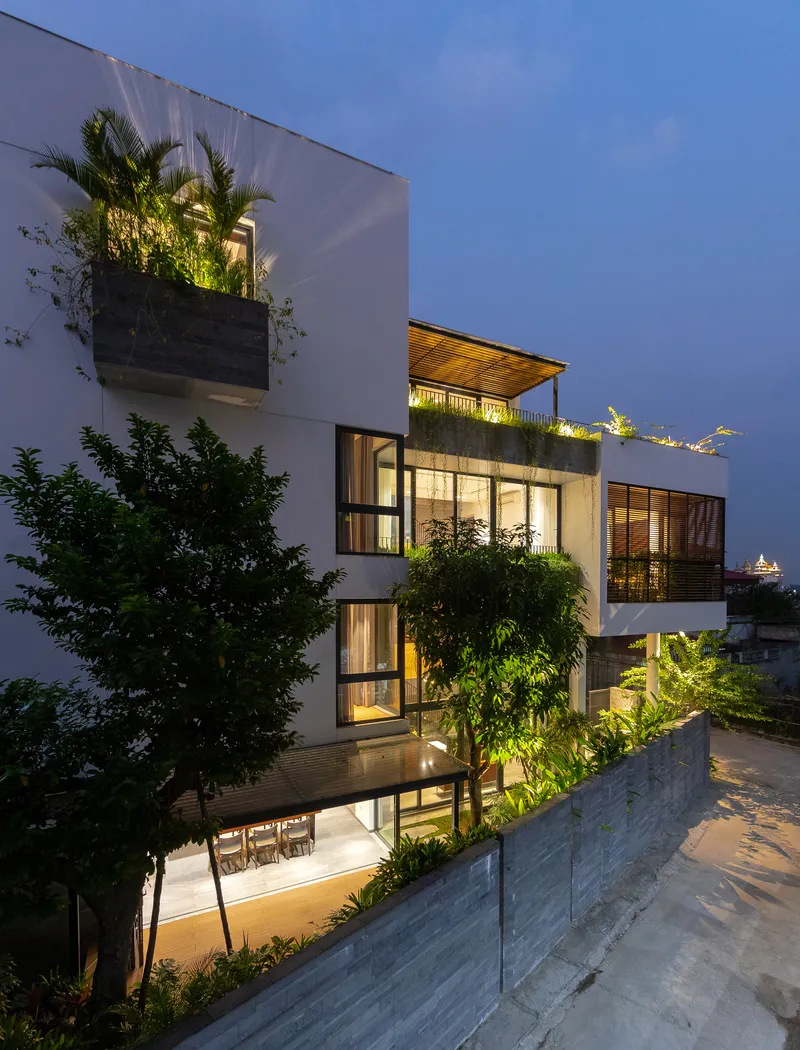
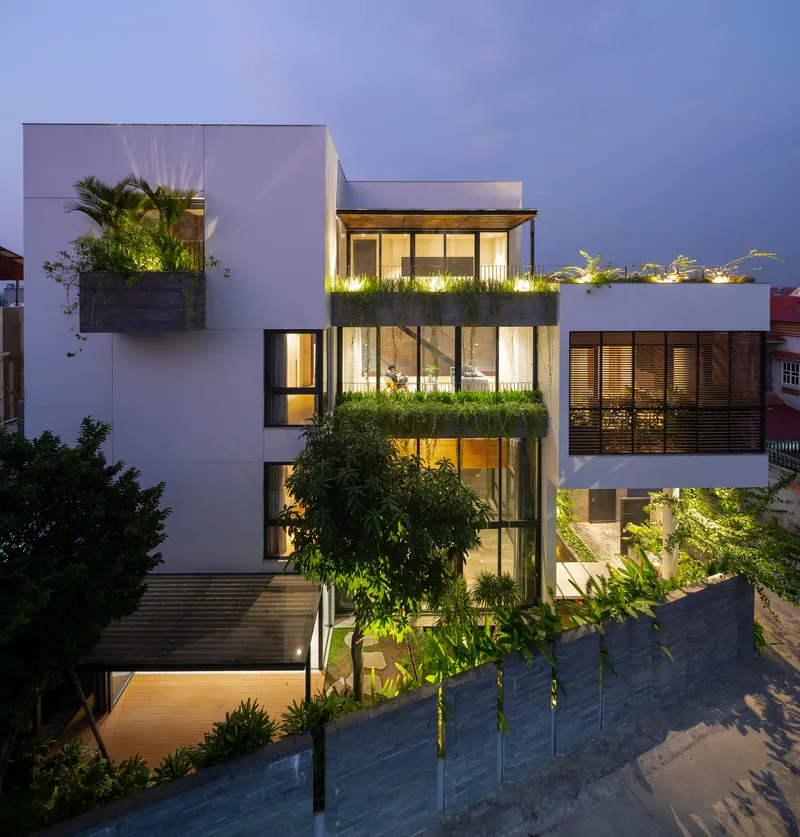
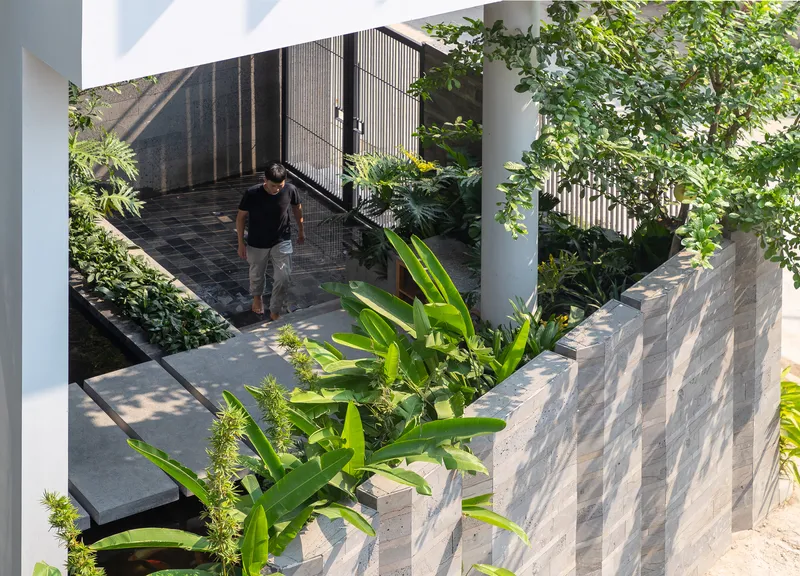
At twilight, TB House reveals its section. Full-height glazing on the stepped facade turns each level into a lit display case, while uplighting beneath planted terraces makes the greenery glow against the darkening sky. The timber screens become translucent, their slats backlit from within. The house communicates its internal logic to the street more clearly at night than during the day.
An elevated walkway connecting planted terraces captures a figure descending between levels, a reminder that this is a house for movement, for children running between floors and gardens. The architecture doesn't sit still, and neither do its inhabitants.
Plans and Drawings
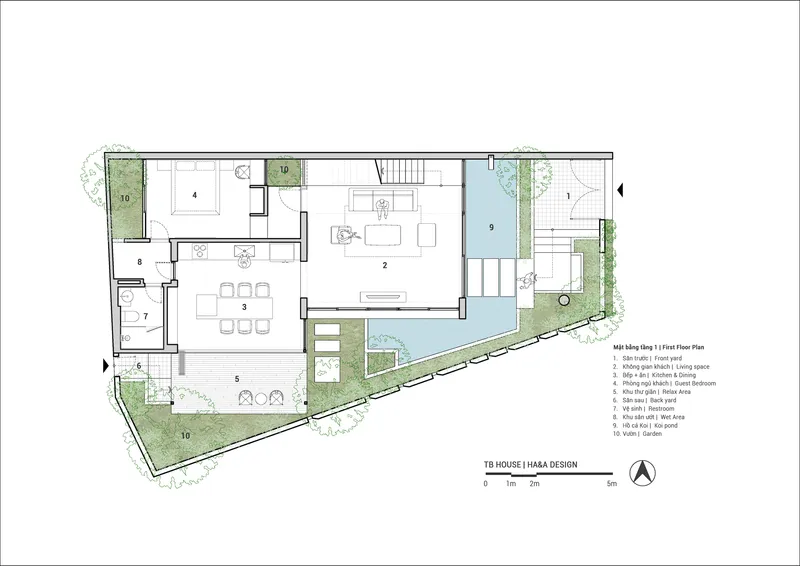
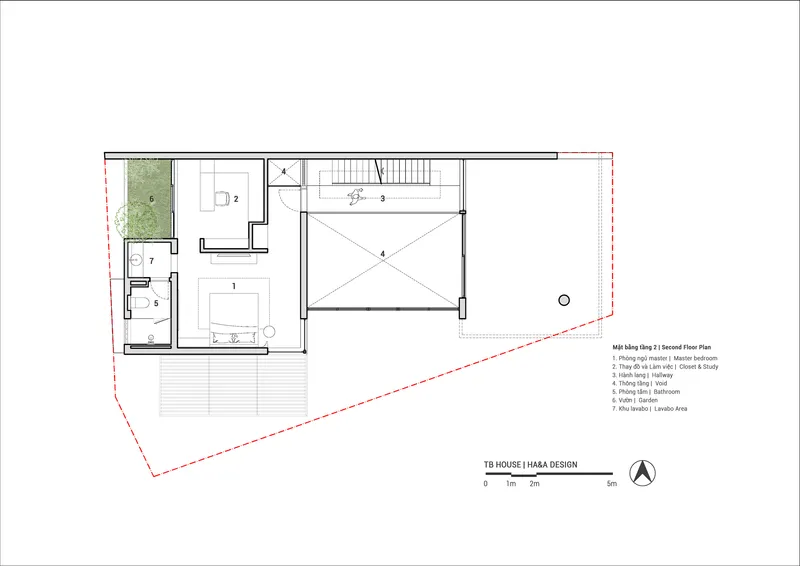
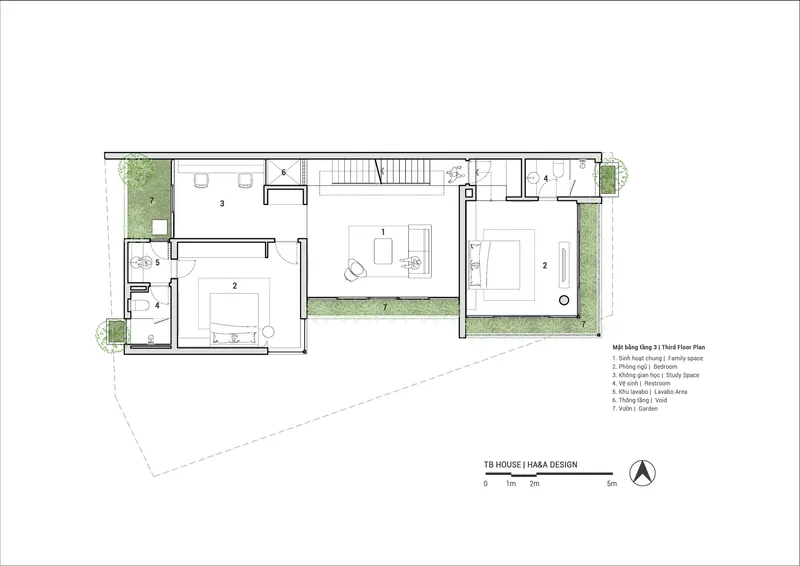
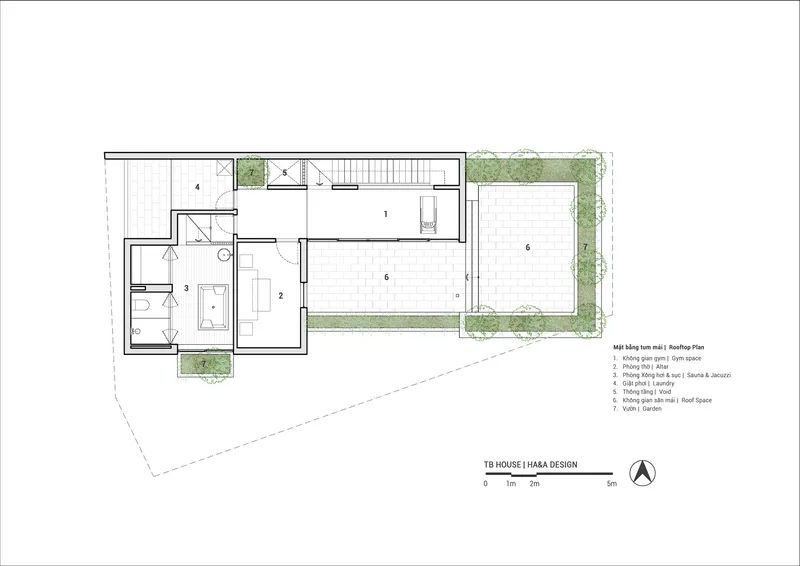
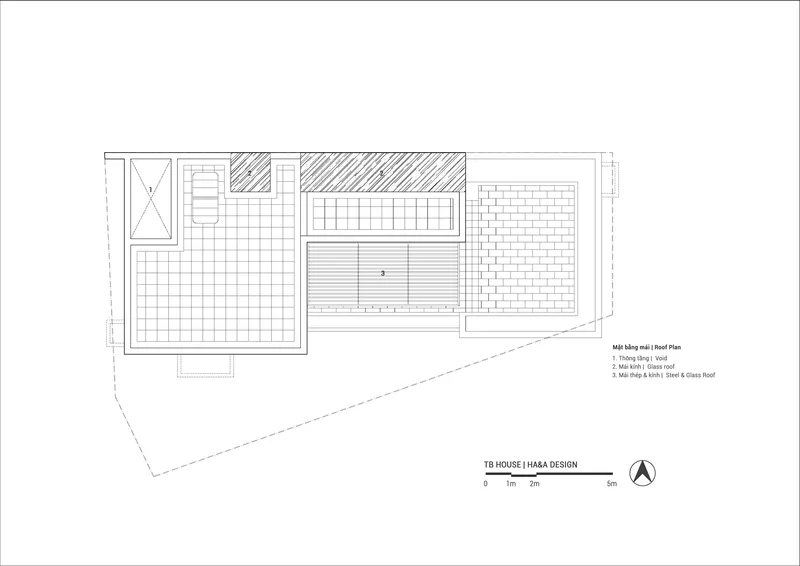
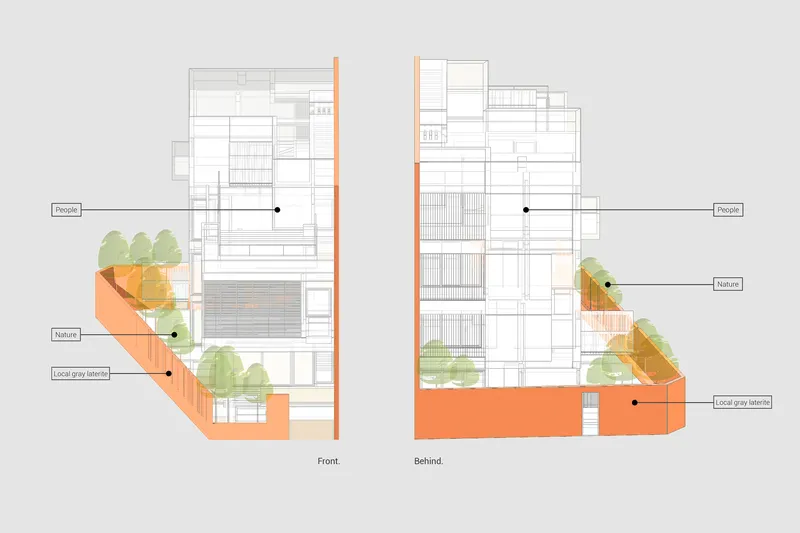
The floor plans confirm what the photographs suggest: the house is organized around a series of voids and courtyards that stitch three volumes together. The first floor clusters living spaces around a pool and landscaped courtyards. The second floor dedicates itself to a bedroom suite with a planted balcony. The third floor houses two children's bedrooms, each with access to its own courtyard and green space. The rooftop opens into terraces edged with planting and accessed by a central stair.
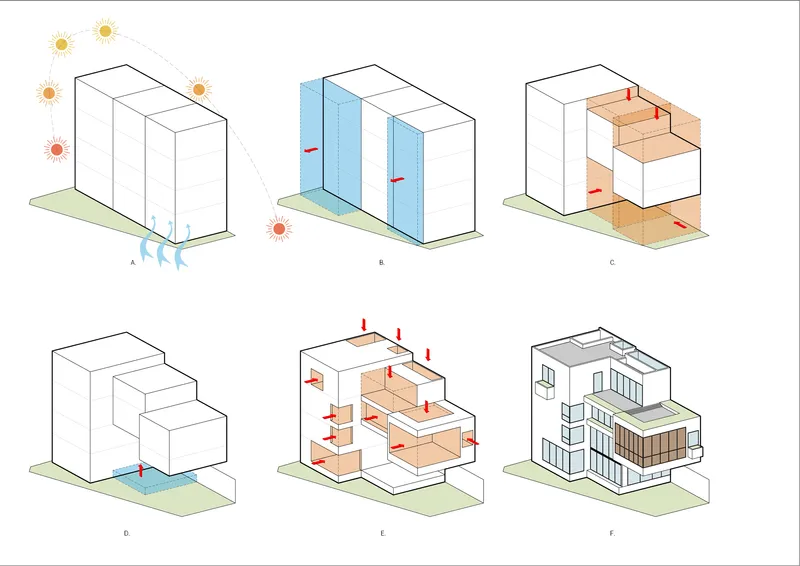
The isometric diagram sequence is the most revealing drawing. It illustrates the massing development as a process of subtraction and perforation: solid volumes are carved, shifted, and opened to admit ventilation, shown with directional arrows tracing the path of prevailing wind through the building. The section drawings display the terraced profile in elevation, with orange-coded volumes stepping back from the street and planted areas filling the resulting gaps. This is a house designed in section first, with plan following the logic of airflow and light.
Why This Project Matters
TB House matters because it takes a familiar problem, how to build a private house on a small lot in a rapidly urbanizing village, and turns it into an argument for environmental generosity. The architects didn't retreat behind walls. They stacked gardens, opened courtyards, aligned volumes with wind and sun, and used local stone and timber to root the building in its place. The passive climate strategy isn't a technical afterthought; it's the generative idea behind the entire design.
For a house built as a gift to children, the gesture is apt. HA&A Design have created a building that doesn't just provide rooms to sleep and eat in. It provides a relationship with weather, light, water, and growing things. In a village that is losing its green edges to development, this house insists on keeping them, not at the periphery, but woven into the very fabric of domestic life. That insistence is worth paying attention to.
TB House by HA&A Design, Vietnam. 400 m². Completed 2022. Lead architect: Vũ Ngọc Hậu. Photography by Triệu Chiến.
About the Studio
Share Your Own Work on uni.xyz
If projects like this are the kind of work you want to make, uni.xyz is a place to publish your own, find collaborators, and enter design competitions.


Popular Articles
Popular articles from the community


Lunar Spiral: Space Architecture Shaped by the Mathematics of the Universe
Lunar Spiral reimagines space architecture through Fibonacci geometry, lunar regolith, levitating habitats, and self-sustaining Moon living.

Play: Fragments of Their World
Familiar architecture becomes modular playground design, creating safe spaces where displaced children can learn, connect, imagine and play.

Riyadh For All: Intergenerational Urban Design for Active Aging in Rabat
Riyadh For All reimagines urban design in Rabat with intergenerational co-living, adaptive courtyards, and Moroccan cultural exchange today.

Co-Life: Senior Housing Design That Reconnects Older Adults With the City
Co-Life reimagines senior housing design through healing gardens, shared streets, workshops, and a sustainable community across generations.

Similar Reads
You might also enjoy these articles

Bao Huynh Watercolor Atelier: A Serene Art Retreat in Hội An
Bao Huynh Watercolor Atelier in Hội An blends multifunctional art spaces, sustainable design, local materials, and family-friendly living in a serene environment.

Atelier Macri Concept Store Interior Design by CASE-REAL
Atelier Macri store features a "ko" counter, walnut wood details, cork displays, blending retail, gallery, and seamless customer experiences.

Manuel Vargas Izquierdo Stadium and High-Performance Sports Center: Architectural Excellence in Jalpa de Méndez
The Manuel Vargas Izquierdo Stadium blends sustainable design, inclusive sports facilities, and cultural-inspired architecture, revitalizing Jalpa de Méndez’s public spaces.

KAKR Buluh Awar Hall: Revitalizing Community and Ecology Through Bamboo Architecture
Community built bamboo hall revitalizes Buluh Awar village, empowering youth, restoring ecology, celebrating vernacular craftsmanship through sustainable architecture and culture.




Comments (0)
Please login or sign up to add comments
No comments yet. Be the first to comment!