
Habi + Dular
Container City on Waters

The brief of the competition begins with talking about the issue that the cities all over the world are facing - rising rents in urban areas and shrinking quality of life. The biggest contributors to the rising costs are rising land values and construction costs.
The idea of utilizing shipping containers for housing is a proposed solution in the brief to reduce the construction costs and introduce the concept of modularity which further economizes the construction and real estate industry.
 While deciding about where to place the intervention consisting of student housing made up of 15 shipping containers, the idea of placing on water was something that came first to mind. As the brief in depth talks about dearth of land and rising land values, water is a resource that remains untouched with respect to housing cities. Oceans can be the be the next real estate by humans being more adaptable and construction technologies reaching newer highs.
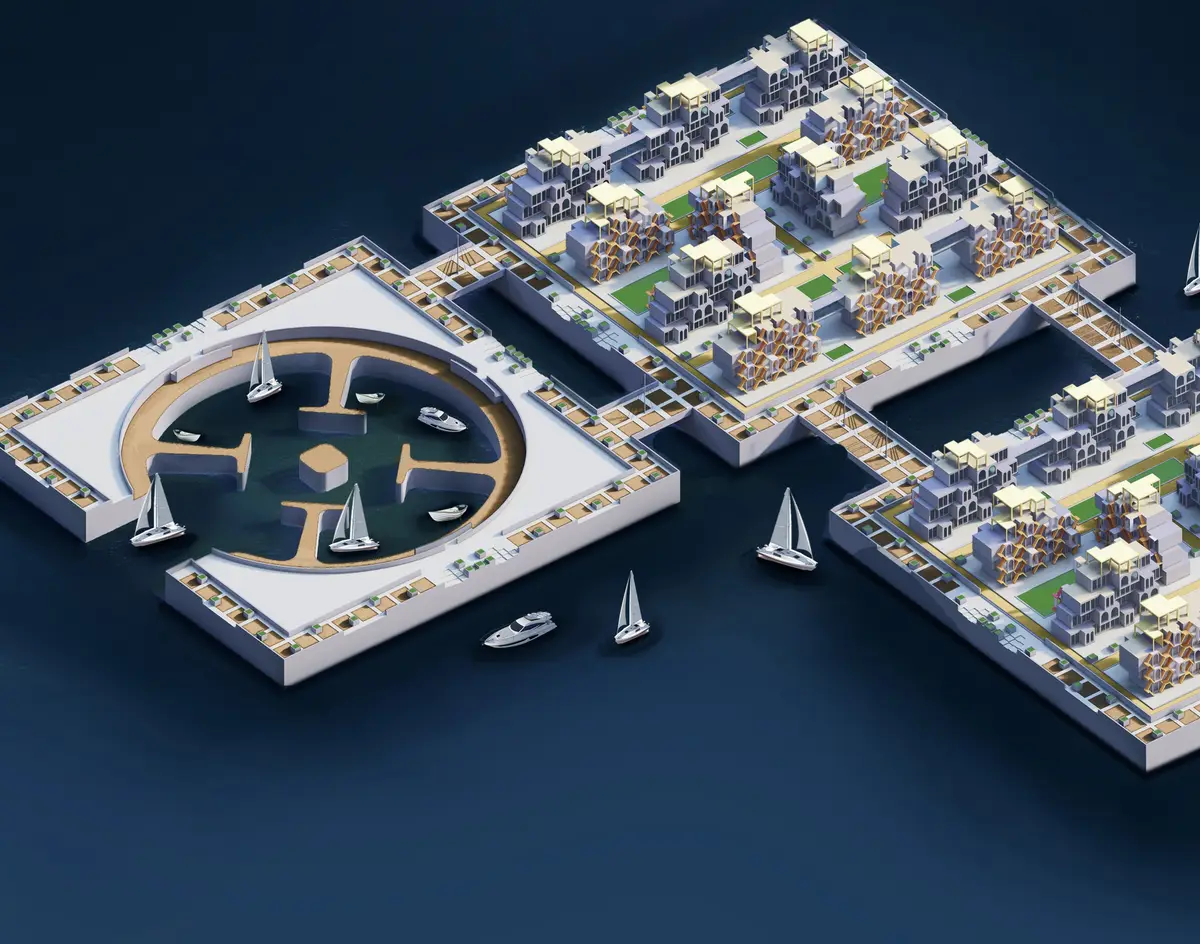
Hence, a city on waters is being proposed keeping the issues highlighted in the brief at the heart of the intervention.
The intervention focuses on creating a student housing city that is self sufficient on water. The modularity concept is not only restricted to the use of shipping containers but also while planning the city.
The design process was taken up in two stages simultaneously. While one facet of the design focuses on the use of shipping containers for housing and optimum utilization of the same, the other facet focused on creating a modular city for the student housing made up of shipping containers. The modularity concept is central to the entire scheme keeping it in the heart of the design concept.
As in can be seen from the image below, a square as a shape was chosen to form the footprint of a single module of the intended city. This compliments the form of the shipping containers as well and hence work well in harmony with the given form. A square being orthogonal is efficient in terms of space utilization since it does not form any acute angles and hence minimizes the possibility of creation of unusable spaces. There are many iterations possible to plan the footprint of the shipping containers within a square framework. A footprint in the form of a square enhances the possibility of future expansion as each side is equal to the other and hence providing space for expansion.
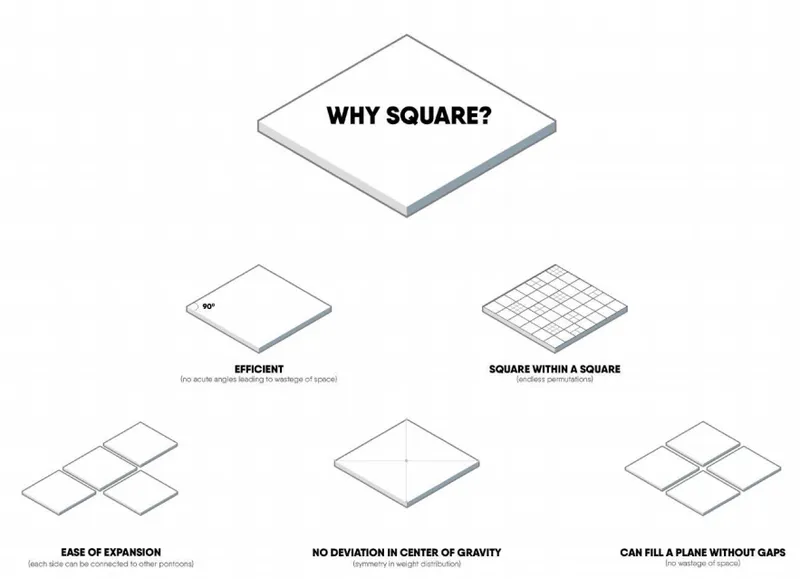

As it can be seen from above, before arriving at the final form and layout, a lot of iterations were played with and designed. Due to the modular nature of the component, the possibilities of its interaction with one another and other building components (for example, staircases) is endless and that is what was explored.
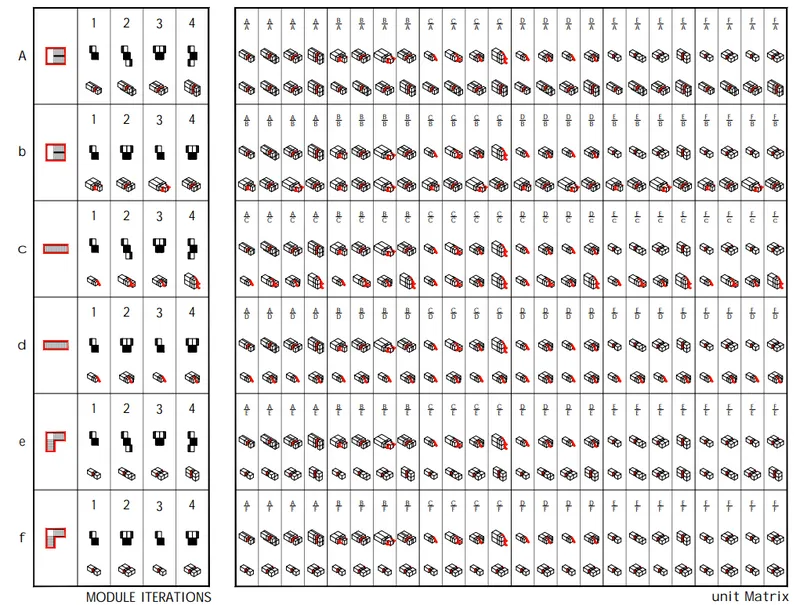
Above is an extension of the iterations explored. The ideas of modularity and inter relationships of the module is something that was explored in the above matrix before coming into and detailing the final inter relationship and juxtapositioning.
As the footprint of the city was finalized, the next step in the design process was to play around with placing shipping containers upon it and creating a schematic master plan of sorts. After completing massing and formalizing a form for the 15 containers, priority was placed on creating interior layouts of the containers and optimizing upon these layouts was key. Since the design brief stressed upon the dearth of land and rising land values and cost of construction, minimal and optimum spaces were the design drivers for the layouts of the containers so as to incorporate as many people as possible in the 15 containers without making it too crammed but at the same time ensuring space efficiency.

As it can be seen from above, an attempt was made to utilize the capacity of the shipping containers as much as possible so as to house as many people as possible in the 15 containers provided. The layout of the housing is kept as minimal and functional as possible keeping the needs of the students in mind.

The next step after creating layouts in the shipping containers was to work on the 15 shipping containers as a module and see the interaction of each individual shipping container with each other. As it can be seen from above, a form is generated which celebrates the modularity and orthogonal form of the shipping containers by highlighting it in terms of the cantilevers and protrusions. The fenestration design was also done using pure shapes keeping the integrity of the starting form intact.

Next step was to place the 15 shipping container module on the square footprint and play around with future expansion ideas. The idea was to show how the concept of future expansion is kept central to the proposal. A concept of 'module within a module' is also in play here.
Each shipping container is a module (as given). That is used to create modular layouts for student housing (as per the brief). Each shipping container is then used as a module to create a unit of 15 containers and that again is used as one housing module and repeated in a pattern one a footprint which is also used as a module for the city.

The brief talks about utilizing 15 containers and going upto four floors. However, while designing the form of the built up, future expansion vertically was considered and then the form was derived.
Both horizontal expansion (in terms of the city) and vertical expansion (as shown above) were explored and the same have been represented.
Hence, as it can be seen from above, the ideas of modularity and future expansion are kept at heart of the intervention and is being incorporated at each facet of the design.

Popular Articles
Popular articles from the community


Temporary Home for Dogs: A Reversed Zoo Rethinks Animal Shelter Architecture
In Bucharest, a sinuous corridor and freed landscape flip the logic of containment, designing a shelter that works to make itself unnecessary.

Opera on the Sea: Driftwood Logic Shapes a Timber Opera House on Estonia's Coast
Trevor Orgill's opera house translates the entangled drift of floating timber into a civic building where wood, water, and music converge.
Cloaked Colonization: A Mobile Underwater Habitat That Moves Like a Fish
Micah Abaya's shortlisted EHC Pacific entry reimagines ocean settlement as a dispersed network of self-sustaining architectural organisms.

Manzana Morphosis: Stretching Barcelona's Grid into a Living Landscape for 2050
A radical reworking of the Eixample manzana turns density into a tool for generous public space, vertical ecology, and environmental performance.

Similar Reads
You might also enjoy these articles

Shakur's House: Exposed Brick as an Interior Organiser in a 168 m² Mashhad Residence
Brick moves indoors in this Mashhad residence, where masonry walls, glass partitions and teal planes sequence a compact home without closing it off.

Day and Night Park: A Time-Based Urban Newsstand in Beijing
A temporary urban newsstand in Beijing blending travel, light, and reading through poetic colors, compact form, and community-focused design.

Modernist Patio Renovation in El Masnou, Barcelona by Oliver Segura Arquitectura + Cebrià Arquitectura
Modernist patio renovation blending tradition and innovation with a movable pool, leveled floors, and Catalan materials in El Masnou.

Alto Residencial Coop: Cooperative Housing Development in Santiago de Compostela by Carbajo Barrios Arquitectos
A linear cooperative housing complex blending white volumes and perforated metal façades, enhancing community living, natural light, privacy, and urban integration.

Explore Modular Housing Competitions
Discover active competitions in this discipline


Challenge to reimagine the Iron Throne

Photograph architecture without architects

Illustrate the lost glory of Angkor Wat - Render Challenge

Design challenge to reuse E-waste
Comments (0)
Please login or sign up to add comments
No comments yet. Be the first to comment!