
Halcyon House Stacks Warmth in Singapore
Ming Architects layers timber, stone, and light into a generous Singapore home that feels both monumental and deeply intimate.

Singapore's residential architecture often oscillates between two poles: the glassy minimalist box and the tropical courtyard house. Halcyon House, designed by Ming Architects and completed in 2023, occupies a more interesting middle ground. At 600 square meters, it is unmistakably generous, yet its intelligence lies not in sheer size but in how it choreographs volume, material, and natural light to produce a home that feels both ceremonial and lived-in.
Lead architect Tan Cher Ming organized the house around a raised double-volume living room and a central stairwell that functions almost like a vertical courtyard, pulling daylight deep into the plan. The material palette is disciplined but warm: ribbed timber, veined marble, pebbled stone, and concrete in careful proportions. What makes the project worth studying is its refusal to let any single gesture dominate. Every room earns its own spatial character while serving a larger compositional logic.
A Layered Facade That Breathes
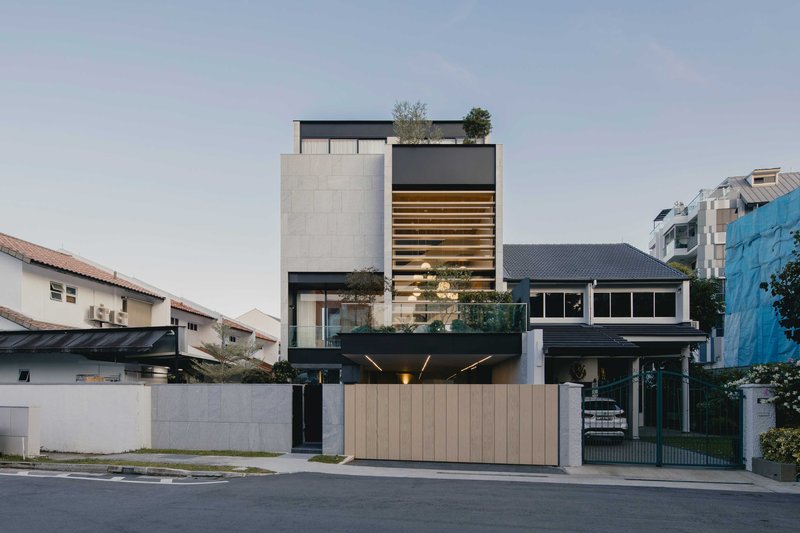
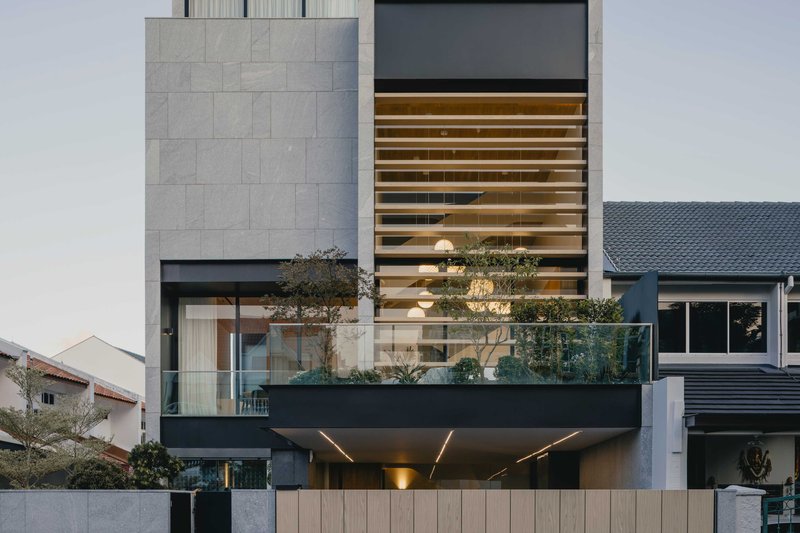
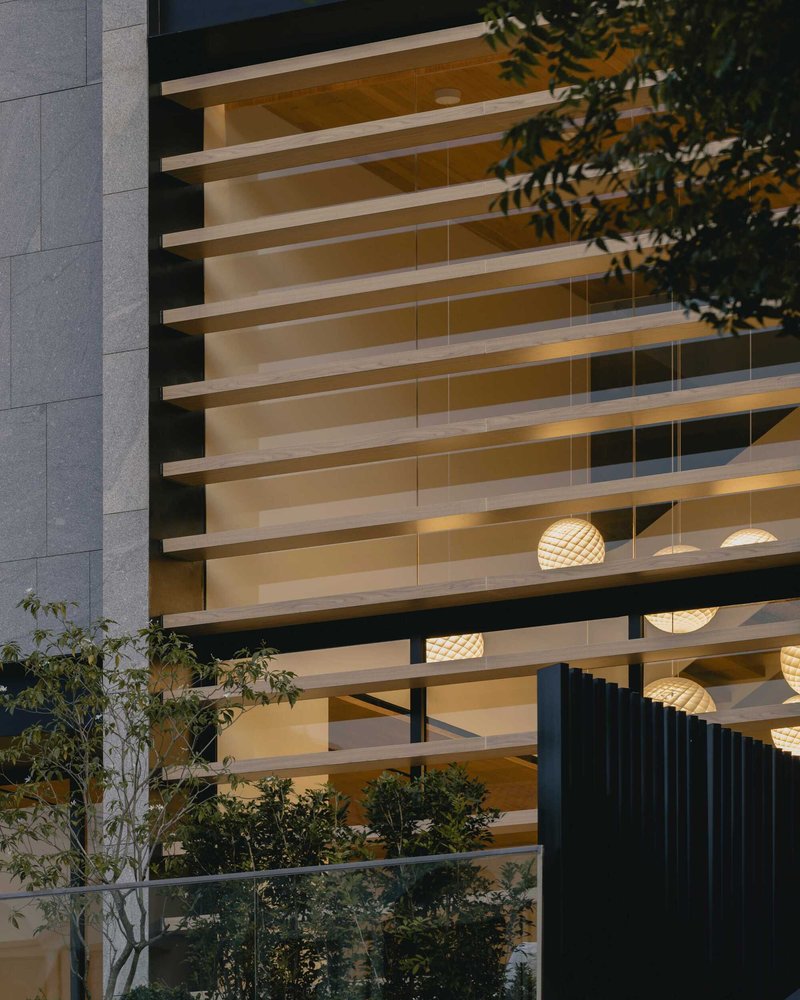
From the street, Halcyon House reads as a stack of horizontal layers: grey stone base, timber-louvered middle, and planted rooftop terrace. The louvered screens are not merely decorative. In Singapore's equatorial climate, they filter direct sun while allowing cross-ventilation, a functional move that also gives the facade depth and shadow play as light conditions shift throughout the day.
Photographed at dusk, the screens become semi-transparent, revealing pendant lights and interior volumes beyond. The effect is cinematic. Rather than presenting a sealed wall to the neighborhood, the house flickers between opacity and openness, offering glimpses without full disclosure. It is a facade that changes its mood with the hour.
The Double-Height Living Room as Social Engine
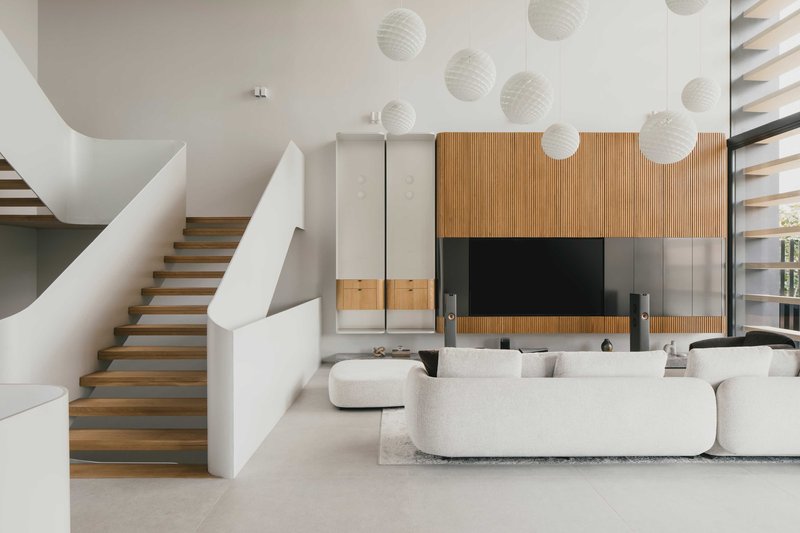
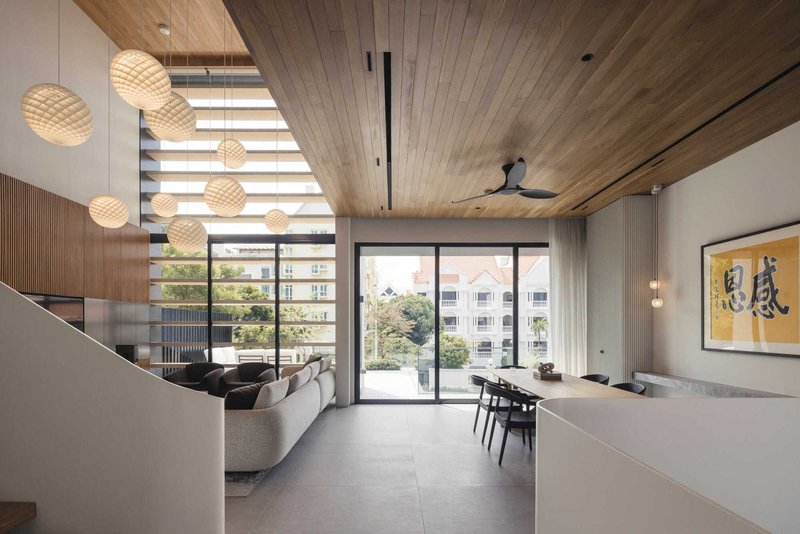
The raised double-volume living room is the heart of the house, and Ming Architects treat it with appropriate ambition. A ribbed timber media wall anchors one end, while a cantilevered timber staircase floats along the other, turning circulation into spectacle. Spherical and woven pendant lights drop from a timber-clad ceiling, their softness counterbalancing the room's verticality.
Horizontal louvered screens wrap the upper portion of the space, establishing a visual connection to the exterior while moderating the scale. The room is designed for gathering: big enough to host, warm enough to feel intimate. It avoids the hollow grandeur that can plague double-height residential spaces, largely because its surfaces are tactile and its proportions carefully tuned.
The Stairwell as Vertical Courtyard
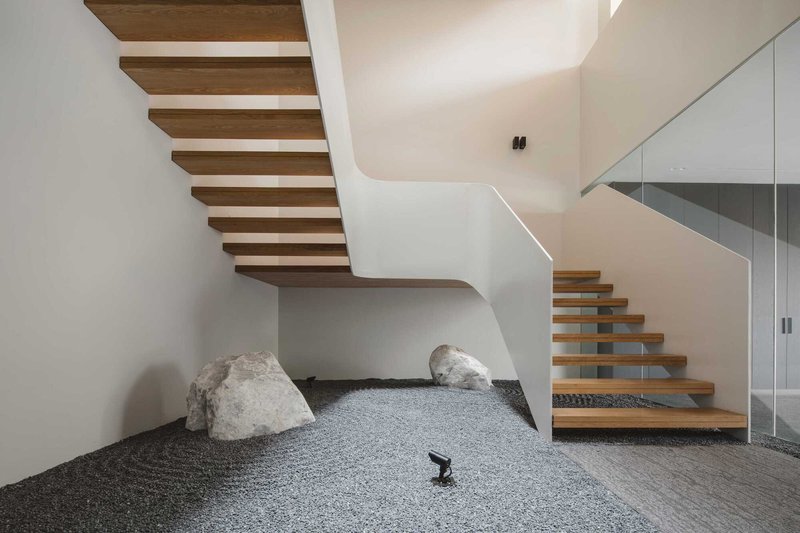
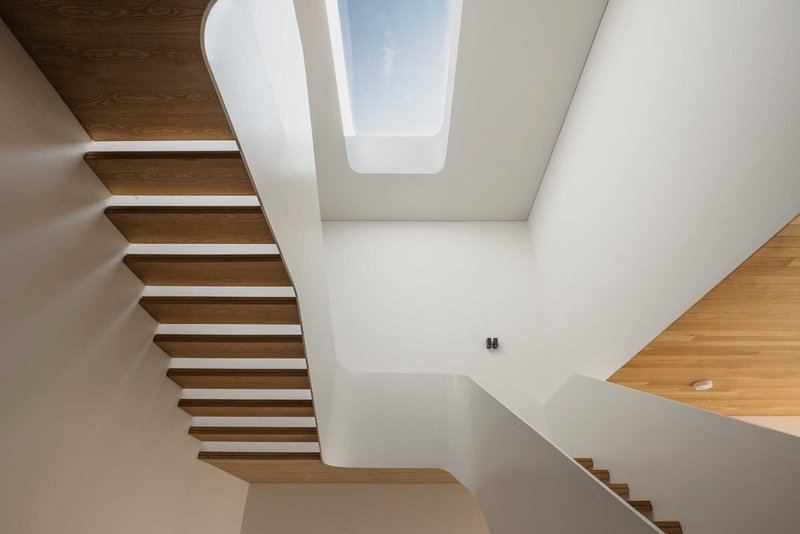
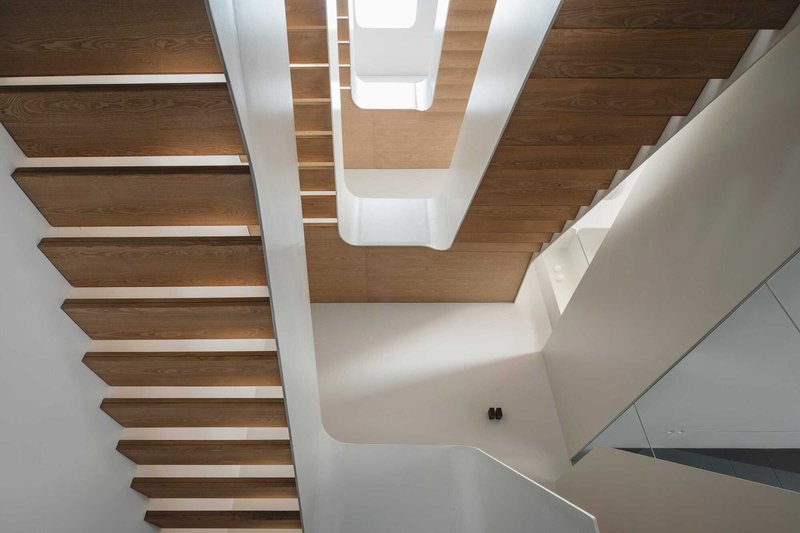
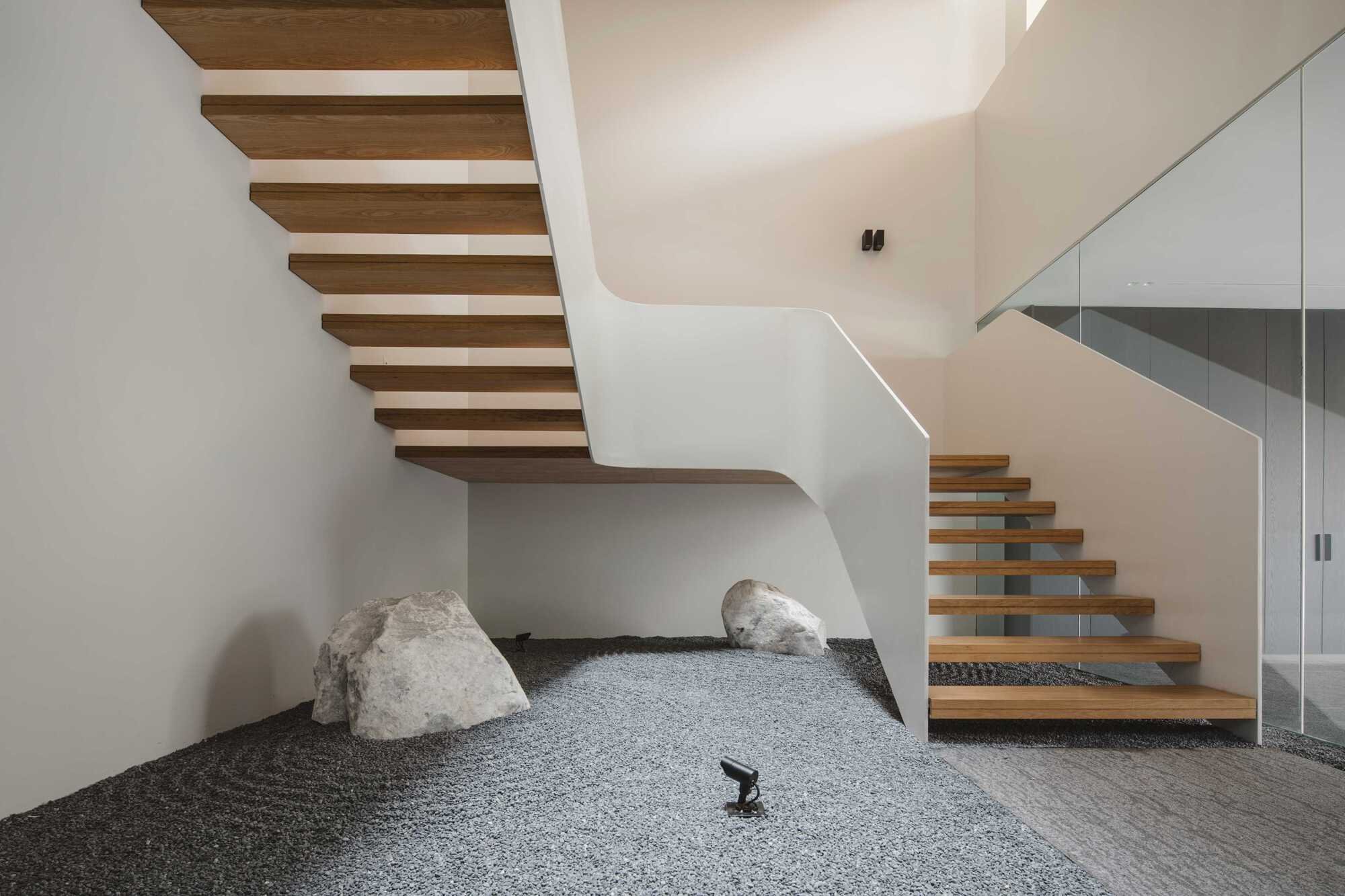
Perhaps the most striking spatial move in Halcyon House is the central stairwell, which Ming Architects have transformed into something closer to a light well or vertical courtyard. A pebbled interior garden sits at its base, white sculptural walls rise around it, and a rectangular skylight crowns the sequence above. The cantilevered timber treads and glass balustrades keep the composition visually open, allowing light to cascade uninterrupted from roof to ground.
Looking upward, the coffered timber ceiling and skylight create a framed composition that recalls the oculus of a much older architectural tradition. It is a contemplative moment in a house otherwise oriented toward family life and hospitality. The stairwell quietly insists that moving between floors should be an experience, not merely a transition.
Kitchen and Dining: Timber Warmth Meets Stone Weight
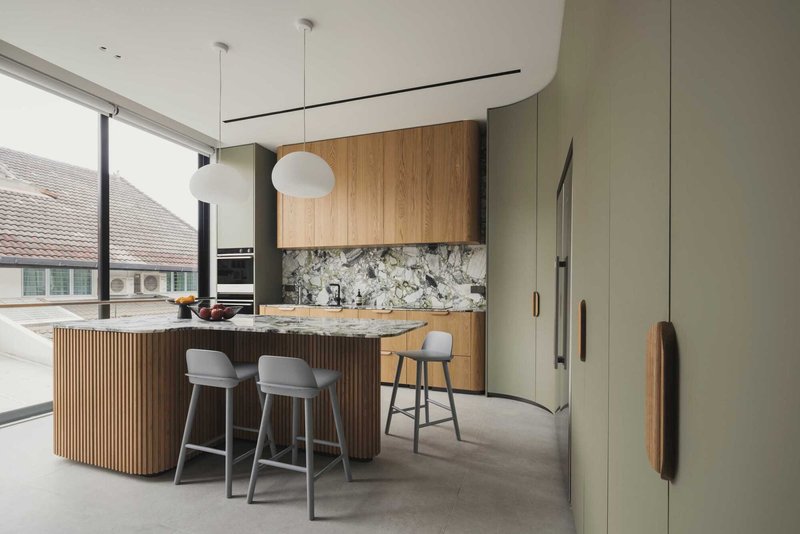
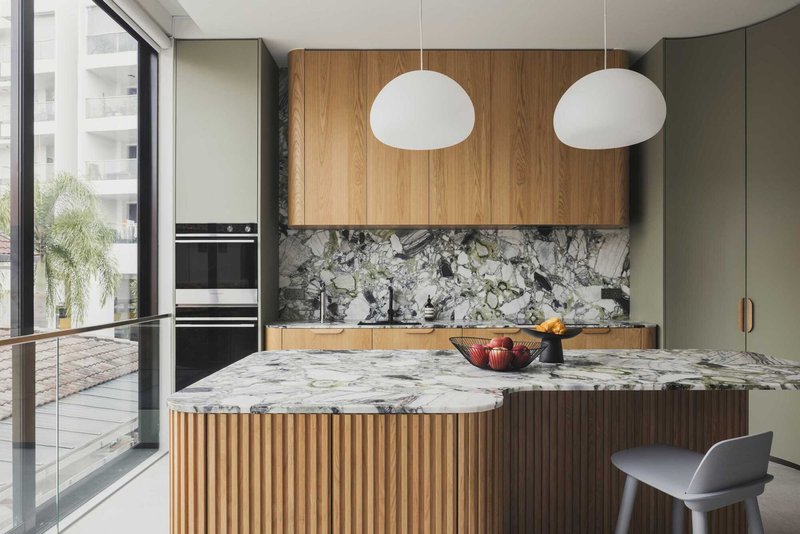
The kitchen is centered on a curved, ribbed timber island topped with heavily veined marble, a combination that balances organic warmth with geological heft. White dome pendants hang low, establishing an intimate scale within the larger open plan. The marbled stone backsplash behind continues the material dialogue, grounding the cooking zone in permanence.
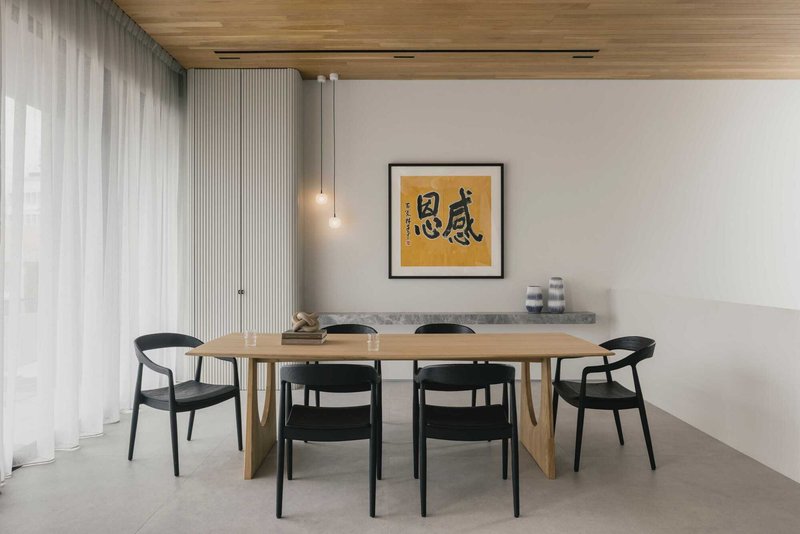
Adjacent to the kitchen, the dining area takes a quieter tone. A timber table sits beneath a slatted timber ceiling, with vertical slatted wall panels creating rhythm without competing with the food and conversation the room is designed to hold. The restraint here is deliberate: after the drama of the living room and stairwell, the dining space offers a pause.
Thresholds and Entry Moments
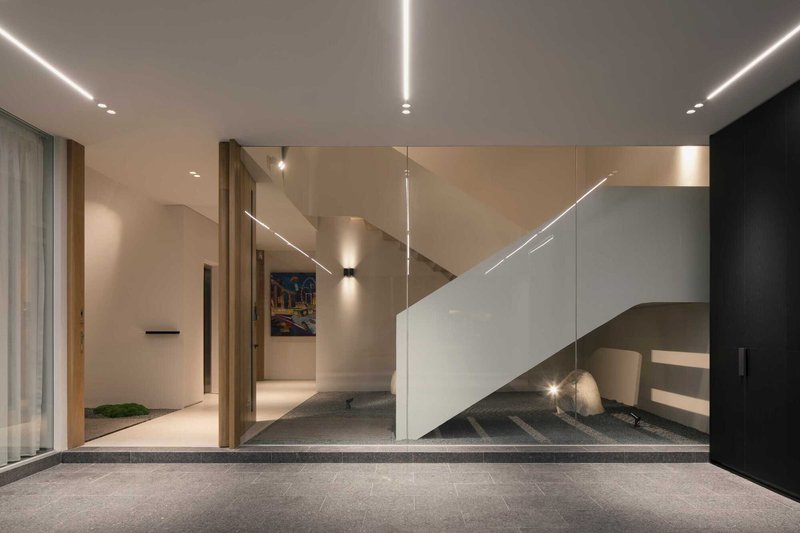
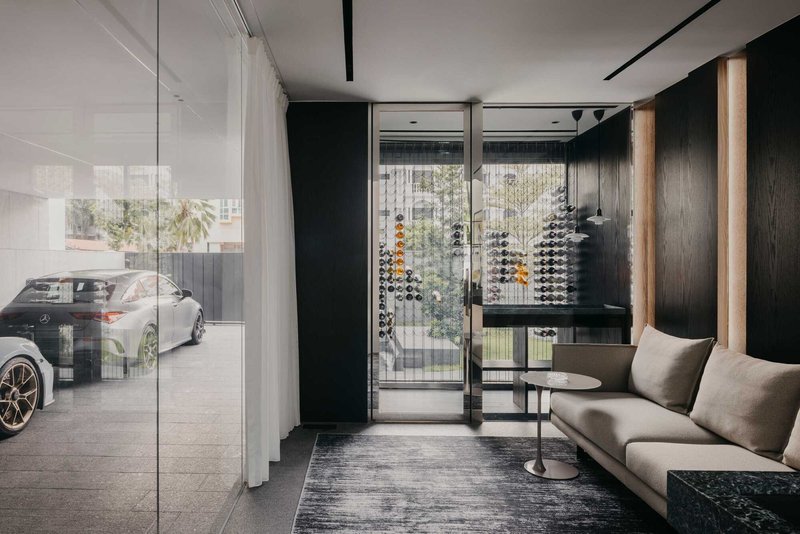
The entry sequence deserves attention. The foyer features a white sculptural staircase under linear ceiling lighting that draws you inward. At ground level, dark timber paneling and a glass wall create a compressed, moody arrival experience. A wine display behind the seating area signals the house's social ambitions from the very first step inside.
These threshold moments reveal Ming Architects' cinematic sensibility. Compression gives way to release as you move from the entry into the soaring living room. The sequence is not accidental; it is orchestrated to amplify the emotional impact of the main volume.
Private Quarters: Softness and Controlled Light
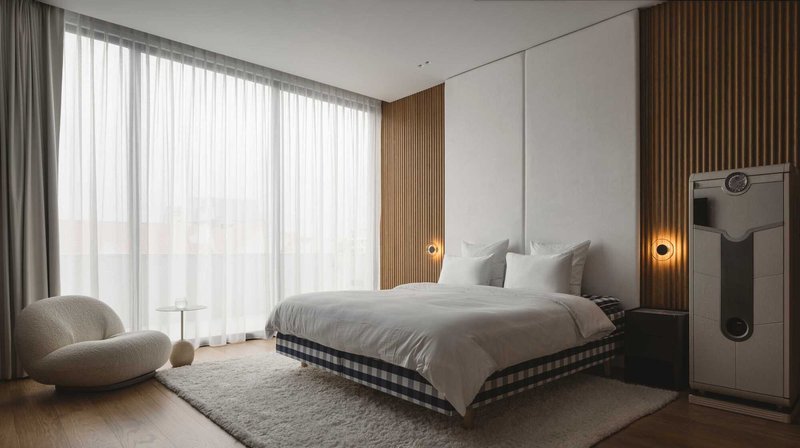
Upstairs, the bedrooms and bathrooms shift to a softer register. The primary bedroom pairs an upholstered headboard wall with timber slat panels and sheer curtains that diffuse Singapore's intense daylight into a gentle wash. It is comfortable without being fussy, material-rich without clutter.
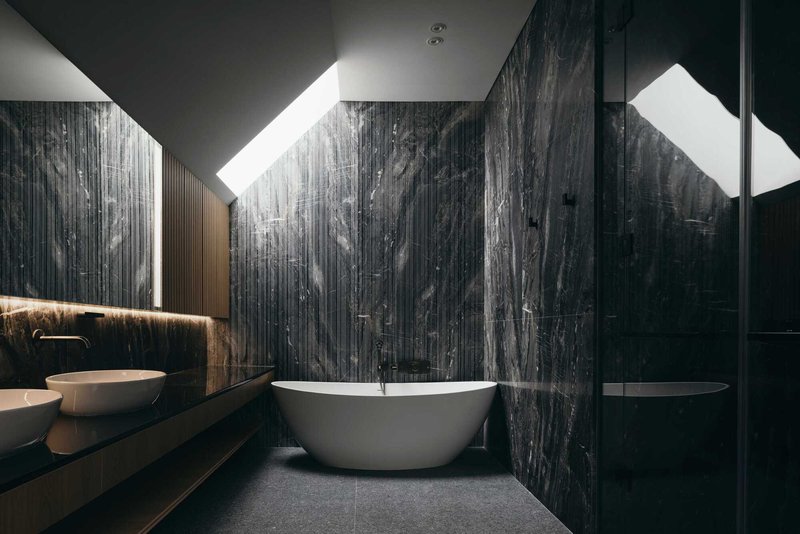
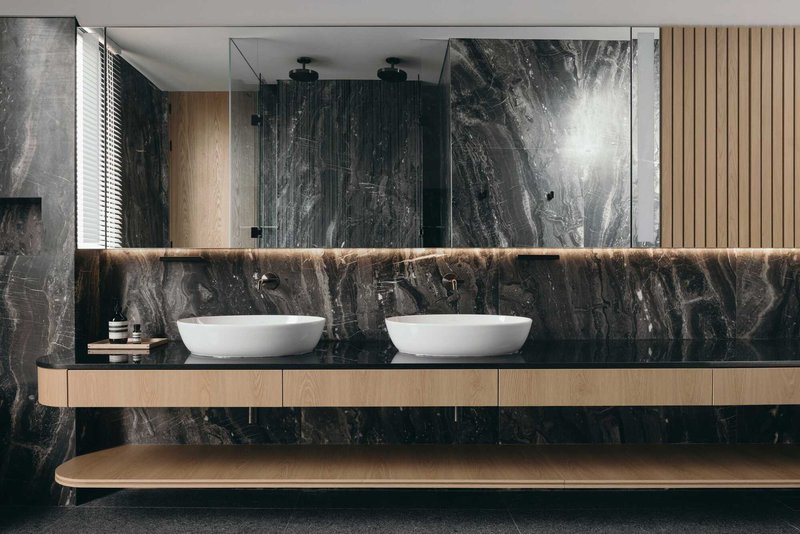
The bathrooms, by contrast, lean into drama. A freestanding tub sits against dark marble walls, lit from above by angular skylights that carve geometric light patterns across the stone. The double vanity continues the dark palette, with vessel sinks on timber cabinetry beneath a backlit mirror. These are spaces that treat bathing as ritual, not routine.
Rear Facade and Rooftop
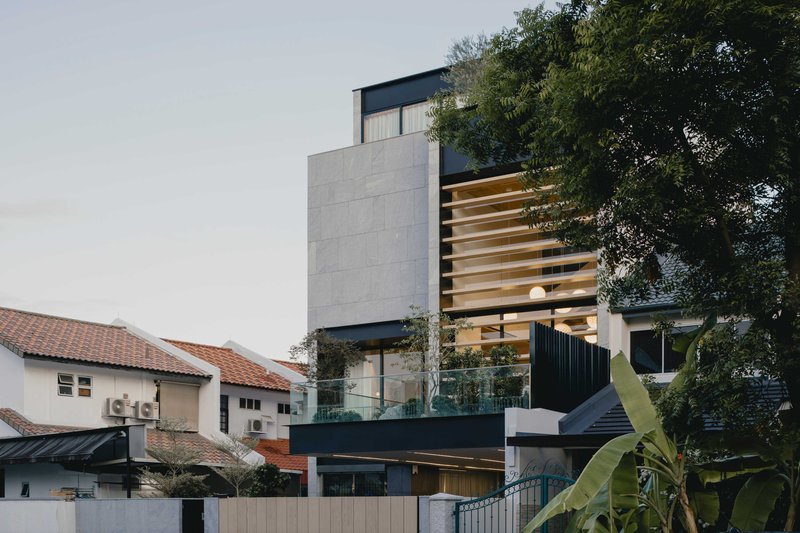
The rear elevation reveals the house's volumetric logic more clearly than the front. Stacked volumes step back to create terraces and outdoor rooms at different levels, with horizontal timber louvers wrapping the composition and tying front to back. The rooftop terrace sits among neighboring trees, offering a canopy-level retreat that extends the usable outdoor space well beyond the ground-floor footprint.
Plans and Drawings
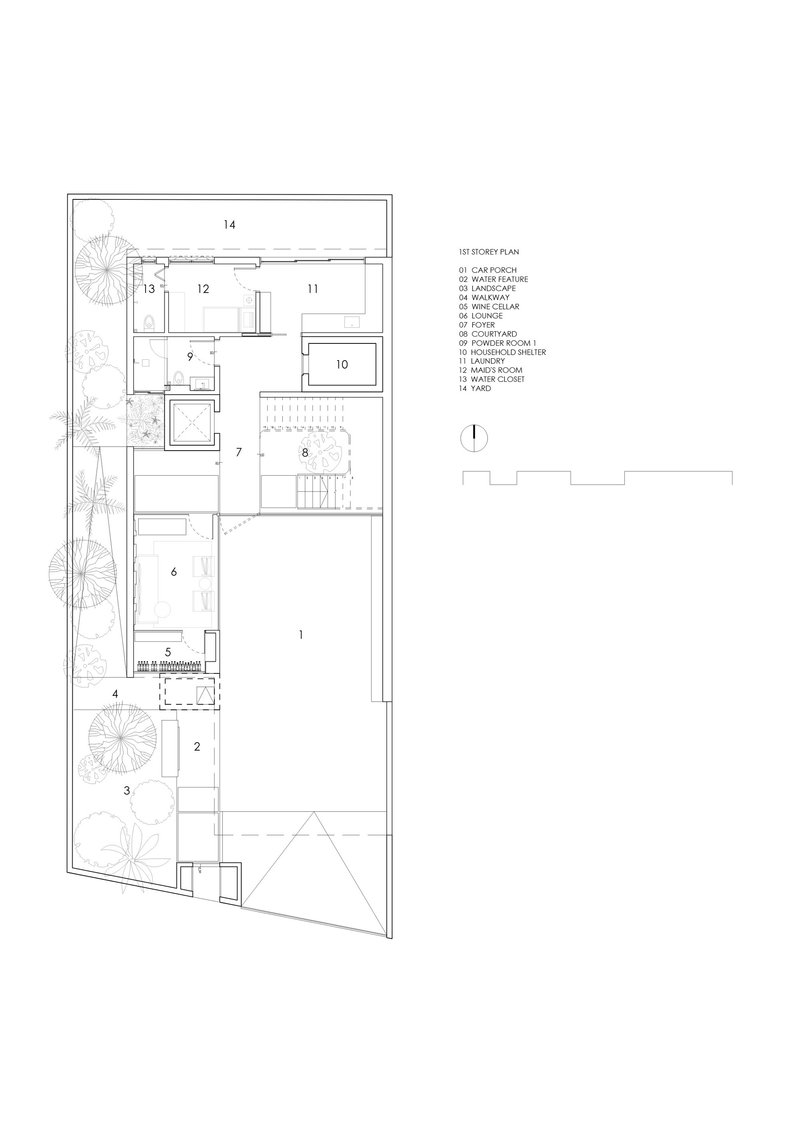
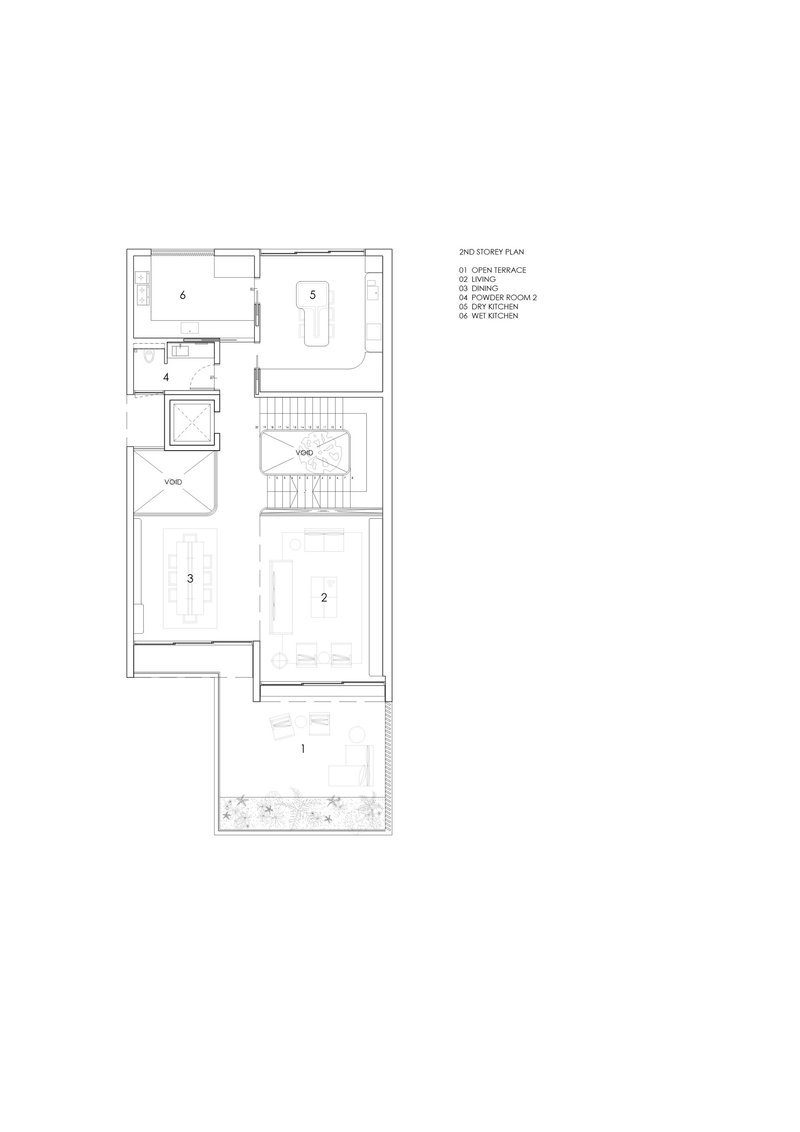
The floor plans confirm what the photographs suggest: the house is organized around a central stairwell that acts as both structural spine and light shaft. On the first floor, bedrooms are arranged to either side of this core, with an outdoor terrace providing a buffer between private and semi-private zones. The second floor continues the logic, with rooms numbered around the central void. The plans reveal a disciplined, compact organization that belies the spatial generosity experienced inside.
Why This Project Matters
Halcyon House matters because it demonstrates that tropical residential architecture can be simultaneously rigorous and sensual. Ming Architects have not defaulted to the open-plan glass pavilion or the inward-looking concrete bunker. Instead, they have built a house that negotiates between public and private, open and enclosed, monumental and tactile, with real skill. The material palette alone is worth studying: every surface has weight and grain, but nothing competes.
For a growing family that wants to host generously without sacrificing intimacy, the architectural challenge is genuine. Halcyon House solves it through section rather than plan, using double-height volumes, vertical light wells, and layered facades to create variety within a compact footprint. It is a house that rewards slow occupation: the light changes, the screens filter, and the timber deepens with time.
Halcyon House by Ming Architects (lead architect: Tan Cher Ming), Singapore. 600 m², completed 2023. Photography by Studio Periphery.
About the Studio
Share Your Own Work on uni.xyz
If projects like this are the kind of work you want to make, uni.xyz is a place to publish your own, find collaborators, and enter design competitions.




Popular Articles
Popular articles from the community

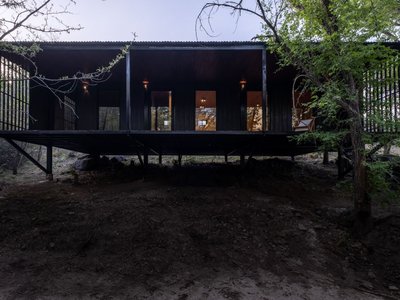
Pablo Senmartin Suspends a Steel-and-Timber Refuge Above a River Forest in Córdoba
An 80-square-meter dwelling on pilotis camouflages itself among the trees of Mayu Sumaj, designed to be dismantled without waste.
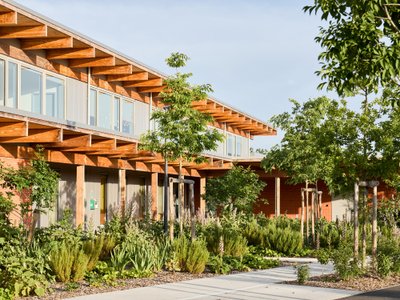
GGR Architectes Anchors a New Neighborhood in Frouzins with a Brick and Timber School Complex
A cruciform plan of terracotta brick and exposed wood frames four courtyards for 140 students outside Toulouse, France.
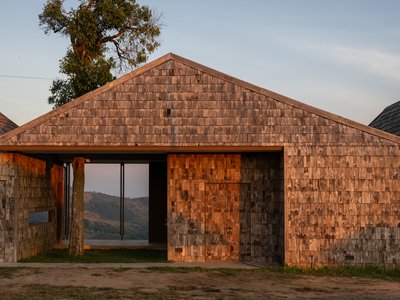
S.O.S Architects Scatters a Cluster of Timber Pavilions Across a Chiang Rai Hillside
The Wood Cabin arranges shingled gabled volumes along the slopes of Doi Chang, framing mountain vistas from every room and courtyard.

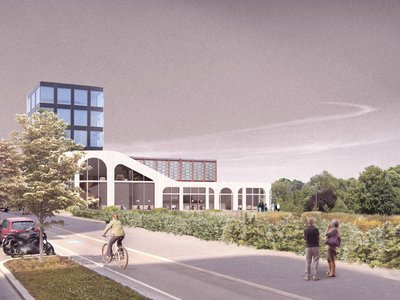
The Flow: Coffee Shop Interior Design Where Time, People, and Process Intertwine
The Flow reimagines Viennese coffee culture through arched forms, warm interiors, music, reading, work, and social gathering.


Similar Reads
You might also enjoy these articles
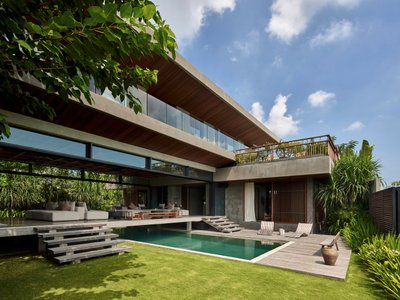
Freebird Residence by Alexis Dornier: A Tropical Modernist Sanctuary in Bali
Floating living pavilion above pool anchors H-shaped tropical villa, blending Japanese minimalism, sustainable strategies, lush landscape, and sculptural interiors.
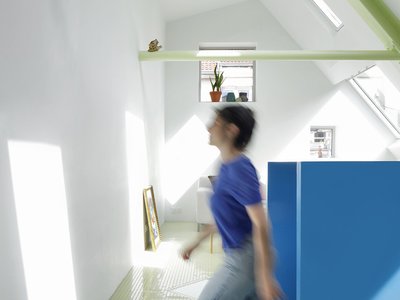
127af Flips a Tiny Bagnolet Rowhouse Upside Down with a Handcrafted Roof Extension
A 55-square-meter terraced house on the edge of Paris gains a luminous upper living floor through lightweight timber and steel.
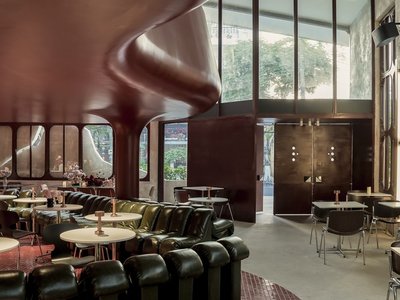
1.61 Design Workshop Wraps a 600-Square-Meter Café in Vietnam in Sculptural Burgundy Drama
Reden Café & Bistro pairs a helical staircase, mosaic floors, and deep red interiors to rethink Vietnamese hospitality space.

The Unbound Brain: A School Shaped by Cognitive Architecture
Cylindrical learning pods radiate like neurons from a central cortex, turning the floor plan into a spatial model of human thought.


Explore Landscape Design Competitions
Discover active competitions in this discipline




The Global Benchmark for Architecture Dissertation Awards


Challenge to design mud housing for contemporary communities
Comments (0)
Please login or sign up to add comments
No comments yet. Be the first to comment!