

Marina Tabassum Turns a Political Safe House on the Buriganga River into a Memorial Landscape
A family compound in Fatullah, Narayanganj becomes an open-air promenade of pavilions, courtyards, and quiet remembrance.


Before it was a memorial, it was a hiding place. The Hamid family home, built in the 1960s on the western edge of a riverfront compound in Fatullah, Narayanganj, served as a clandestine meeting point for Awami League politicians during Bangladesh's independence struggle. Leaders arrived by boat along the Buriganga River, unseen by surveillance. Decades later, the compound had been carved up by a cold storage facility and a textile factory, and the original residence had fallen into disrepair. The commission to Marina Tabassum Architects was not simply to build a monument to Hamidur Rahman, a founding member and treasurer of the Awami League, but to recover the spatial and emotional memory of the place itself.
What emerged across the 23,790 square foot site is not a single building but a sequence: a gatehouse, a visitor's lounge pavilion, a weekend villa adapted from a factory storehouse, the partially restored family residence turned museum, and a gravesite facing Mecca in the southern corner. The complex reads as an open-air architectural promenade, each element distinct in material character yet held together by a consistent logic of brick, concrete, courtyards, and filtered light. The genius is that it feels less like a memorial and more like returning to a village home, which is precisely the intent.
Promenade and Pavilion
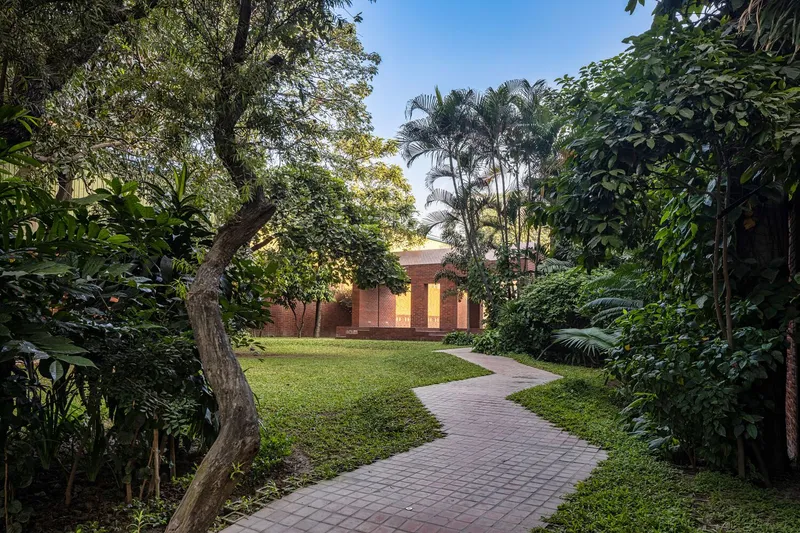
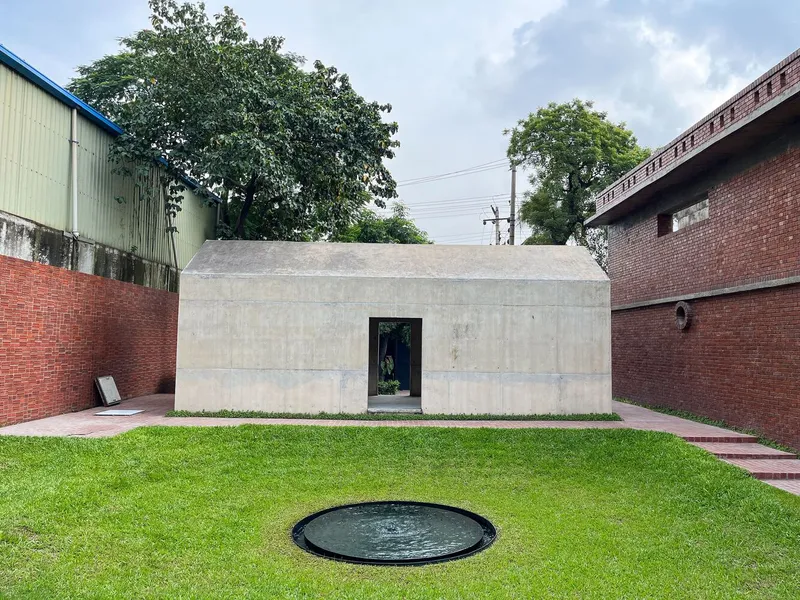
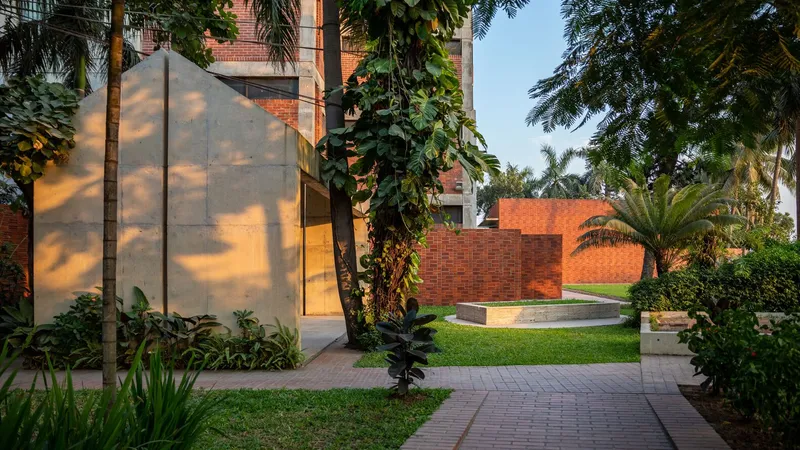
The site's inherent linearity, stretched along the riverbank behind a high perimeter wall, could easily have produced a rigid procession. Marina Tabassum breaks the line by inserting two pavilions that generate courtyards between them, fragmenting the walk into a series of spatial episodes. A brick paver pathway winds through lawns and palms toward the red brick gatehouse, establishing a tempo that is slow and deliberate. A concrete pavilion with a single doorway sits within a courtyard bordered by mature trees, its formal restraint making it function almost as a threshold rather than a destination.
At dusk, a translucent glass volume beside one of the brick structures glows against the tropical planting, collapsing the boundary between garden and architecture. The whole premise, screened from the noise and chemical smell of surrounding factories, operates as a kind of walled sanctuary. The trees do most of the environmental work, but the careful calibration of openings and enclosures creates microclimates of shade and breeze that make lingering possible even in Dhaka's oppressive heat.
A Storehouse Becomes a Home
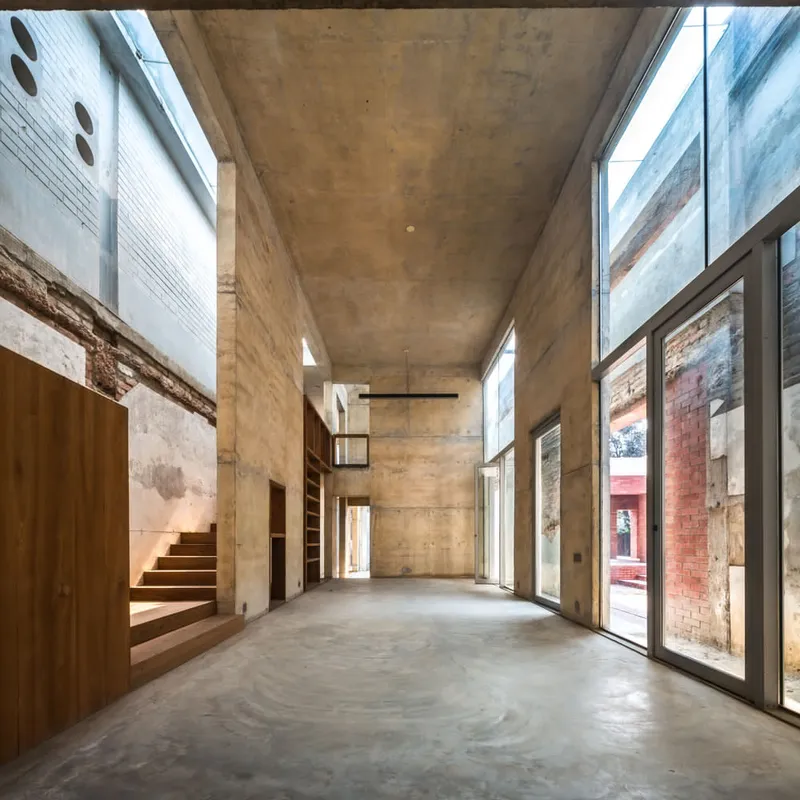
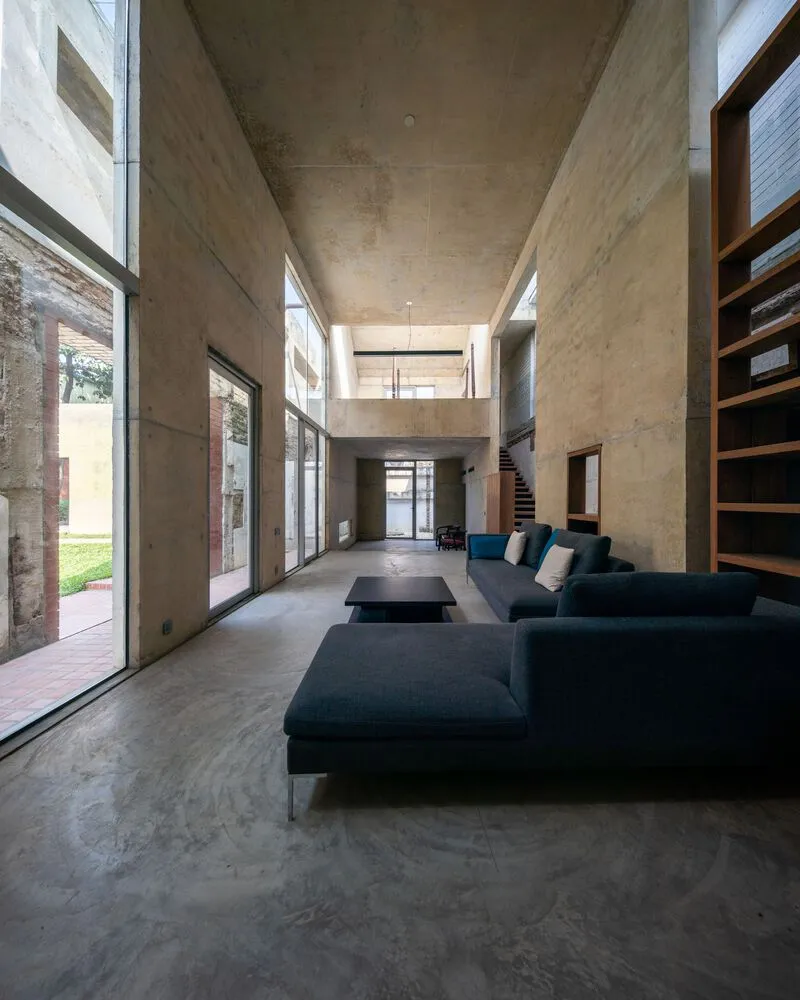
The most compelling act of adaptive reuse on the site is the conversion of the textile factory's raw material store into a weekend house. Marina Tabassum keeps the industrial bones legible: board-formed concrete walls and ceilings bear the imprint of their formwork, and the double-height hall exposes the rough texture of the original structure alongside new glazed openings that reveal surviving brick. A timber stair ascends to a mezzanine level, turning what was a utilitarian warehouse into a loft-like living area with two bedrooms and two bathrooms.
The material palette is deliberately restrained. Polished floors reflect overhead light, timber shelving and balustrades provide warmth against the concrete, and the architecture trusts its own surfaces rather than applied finishes. It is a strategy consistent with Tabassum's broader practice, where buildings are constructed by hand, not machinery, and local craftspeople execute the detailing. The result is that the concrete feels worked rather than poured, carrying evidence of human labor in every surface.
Light as Material

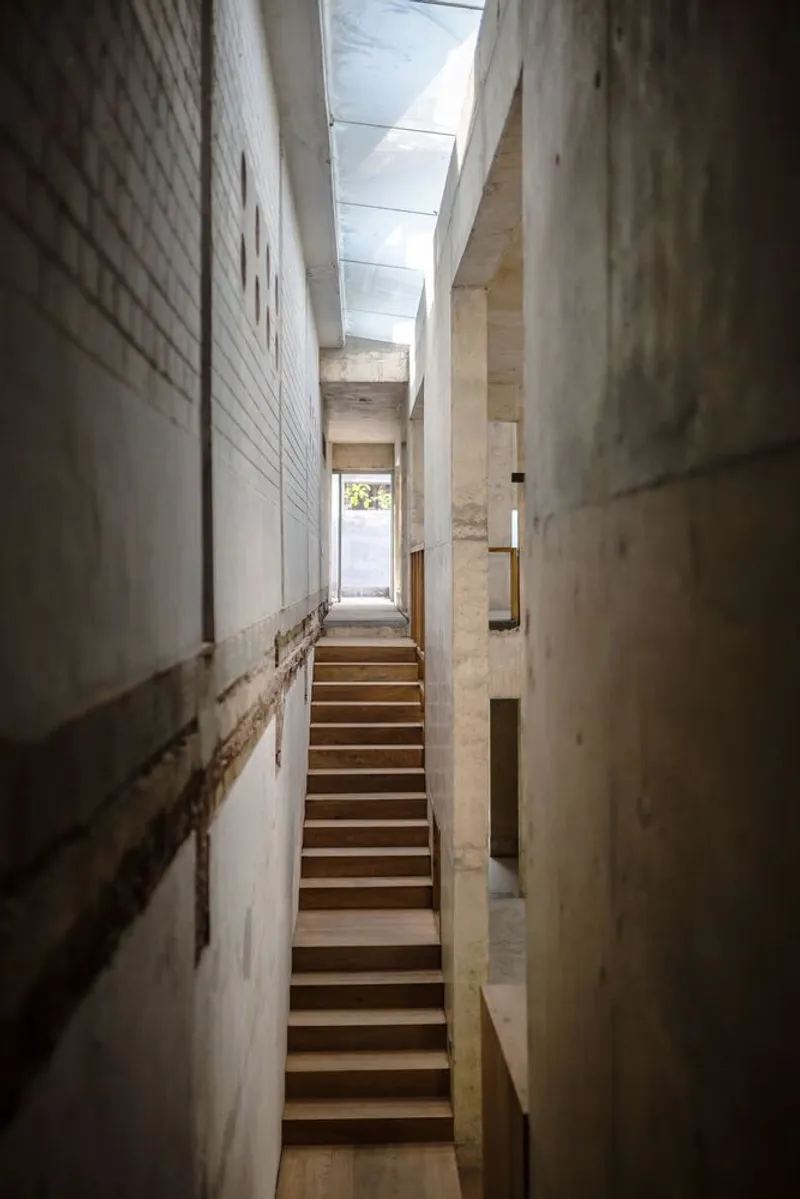

If there is a single image that captures the ambition of this project, it is the vaulted brick corridor where a continuous skylight casts geometric shadow patterns across the clay tile floor and curved ceiling. The effect is almost devotional, turning a circulation space into a space of contemplation. Marina Tabassum uses skylights throughout the complex not as neutral illumination devices but as compositional instruments: a narrow concrete passage becomes a vertical light well around a timber stair, while a gabled concrete ceiling in the museum interior channels a single strip of daylight down the ridge.
The consistency of approach is striking. Every significant interior moment is defined by overhead light entering through a slot, a perforated screen, or a continuous gap between wall and roof. Natural light becomes the primary decorative element, eliminating the need for ornament. The shadows change through the day, giving each room a temporal dimension that reinforces the memorial's larger theme of passage and memory.
Brick Screens and Handcraft
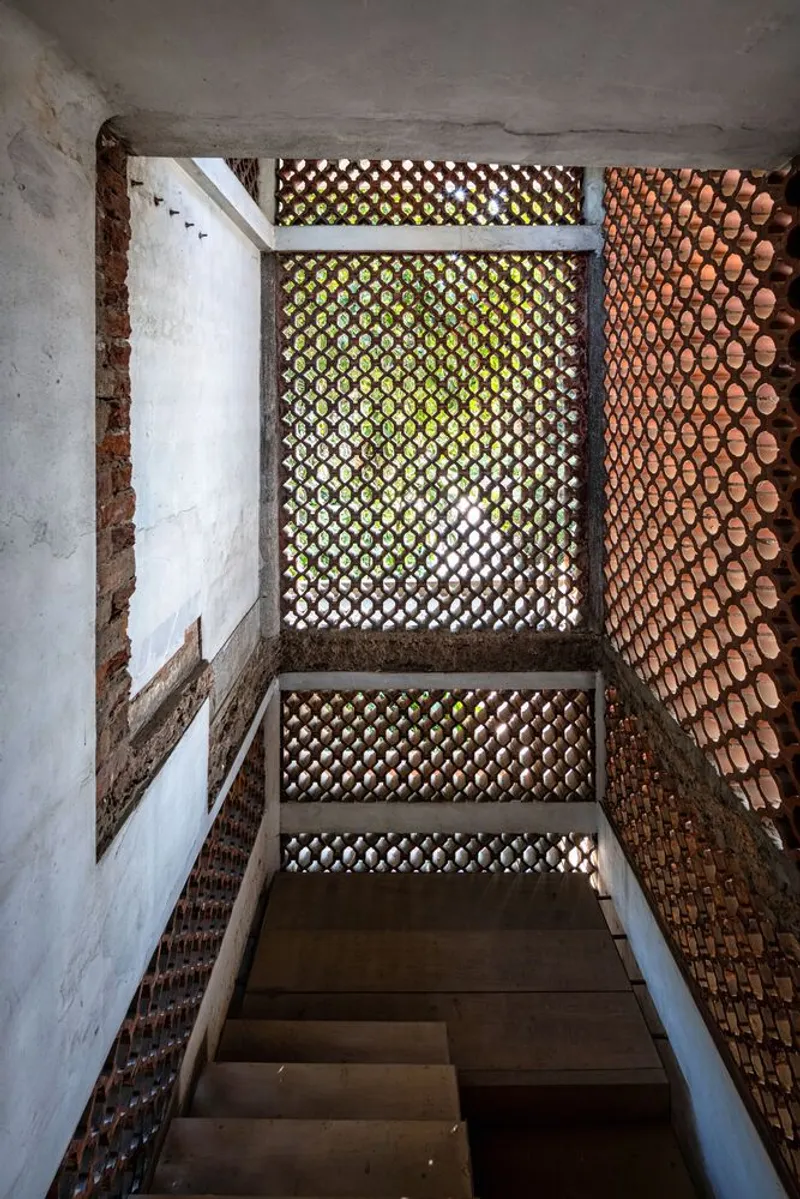
A perforated brick screen wraps one of the stair volumes, filtering light into a pattern of dots and lines that shift as you ascend. The screen is set against whitewashed walls and a timber stair, and the contrast between the rough perforations and the smooth plaster underscores the tectonic range the project achieves with a narrow material vocabulary. Brick, concrete, timber, glass: nothing more is needed.
Tabassum's insistence on local materials and handcraft is not a nostalgic gesture. It is a practical and ethical position rooted in Bangladesh's construction economy, where skilled masons remain more available and affordable than mechanized systems. The brickwork here carries the slight irregularity of hand-laid courses, giving walls a texture that machine-made facades cannot replicate. The building teaches its own construction history to anyone who looks closely.
River, Site, and Surrounding World
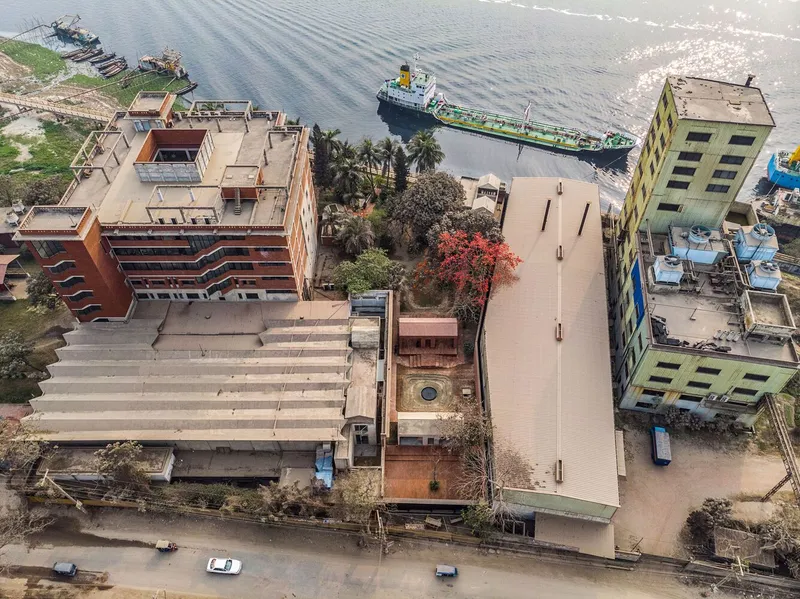
The aerial view tells a story the ground-level experience deliberately conceals. The compound sits on a narrow strip between the Buriganga River and a dense fabric of mixed-use structures, factories, and informal development. A tanker passes within meters of the terraced concrete roofs. The high perimeter wall is not merely a design choice; it is a necessity, screening the memorial from the visual and olfactory intensity of the industrial surroundings.
Yet the river is not excluded. A small garden-like space near the original residence is designed so that the water and the building merge at the threshold, preserving the historic relationship that once allowed political figures to arrive by boat undetected. The memorial does not sanitize the site's layered history. It preserves the traces of the 1960s family home, the industrial overlay of the post-1971 decades, and the Islamic burial tradition of the southern grave mound, holding all of them in a single spatial narrative without hierarchy.
Why This Project Matters
Memorial architecture too often defaults to spectacle: large gestures, symbolic forms, expensive materials. The Hamidur Rahman Memorial Complex refuses all three. Its power comes from restraint, from the decision to work with what was already there and to let light, landscape, and handcrafted surfaces do the emotional work. Marina Tabassum demonstrates that a memorial can be domestic in scale and contemplative in character while still carrying the weight of national political history.
The project also stands as a model for how adaptive reuse can operate in South Asian contexts where heritage protection frameworks are weak and demolition is the default response to neglect. By partially restoring the original residence, repurposing the factory storehouse, and inserting new pavilions as connective tissue, Tabassum creates a methodology that is transferable well beyond this single site. The complex is not frozen in time. It is a living compound, used by the family and open to visitors, where the past is neither preserved under glass nor erased but woven into daily life.
Hamidur Rahman Memorial Complex by Marina Tabassum Architects, Fatullah, Narayanganj, Bangladesh. 23,790 sq ft. Photographs by City Syntax and Asif Salman.
About the Studio
Share Your Own Work on uni.xyz
If projects like this are the kind of work you want to make, uni.xyz is a place to publish your own, find collaborators, and enter design competitions.


Popular Articles
Popular articles from the community


David Ortega Stacks a Two-Story Mexico City Penthouse Around a Steel Stair and a Pergola-Shaded Roof Terrace
In Colonia Roma, a 300 m² penthouse uses oak joinery, a planted steel stair and a slatted roof pergola to make a new-build apartment feel like a house.

Architekt Andreas Gruber Scatters 23 Dark Timber Chalets Across a South Tyrolean Forest Edge
In Molini di Tures, Amonti Chalets breaks a resort into a hamlet of gabled timber houses, with parking, storage and services pushed into the slope.

LT2A and OPEN Architectes Thread a Brick and Glass High School Through a Wooded Belgian Campus
In Braine-l'Alleud, a 3,000 m² wing for Collège Cardinal Mercier pairs pale brick with a glazed colonnade, deferring to a small chapel and a dense wood.

Jaramillo Van Sluys Arquitectura and Urbanismo Turn a Demolished Registry Lot in Quito into an Orchard Plaza
In Quito's Centro Histórico, a 2,800 m² plaza exposes the San Agustín convent wall and redraws its lost Augustinian orchard in volcanic stone.

Similar Reads
You might also enjoy these articles


Hodi-Mandai Geram
Project Function: Preservation and revitalization of the Intangible heritage and socio-spatial identity of the Hodi by Housing, Cultural Memory Center, Sacred Grove, landscape, local tourism economy


Olio Towers: A Mid-Rise for Performers That Fuses Housing, Rehearsal, and Stage
Located blocks from Houston's Theater District, this modular tower stacks living units around a central performance atrium.

Oasis: Modular Green Housing Carved into Dhaka's Urban Fabric
A shortlisted Plugin Housing entry reclaims unauthorized settlements in Dhaka with stepped concrete volumes, green roofs, and ventilation-driven design.

Black Hole: A Floating Megastructure for the Post-Physical Era
Emiliano Mazzarotto envisions a spherical, self-scaling arena where e-sports, digital hotels, and holographic stadiums replace traditional public space.

Explore Residential Building Competitions
Discover active competitions in this discipline

Challenge to design mud housing for contemporary communities

Challenge to reimagine the Iron Throne

Photograph architecture without architects

Illustrate the lost glory of Angkor Wat - Render Challenge
Comments (0)
Please login or sign up to add comments
No comments yet. Be the first to comment!