
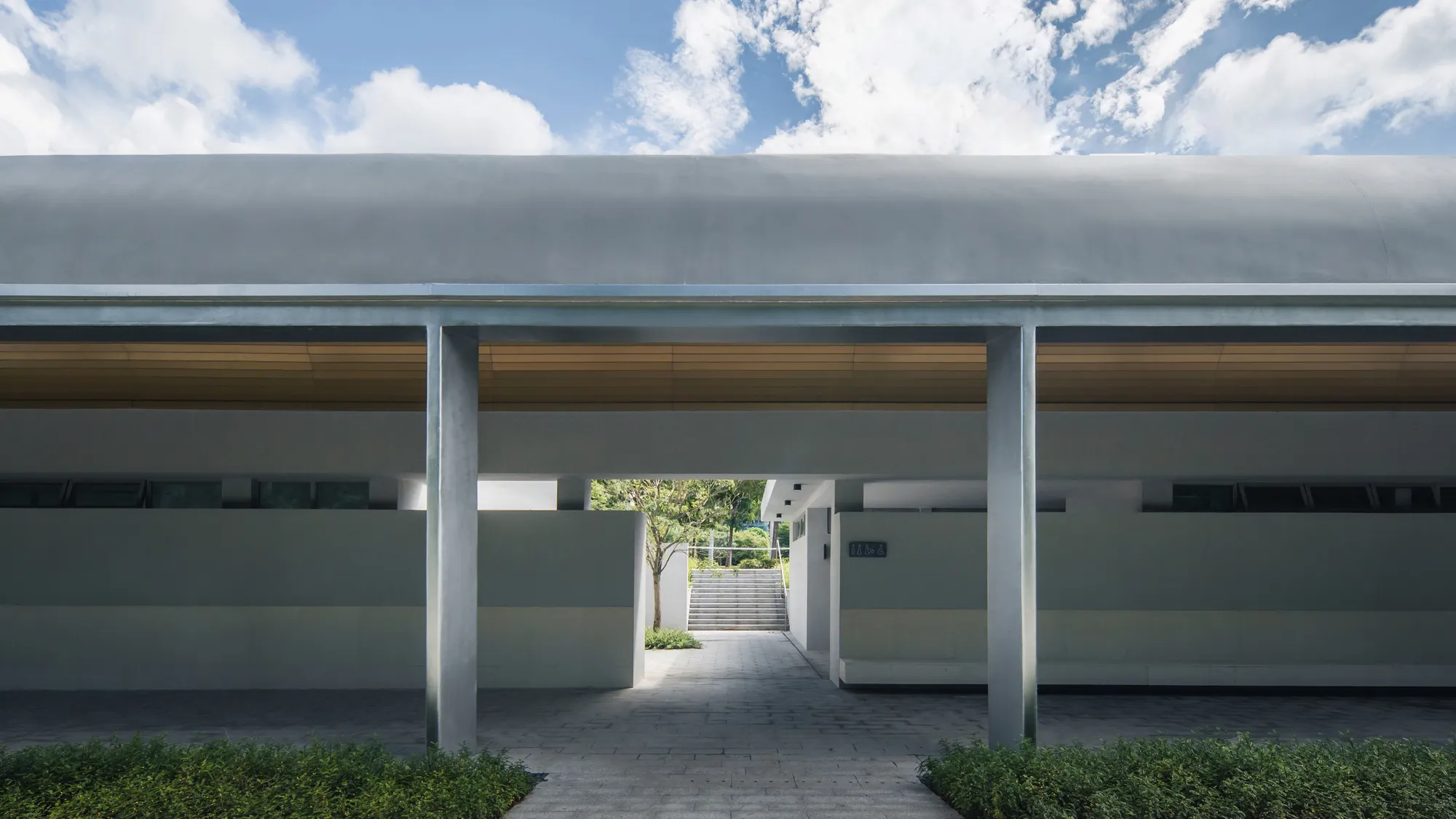
Hang Cheng Studio Weaves Three Pavilions into a Shenzhen Park Over Six Years of Design
Three service buildings emerge as quiet architectural instruments within Guiwan Park, the core public space of Shenzhen's Qianhai New District.


A six-year timeline from strategy to completion is long for three modest park buildings. But the duration tells you something important about this project: hang cheng studio treated these pavilions not as objects dropped onto a finished landscape but as organs grown from within it. Located in Guiwan Park, the first water corridor park delivered under the Qianhai Water City masterplan originally won by Field Operations in 2010, the three service buildings are part of a larger constellation of six structures that serve what is now the core public open space of Shenzhen's Qianhai New District.
What makes the project genuinely interesting is the degree to which architecture here dissolves into infrastructure. Each pavilion adopts a different formal language, a different roof geometry, a different relationship to ground, yet all three share a commitment to horizontality, permeability, and landscape continuity. The studio describes a design evolution that moved from form-first to function-driven to what they call a "moderately diversified" approach. That phrase is modest to the point of self-effacement, but it accurately describes what you see: buildings that refuse to compete with the park, the skyline, or each other.
The Barrel Vault as Public Threshold
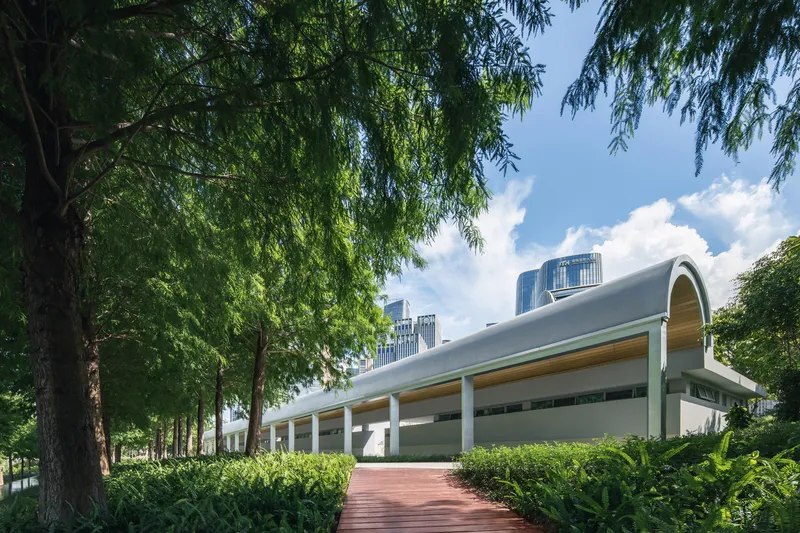
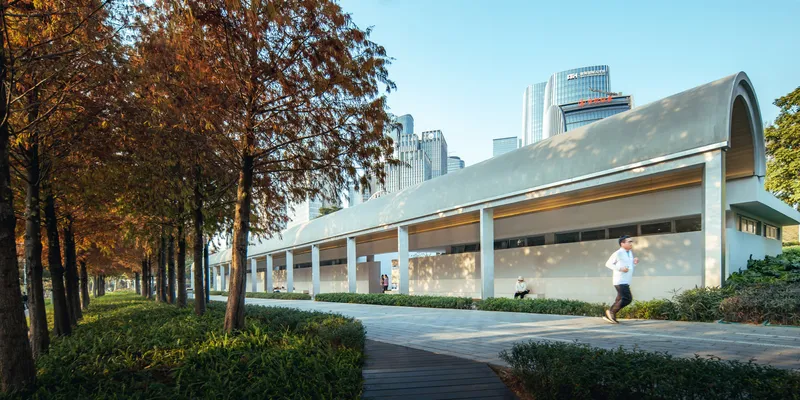
The most formally assertive of the three pavilions deploys a concrete barrel vault, or rather a pair of asymmetrical vaults, that act as both roof and signal. The arched profile reads from a distance as a gateway, a piece of civic punctuation marking entry into the park. Up close, the vault becomes a colonnade, rhythmic and shaded, running alongside a tree-lined jogging path. The proportions are generous enough to feel monumental but low enough to stay deferential to the surrounding canopy.
At dusk, the paired vaults glow against the glass towers of Qianhai behind them. The relationship is intentional: these are buildings designed to mediate between the vertical ambition of the district and the horizontal calm of the park. The white stucco walls catch ambient light and lend the structure a quiet solidity that reads as permanence rather than spectacle.
Timber Soffits and Clerestory Light
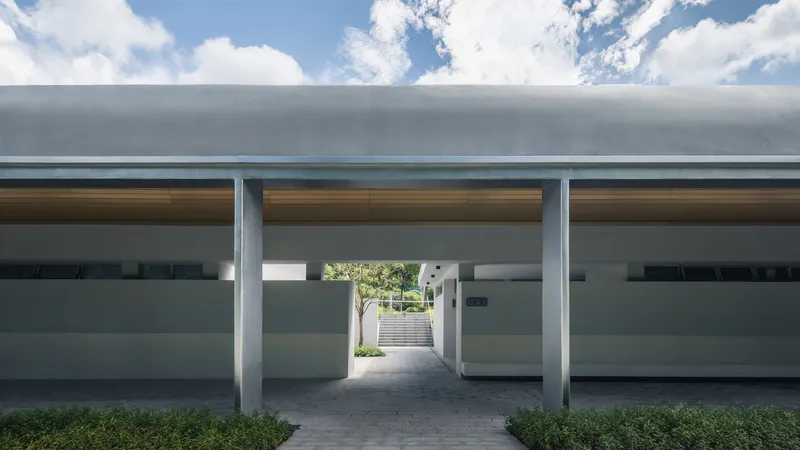
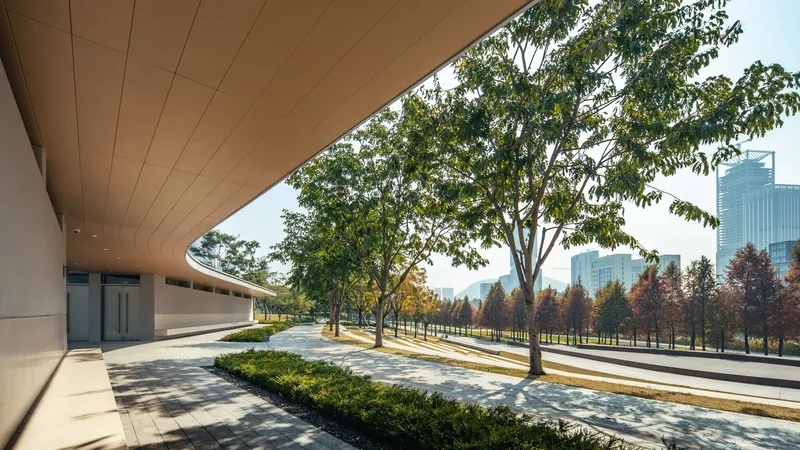
Walk beneath the barrel vaults and the material palette shifts from concrete shell to warm timber soffit. The central passage of one pavilion is organized beneath three parallel vaults separated by clerestory glazing that washes the interior with diffused daylight. It is a simple move, structurally and spatially, but executed with real precision. The timber panels soften acoustics and temperature perception in a subtropical climate where shade is not a luxury but a necessity.
The covered walkways extend outward as promenades, lined with autumn-leaved trees. These are not corridors connecting rooms; they are park paths that happen to be roofed. The blurring of interior and exterior is so thorough that you cross thresholds without noticing, which is exactly the point.
Landscape as the Primary Material
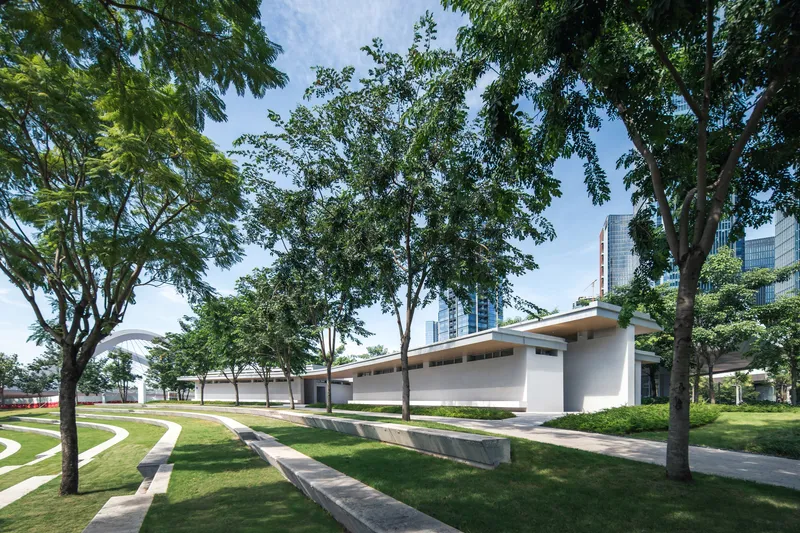
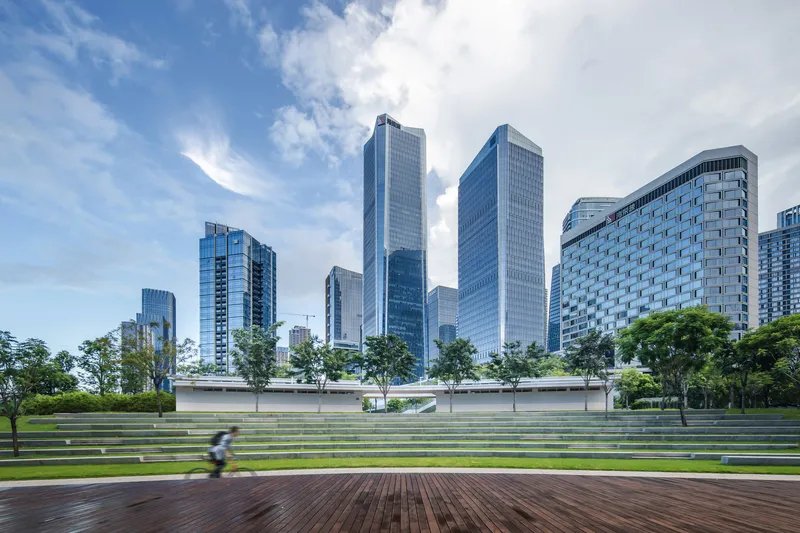
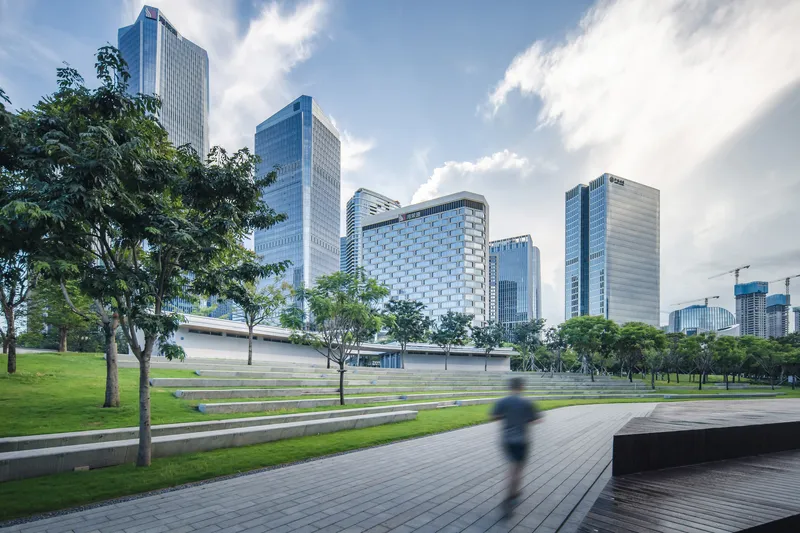
The second pavilion sits so low in the terrain that from certain angles it reads as a retaining wall with a roof. Curved pathways and mature canopy trees do most of the spatial work, with the building operating as a horizon line rather than a focal point. Terraced lawns, timber decks, and stone seating steps define outdoor rooms that are at least as programmatically useful as anything under the roof.
Hang cheng studio's deep involvement in the landscape planning process is legible here. The siting of each building responds to pedestrian desire lines and existing topography in ways that suggest the architecture followed the park rather than the other way around. The curving paved plaza, with its scattered trees and gentle grades, feels like terrain that was always there.
Activating the Edge at Dusk
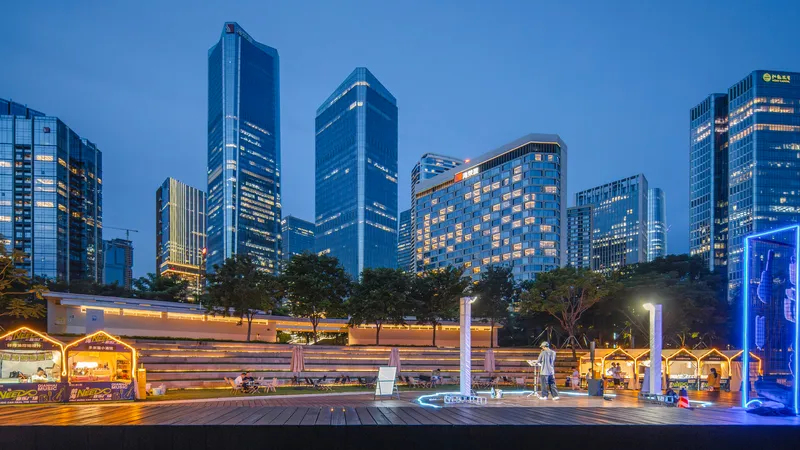
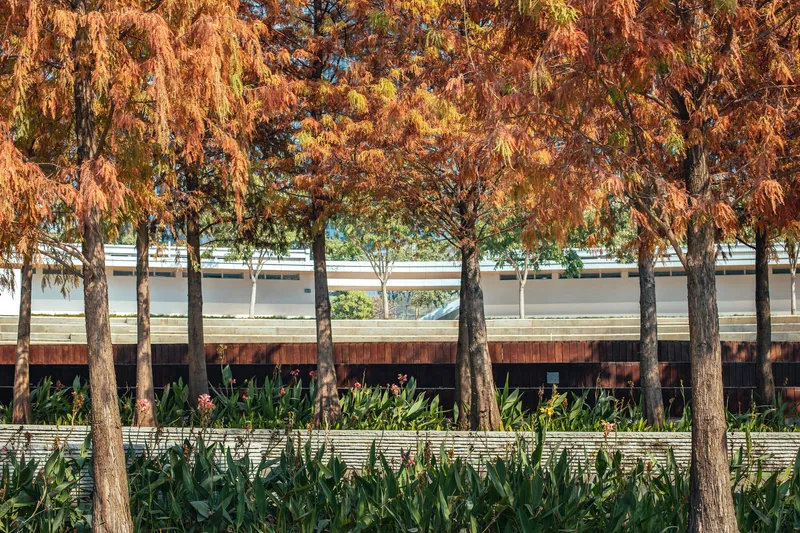
The third pavilion reveals its program most clearly at night. Illuminated market stalls line a timber deck beneath a low white volume, transforming a daytime park amenity into an evening social destination. The Qianhai tower skyline provides a cinematic backdrop, but the real action is at ground level: people buying food, sitting on steps, lingering under warm light.
By day, this same building recedes behind a row of autumn-foliage trees and white louvers. The seasonal planting beds along its base integrate it into the park's horticultural system. It is a building that changes character with the clock and the calendar, performing differently in morning light than under string lights at dusk. That temporal flexibility is harder to design than a fixed aesthetic statement.
Plans and Drawings
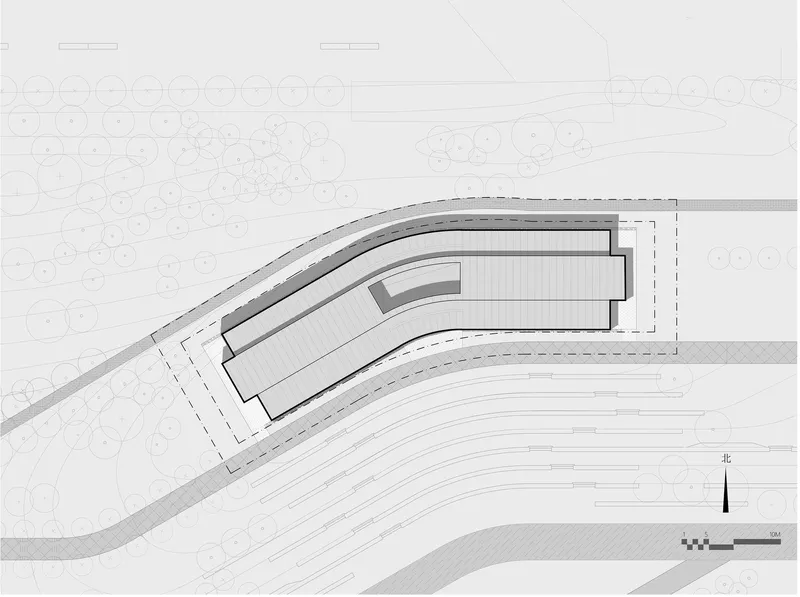
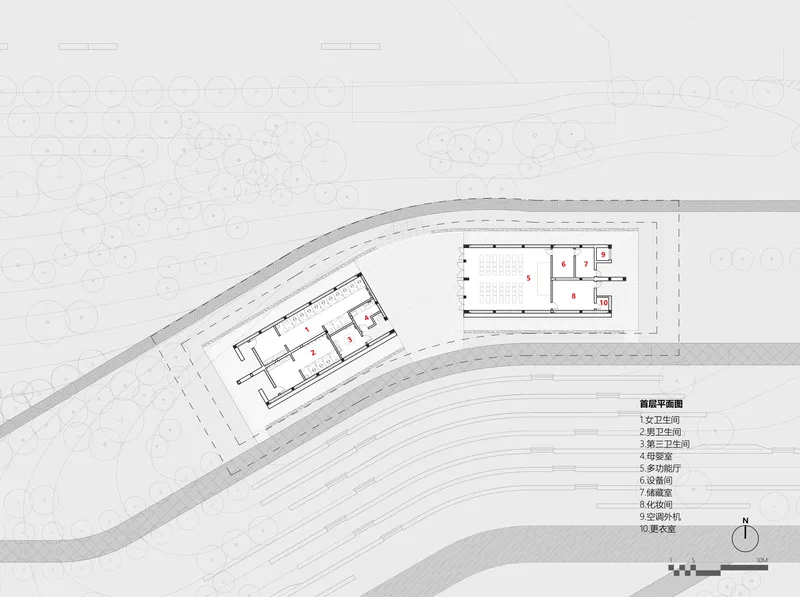
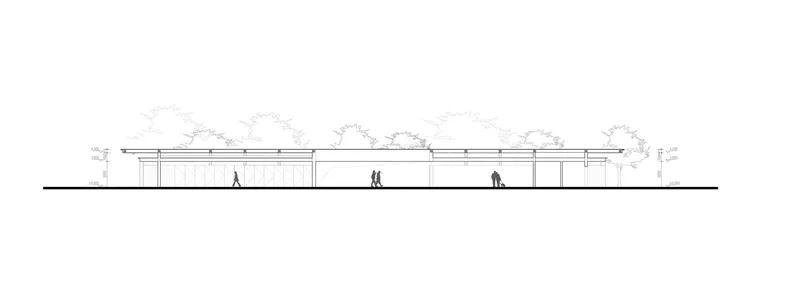
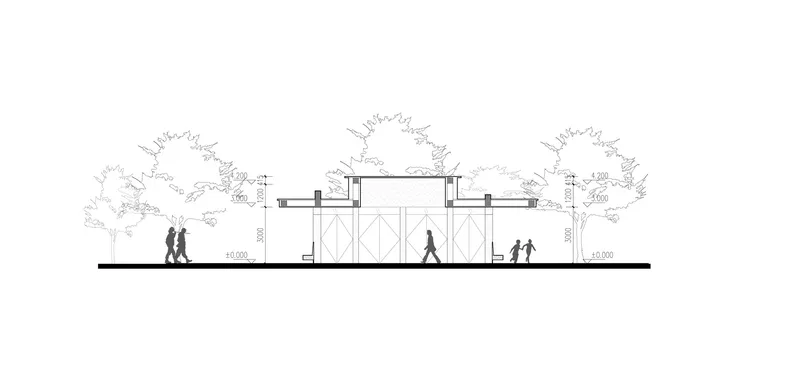
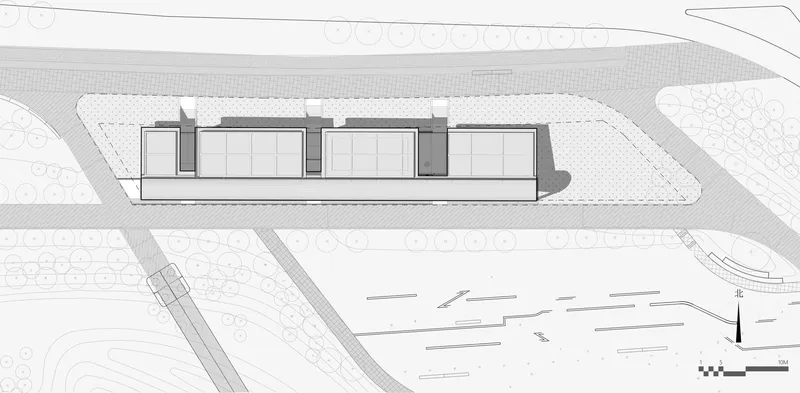
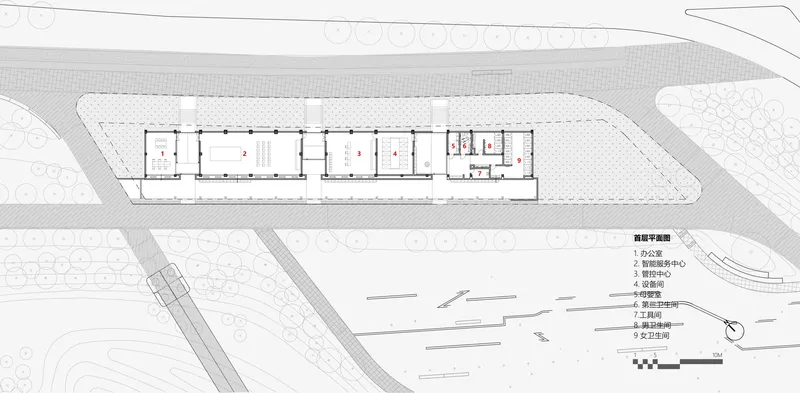
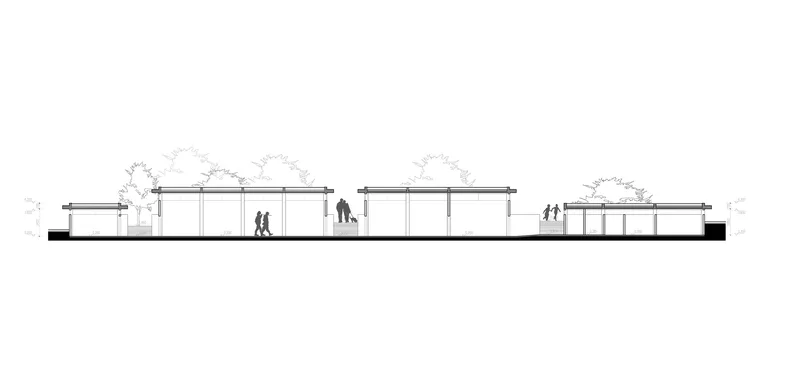
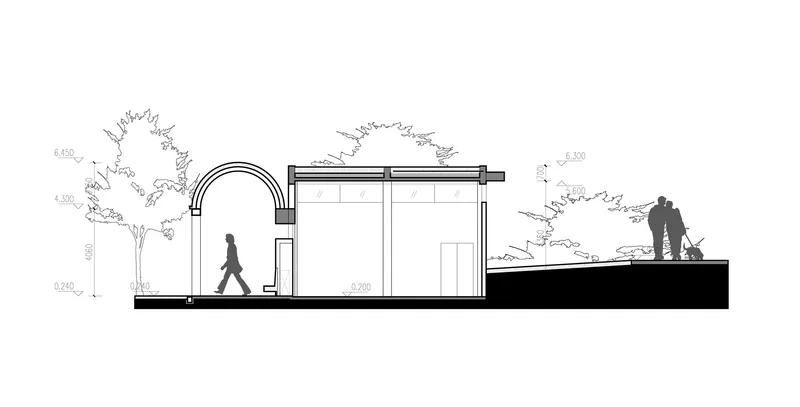
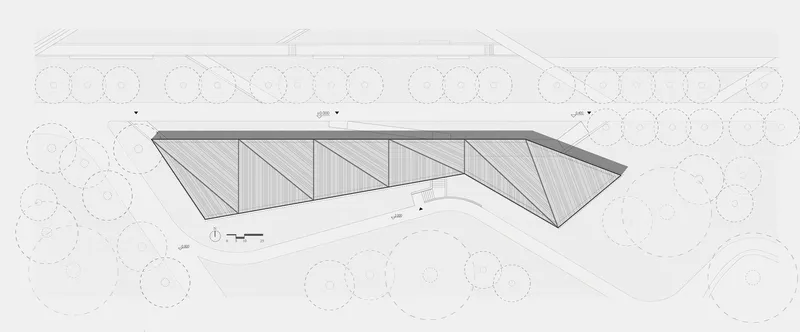
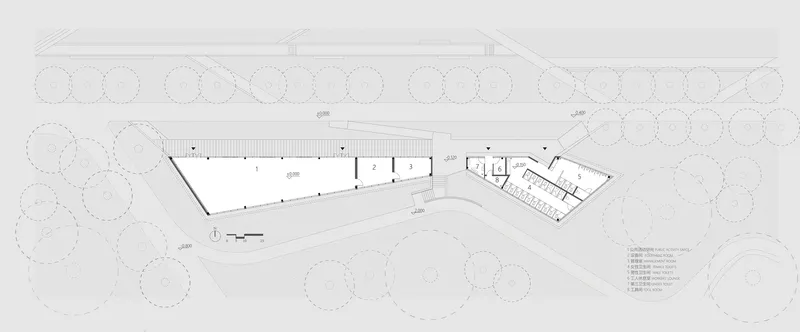
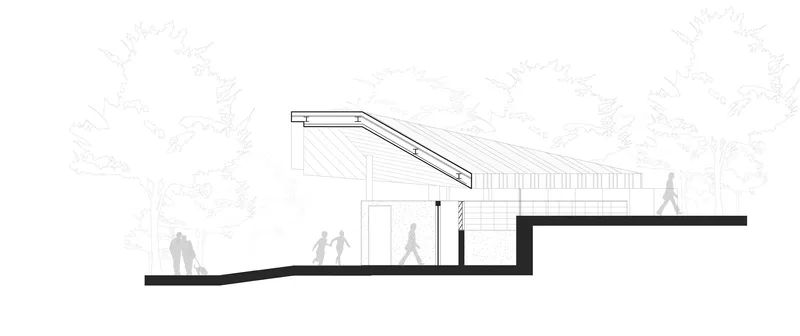
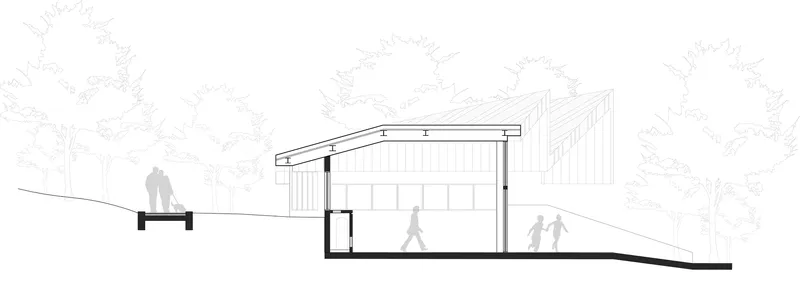

The drawing set confirms what the photographs suggest: three distinct buildings with three distinct geometries. The site plans reveal curved footprints that follow the park's organic circulation, while the floor plans show rectangular programmatic spaces organized along these curves. Sections are particularly revealing, showing how offset roof heights, arched portals, and sloped ground planes create spatial variety within a consistently low profile.
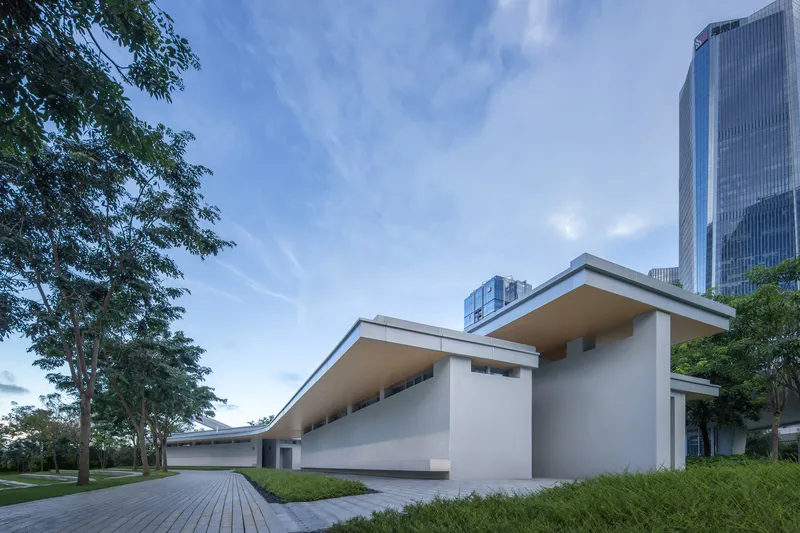
The angled wings of the third pavilion, visible in plan and roof drawing, produce a different spatial logic from the linear barrel vault of the first. Gabled roof volumes with vertical cladding in the elevation drawings indicate yet another material and formal register. Taken together, the drawings illustrate a deliberate strategy of diversity within restraint. Each building has its own tectonic identity, but all three share a commitment to staying below the tree line and serving the landscape rather than dominating it.
Why This Project Matters
New Chinese districts tend to deliver public space as afterthought: leftover ground between towers, furnished with identical benches and decorative planting. Guiwan Park inverts this hierarchy, treating the landscape as primary infrastructure and the surrounding development as its context. That the park's service buildings were designed by a studio embedded in the landscape planning process for six years is not a bureaucratic footnote; it is the reason the architecture feels inevitable rather than imposed.
Hang cheng studio's contribution here is a lesson in disciplined self-restraint. Three buildings, three roof types, three distinct relationships to ground, yet none of them asks to be photographed more than the trees around them. In a city racing skyward, these pavilions argue convincingly for staying low, staying open, and letting the park do the talking. That argument, sustained across 5,500 square meters and half a decade of design iteration, is worth paying attention to.
Three Service Pavilions of Guiwan Park, designed by hang cheng studio, is located in Guiwan Park, Qianhai New District, Shenzhen, China. The project encompasses 5,500 m² and was completed in 2024. Photography by Saihong Wang and Holi Photography.
About the Studio
hang cheng studio
Share Your Own Work on uni.xyz
If projects like this are the kind of work you want to make, uni.xyz is a place to publish your own, find collaborators, and enter design competitions.



Popular Articles
Popular articles from the community


The Ocean Hive: Sustainable Architecture for a Self-Sufficient Civilization at Sea
The Ocean Hive imagines sustainable architecture at sea, where modular habitats, algae, wave power and ocean waste sustain a growing colony.

The Earth Pod: 3D Printed Homes for Resilient Refugee Communities
The Earth Pod reimagines refugee housing through 3D printed homes made from clay, combining resilience, self-sufficiency, and rapid shelter.

Co-Life: Senior Housing Design That Reconnects Older Adults With the City
Co-Life reimagines senior housing design through healing gardens, shared streets, workshops, and a sustainable community across generations.

Hill & Cross Opera: Sculptural Opera House Architecture Shaped by Tallinn’s Landscape and Identity
Hill & Cross Opera reimagines opera house architecture in Tallinn through its sculptural hill, civic plaza, glass wave and a luminous cross.
Similar Reads
You might also enjoy these articles

Bao Huynh Watercolor Atelier: A Serene Art Retreat in Hội An
Bao Huynh Watercolor Atelier in Hội An blends multifunctional art spaces, sustainable design, local materials, and family-friendly living in a serene environment.

Atelier Macri Concept Store Interior Design by CASE-REAL
Atelier Macri store features a "ko" counter, walnut wood details, cork displays, blending retail, gallery, and seamless customer experiences.

Manuel Vargas Izquierdo Stadium and High-Performance Sports Center: Architectural Excellence in Jalpa de Méndez
The Manuel Vargas Izquierdo Stadium blends sustainable design, inclusive sports facilities, and cultural-inspired architecture, revitalizing Jalpa de Méndez’s public spaces.
KAKR Buluh Awar Hall: Revitalizing Community and Ecology Through Bamboo Architecture
Community built bamboo hall revitalizes Buluh Awar village, empowering youth, restoring ecology, celebrating vernacular craftsmanship through sustainable architecture and culture.

Explore City Park Competitions
Discover active competitions in this discipline


Challenge to design a portable theatre

Challenge to design a portable music platform

Challenge to design an open learning module for the elderly
Comments (0)
Please login or sign up to add comments
No comments yet. Be the first to comment!