

Haptic Park: Five Turkish Biomes on a Single Waterfront Edge
A shortlisted Ripple entry choreographs water, terraces, and native ecologies into a sensory landscape that walks visitors across Turkey.


What if a single public park could compress an entire country's ecological diversity into a coastal promenade? Haptic Park attempts exactly that, stacking five terraces along a waterfront edge, each one modeled on a distinct Turkish biome, from Balkan mixed forest down to coastal dunes. Water is not merely present in the landscape; it is the landscape's organizing logic, flowing from rainwater collection at the highest terrace through bioswales and sculpted waterways that cool the air, filter runoff, and carve out habitat zones for native species.
Designed by Elena Johnson and shortlisted in the Ripple competition, the project positions itself as sensory landscape architecture: a space where touch, sound, sight, and spatial immersion override the passive visual consumption that defines most urban parks. Elevated walkways thread through tree canopies, curvilinear amphitheaters pull visitors into grounded, tactile zones, and a sequence of mist gardens, breeze gardens, and reflective ponds turn a walk through the park into a choreographed encounter with water in every phase.
Terraces That Telescope Geography
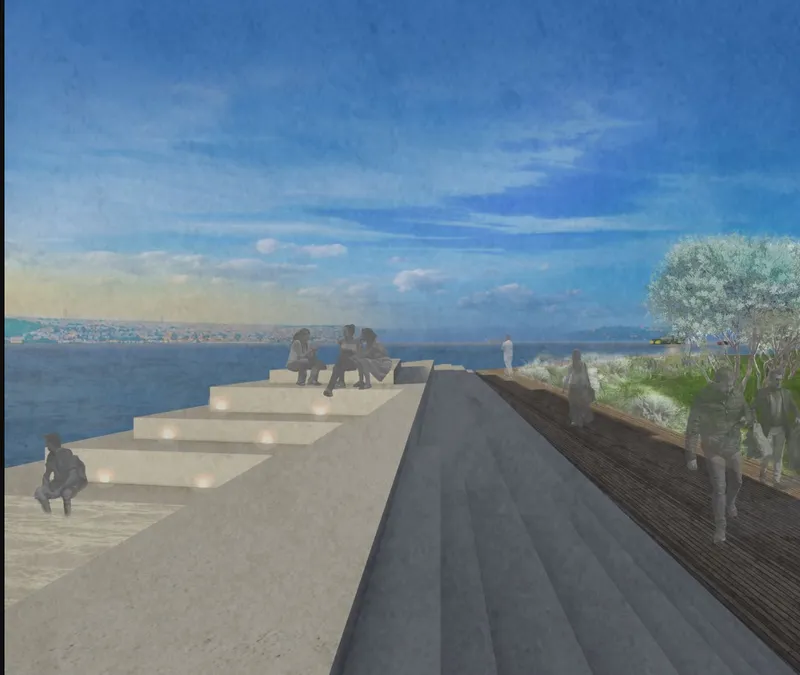
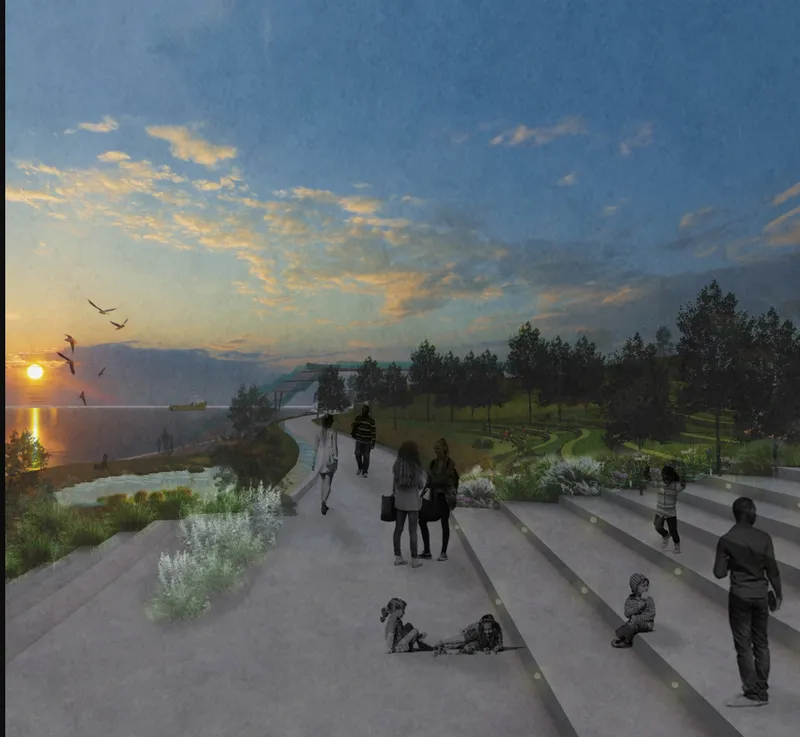
The five terraces form the project's structural backbone, each one mirroring a specific Turkish ecoregion: Balkan mixed forest, Caucasus forest, sclerophyllous woodland, Eastern Anatolian steppe, and coastal dunes. Visitors ascend what the designer calls the Silk Road stairs, transitioning between native vegetation systems and soil profiles that shift underfoot. The stepped concrete viewing platform at the park's upper edge, visible in the first image, offers a long sightline across the blue waterway below, framing the relationship between constructed topography and open water. At sunset, the lower terraces become social amphitheaters where planted beds meet gathering spaces along the water's edge.
The existing Atatürk monument is not displaced but absorbed into this terraced sequence, repositioned as a contemplative anchor atop the eastern amphitheater. It becomes a point of historical reflection within a landscape explicitly concerned with ecological futures, a gesture that binds cultural memory to living systems without subordinating one to the other.
Water as Infrastructure and Experience

The section drawing reveals the hydraulic logic beneath the park's surface. Rainwater is harvested at the highest terrace and directed through bioswales at varying water levels into underground storage tanks, where it can be recirculated or allowed to percolate into wetland filtration systems. A central pavilion collects rainwater and reuses greywater, functioning as both a public landmark and a working piece of hydrological infrastructure. The result is a stormwater management system that doubles as microclimate engineering: evaporative cooling from wetland pools and mist gardens tempers the coastal heat, while the waterway channels visible from the promenade host habitat for native flora and fauna.
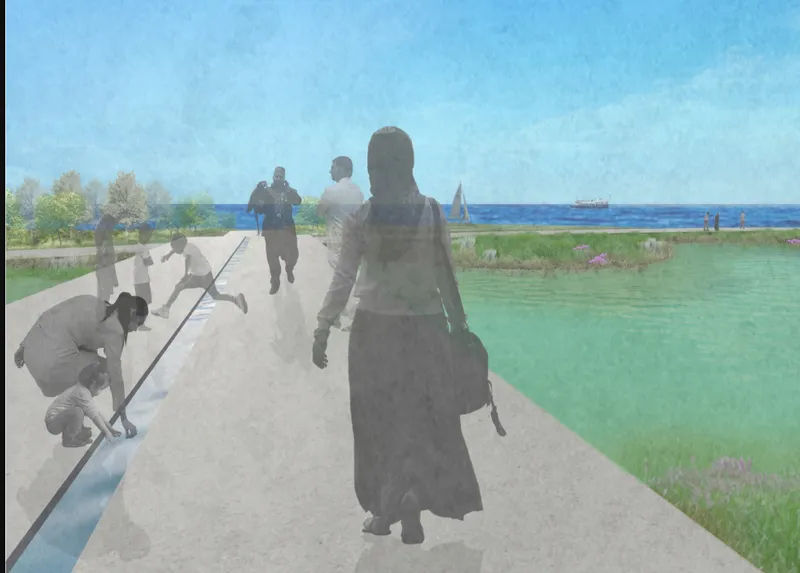
Walking the concrete promenade alongside these wetland pools, as shown in the second image, visitors are not simply adjacent to ecology; they are inside it. The steel railings guide pedestrians along the water's edge without separating them from it. Cascading channels and reflective ponds register different depths and flow velocities, making the park's water cycle legible to anyone willing to pay attention.
Social Ground Between Mist and Stone

Haptic Park's programmatic range is deliberately broad. Large open lawns, a playful garden, lookout decks, and sea gazing steps distribute social activity across the site, while the mist garden and breeze garden inject sensory specificity into otherwise familiar park typologies. The timber deck and stone staircase shown in the final image converge around a central water feature beneath a misty tree line, creating an intimate threshold between the park's active social zones and its quieter ecological corridors. A flag pole marks the civic axis, anchoring public identity to a landscape that could otherwise read as purely naturalistic.
The choreography here is precise. Elevated pathways pull visitors up through the canopy, then release them into curvilinear amphitheaters that funnel movement back to ground level. The transitions between these modes, airborne and grounded, exposed and sheltered, social and solitary, are what give the park its haptic quality. Movement is not incidental; it is the medium through which the design communicates.
Why This Project Matters
Most waterfront parks treat water as a backdrop. Haptic Park treats it as a protagonist, routing it through five ecological terraces, filtering it through native soil systems, suspending it as mist, and letting it pool in reflective surfaces that shift with the light. The insistence on sensory engagement over visual spectacle is a meaningful position: it asks visitors to touch, listen, and move through water rather than simply look at it. In a competition like Ripple, which foregrounds water's role in public space, that commitment to full-body interaction is exactly what distinguishes a thoughtful entry.
Elena Johnson's decision to ground the project in Turkey's actual biome diversity gives the design a specificity that generic "green infrastructure" proposals lack. The Silk Road stairs are not just a circulation device; they are a geographic argument, compressing a continental gradient into a walkable sequence. Whether or not every terrace achieves ecological authenticity at this scale, the ambition to make a public park function simultaneously as stormwater system, cultural landscape, and ecological primer is one worth taking seriously.
View the Full Project
About the Designers
Designer: Elena Johnson
Enter a Design Competition on uni.xyz
uni.xyz runs architecture and design competitions year-round that reward proposals with spatial conviction and real site intelligence.
Project credits: Haptic Park by Elena Johnson Ripple (uni.xyz).


Popular Articles
Popular articles from the community


Juan García Correa, John González and Claudia Rueda Sink a Circular Amphitheater into a Manizales Engineering Building
On the La Nubia campus in Manizales, Colombia, the S1 Building folds labs and offices into a hillside of ramped lawns that double as a campus route.

GROUP A Strips a 1969 Rotterdam Harbor Headquarters to Its Frame and Wraps It in Timber Louvers
In Rotterdam's M4H harbor district, Ferro Offices reuses a 1969 frame, adds one timber storey and reaches BREEAM-NL Outstanding.

LT2A and OPEN Architectes Thread a Brick and Glass High School Through a Wooded Belgian Campus
In Braine-l'Alleud, a 3,000 m² wing for Collège Cardinal Mercier pairs pale brick with a glazed colonnade, deferring to a small chapel and a dense wood.

Cube Design Draws an Ecological Corridor Between Two Shenzhen Hills with the Nankai Building
Beside Shenzhen's container docks, the Nankai Building pairs stacked balconies with a climbing green screen to connect two hillsides across its height.

Similar Reads
You might also enjoy these articles


Vereda Arquitetos Renovates a 40-Square-Meter Apartment Inside Niemeyer's Copan Building
A compact unit in São Paulo's most iconic residential tower gets a material overhaul that pairs exposed concrete with bold blue Formica.

Shakur's House: Exposed Brick as an Interior Organiser in a 168 m² Mashhad Residence
Brick moves indoors in this Mashhad residence, where masonry walls, glass partitions and teal planes sequence a compact home without closing it off.

Day and Night Park: A Time-Based Urban Newsstand in Beijing
A temporary urban newsstand in Beijing blending travel, light, and reading through poetic colors, compact form, and community-focused design.

Modernist Patio Renovation in El Masnou, Barcelona by Oliver Segura Arquitectura + Cebrià Arquitectura
Modernist patio renovation blending tradition and innovation with a movable pool, leveled floors, and Catalan materials in El Masnou.


Comments (0)
Please login or sign up to add comments
No comments yet. Be the first to comment!