
Thijs Asselbergs Packs 324 Apartments into a Harborfront Brick Ensemble in Nijmegen
Eight interlocking blocks of social, mid-range, and market housing redefine Nijmegen's former industrial waterfront along the Waal River.


The Dutch housing crisis gets talked about in abstraction: shortages, waiting lists, percentages. What it rarely gets is architecture that treats social rent apartments with the same material seriousness as market-rate ones. Havenkade, completed in 2023 on Nijmegen's Waalfront, does exactly that. Designed by Thijs Asselbergs (architectuurcentrale) together with vanOmmeren-architecten, the project distributes 324 apartments across eight building blocks, ranging from five stories to a 23-story, 70-meter tower, all clad in the same two stone types and champagne-colored anodized aluminum. There is no visible hierarchy between the 164 social rental units, 38 mid-price apartments, and 122 private-sector homes. The brick does not get cheaper when the rent does.
What makes the project worth studying is how it turns a constraint into a strategy. The original plan called for two separate buildings. Asselbergs and van Ommeren argued for merging them into a single integrated development, which allowed the team to pool infrastructure costs: one shared parking layer, one coordinated landscape plan by Felixx Landscape Architects, one coherent ensemble instead of two competing objects. The result is a block that reads as a composed whole from the harbor while offering three distinct living conditions on the inside: waterside, streetside, and courtyard.
A Brick Ensemble, Not a Brick Wall
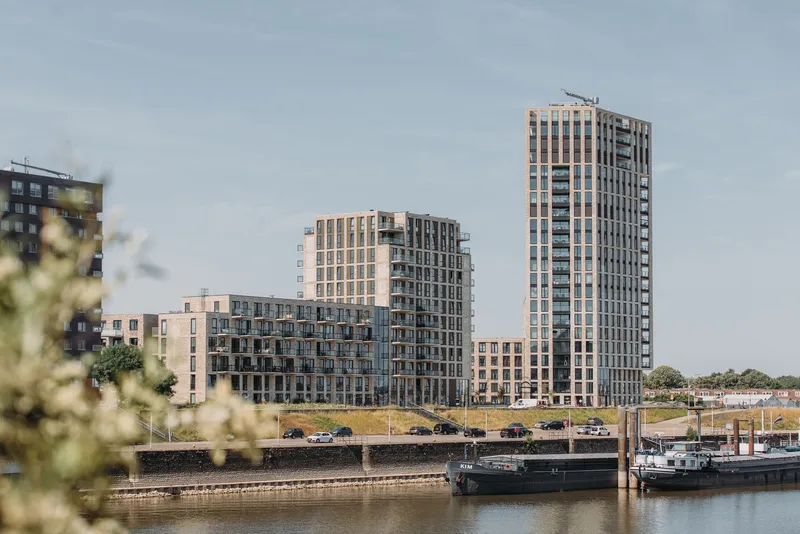

Seen from across the canal, Havenkade could read as a single mass. It does not, because the architects broke the volume into eight distinct blocks with staggered heights, creating a silhouette that steps from five stories at the periphery up to the 23-story tower. Two stone types carry across all blocks, giving the ensemble coherence without uniformity. The subtle shifts in brick coursing and tone keep each block identifiable. Viewed from the planted boulevard that separates the two main volumes, the differentiation becomes even clearer: varying setbacks and balcony rhythms distinguish each segment.
The decision to use robust masonry on every facade, regardless of program, is the project's quiet political statement. Social housing here is not clad in render or composite panels while market apartments get the "real" material. Everyone gets brick. Everyone gets aluminum window frames in the same champagne anodization. The cost discipline comes from serial production and modular standardization, not from downgrading materials for lower-income tenants.
Facade Logic: Depth Through Restraint
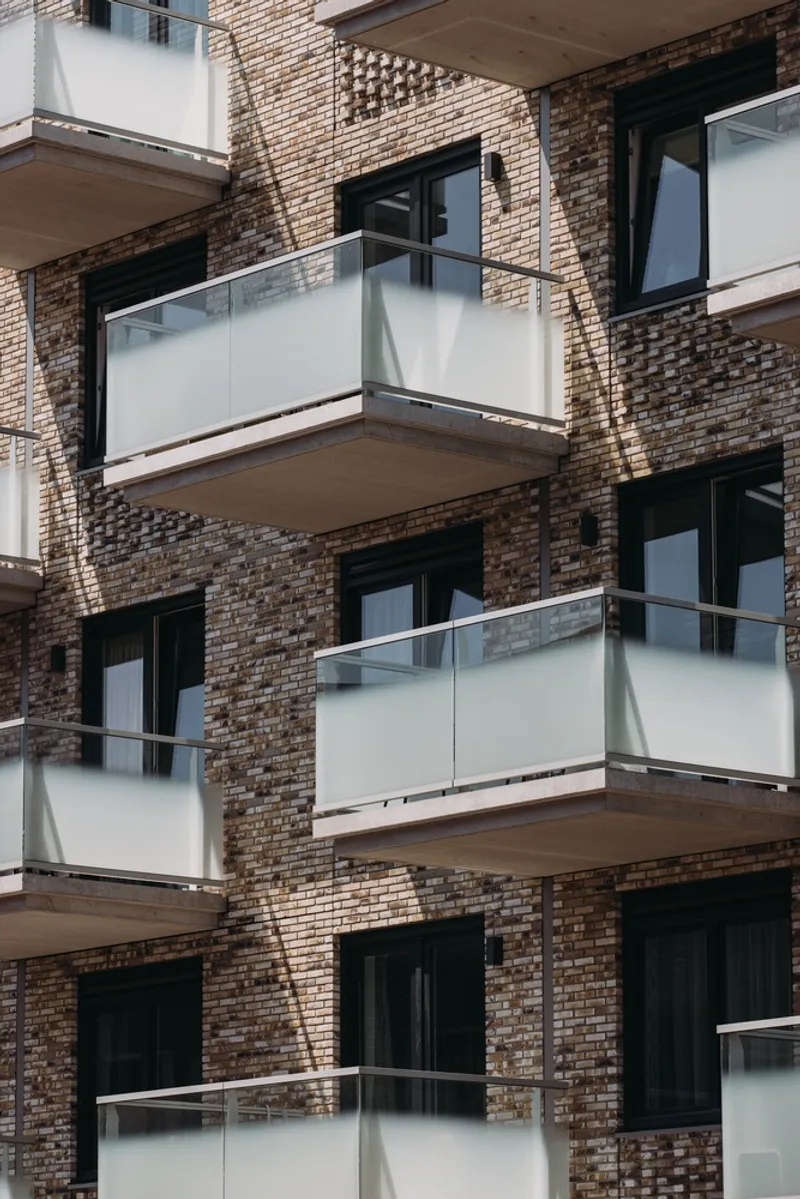
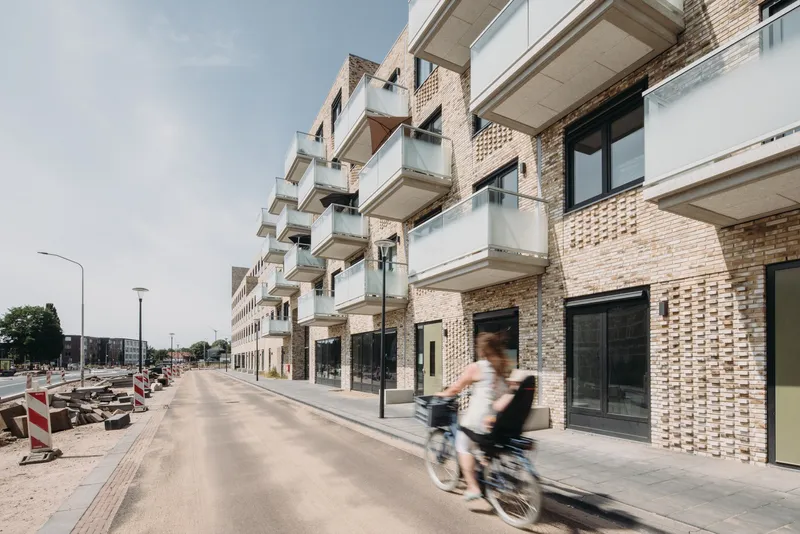
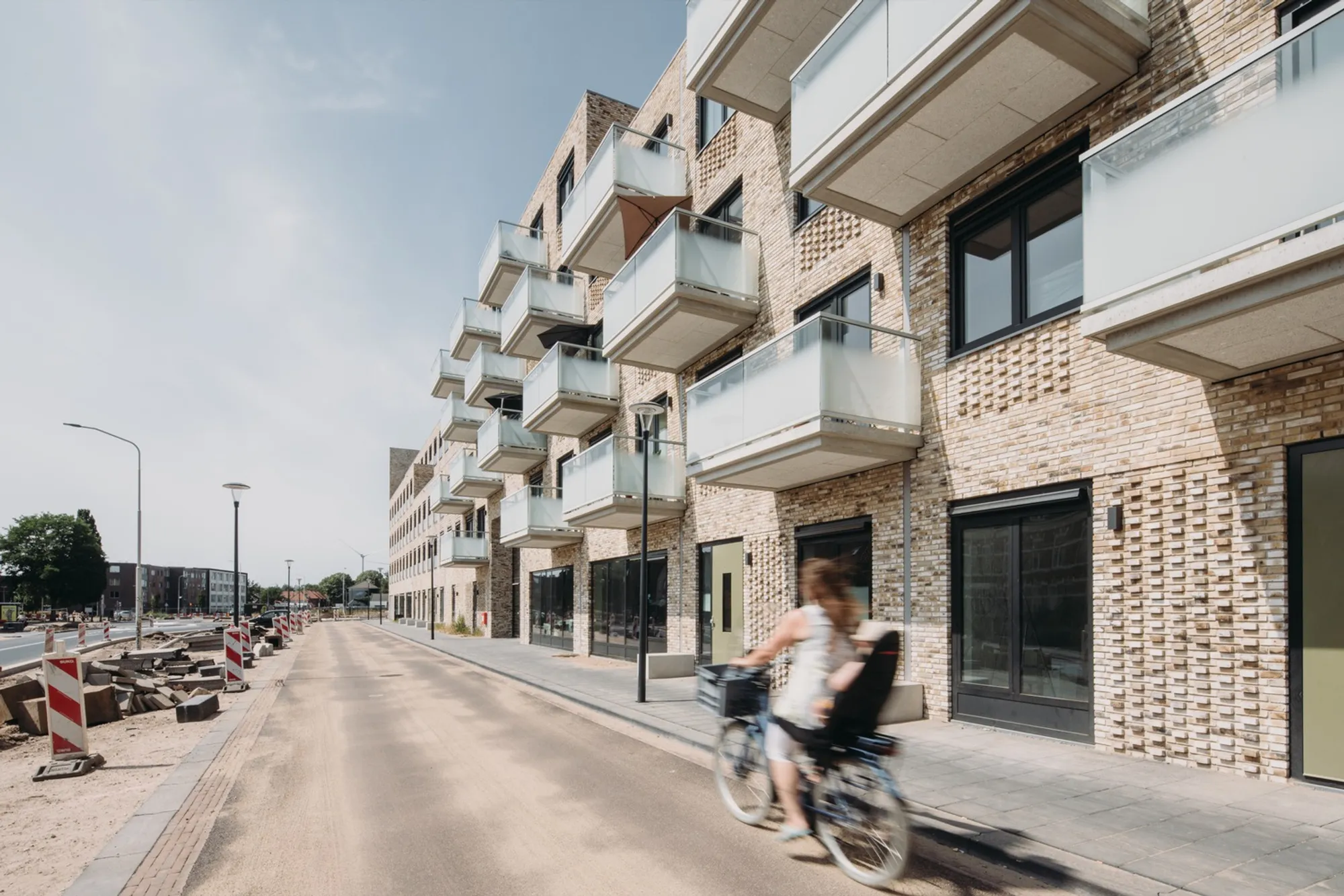
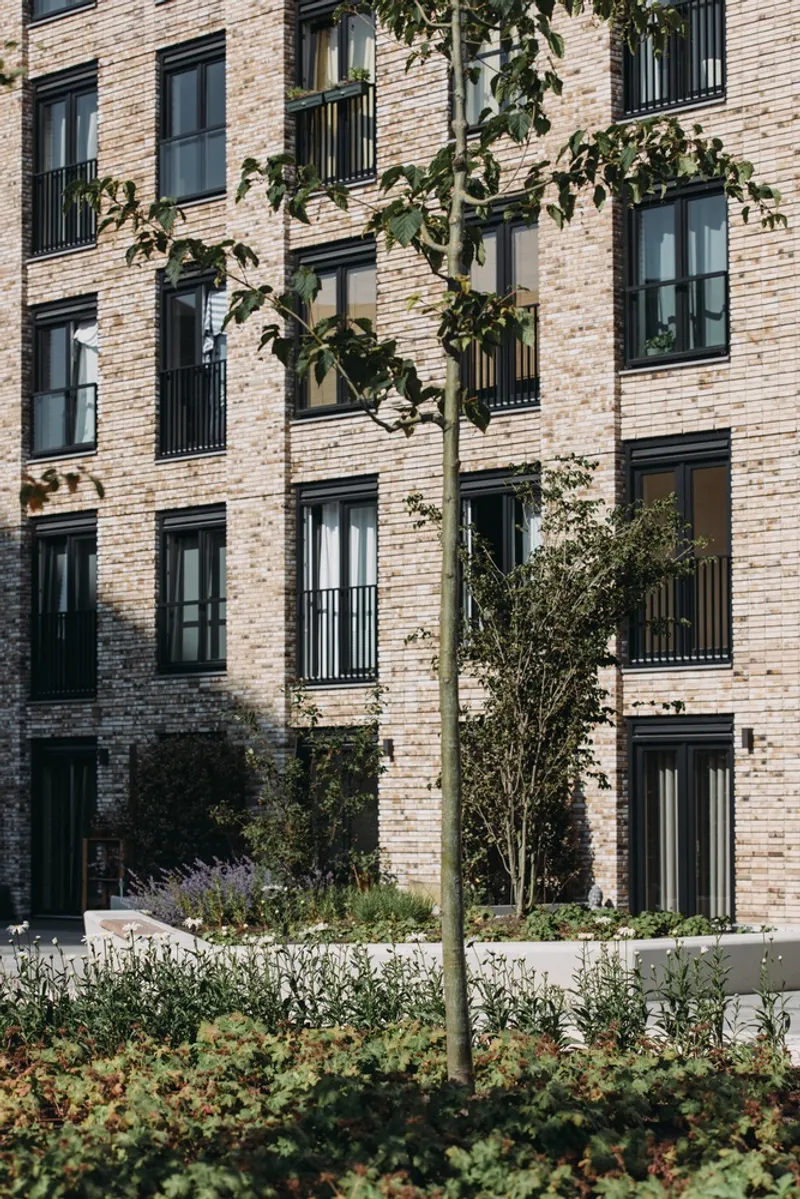
The detailing deserves a close look. Openings are set into a recessed plane and filled variously with glass, cladding, or masonry in a contrasting stone, which gives the facades a layered depth that changes with the light. Aluminum plank profiles handle doors and grilles, picking up the champagne tone of the window frames. The effect is that what could be a repetitive grid of identical windows instead reads as a textured surface with clear figure-ground relationships.
Stacked balconies with frosted glass railings project from the brown brick field, giving residents private outdoor space without turning the elevation into a chaotic assemblage of personal expression. The pattern discipline is strict, yet the variations in brick tone between blocks introduce just enough chromatic shift to keep the streetscape from feeling monolithic. A cyclist passing the base, as captured in one image, encounters a scale that is urban and active, not residential and sleepy.
The Courtyard as Social Infrastructure
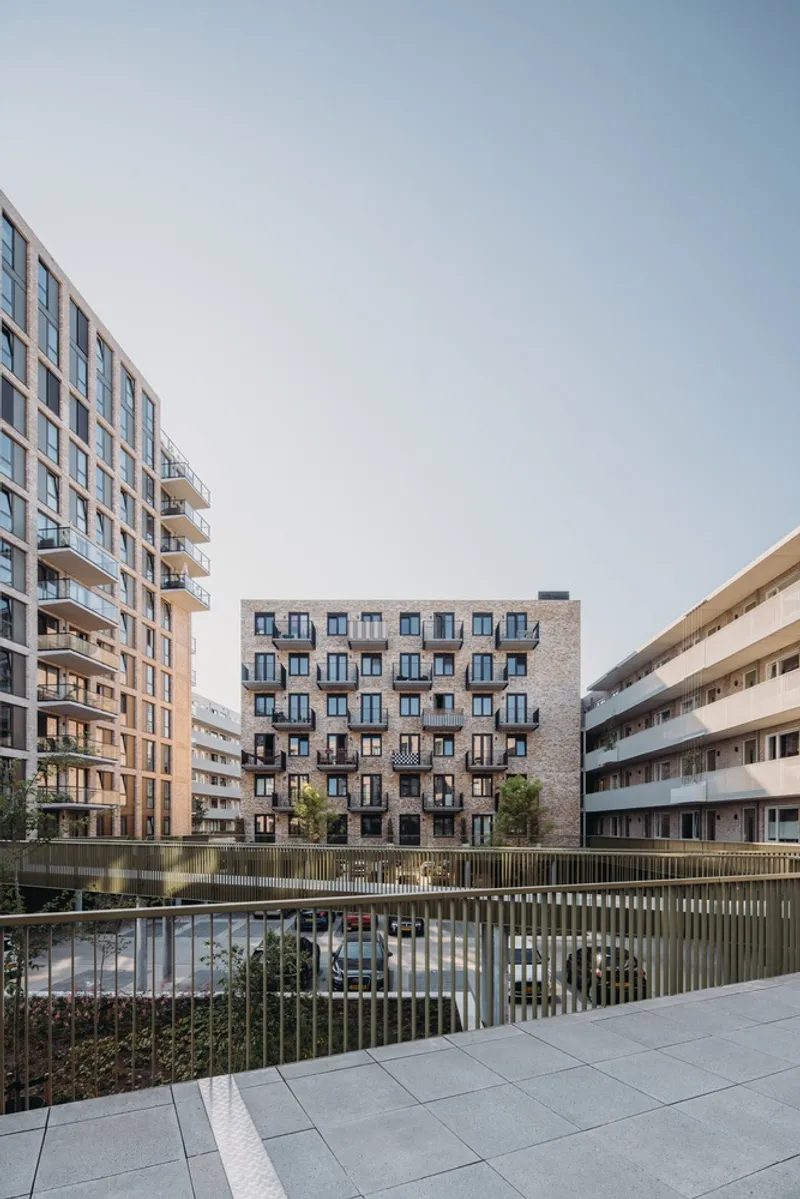

The courtyard is the project's communal engine. It opens toward the harbor, deliberately connecting residents to the public waterfront rather than walling them off from it. Felixx Landscape Architects designed the ground plane so that the courtyard flows into the dike-top landscape without a hard boundary, blurring the line between private amenity and public park. Vertical timber screening at ground level provides a privacy buffer for units facing the yard without blocking sightlines or airflow.
The architects kept interior facade detailing deliberately neutral, providing a calm backdrop that lets greenery take precedence. Planted terraces, young trees, and lavender beds do the visual work at eye level, while the brick volumes rise overhead. Rainwater infiltration within the courtyard turns the landscape into a functional climate device, not just a decorative amenity. Below it all, the parking layer covers nearly the entire plot on the embankment side, keeping cars invisible without burying them underground at prohibitive cost.
Ground Floor: Double-Height Entrances as Urban Connectors
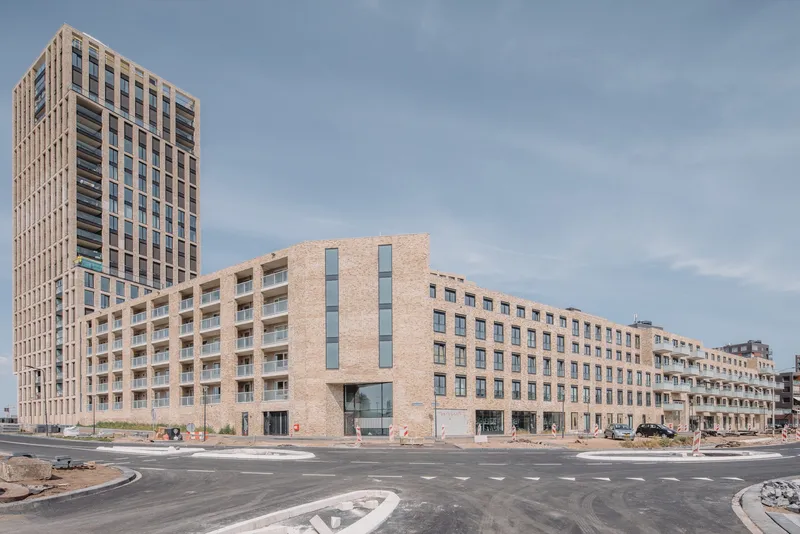
One of the smarter moves in the plan is the treatment of the ground floor. Double-height entrances punch through the block, connecting the street to the interior courtyard. These are not grand lobbies; they are passageways that stitch two sides of the development together. The gesture makes the block permeable, preventing it from becoming an impenetrable wall of housing along the new city street. At the roundabout corner, the buff brick facade steps down to a commercial base, activating the edge condition and signaling that this is a piece of city, not a compound.
Security is handled quietly. Ventilating elements meet burglar resistance class WK-2 guidelines, and JAZO baffle dampers at the bottom of doors manage noise from technical installations. The apartments themselves use heat recovery ventilation, achieving a well-insulated envelope that the residents never have to think about. Good passive design tends to be invisible; here it is.
Typological Range Within a Tight Envelope
The housing mix is genuinely varied. Thirty-three two-room apartments at 50 square meters sit alongside 23 units at 60 square meters and mid-level rentals in the 61 to 70 square meter range. Maisonettes and larger waterfront apartments fill out the upper end. One block stretches nearly 48 meters in length with six residential floors above the parking and storage layer, housing a significant number of units in a single efficient volume. The point is density without sameness: a single person renting a compact apartment and a family in a waterside maisonette share the same address, the same courtyard, the same brick.
This matters because too many mixed-income housing projects segregate their residents by entrance, material, or orientation. Havenkade does not. The standardization is in the construction method, not in the living experience. Asselbergs has long advocated for "tailored standardized construction" as a way to deliver architectural quality at social housing budgets, and this project is the clearest demonstration of that thesis at scale.
Why This Project Matters
Havenkade matters because it refuses the false choice between affordability and architectural ambition. In a country where the social housing sector has been steadily squeezed, this project proves that 164 social rent apartments can share a robust masonry envelope, a carefully designed landscape, and a prominent harborfront address with market-rate units, without looking or feeling like a concession. The integrated development model, combining what would have been two separate buildings into one coordinated ensemble, is a planning lesson worth exporting.
More broadly, the project demonstrates that serial production and modular building do not have to produce monotony. The diversity of typologies, orientations, and block heights within a tight material palette is precisely the kind of "architectural richness with lasting value" that Asselbergs advocates. As Nijmegen's Waalfront transformation continues to convert former industrial land into city, Havenkade sets a benchmark: dense, democratic, and built to last.
Havenkade Nijmegen Social Housing by Thijs Asselbergs (architectuurcentrale) and vanOmmeren-architecten. Nijmegen, The Netherlands. 324 apartments across eight blocks. Completed 2023. Landscape by Felixx Landscape Architects and Planners. Photography by Eva Bloem.
About the Studio
Share Your Own Work on uni.xyz
If projects like this are the kind of work you want to make, uni.xyz is a place to publish your own, find collaborators, and enter design competitions.




Popular Articles
Popular articles from the community


Co-life: Sustainable Architecture for Age-Friendly Community Living
Co-life reimagines sustainable architecture for seniors through courtyards, rammed earth, shared gardens, and spaces designed for belonging.

Co-Life: Senior Housing Design That Reconnects Older Adults With the City
Co-Life reimagines senior housing design through healing gardens, shared streets, workshops, and a sustainable community across generations.

Conexión: Biophilic Design Reimagines High-Rise Living in Hong Kong
Conexión reimagines high-rise living in Hong Kong through biophilic design, green facades, shared spaces, daylight, water and nature within.

The Earth Pod: 3D Printed Homes for Resilient Refugee Communities
The Earth Pod reimagines refugee housing through 3D printed homes made from clay, combining resilience, self-sufficiency, and rapid shelter.


Similar Reads
You might also enjoy these articles


Hodi-Mandai Geram
Project Function: Preservation and revitalization of the Intangible heritage and socio-spatial identity of the Hodi by Housing, Cultural Memory Center, Sacred Grove, landscape, local tourism economy


Olio Towers: A Mid-Rise for Performers That Fuses Housing, Rehearsal, and Stage
Located blocks from Houston's Theater District, this modular tower stacks living units around a central performance atrium.

Oasis: Modular Green Housing Carved into Dhaka's Urban Fabric
A shortlisted Plugin Housing entry reclaims unauthorized settlements in Dhaka with stepped concrete volumes, green roofs, and ventilation-driven design.

Black Hole: A Floating Megastructure for the Post-Physical Era
Emiliano Mazzarotto envisions a spherical, self-scaling arena where e-sports, digital hotels, and holographic stadiums replace traditional public space.


Explore Housing Competitions
Discover active competitions in this discipline



Challenge to reimagine the Iron Throne


Photograph architecture without architects


Illustrate the lost glory of Angkor Wat - Render Challenge


Design challenge to reuse E-waste
Comments (0)
Please login or sign up to add comments
No comments yet. Be the first to comment!