

The Creative Horizon of Life: A Palliative Care Village Built from the Archetype of Home
Adrianna Tkaczyk breaks a palliative care centre into gabled houses along a waterfront, letting meadows, courtyards and light carry the work of care.


Most hospitals are designed to process illness. A palliative care centre has a harder brief: it has to hold a person, and the people who love them, through the final chapter of a life. The Creative Horizon of Life answers that brief by refusing to look like a hospital at all. In place of a single institutional block, it is a cluster of small pitched-roof houses scattered along a quiet shoreline, close to a village in spirit. Here the architecture works as part of the therapy, not just as a container for it.
The project is by Adrianna Tkaczyk and draws on the principles of healing architecture: daylight, materiality, spatial clarity and a sustained connection to nature. Set on a tranquil waterfront, the proposal links residential units, communal spaces, wellness areas and medical facilities through a network of paths, boardwalks and meadows. Its stated aim is to turn the transition at the end of life into one of dignity, acceptance and calm reflection, with care extended to families as well as patients.
A Row of Houses Turned Toward the Water
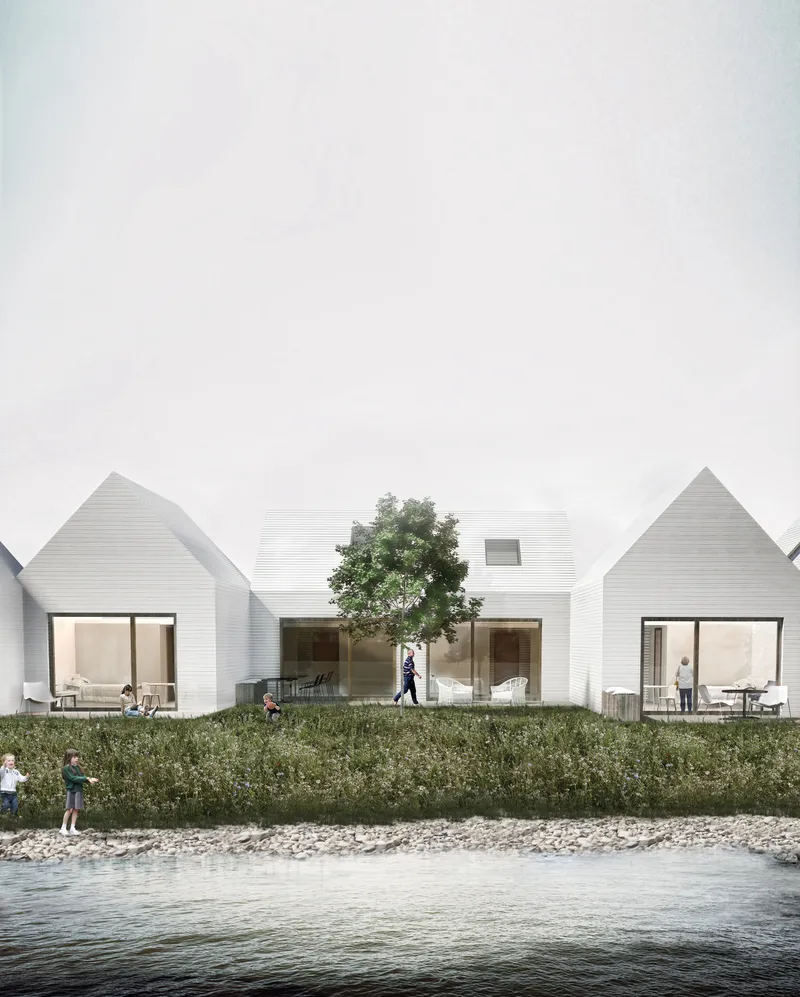
The opening image sets the tone before any plan is read. White gabled volumes line up behind a meadow and a pebble shore, and their glazed living rooms open directly onto the landscape. Children play in the mist at the water's edge. The scene reads as a seaside hamlet, and that is the point. Tkaczyk uses the archetypal house silhouette, the shape a child would draw, to remove the anxiety people bring into medical spaces and replace it with something they already recognise.
The residential units repeat as a modular rhythm, yet each keeps its own identity and its own outward view. Every unit is oriented toward nature and daylight, so no room faces inward onto a corridor. For a resident whose world may shrink to a single bed, a framed view of water and grass becomes far more than a design amenity.
A Masterplan Threaded Through Forest and Shoreline
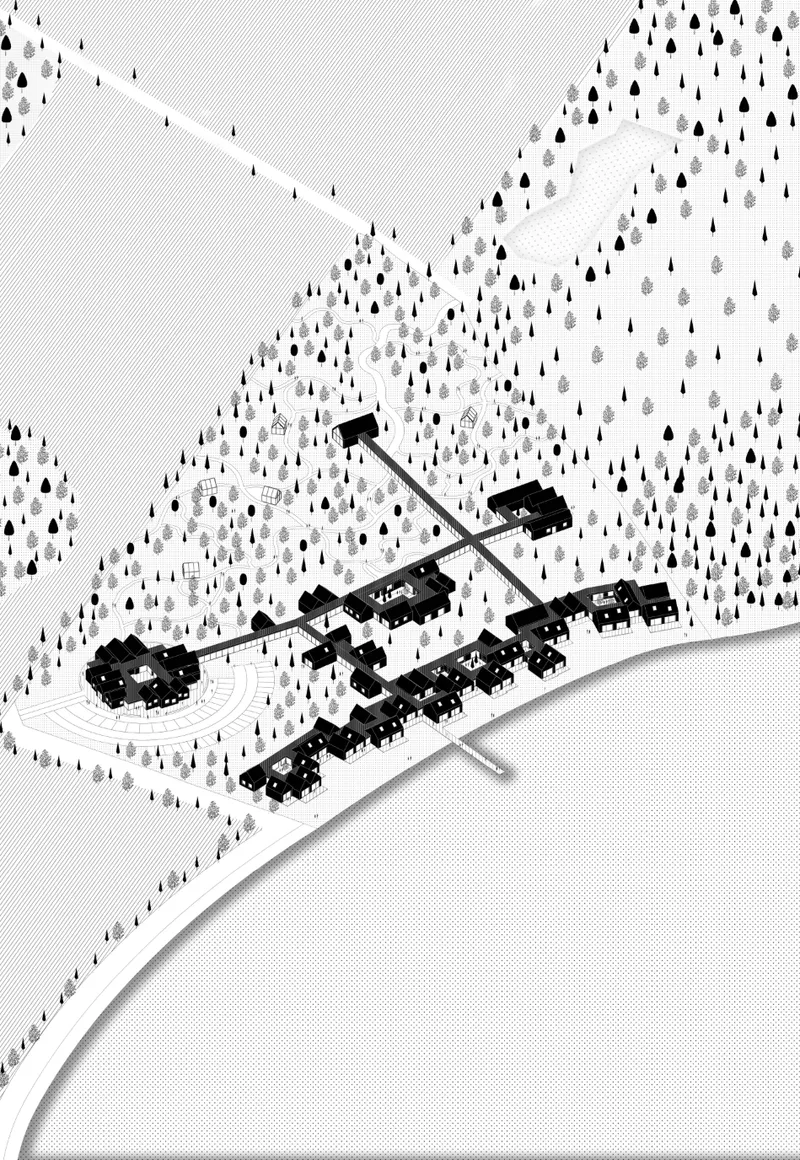
The axonometric site drawing shows the logic behind the picturesque surface. Clustered houses sit in a forest beside a curving shoreline, tied together by walkways instead of being stacked into one building. Breaking up the massing does two jobs. It lets light reach deep into each space, and it turns movement between rooms into a walk outdoors. Waterfront promenades, wooden boardwalks and meadow paths keep the built and the natural in constant contact.
The circulation is deliberately intuitive and human-scaled, which matters in a setting where confusion and fatigue are real burdens. At the centre sits a communal hub for shared dining, therapy sessions and social activities, the place where the scattered houses come together. The plan encourages gentle movement and casual encounters without forcing either, which suits residents whose energy varies day to day.
Skylights, Jetty and the Quiet Discipline of the Gable
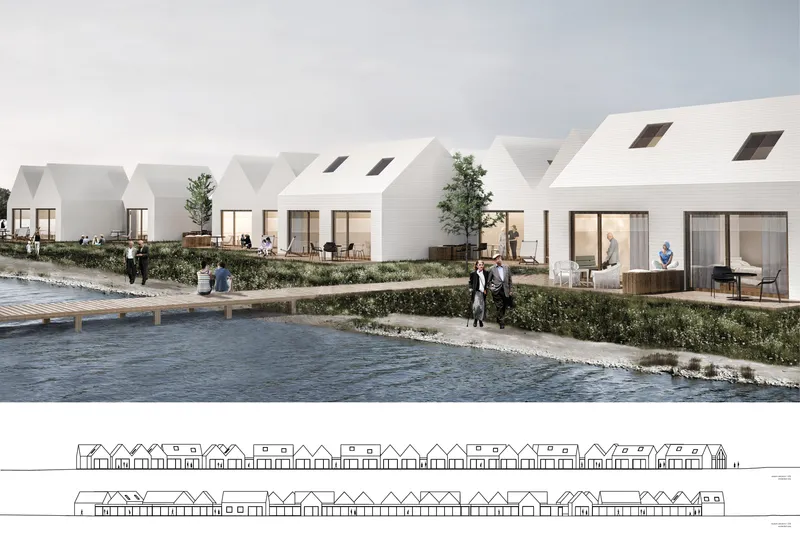
Seen from the water, the houses show their full vocabulary: simple gabled roofs, white-clad walls, skylights cut into the pitches, and a timber jetty reaching out over the shore. The two long elevations below the view confirm the restraint. The volumes vary in placement but not in character, so the ensemble reads as one settlement rather than a collection of competing objects. Skylights bring light down from above as well as through the large glazed openings, an important move for rooms where people may spend long stretches lying down.
The jetty is a small gesture with real weight. It gives residents and families a destination: somewhere to go, sit and look out toward the horizon the project is named after. In a building type often defined by limits, a walk to the end of a pier is a modest kind of freedom.
Courtyards and Covered Paths as Rooms of Pause
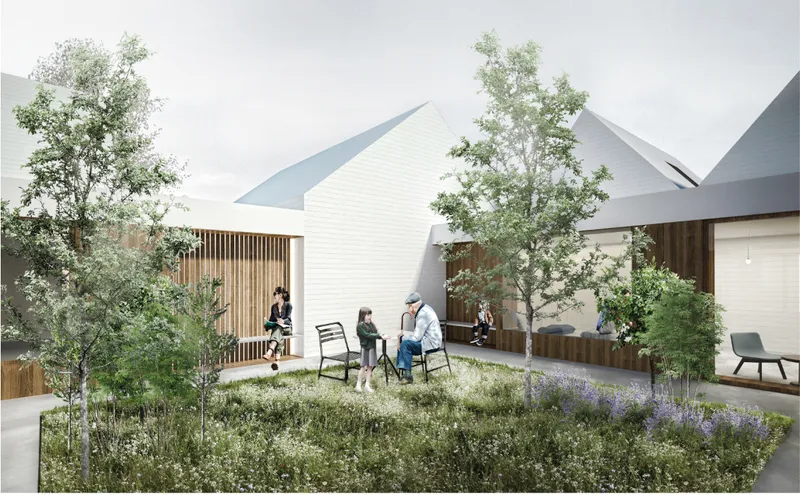
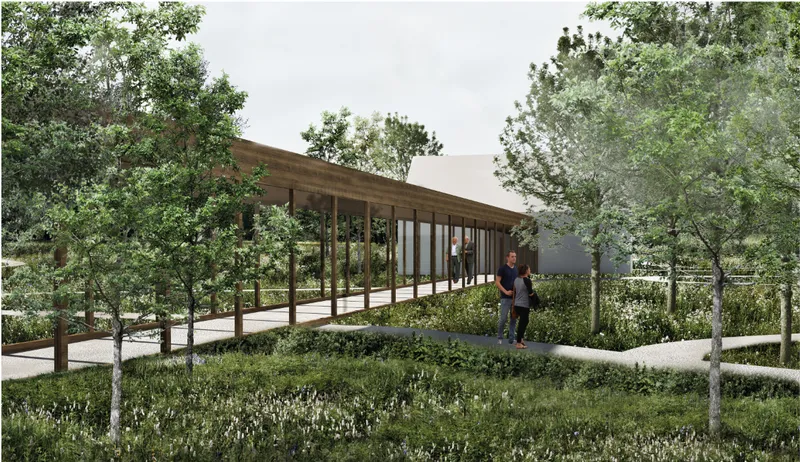
The courtyard image may be the most persuasive in the set. An older man and a child sit at a small table among birch trees and wildflowers, an ordinary afternoon held inside the grounds of a care facility. Tkaczyk describes gardens as living therapy rooms and courtyards as spaces of pause, and this view shows what that means in practice: a setting where family time can feel unhurried rather than clinical. Trees and wild grasses soften the edges of the buildings so the architecture never dominates the moment.
The covered timber walkway, carried on slim posts through the birches toward a white gabled volume, answers a practical question. If care is spread across separate houses, how do people move between them in bad weather? The answer is a sheltered path that keeps the forest close. It protects without enclosing, so a trip to the communal hub stays an experience of the landscape instead of a corridor.
Timber, Glass and the Balance of Privacy and Company
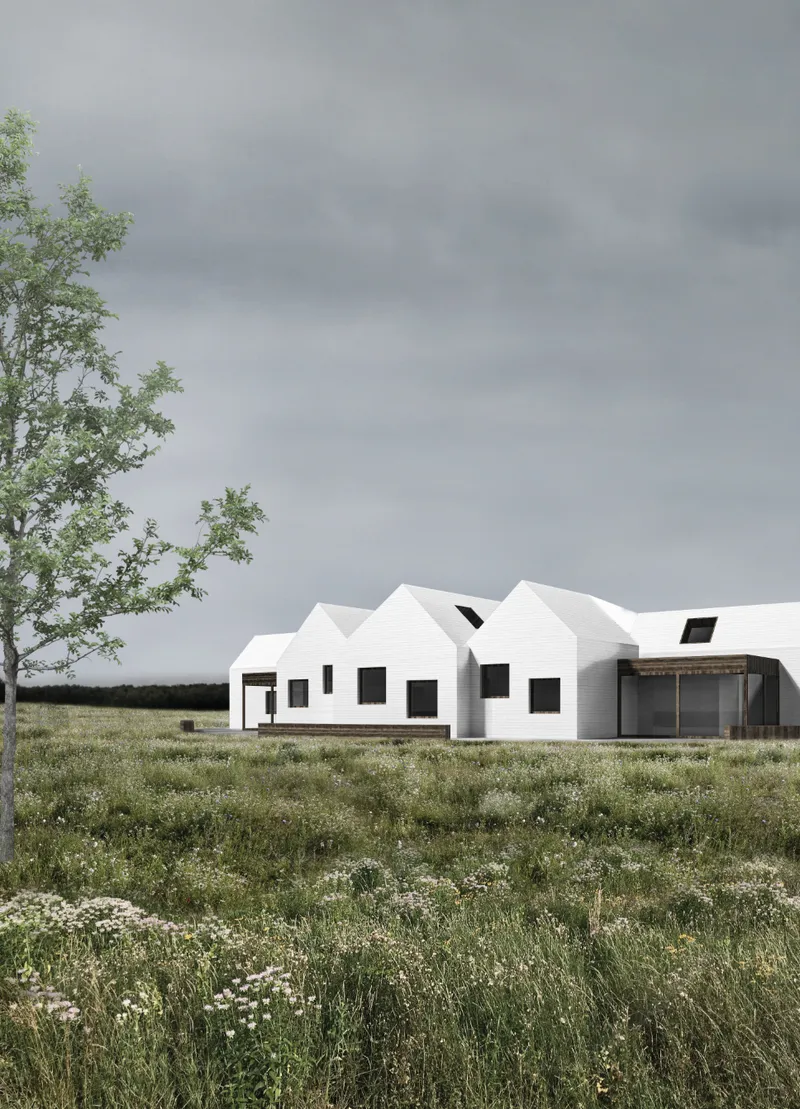
Under a heavy grey sky, the final view shows a group of white houses with dark window openings and a timber porch, set across a wildflower meadow. The weather is honest, and the architecture does not need sunshine to feel sheltering. Inside, the project describes warm timber finishes, integrated seating niches and framed views toward the landscaped courtyards. The palette of wood, glass and muted surfaces offers comfort without overloading the senses, which suits occupants for whom stimulation can quickly become strain.
The porch captures the project's social balance. It is a threshold between a private home and a shared landscape: a place to sit alone or receive a visitor. Each resident keeps autonomy within their own unit, while shared spaces work against the isolation that so often comes with palliative environments.
Why This Project Matters
Palliative care is often treated as the quiet end of the hospital system, so it inherits that system's corridors, waiting areas and fluorescent anonymity. The Creative Horizon of Life challenges that inheritance directly. By breaking the programme into houses, opening every room to the landscape and connecting everything with walks through birch forest and along the shore, Tkaczyk argues that the setting of the final chapter of life deserves the same care as the treatment delivered within it.
The proposal's strength is that it holds back. It does not reach for monumental form to signal significance. It relies on the oldest image of shelter, a pitched roof over a lit window, and trusts light, nature and familiarity to do the emotional work. For a building type defined by loss, that humility feels right, and it offers a clear model for how healing architecture can serve families and patients together.
View the Full Project
About the Designers
Designer: Adrianna Tkaczyk
Enter a Design Competition on uni.xyz
uni.xyz runs architecture and design competitions year-round that reward proposals with spatial conviction and real site intelligence.
Project credits: The Creative Horizon of Life, Palliative Care Center by Adrianna Tkaczyk.


Popular Articles
Popular articles from the community


Singing Woman: An Opera House That Performs Before the Curtain Rises
Ovidiu Cristian Pavel's conceptual opera house translates Estonia's choral identity into a sculpted waterfront landmark facing the Baltic Sea.

Aquadapt: An Underwater Habitat That Rewrites Its Rooms by the Hour
Curved modules ring the seabed while one shell shifts from breakfast room to cinema, farm and football pitch as residents' needs change.


ETEH Reworks the Shared Spaces of São Domingos School in Brazil Around Timber, Color and Hanging Plants
At São Domingos School in Brazil, 436 m² of hall, refectory and library are recast with timber joinery, a yellow and blue code and trailing greenery.

The Amber Palace Opera: A Geological Fiction Surfaces on Tallinn's Baltic Waterfront
Pierre Brillard reimagines a Baltic legend as a public landscape, opera house, and waterfront promenade rooted in Tallinn's coastal identity.

Similar Reads
You might also enjoy these articles
Healing Façade: A Modular Chapel System That Restores Ethiopia's Sacred Forests
Winner of the Eco-Chapel competition, this circular timber façade collects water from air to rebuild soil and reforest degraded Ethiopian landscapes.
Kaffeebühnen: Where Coffee Shop Architecture Becomes a Civic Stage in Vienna
A linear sequence of timber boxes, transparent shells, and open yards turns the Viennese café tradition into a public performance space.
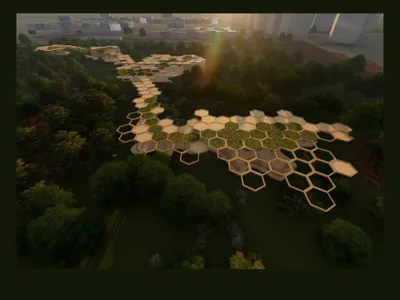
Eco Chapel: A Modular Forest Pavilion That Grows Like the Landscape It Protects
Hexagonal timber modules weave through existing trees, turning a chapel into a living system for prayer, education, and reforestation.


Urban Forest: A Vertical Ecosystem for 5,000 Workers in Singapore's Changi Business Park
Radially stacked pods and layered green decks turn a 7-acre plot into 47 acres of ecological workspace projected for 2040.


Comments (0)
Please login or sign up to add comments
No comments yet. Be the first to comment!