
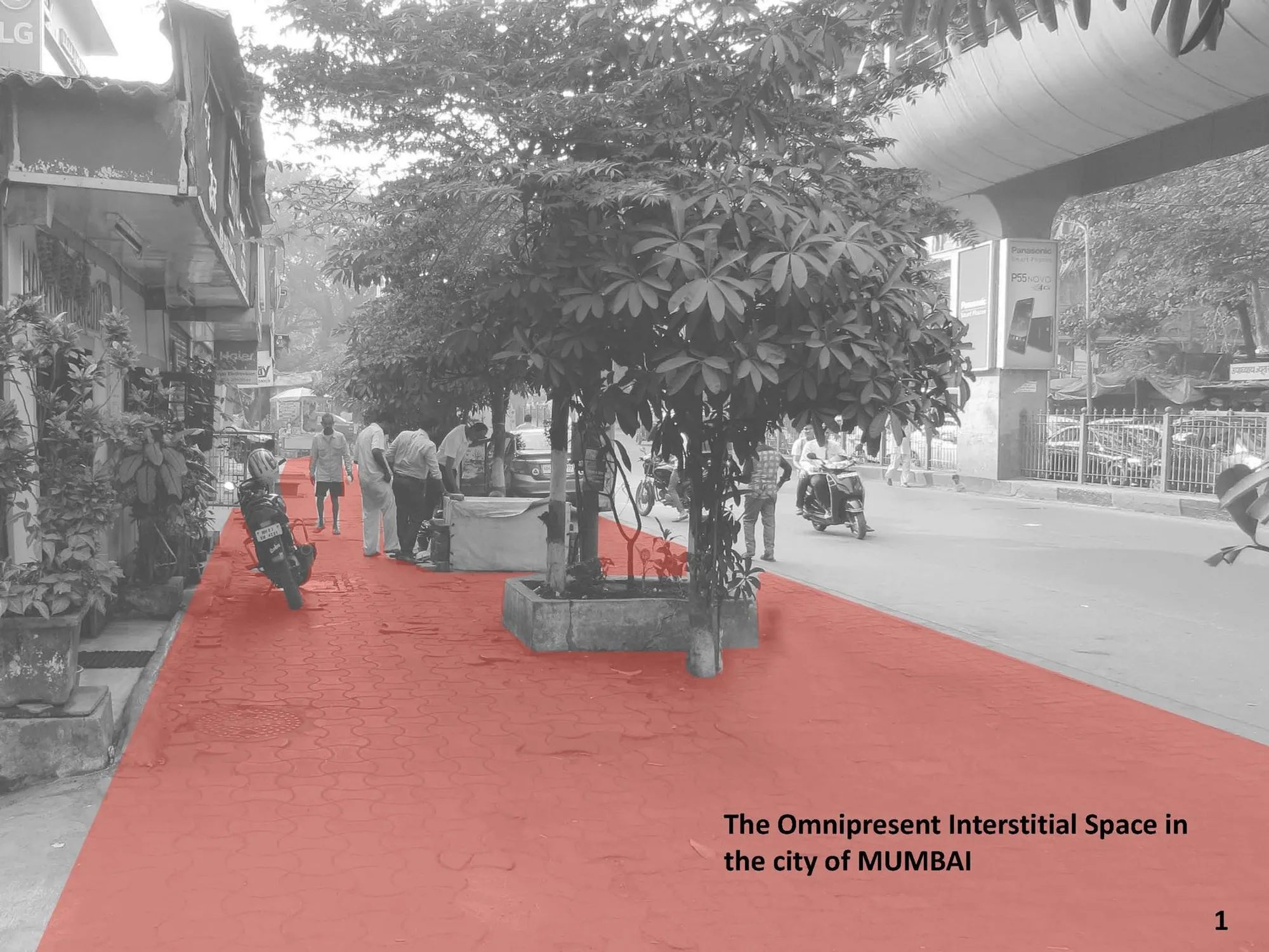
Health & The City: Turning Mumbai's Footpaths into Wellness Infrastructure
A modular urban furniture system embeds exercise, hydration, and rest into Mumbai's pedestrian network to fight a citywide health crisis.


In a city where 52% of households fall below the poverty line due to healthcare costs alone, the most radical health intervention might not be a hospital. It might be a footpath. Health & The City reframes Mumbai's sidewalks as sites of preventive care, proposing a modular furniture system that weaves exercise, hydration, and rest into the daily rhythm of the street. The premise is disarmingly simple: if people already walk, pause, and gather on footpaths, why not design those surfaces to actively improve their health?
The project comes from designers Parin Visariya, Sanya Gupta, Trishala Konnure, and Tejashree Kulkarni. Drawing on data from the State of Health of Mumbai Report (2015), which pegs average annual household medical expenditure at Rs. 48,321, or roughly 8.6% of individual income, the team argues that Mumbai's lack of open public space and limited infrastructure for physical activity are not just urban design failures but public health emergencies.
The Footpath as Untapped Public Architecture
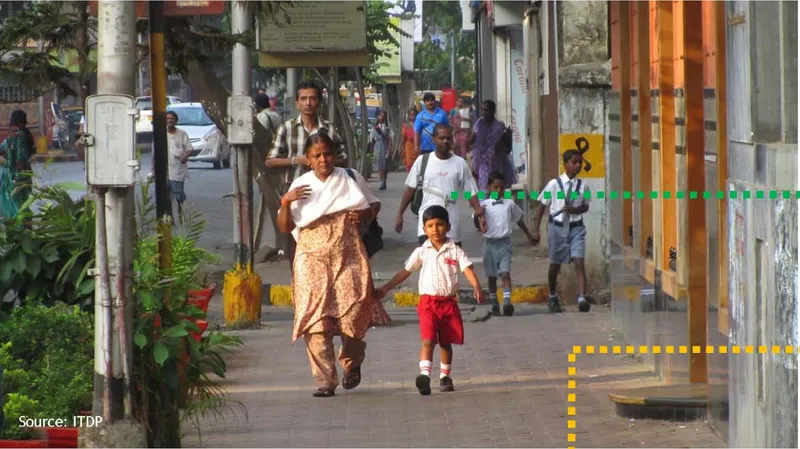
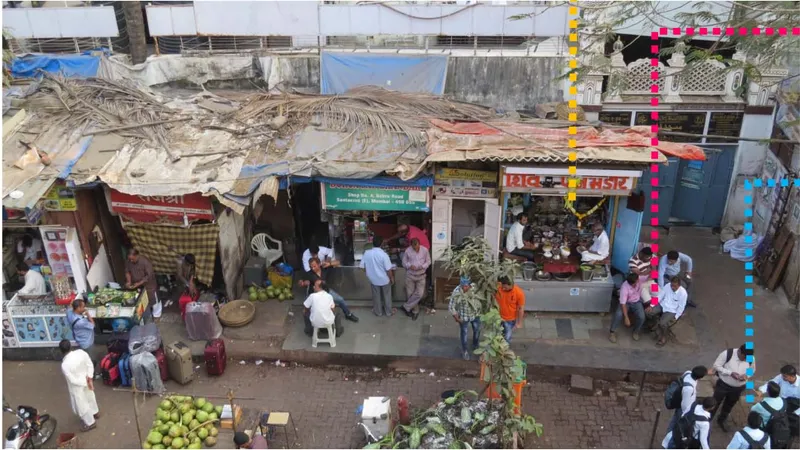
Mumbai's footpaths are far more than circulation corridors. They function as interstitial public spaces: sites of walking, socializing, commerce, and improvised rest. The existing conditions captured here show a paved pedestrian walkway with planted edges alongside a bustling open-air market with corrugated-roof stalls. Both scenes reveal infrastructure already thick with human activity, yet neither is designed to support the physical wellbeing of the people who use it. The designers identify this gap as an opportunity. Rather than proposing costly new parks or plazas, they target the city's most ubiquitous and accessible public surface: the sidewalk.
The argument is grounded in hard numbers. Diabetes, hypertension, and lifestyle-related diseases claim thousands of lives in Mumbai each year. Faulty lifestyle habits compound the problem, but the built environment offers almost no invitation to counteract them. By treating footpaths as platforms for community health, the project shifts the design conversation from reactive medical spending to proactive spatial intervention.
Three Elements in One Modular Insert
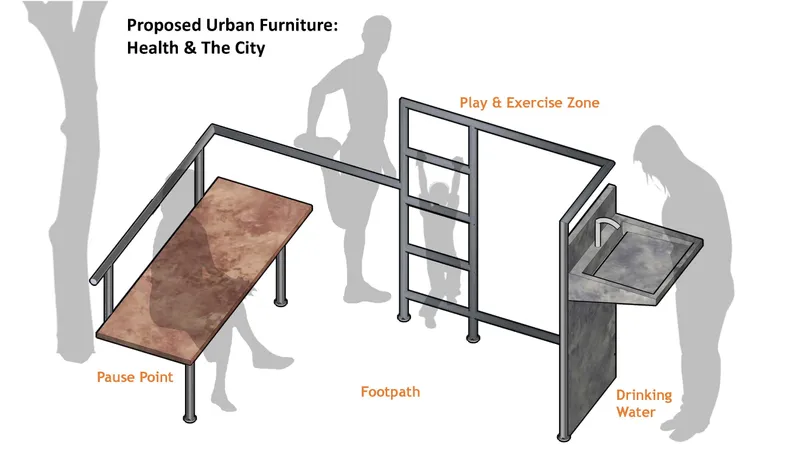
The proposed furniture is an integrated system built from three components: exercise rods for stretching and play, a drinking water fountain addressing the scarcity of public hydration points, and seating zones that provide pause points for rest and social interaction. The isometric drawing above shows these elements assembled into a compact street-level insert, with figure silhouettes illustrating use by children, adults, and elderly residents. The climbing frame doubles as a playful attractor for kids and a stretching station for commuters. The bench anchors the composition as a place of pause. The fountain sits between them, a small but critical piece of infrastructure in a city where public water access remains limited.
What makes the system convincing is its inclusivity by design. The team explicitly addresses all age groups, genders, and economic backgrounds. There is no membership, no gate, no fee. The furniture simply exists on the sidewalk, available to anyone who walks past it. That accessibility is the point: preventive health infrastructure should be as ubiquitous as the diseases it aims to counter.
Dimensioned for the Human Body, Scaled for the City
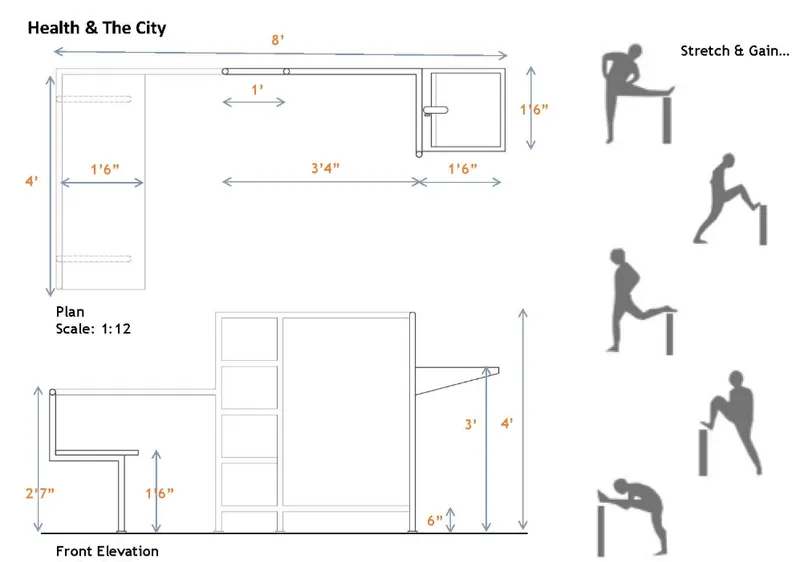
The plan and elevation drawings detail the modular fitness equipment with specific dimensions and user postures for stretching. This level of resolution matters. The exercise rods are not abstract gestures toward wellness; they are sized to accommodate real body mechanics, from overhead reaches to lateral stretches. The drawings show multiple user configurations simultaneously, proving that the footprint can support group use without congestion. For a city as dense as Mumbai, that spatial efficiency is non-negotiable.
The modularity of the system is its strategic advantage. Unlike large-scale urban developments that require years of planning and construction, these inserts are compact and repeatable. They can be deployed across Mumbai's vast pedestrian network incrementally, adapting to different sidewalk widths and neighborhood conditions. The design does not demand a masterplan. It demands a prototype and political will.
Imagining the Activated Street
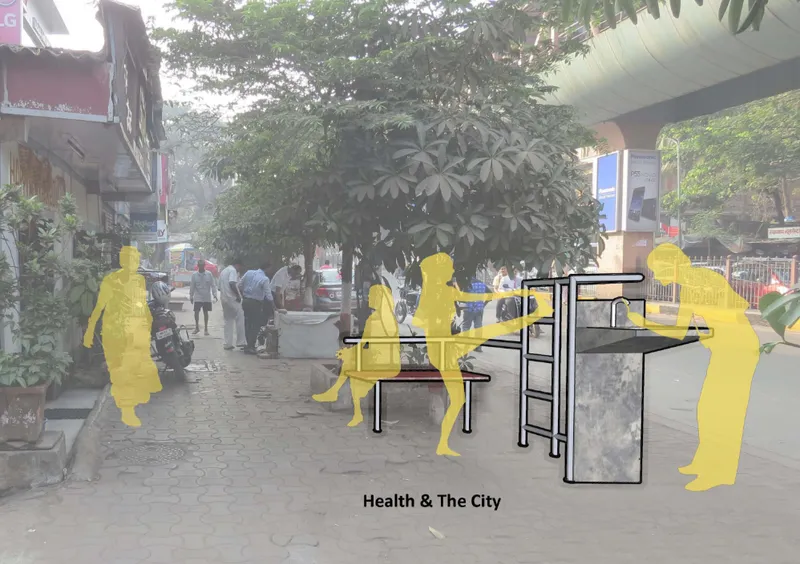
The final image overlays yellow silhouettes of exercising figures onto an existing Mumbai street scene, complete with trees and pedestrians. It is a projection of what the activated footpath could look like: people stretching alongside those walking, the furniture folded into the canopy of street trees and the flow of daily movement. The overlay technique is deliberately low-tech, foregrounding the idea that this intervention does not require a dramatic transformation of the streetscape. It requires strategic placement and a willingness to see sidewalks as more than leftover space between buildings and roads.
Why This Project Matters
Health & The City is valuable because it refuses the false separation between architecture and public health. The designers do not propose a building; they propose a behavioral shift embedded in the most ordinary piece of urban infrastructure. Exercise rods, a water fountain, and a bench are not revolutionary objects. But placed together on a Mumbai footpath, calibrated to the dimensions of the human body, and made available to anyone regardless of income, they become a quiet argument that cities owe their residents more than efficient circulation.
The project also demonstrates a design methodology worth watching: start with epidemiological data, identify the spatial conditions that worsen health outcomes, and intervene at the scale where change is most feasible. For Visariya, Gupta, Konnure, and Kulkarni, that scale is the sidewalk. In a city spending billions on reactive healthcare, investing in a few square meters of preventive infrastructure per block seems not just sensible but overdue.
View the Full Project
About the Designers
Designers: Parin Visariya, Sanya Gupta, Trishala Konnure, Tejashree Kulkarni
Enter a Design Competition on uni.xyz
uni.xyz runs architecture and design competitions year-round that reward proposals with spatial conviction and real site intelligence.
Project credits: Health & The City by Parin Visariya, Sanya Gupta, Trishala Konnure, Tejashree Kulkarni.



Popular Articles
Popular articles from the community


Co-life: Sustainable Architecture for Age-Friendly Community Living
Co-life reimagines sustainable architecture for seniors through courtyards, rammed earth, shared gardens, and spaces designed for belonging.

Co-Life: Senior Housing Design That Reconnects Older Adults With the City
Co-Life reimagines senior housing design through healing gardens, shared streets, workshops, and a sustainable community across generations.

The Earth Pod: 3D Printed Homes for Resilient Refugee Communities
The Earth Pod reimagines refugee housing through 3D printed homes made from clay, combining resilience, self-sufficiency, and rapid shelter.

Lunar Spiral: Space Architecture Shaped by the Mathematics of the Universe
Lunar Spiral reimagines space architecture through Fibonacci geometry, lunar regolith, levitating habitats, and self-sustaining Moon living.


Similar Reads
You might also enjoy these articles
Lunar Spiral: Space Architecture Shaped by the Mathematics of the Universe
Lunar Spiral reimagines space architecture through Fibonacci geometry, lunar regolith, levitating habitats, and self-sustaining Moon living.
The Main Dream: Modular Architecture for Play, Learning, and Community
A modular playground turns recycled plastic into adaptable spaces where refugee children can play, build, learn, and reconnect.

Play: Fragments of Their World
Familiar architecture becomes modular playground design, creating safe spaces where displaced children can learn, connect, imagine and play.

Wadi Rum Observatory: Desert Architecture Designed for the Night Sky
Wadi Rum Observatory turns desert architecture into a quiet instrument for astronomy, hiding research spaces under Jordan's starlit terrain.

Explore Urban Furniture Competitions
Discover active competitions in this discipline



Challenge to merge furniture with learning


Competition to design a workstation for architects
Comments (0)
Please login or sign up to add comments
No comments yet. Be the first to comment!