

Helix Link: A Spiraling Bicycle Bridge That Stitches Copenhagen's Iconic Towers Together
A vertical cycling tower and waterfront promenade connect Vor Frelsers Kirke and Rundetaarn through a contemporary spiral form.


Copenhagen already has two famous spirals: the external staircase of Vor Frelsers Kirke and the internal ramp of Rundetaarn. Helix Link proposes a third. Rather than a restoration or homage, it is a working piece of infrastructure, a vertical bicycle tower and pedestrian bridge that claims the canal between these historic landmarks as new public territory. The spiral here is not decorative; it is the circulatory system of the project, lifting cyclists upward to a panoramic viewpoint while simultaneously organizing bike parking, a cafeteria, workshop spaces, and stepped waterfront terraces into a single continuous structure.
Designed by Ieva Virzonyte and Monika Stražinskaitė, Helix Link was published as a project on the uni.xyz platform. The site sits within Copenhagen's dense historic waterfront, along an urban route connecting Vor Frelsers Kirke, Højbro Plads, and the Børsen. One side faces tightly packed building facades; the other opens onto a public promenade and the canal itself. The designers treat this asymmetry as an opportunity: the bridge doesn't merely cross the water but occupies it, extending platforms and pathways into the canal to blur the boundary between land and harbor.
A Glass Tower That Cyclists Climb
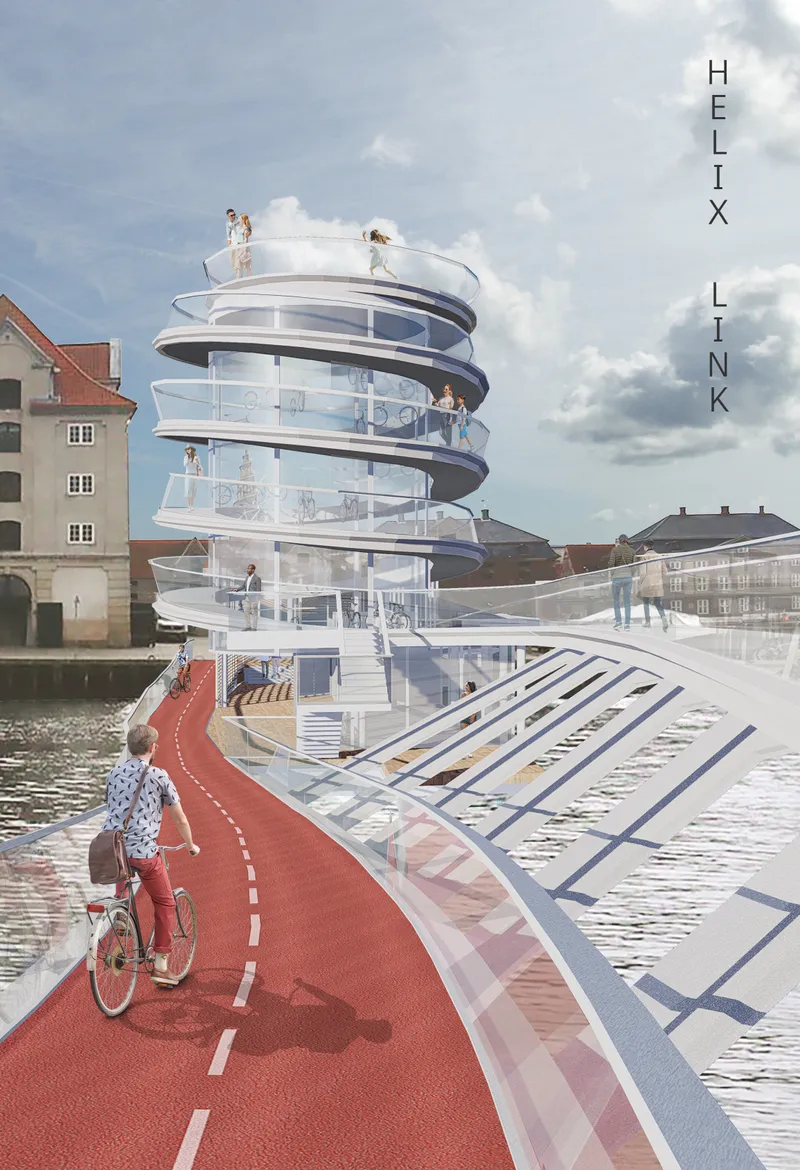
The vertical bicycle tower is the project's most assertive gesture. Wrapped in glass and threaded with a spiraling red cycling path, it rises above the waterfront as both a functional piece of mobility infrastructure and an observation platform. Cyclists ascend along the helical ramp, gaining elevation gradually until they reach a panoramic deck overlooking the city and its canals. The transparency of the tower envelope keeps the interior visually connected to the harbor at every level, so the act of parking a bike becomes an act of sightseeing. It is a clever inversion: the storage silo, typically a hidden utilitarian box, becomes the landmark.
The red path reads clearly against the glass skin and the overcast Copenhagen sky, signaling the cycling route from a distance. That color coding is functional, not merely aesthetic. Separate pathways for pedestrians and cyclists are maintained across the entire structure, with the undulating bridge deck calibrated for different movement speeds. Safety and spatial continuity coexist without the usual compromises.
Timber Terraces Where the City Meets the Water

Along the bridge's waterfront edge, stepped wooden terraces invite people to sit, gather, and watch the canal. These are not leftover spaces; they are the social engine of the project. The timber decking creates a warm, tactile counterpoint to the glass and steel of the tower, and the low, horizontal profile of the terraces contrasts deliberately with the verticality of the helix. Visitors occupy these platforms casually, in the way Scandinavian waterfront culture has always encouraged: shoes off, face to the sun, coffee in hand.
The designers describe this as a contemporary reinterpretation of the Scandinavian relationship with nature and community. The red cycling path runs alongside, maintaining the project's dual identity as both transit infrastructure and public gathering space. By reclaiming what would otherwise be underused waterfront zones, Helix Link turns the canal edge into a destination rather than a corridor.
Ramped Paths and Floating Structures: How the Sections Work
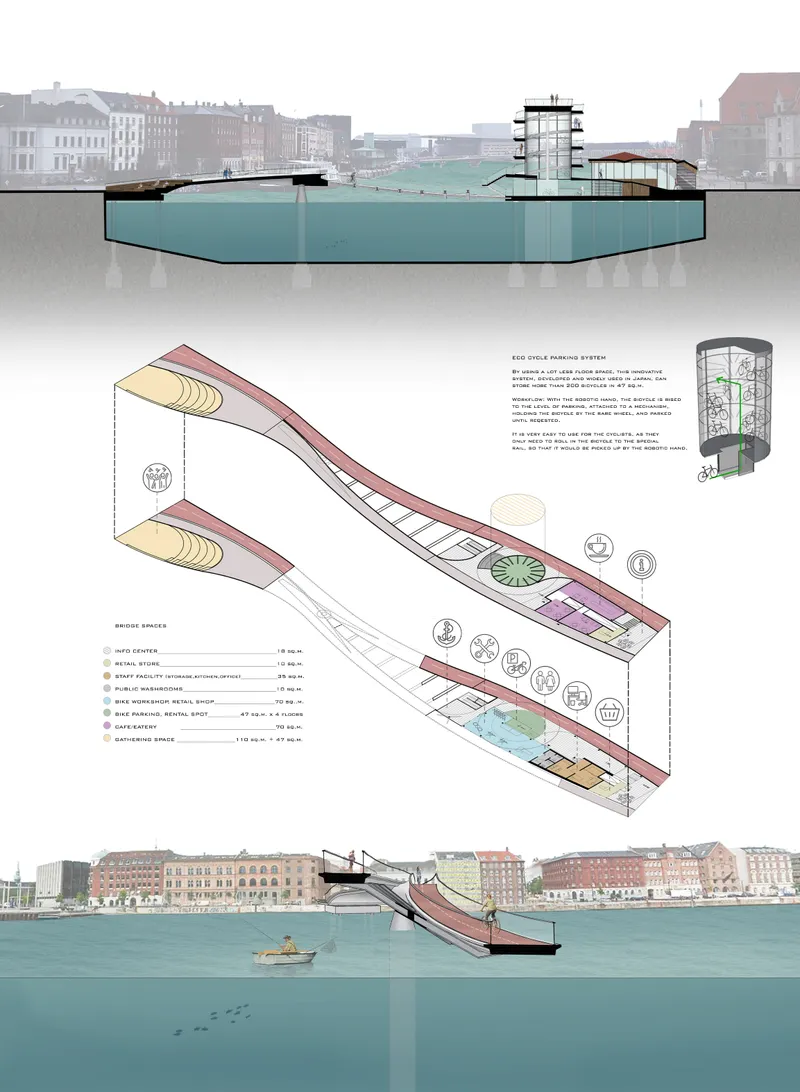
The section and axonometric drawings reveal the project's organizational logic. Ramped paths connect the bridge deck to the tower at varying heights, while floating platforms extend the usable surface area into the harbor itself. The eco-cycle parking system is embedded within the tower's core, efficiently stacking bicycles vertically to minimize the structural footprint. Around it, the programme fans outward: bike rental hub, cafeteria, workshop, and open gathering areas are all threaded along the spiraling circulation route.
What the drawings make legible is the project's ambition to merge infrastructure and architecture into something that functions as active public space. The materials and geometry are optimized for structural economy, but the spatial result is generous. Nothing reads as leftover or back-of-house. Every surface is occupied, every threshold is a transition worth experiencing.
A Harbor Silhouette That Belongs
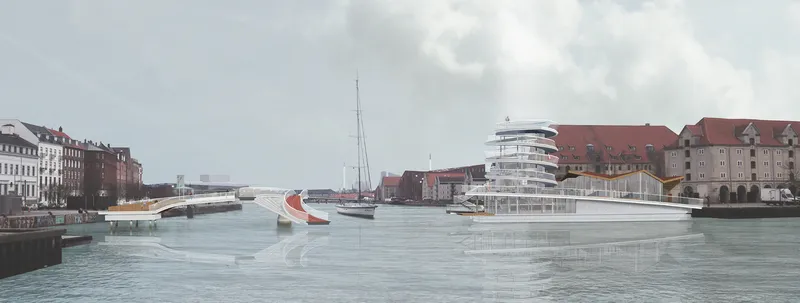
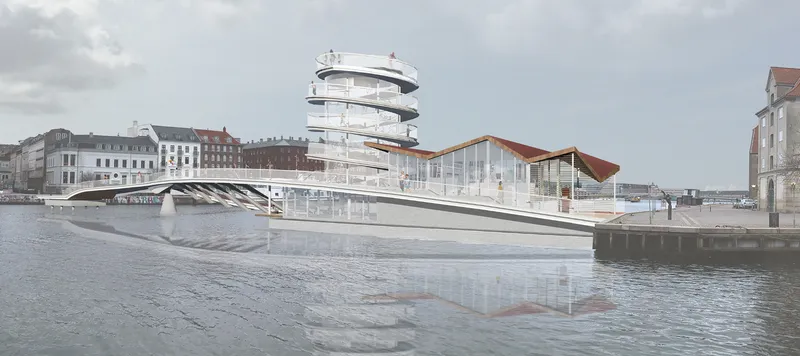
From a distance across the harbor, the spiral tower holds its own against Copenhagen's historic skyline without overwhelming it. Sailing boats in the foreground and the city's roofline behind place Helix Link in a visual conversation with its context. The curved waterfront structures hug the canal edge with a fluidity that avoids the rigidity typical of bridge engineering, and the overall silhouette reads as both contemporary and site-specific.
At the base of the tower, a waterfront pavilion with a folded red roof and glazed facade anchors the project at ground level. The pavilion's angular geometry echoes the tower's spiral energy while operating at a more intimate, pedestrian scale. Together, these elements compose a small urban precinct: tower, bridge, terrace, pavilion. The project's strength lies in this completeness. It does not propose a single object but a network of spaces knitted together by movement and sight.
Why This Project Matters
Most bicycle infrastructure projects optimize for speed and efficiency. Helix Link does something rarer: it optimizes for experience. The decision to make the bike parking tower the tallest, most visible element of the project is a statement about values. In a city that already leads the world in cycling culture, the designers argue that mobility infrastructure deserves the same architectural ambition as museums, concert halls, and civic plazas. The spiral form is not arbitrary; it is a direct response to Copenhagen's own architectural DNA, connecting two historic towers through a third that serves the present.
Virzonyte and Stražinskaitė demonstrate a mature understanding of how public space is made, not just designed. The terraces, the split pathways, the programmatic layering within the tower: these are not flourishes but the mechanisms through which a bridge becomes a place. Helix Link reminds us that the most powerful infrastructure projects are the ones that make people want to linger, not just pass through.
View the Full Project
About the Designers
Designers: Ieva Virzonyte, Monika Stražinskaitė
Enter a Design Competition on uni.xyz
uni.xyz runs architecture and design competitions year-round that reward proposals with spatial conviction and real site intelligence.
Project credits: Helix Link by Ieva Virzonyte, Monika Stražinskaitė.


Popular Articles
Popular articles from the community


The Amber Palace Opera: A Geological Fiction Surfaces on Tallinn's Baltic Waterfront
Pierre Brillard reimagines a Baltic legend as a public landscape, opera house, and waterfront promenade rooted in Tallinn's coastal identity.
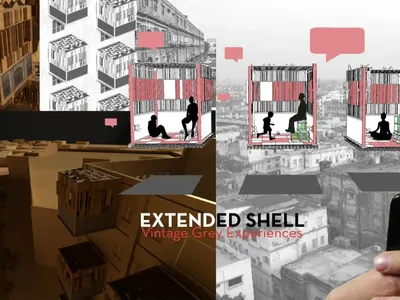
Extended Shell: Retrofitting Kolkata's Balconies as Living Urban Thresholds
A modular retrofit system recovers the social and environmental intelligence of Kolkata's historic verandas for contemporary Park Street residents.

Cloaked Colonization: A Mobile Underwater Habitat That Moves Like a Fish
Micah Abaya's shortlisted EHC Pacific entry reimagines ocean settlement as a dispersed network of self-sustaining architectural organisms.
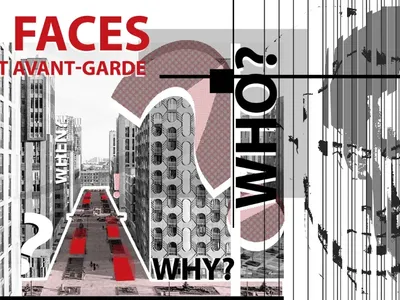
Faces of the Soviet Avant-Garde: Turning Moscow's Street Names into an Open-Air Museum
A network of sculptural installations across a Moscow residential district transforms forgotten architect names into spatial encounters with cultural memor

Similar Reads
You might also enjoy these articles

Play: Fragments of Their World: Remembered Architecture Rebuilt as a Modular Playground for Refugee Camps
Tom Gardner abstracts domes, arches and towers from the homelands of displaced families into a kit of child-scaled play parts for camp settlements.
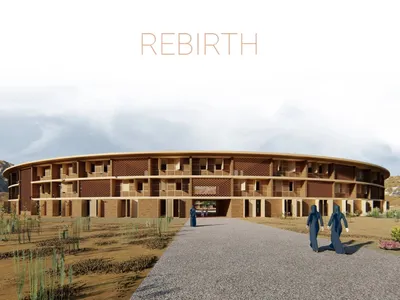
REBIRTH: A Circular Settlement Where Afghan Widows and Their Children Rebuild Life Together
A shortlisted Resile entry turns the circle into a protective ring of timber and brick, gathering homes, classrooms and gardens around a shared landscape.
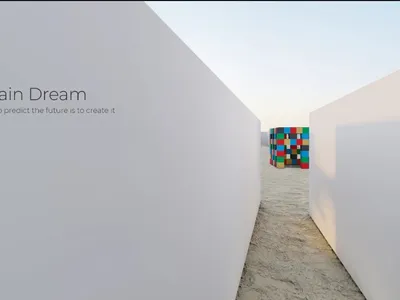
The Main Dream: A Recycled Plastic Kit That Lets Refugee Children Build Their Own Playground
Thirty-centimetre interlocking cubes that connect on three axes turn play into construction, letting children author the spaces they occupy.

Lunar Spiral: A Fibonacci-Driven Moon Settlement Rising from Shackleton Crater
Golden-spiral geometry organises buried infrastructure and orbiting habitable spheres into a lunar base designed to grow as life on the Moon expands.

Explore Helix Bridge Competitions
Discover active competitions in this discipline

Challenge to reimagine the Iron Throne

Photograph architecture without architects

Illustrate the lost glory of Angkor Wat - Render Challenge

Design challenge to reuse E-waste
Comments (0)
Please login or sign up to add comments
No comments yet. Be the first to comment!