

HENN Stacks a 211-Meter Cloud-Inspired Tower onto a Narrow Shenzhen Tech Campus
Kingdee Cloud Tower rises 44 floors on a pentagonal footprint in Nanshan, folding stainless steel and glass into Shenzhen's shifting skyline.


Shenzhen's Nanshan district has spent the last decade in a state of perpetual reinvention, absorbing tower after tower as China's technology sector claims more vertical real estate. Into this crowded skyline, HENN has inserted the Kingdee Cloud Tower: a 211-meter, 44-storey office building that completes a software park campus on what was essentially the leftover land between two existing nine-storey office wings. That constraint, a plot of roughly 5,000 square meters, is the generative fact behind the building's pentagonal footprint and its stepped cantilevers. Rather than accepting a simple extrusion, HENN used the vertical dimension as the release valve, expanding the tower's floor plates as it rises and projecting conference rooms and restaurants outward at key intervals.
What makes the project genuinely interesting is the way it treats its skin. The facade is composed of stainless-steel panels, slightly offset from one another to produce a relief texture, layered over reflective glass that captures Shenzhen's perpetual cloudscape. Ten distinct panel configurations vary according to calculated sun intensity and the function of the floor behind them, balancing outward views with solar control. The building earned LEED Platinum certification, which in a subtropical climate like Shenzhen's is not a passive achievement. Winning the competition in 2014 and opening in 2025, the Cloud Tower also tells a quieter story about the decade-long timelines that large-scale towers in Chinese tech districts actually require.
The Pentagonal Logic


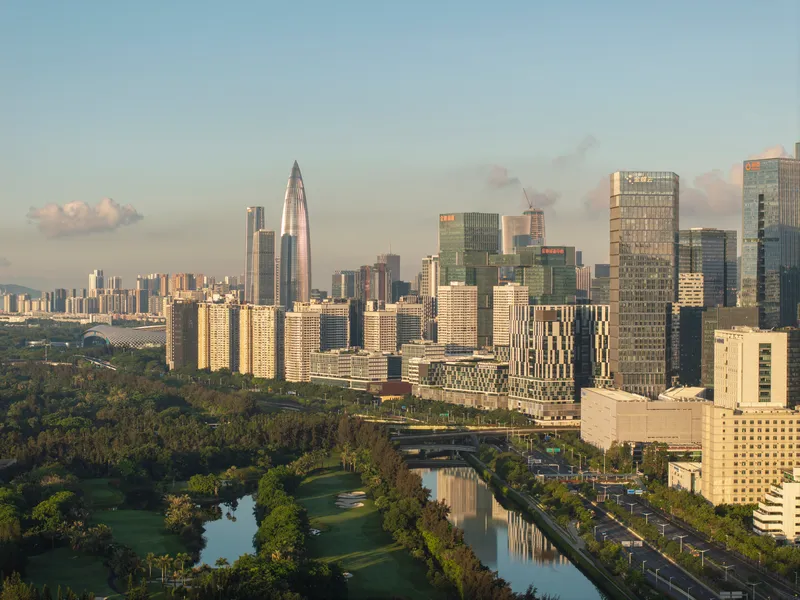
The tower's pentagonal plan is not a formal flourish. It is a direct response to squeezing maximum usable floor area from a tight, irregularly shaped site wedged between two existing office blocks and the edge of a green strip. From the aerial views, the tower reads less as a standalone object and more as a hinge point for the campus, mediating between the linear park, the elevated highway, and the existing low-rise structures. Its cantilevers, visible as horizontal bands that push the upper mass beyond the base footprint, mark the entrance to the software park and establish a dialogue of scale with the neighboring buildings.
At ground level, the strategy flips. The base is open and relatively transparent, built around a fully glazed three-storey atrium that serves as a public lobby. HENN frames this as an "urban living room," and while that phrase gets overused in architectural marketing, the spatial logic holds: the column grid at the base allows daylight and air to reach the courtyard and the lower office wings behind, preventing the tower from casting a dead zone around itself.
A Facade That Works in Ten Variations
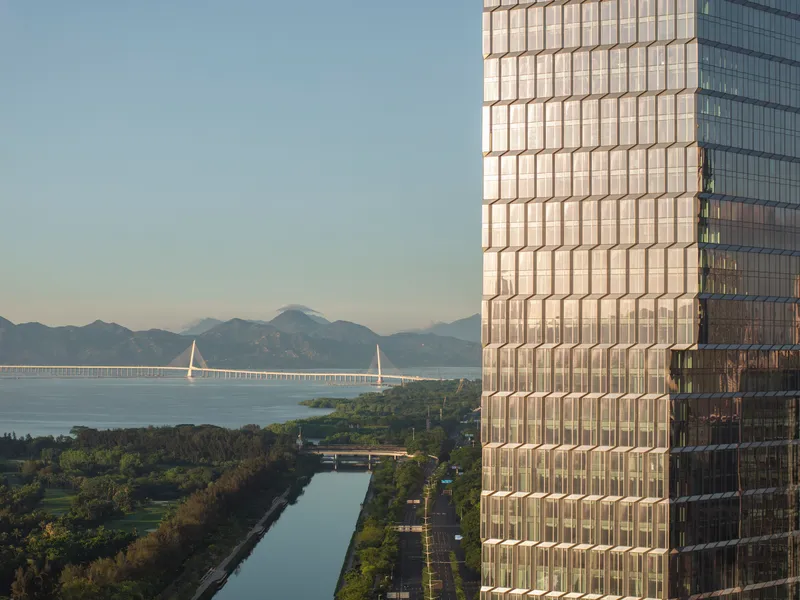


The most technically ambitious move here is the facade system. Rather than applying a uniform curtain wall and relying on blinds or coatings to manage heat gain, HENN developed ten distinct panel types that vary in structure and transparency. These are deployed according to orientation, with the south-facing elevations receiving denser, more opaque treatments and the north-facing surfaces opening up to maximize diffuse daylight. The stainless-steel panels are slightly shifted against each other, producing a tactile, relief-like surface that changes character depending on viewing angle and light conditions.
The effect is genuinely atmospheric. At dusk, the reflective glass captures cloud formations and the warm tones of Shenzhen's industrial horizon, giving the tower an almost dematerialized presence. During the day, the stainless-steel panels catch direct sunlight and fragment it into a shimmering pattern. The facade folds open more aggressively as the building ascends, a gradient that reinforces the impression of a form unfolding upward, consistent with the cloud metaphor that drives the design concept.
Elevated Garden as Campus Connector


Above the tower's open base sits an elevated garden that serves as both amenity and infrastructure. It connects the new tower to the existing office wings at the podium level, creating a continuous landscape platform that houses leisure spaces, sports facilities, and cafés. The garden is open to the wider public, designed to accommodate events and art exhibitions, which gives the campus a civic dimension that pure commercial towers rarely achieve.
The planted terraces, vertical greenery, and timber decking visible in the podium areas suggest a landscape strategy by ACLA that takes the subtropical climate seriously. Rather than ornamental planting, the greenery functions as a buffer zone between the tower's conditioned interior and the heat and humidity of southern Shenzhen. The waterfront pathway along the adjacent canal, framed by mature trees, extends the campus experience into the broader park network, reinforcing Nanshan's identity as a tech district that at least gestures toward livability.
Interior and the View Outward
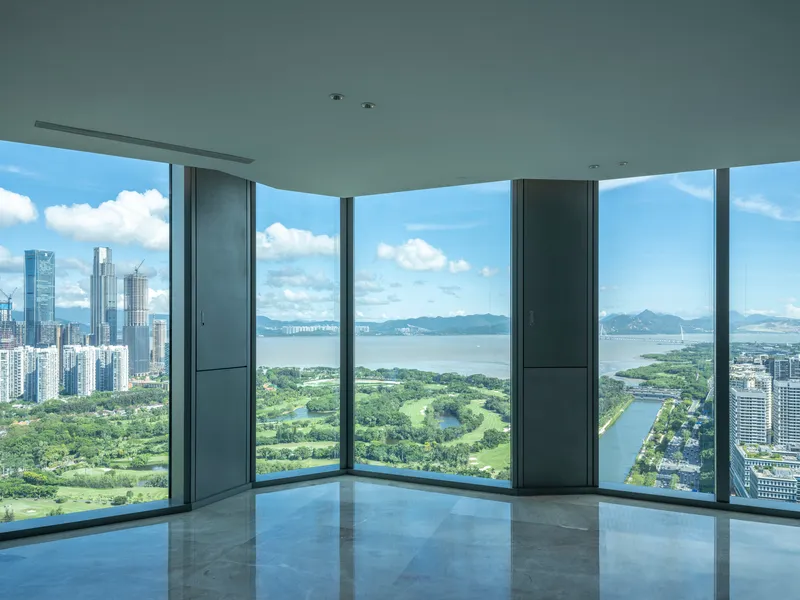

From the interior, the facade performs precisely as intended. The floor-to-ceiling glazing frames wide panoramas of Shenzhen's waterfront landscape, golf courses, and distant mountains, while the variable panel density modulates glare. The corner windows are generous, offering diagonal views that break the tower out of its own grid. For the approximately 6,000 workers the building accommodates, this calibration matters enormously. The difference between a tower that exhausts you with heat and glare and one that makes you want to look outside is often a matter of a few degrees of panel tilt.
The program stacks offices across the majority of the 44 floors, with conference rooms and restaurants positioned at the cantilever levels where the floor plate expands. A hotel component and a rooftop restaurant round out the functional mix. The central core handles vertical circulation via lifts, keeping the perimeter zones free for open workspace.
Plans and Drawings
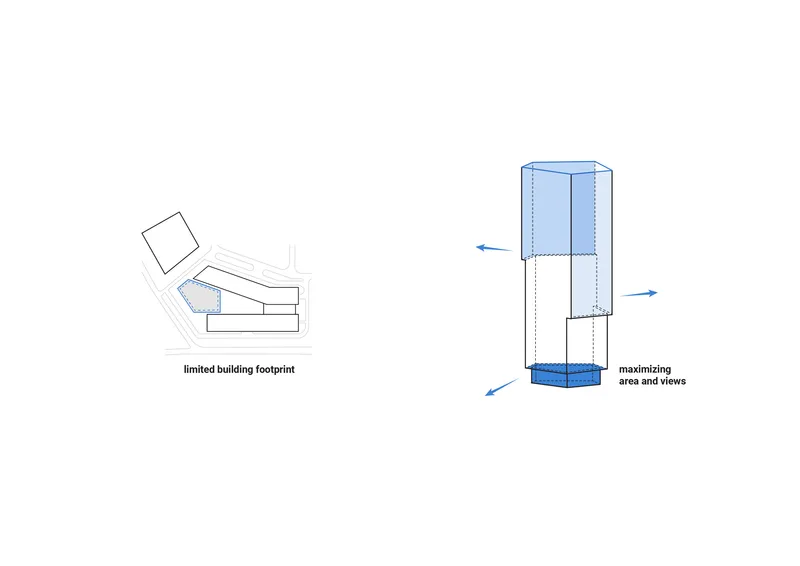


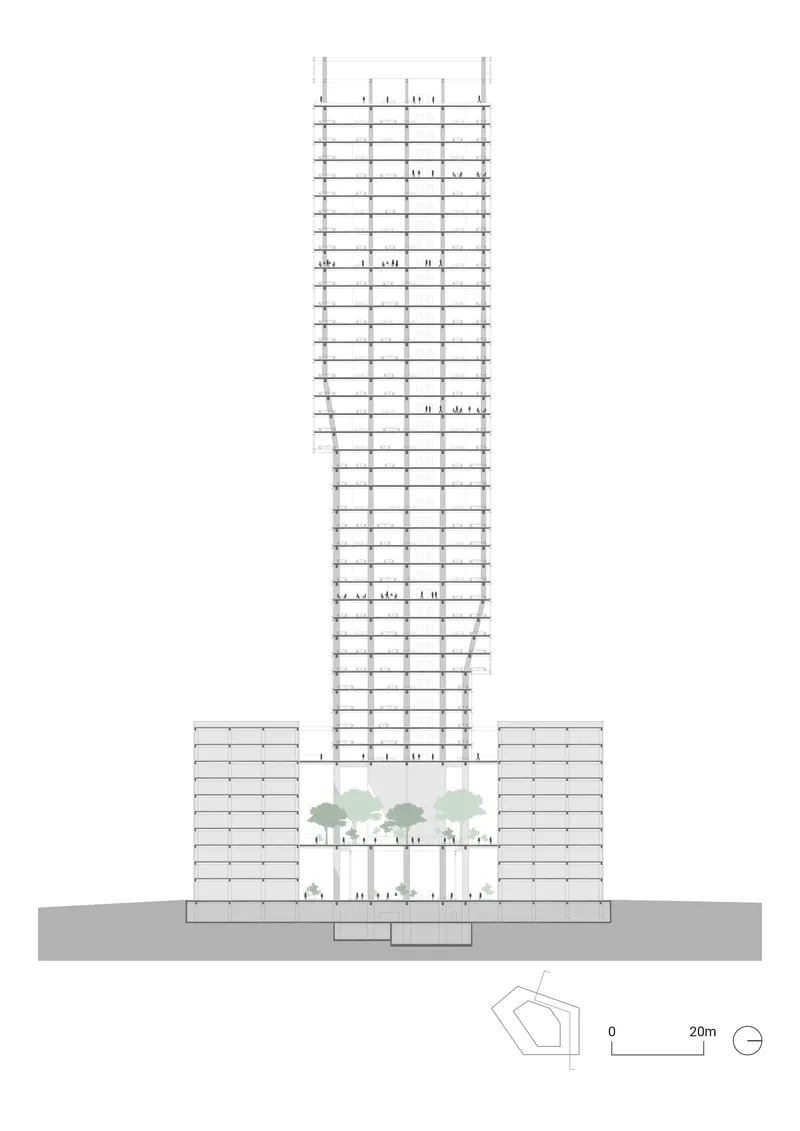
The massing diagram makes the site logic legible: the narrow footprint expands vertically through stepped cantilevers, each one pushing the floor plate beyond the base perimeter. The section drawing reveals how HENN staggers the column grid at technical floors beneath these projections, a structural maneuver that keeps the cantilevers honest rather than cosmetic. The elevation diagrams showing the gradient facade treatment across four cardinal orientations are especially instructive. They map the transition from denser, more shaded surfaces to more transparent ones, confirming that the facade's visual shifts are calculated rather than decorative.
The pentagonal floor plans show the central core cluster angled to maximize usable perimeter workspace, with the upper floors demonstrating how the expanded plate allows for generous open-plan offices. The site plan locates the tower in its urban context, pressed against the waterway and diagonal roadway, making clear how little room HENN had to work with at ground level. The section through the full campus, with its flanking low-rise blocks and landscaped courtyard, captures the project's ambition to be more than a tower: it is a vertical extension of a horizontal campus.
Why This Project Matters
Supertall towers in Chinese tech districts often prioritize symbolic presence over operational intelligence. The Kingdee Cloud Tower does both, but its real contribution is in the details: a facade system that genuinely varies according to environmental data, a pentagonal plan born from site constraints rather than aesthetic whimsy, and a campus strategy that uses the tower as a connector rather than an island. LEED Platinum in a subtropical climate demands performance, not just aspiration, and the ten-variant facade system suggests that HENN and consultant PAG Façade Systems took that demand seriously.
The project also offers a useful case study in patience. An eleven-year timeline from competition win to completion is not unusual for a tower of this scale, but it is a reminder that the buildings shaping Shenzhen's skyline today were conceived in a very different economic and architectural moment. That the design still feels contemporary and technically rigorous speaks to the durability of a concept rooted in physical logic rather than trend. For Nanshan's ongoing transformation, the Cloud Tower sets a standard: density must be earned through intelligence, not just height.
Kingdee Cloud Tower by HENN, lead architects Hans Funk, Yuchen Wang, and Sha Liao. Shenzhen, China. 98,800 m², 44 floors, 211 meters. Completed 2025. Photography by Tian Fangfang.
About the Studio
Share Your Own Work on uni.xyz
If projects like this are the kind of work you want to make, uni.xyz is a place to publish your own, find collaborators, and enter design competitions.


Popular Articles
Popular articles from the community

Tsunami Convergenics: Turning Catastrophic Ocean Forces into Underwater Housing Infrastructure
A speculative underwater settlement off the coast of Onagawa, Japan, treats tsunamis and typhoons as energy sources rather than threats.
Extended Shell: Retrofitting Kolkata's Balconies as Living Urban Thresholds
A modular retrofit system recovers the social and environmental intelligence of Kolkata's historic verandas for contemporary Park Street residents.
Opera by the Sea Estonia: Three Shells Dissolving Architecture into Tallinn's Coastline
A winning opera house proposal replaces monumental form with interconnected shells that blur the boundary between building, park and Baltic Sea.

Opera on the Sea: Driftwood Logic Shapes a Timber Opera House on Estonia's Coast
Trevor Orgill's opera house translates the entangled drift of floating timber into a civic building where wood, water, and music converge.

Similar Reads
You might also enjoy these articles

Bao Huynh Watercolor Atelier: A Serene Art Retreat in Hội An
Bao Huynh Watercolor Atelier in Hội An blends multifunctional art spaces, sustainable design, local materials, and family-friendly living in a serene environment.

Atelier Macri Concept Store Interior Design by CASE-REAL
Atelier Macri store features a "ko" counter, walnut wood details, cork displays, blending retail, gallery, and seamless customer experiences.

Manuel Vargas Izquierdo Stadium and High-Performance Sports Center: Architectural Excellence in Jalpa de Méndez
The Manuel Vargas Izquierdo Stadium blends sustainable design, inclusive sports facilities, and cultural-inspired architecture, revitalizing Jalpa de Méndez’s public spaces.

KAKR Buluh Awar Hall: Revitalizing Community and Ecology Through Bamboo Architecture
Community built bamboo hall revitalizes Buluh Awar village, empowering youth, restoring ecology, celebrating vernacular craftsmanship through sustainable architecture and culture.


Comments (0)
Please login or sign up to add comments
No comments yet. Be the first to comment!