
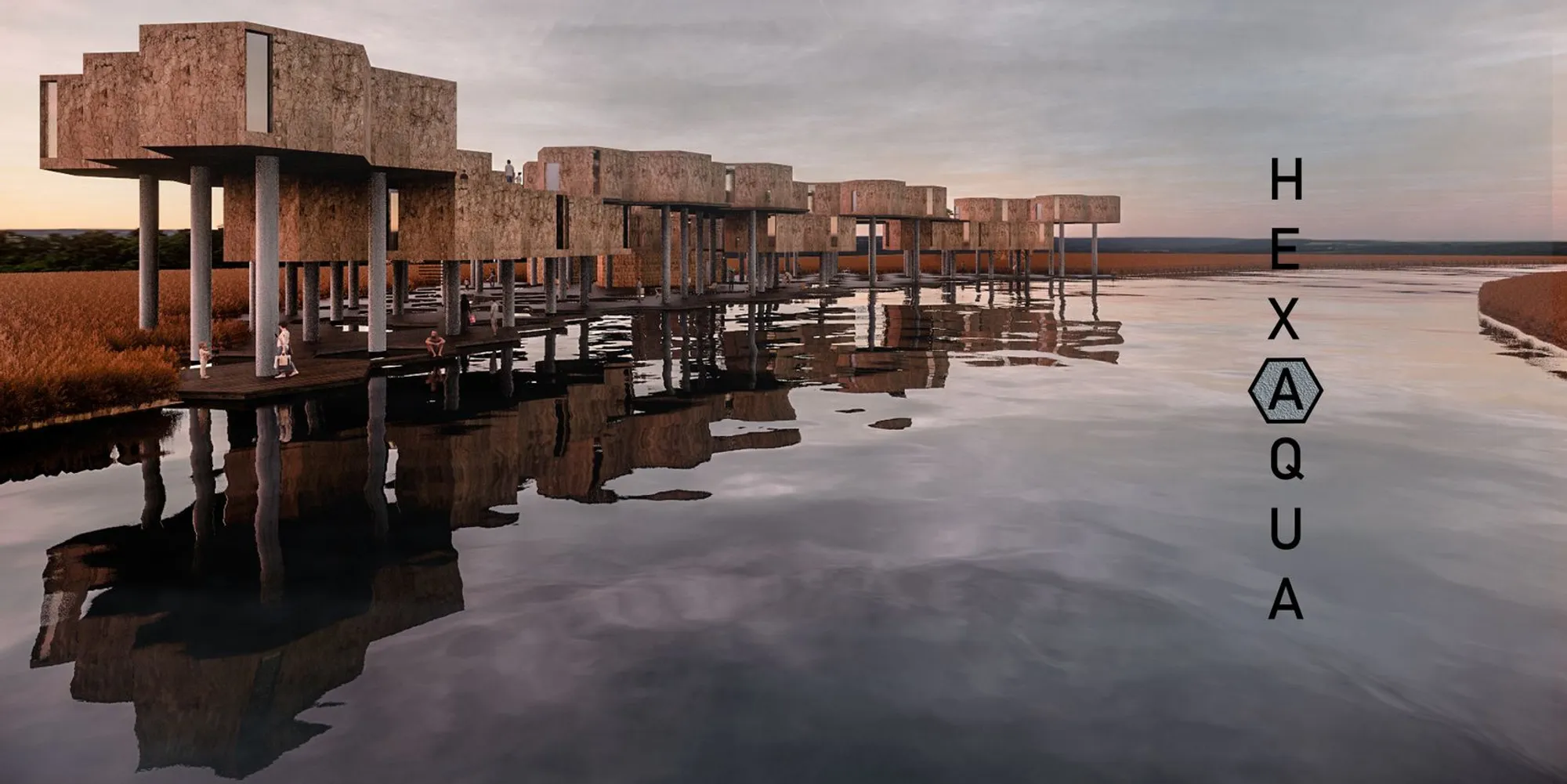
Hexaqua: Floating Hexagonal Housing That Cools Refugees Through Water and Geometry
A modular cork-clad settlement hovers above artificial wetlands in Şanlıurfa, Turkey, turning refugee housing into climate infrastructure.


What if a refugee settlement could function as a cooling machine? Hexaqua takes the hexagonal module, a geometry beloved by parametric designers, and puts it to genuinely practical use: creating a floating housing network over artificial water bodies in one of Turkey's hottest cities. The result is not a formal exercise but a thermodynamic one, where every design decision serves the goal of keeping people alive and comfortable in 38°C summers.
Designed by Onuralp Zengin and İldem Çınar, the project was submitted to the Plugin Housing Challenge 2020, where it received the Institutional Excellence Award. The site is Şanlıurfa, a city of over 1.9 million in southeastern Turkey that bears the double weight of Mesopotamian heritage and a present-day crisis: seasonal agricultural laborers and displaced refugees live in harsh, unsanitary conditions because no one has designed adequate infrastructure for them. Hexaqua proposes that the infrastructure itself could be the architecture.
Cork Volumes Over Still Water
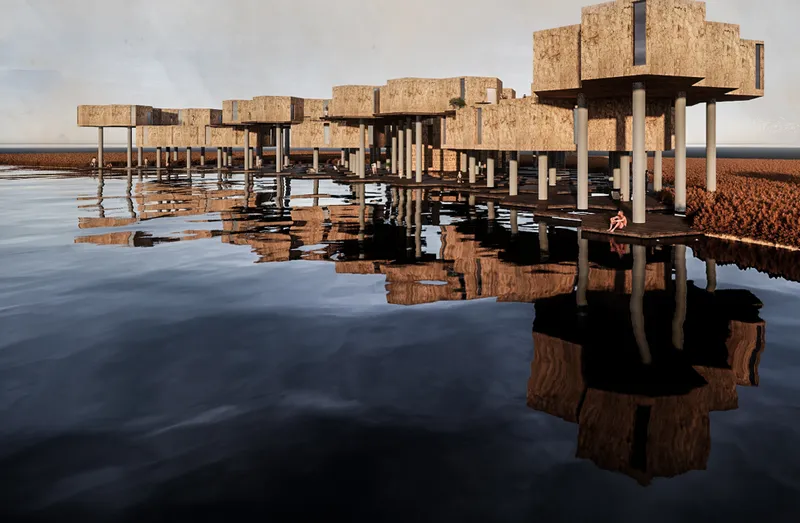
The opening image tells you almost everything you need to know about Hexaqua's environmental strategy. Cork-clad volumes sit elevated on white cylindrical columns above a plane of calm water that reflects both the structures and the surrounding landscape. The water is not decorative. In Şanlıurfa's arid climate, these artificial wetlands create cooling microclimates underneath and around the housing units. Evaporation pulls heat from the air, wind passes freely beneath the raised platforms, and the settlement breathes in a way that a ground-level camp never could.
The elevation strategy does more than cool. By lifting structures off the ground on structural columns, the design avoids the seasonal flooding risks of a wetland site while allowing the water system to function as a continuous thermal buffer. The base connection between structure and column is recessed, maintaining structural integrity while keeping the system disassemblable, a critical requirement for housing that may need to move with its occupants.
A Modular Logic Drawn from Mesopotamian Terrain

The exploded axonometric drawing reveals how Hexaqua's hexagonal modules stack and layer. Cork volumes are suspended on the column grid, with program icons below indicating how different functions, living, gathering, circulation, slot into the geometry. The hexagonal plan is not arbitrary. It draws from the Mesopotamian terrain of the region and offers a structural advantage: each module can expand or contract by adding or removing adjacent hexagonal blocks, accommodating shifting household sizes without demolishing anything.
Wall panels are removable and reconfigurable, meaning a unit housing two people can grow to shelter a family, or an entire cluster can be disassembled and relocated to a new site. The phased evolution of the design, refined through multiple iterations, prioritizes solar orientation and the placement of community gathering spaces. The final model minimizes ecological impact while maximizing the number of shaded, ventilated zones between units.
Rooftop Life and Communal Thresholds
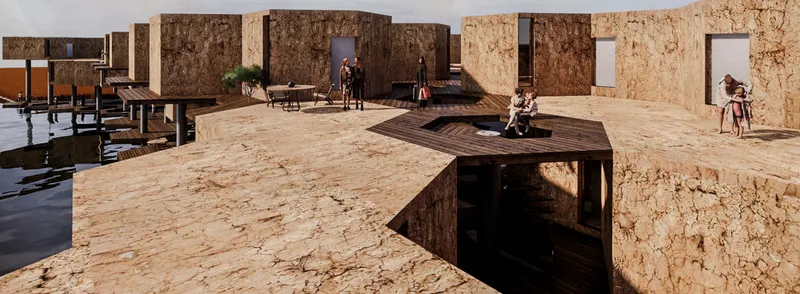
The cork-paved rooftop terrace is where Hexaqua shifts from survival architecture to something more generous. Openings cut into the roof surface connect visually and spatially to the level below, turning what could be isolated private units into a vertically linked community. Visitors gather in the afternoon light, and the terrace becomes a shared threshold, neither fully public nor fully private, that encourages the kind of casual social interaction refugee camps rarely afford.
Cork recurs throughout the project as both cladding and surface material. Its thermal properties are well suited to the climate: it insulates against heat gain during the day and radiates stored warmth during cool desert nights. As a material choice, it also signals a departure from the tarp-and-metal vocabulary of emergency housing, offering occupants a surface that feels deliberate rather than temporary.
Timber Walkways Between Columns and Water
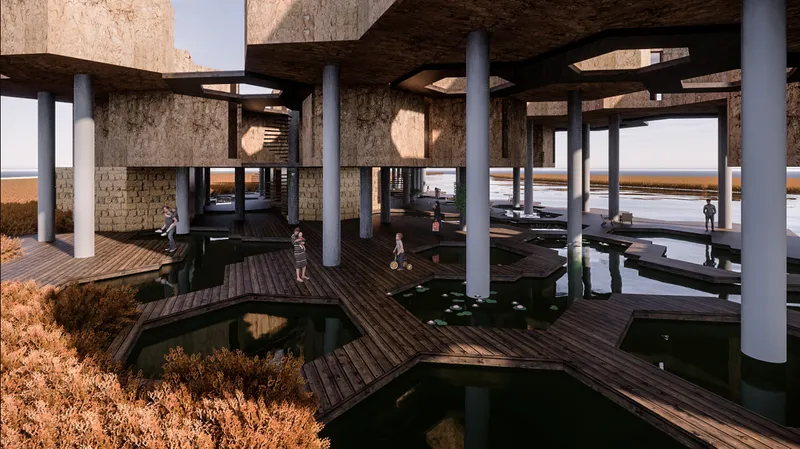
Beneath the elevated volumes, the ground level becomes a shaded, water-cooled circulation network. Timber walkways cross shallow pools between the cylindrical columns, creating a covered zone where temperatures drop measurably compared to the exposed terrain outside the settlement. The space reads less like the underside of a building and more like a wading garden, a transitional environment where residents move between units, cool down, and encounter neighbors.
The network of ponds and shaded pathways ensures that even during extreme heat, the settlement maintains livable conditions across its entire footprint, not just inside individual rooms. The wind passing beneath the structures is channeled by the column grid and the water surface below, creating a passive ventilation loop that reduces reliance on any mechanical system. For a population without reliable access to electricity, this is not a luxury; it is the difference between habitable and hostile.
Why This Project Matters
Hexaqua reframes the refugee housing question. Instead of asking how cheaply and quickly a shelter can be assembled, Zengin and Çınar ask how a settlement can perform climatically, socially, and spatially over time. Their answer, a floating hexagonal network that uses water as thermal infrastructure and cork as a dignified envelope, is both technically specific and conceptually transferable. The strategies deployed here would work in any arid displacement context, from North Africa to Central Asia.
What makes the project compelling is its refusal to separate humanitarian urgency from architectural ambition. The modular system is practical: it can be disassembled, relocated, and expanded. But the spatial experience it produces, timber walkways over water, rooftop terraces open to the sky, shaded communal thresholds, belongs to a tradition of thoughtful placemaking that most emergency housing never attempts. Hexaqua suggests that climate-responsive design and human dignity are not competing priorities but the same project.
View the Full Project
About the Designers
Designers: Onuralp Zengin, İldem Çınar
Enter a Design Competition on uni.xyz
uni.xyz runs architecture and design competitions year-round that reward proposals with spatial conviction and real site intelligence.
Project credits: Hexaqua by Onuralp Zengin, İldem Çınar Plugin Housing Challenge 2020 (uni.xyz).



Popular Articles
Popular articles from the community


The Earth Pod: 3D Printed Homes for Resilient Refugee Communities
The Earth Pod reimagines refugee housing through 3D printed homes made from clay, combining resilience, self-sufficiency, and rapid shelter.

AL-JANNAH: Sustainable Architecture and Permaculture for Afghan Widows
AL-JANNAH uses sustainable architecture and permaculture to create resilient oasis of housing, learning, work and renewal for Afghan widows.
Garden of Hope: Sustainable Architecture for a Resilient Community in Qandahar
Garden of Hope reimagines sustainable architecture as secure, organic community where women rebuild lives through housing, work, and nature.
REBIRTH: Sustainable Architecture Shaped by Community, Resilience and Renewal
REBIRTH uses sustainable architecture, circular design, local materials and shared spaces to restore community, dignity and hope for widows.


Similar Reads
You might also enjoy these articles

Day and Night Park: A Time-Based Urban Newsstand in Beijing
A temporary urban newsstand in Beijing blending travel, light, and reading through poetic colors, compact form, and community-focused design.

Modernist Patio Renovation in El Masnou, Barcelona by Oliver Segura Arquitectura + Cebrià Arquitectura
Modernist patio renovation blending tradition and innovation with a movable pool, leveled floors, and Catalan materials in El Masnou.

Alto Residencial Coop: Cooperative Housing Development in Santiago de Compostela by Carbajo Barrios Arquitectos
A linear cooperative housing complex blending white volumes and perforated metal façades, enhancing community living, natural light, privacy, and urban integration.
Vil Genis School by BPA ARCHITECTURE – Massy, France
Vil Genis School in Massy, France, features sustainable design, south-facing classrooms, community integration, accessible spaces, and modern educational architecture.


Explore Housing Competitions
Discover active competitions in this discipline



The International Standard for Design Portfolios


The Global Benchmark for Architecture Dissertation Awards

The Global Benchmark for Graduation Excellence


Challenge to reimagine the Iron Throne
Comments (0)
Please login or sign up to add comments
No comments yet. Be the first to comment!