
Hi Ladders High: Children Build a Pavilion from 20 Handcrafted Ladders in Rural China
A community-driven timber structure assembled by left-behind children transforms common rural tools into a luminous gathering space.

Twenty wooden ladders, handcrafted by children in a mountainous region of China, lean together to form a pyramidal pavilion that glows from within at nightfall. Hi Ladders High is not a designed-then-delivered structure; it is an act of collective making, where the most common tool in rural Chinese life becomes the primary building element of a space for play, learning, and community pride.
Led by designer Hao Li and One Take Architects, alongside college volunteers and local left-behind children, the project was submitted as a Citation entry to Architecture on the Clock. Set in a rural community where many parents have migrated to cities for work, the pavilion gives children agency over their built environment, proving that architecture does not require professional gatekeeping to be spatially inventive and socially meaningful.
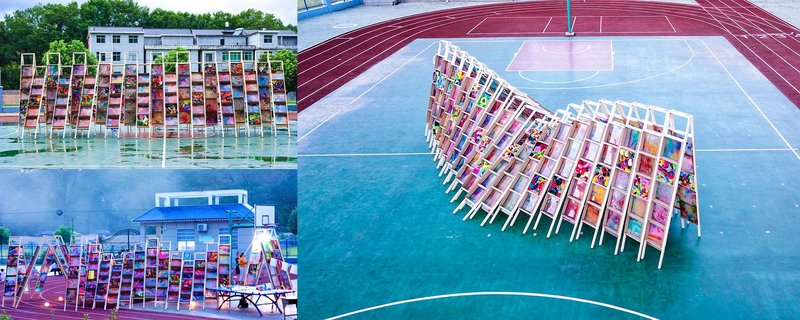
A Pyramid of Ladders Glowing on the Village Plaza

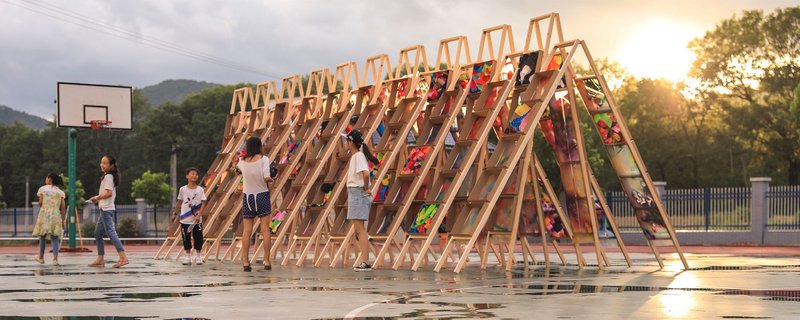
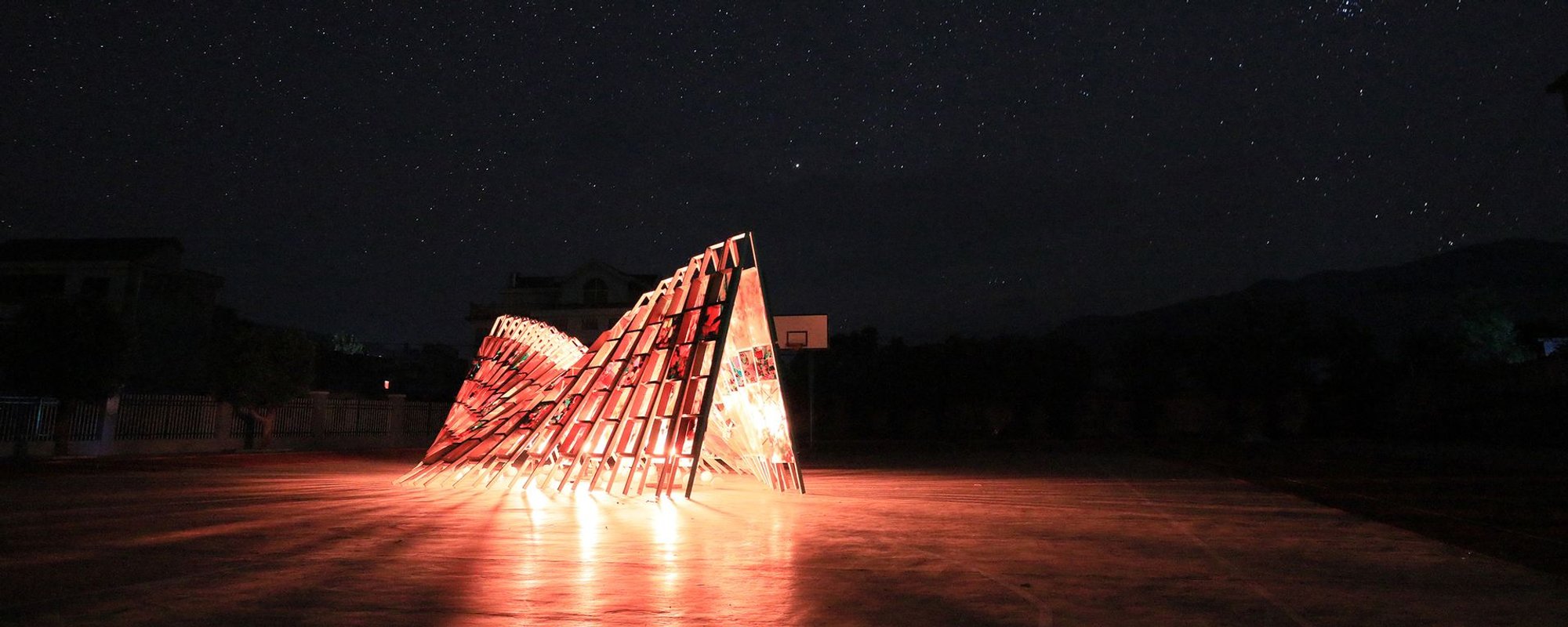
At night, the completed pavilion reads as a luminous pyramid against a starry sky, its timber skeleton filtering warm interior light through translucent panels. By day, the same structure doubles as a climbing frame: children scale the A-frame lattice on a wet basketball court at sunset, testing the structure with their bodies the way they tested its joints during assembly. The dual identity is deliberate. A ladder is already something you climb, and the pavilion keeps that kinetic relationship intact.
Looking Up Through Color, Light, and Timber Geometry
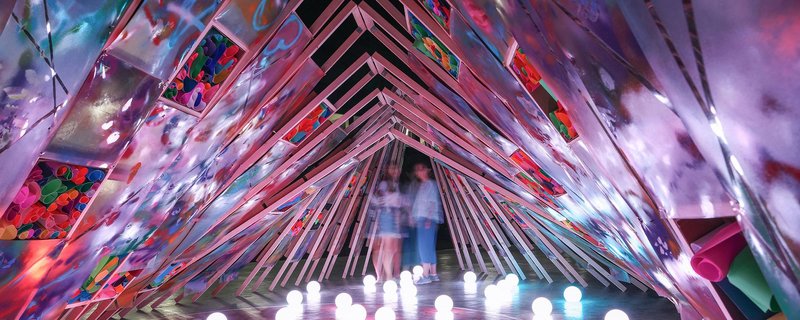

From inside, the view upward reveals the structural logic of the converging ladders, their rungs creating a rhythmic lattice that frames translucent panels and suspended globe lights. The panels themselves are worth a closer look: colorful artwork, painted by the children, is sandwiched between layers, turning each infill into a small stained-glass window. The effect is both playful and architecturally precise, as the watercolor-like imagery diffuses daylight into soft, shifting hues within the enclosure.
Children Framed by Their Own Artwork
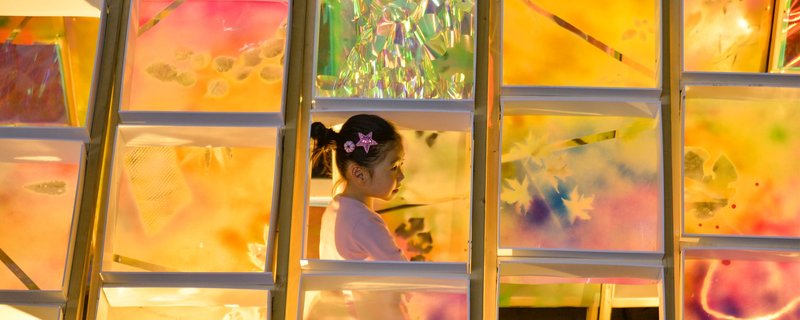
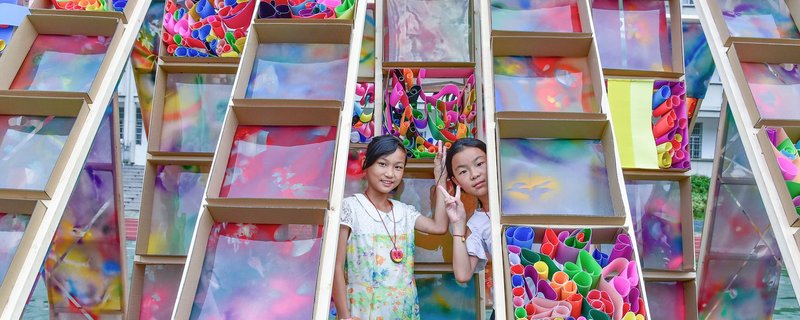
The most compelling images from the project place the children inside the structure they built, peering through openings framed by their own painted panels. A young girl stands in the interior, surrounded by watercolor landscapes she helped create; two children press their faces into gaps in the timber lattice, the colored translucent surfaces catching light around them. These moments reveal the pavilion's real programme: not a building to be admired from a distance, but a space to inhabit, claim, and continually rediscover.
From Tabletop Models to Full-Scale Construction
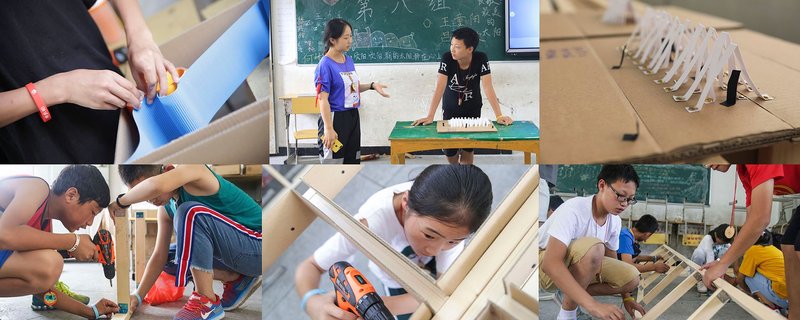
The design process was itself a pedagogical exercise. Workshop photographs show children and volunteers assembling small wooden structural models at tables, learning the principles of triangulation and load transfer before scaling up. By working with accessible materials already present in their daily lives, the participants moved from abstract spatial concepts to tangible construction skills. The ladders were not imported; they were fabricated on site, keeping the entire project within the community's material economy.
Why This Project Matters
Hi Ladders High operates at the intersection of architecture, education, and social care. In communities where children are often left behind by migrating parents, the act of building together offers something that a donated playground cannot: ownership. Every rung, every painted panel, every joint carries the memory of a child's participation, embedding the structure into the community's identity rather than imposing an outsider's vision upon it.
The project also makes a quiet argument about material intelligence. Ladders are ubiquitous in rural China, understood by everyone, and structurally sound by default. By selecting an element that requires no specialized knowledge to fabricate, Hao Li and the volunteer team eliminated the expertise barrier that typically separates communities from the buildings they use. The result is a pavilion that is structurally honest, visually generous, and entirely made by the people it serves.
View the Full Project
About the Designers
Designer: Hao Li
Enter a Design Competition on uni.xyz
uni.xyz runs architecture and design competitions year-round that reward proposals with spatial conviction and real site intelligence.
Project credits: Hi Ladders by Hao Li Citation entry of Architecture on the Clock (uni.xyz).




Popular Articles
Popular articles from the community
Flow: Spatializing Well-being Through Intersecting Layers
Transforming the inner depth of wellness into a spatial reality.

KCAP and DCA Architects Build a Stepped Urban Village on Singapore's King's Dock Waterfront
A 26,000 square meter residential development in Singapore trades tower isolation for terraced courtyards and a planted promenade along the harbor.
ure LLC Builds a Timber-Framed Suburban Office That Doubles as a Community Living Room in Hiroshima
KItoNOKO wraps sawtooth roofs and corrugated metal around an exposed timber frame to give a commercial district a new civic anchor.

De la Riva Sherry Homes By Juan Vega Arquitectos
De la Riva Sherry Homes transform a historic winery into unique residences, blending industrial heritage, modern comfort, and community-focused courtyard living.


Similar Reads
You might also enjoy these articles

sprout - line | collective flourishing
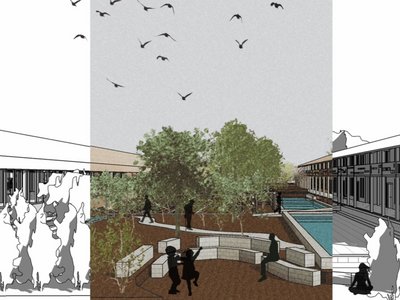
A regenerative rural threshold where soil, skill, and solidarity converge.


MOTION
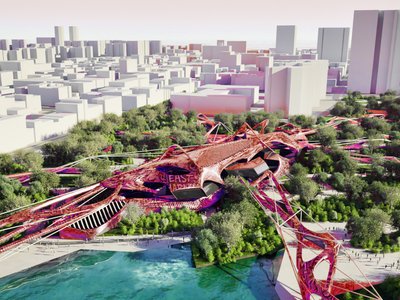
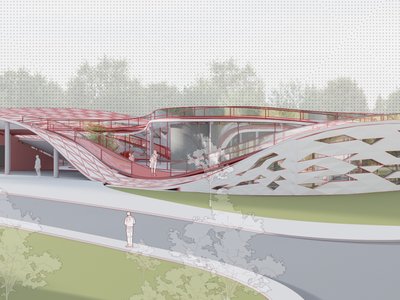
This project explores well being through movement. A continuous loop guides users through shifting spatial conditions, connecting public and introspective spaces. By integrating the urban ground and elevating parts of the path, movement becomes a tool for mental clarity and spatial experience.

Home On A Leaf
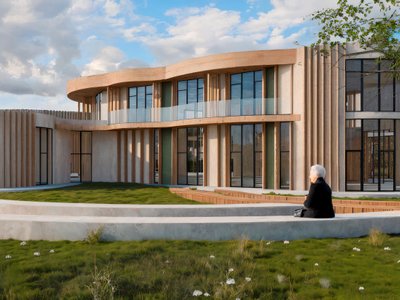
The senior center project in Kielnarowa combines residential, recreational, educational, and cultural functions, promoting an active and sustainable lifestyle. The complex consists of several building


Explore Educational Building Competitions
Discover active competitions in this discipline




The Global Benchmark for Architecture Dissertation Awards


Challenge to design a portable theatre


Challenge to design a portable music platform


Challenge to design public laboratory
Comments (0)
Please login or sign up to add comments
No comments yet. Be the first to comment!