
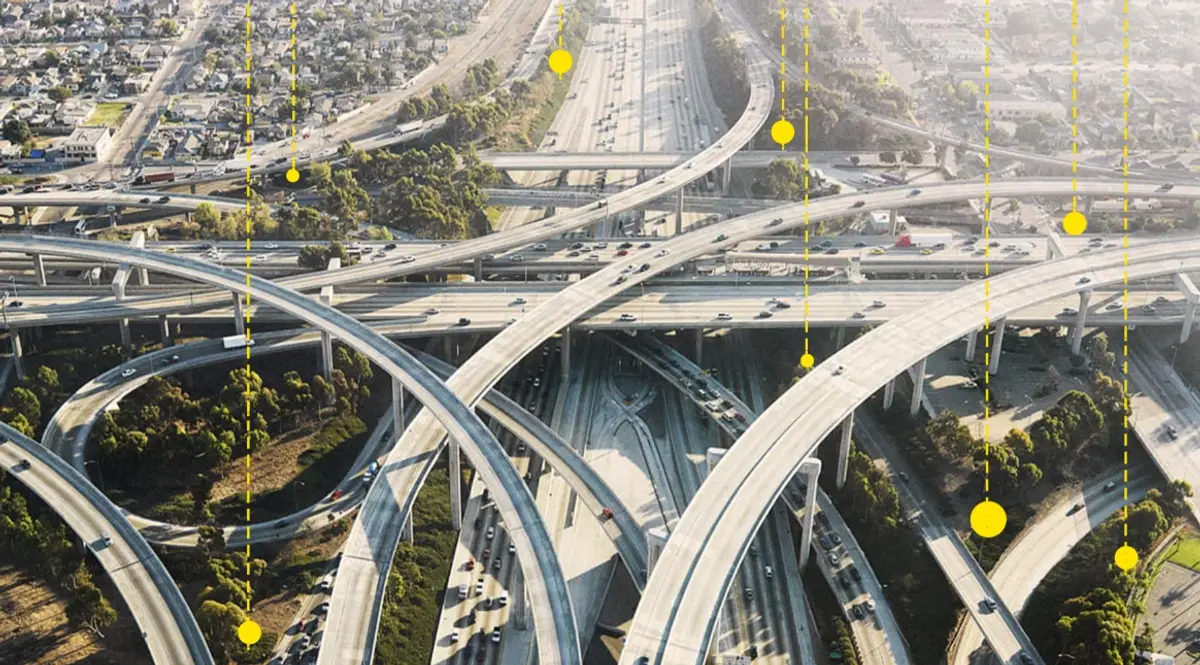
Highway Urban Box: A House-Shaped Waiting Room for the City's Forgotten Highway Edges
A replicable, colour-coded house archetype claims highway shoulders and residual voids as public waiting spaces for emergencies and everyday pauses.


Every city built around the highway carries a second, unofficial geography: the shoulders, edges and in-between voids that infrastructure leaves behind. Nobody designs them, few people notice them, and yet pedestrians, cyclists and bikers use them every day. Highway Urban Box starts from a sharp premise. Instead of treating these fragments as technical leftovers, it treats them as unclaimed public realm, and it gives them a programme that cities almost never design for properly: waiting.
Developed by Avideh Kamrani and Armin Ahmadzadeh, the project proposes a compact, repeatable architectural unit placed along highways. Its ambition is modest in footprint and large in implication: a small, sheltered box that turns residual land into a place where people can stop, rest, orient themselves and, when things go wrong, find help. The designers position the work squarely at the meeting point of large-scale mobility and daily life, asking what it would mean to design the pause rather than only the flow.
A House Silhouette Set Against the Speed of the Road

The form is the project's most persuasive move. Kamrani and Ahmadzadeh borrow the most familiar archetype available, the house, and refine it into a simple volume that can be replicated along any stretch of road. The choice is not nostalgic. Beside traffic moving at highway speed, a pitched silhouette reads instantly as human scale and as shelter, signalling safety in an environment that is otherwise indifferent to the body. The volume is then hollowed out to form the waiting space, so the archetype works both as a sign seen from outside and as a refuge experienced from within.
Two further decisions sharpen the idea. The main façade aligns with the direction of the road, which keeps the occupant oriented and makes the box legible to drivers, setting stillness and movement in direct conversation. Each unit is also distinguished by colour. On a highway, where perception is compressed into seconds, colour is not decoration but a tool for recognition, navigation and safety, and the project uses it with that kind of functional clarity.
Mapping the Gaps the Formal City Refuses to See

Behind the object sits a piece of urban research. Through mapping studies, the designers chart the distribution of highways across the city and, with it, the density of lost spaces generated by road infrastructure. The maps expose a layer that runs parallel to the formal city but is rarely acknowledged in planning, a network of voids that exists precisely because nobody was asked to design it.
This research is what keeps the Urban Box from being a one-off pavilion. Placed strategically within these gaps, the units become a distributed system that reconnects fragmented areas and pulls overlooked land back into collective awareness. The designers are explicit that the intervention is about revealing potential already embedded in infrastructure rather than layering on complexity, and that restraint is the right instinct for sites that have suffered from neglect, not from a shortage of ideas.
One Box, Two Modes: Emergency Refuge and Everyday Pause

The project frames waiting as a legitimate urban condition: waiting for transport, for assistance, for companions, or simply for shelter from weather and traffic. The Urban Box is calibrated for short-term occupation, for standing, resting, observing and orienting oneself, and it is designed to hold two very different scenarios within the same compact shell.
In an emergency, the box becomes a point of assistance, communication or refuge during breakdowns, accidents or extreme weather, exactly the moments when a highway shoulder is at its most exposed. Outside of those moments, it remains a place of everyday pause for the pedestrians and cyclists who already move through these edges informally. That dual role is the project's real argument: a single, legible piece of architecture can serve both crisis and routine, and in doing so justify its presence on land that the city had written off.
Why This Project Matters
Highway Urban Box tackles a condition that is ubiquitous yet almost absent from architectural conversation. Most responses to highway-dominated cities aim at large gestures such as capping roads, burying them or building parks over them. Kamrani and Ahmadzadeh go the other way, working at the scale of a single sheltered person and multiplying that scale across the network. The result is an intervention that is cheap to imagine, easy to replicate and grounded in a clear reading of how people actually use these edges today.
Its strongest lesson is that program can be as transformative as form. By naming waiting as something worth designing for, and by pairing that idea with a recognisable archetype, road-aligned orientation and colour as a safety device, the project turns invisible residue into visible civic infrastructure. It is a reminder that the public realm does not only live in squares and streets; it also lives on the shoulder of the road, if someone decides to build it there.
View the Full Project
About the Designers
Designers: Avideh Kamrani, Armin Ahmadzadeh
Enter a Design Competition on uni.xyz
uni.xyz runs architecture and design competitions year-round that reward proposals with spatial conviction and real site intelligence.
Project credits: Highway Urban Box by Avideh Kamrani, Armin Ahmadzadeh.


Popular Articles
Popular articles from the community


Jaramillo Van Sluys Arquitectura and Urbanismo Turn a Demolished Registry Lot in Quito into an Orchard Plaza
In Quito's Centro Histórico, a 2,800 m² plaza exposes the San Agustín convent wall and redraws its lost Augustinian orchard in volcanic stone.

David Macias Steps a Doorless Stone and Plaster House Down a Tropical Colombian Hillside
In the humid hills of Colombia, Threshold House replaces the front door with an open void and terraces its 850 m² down the slope instead of fighting it.

Juan García Correa, John González and Claudia Rueda Sink a Circular Amphitheater into a Manizales Engineering Building
On the La Nubia campus in Manizales, Colombia, the S1 Building folds labs and offices into a hillside of ramped lawns that double as a campus route.

longwave studio Reorganizes a 112 m² Tainan Apartment Around the Daily Routines of a Family and Two Cats
In Tainan, Taiwan, birch plywood, rust-red furniture and a freestanding plaster wall link arrival, storage, work and family life in one apartment.

Similar Reads
You might also enjoy these articles
Healing Façade: A Modular Chapel System That Restores Ethiopia's Sacred Forests
Winner of the Eco-Chapel competition, this circular timber façade collects water from air to rebuild soil and reforest degraded Ethiopian landscapes.
Kaffeebühnen: Where Coffee Shop Architecture Becomes a Civic Stage in Vienna
A linear sequence of timber boxes, transparent shells, and open yards turns the Viennese café tradition into a public performance space.
Eco Chapel: A Modular Forest Pavilion That Grows Like the Landscape It Protects
Hexagonal timber modules weave through existing trees, turning a chapel into a living system for prayer, education, and reforestation.


Urban Forest: A Vertical Ecosystem for 5,000 Workers in Singapore's Changi Business Park
Radially stacked pods and layered green decks turn a 7-acre plot into 47 acres of ecological workspace projected for 2040.

Explore Urban Infrastructure Competitions
Discover active competitions in this discipline

Challenge to reimagine the Iron Throne

Photograph architecture without architects

Illustrate the lost glory of Angkor Wat - Render Challenge

Design challenge to reuse E-waste
Comments (0)
Please login or sign up to add comments
No comments yet. Be the first to comment!