
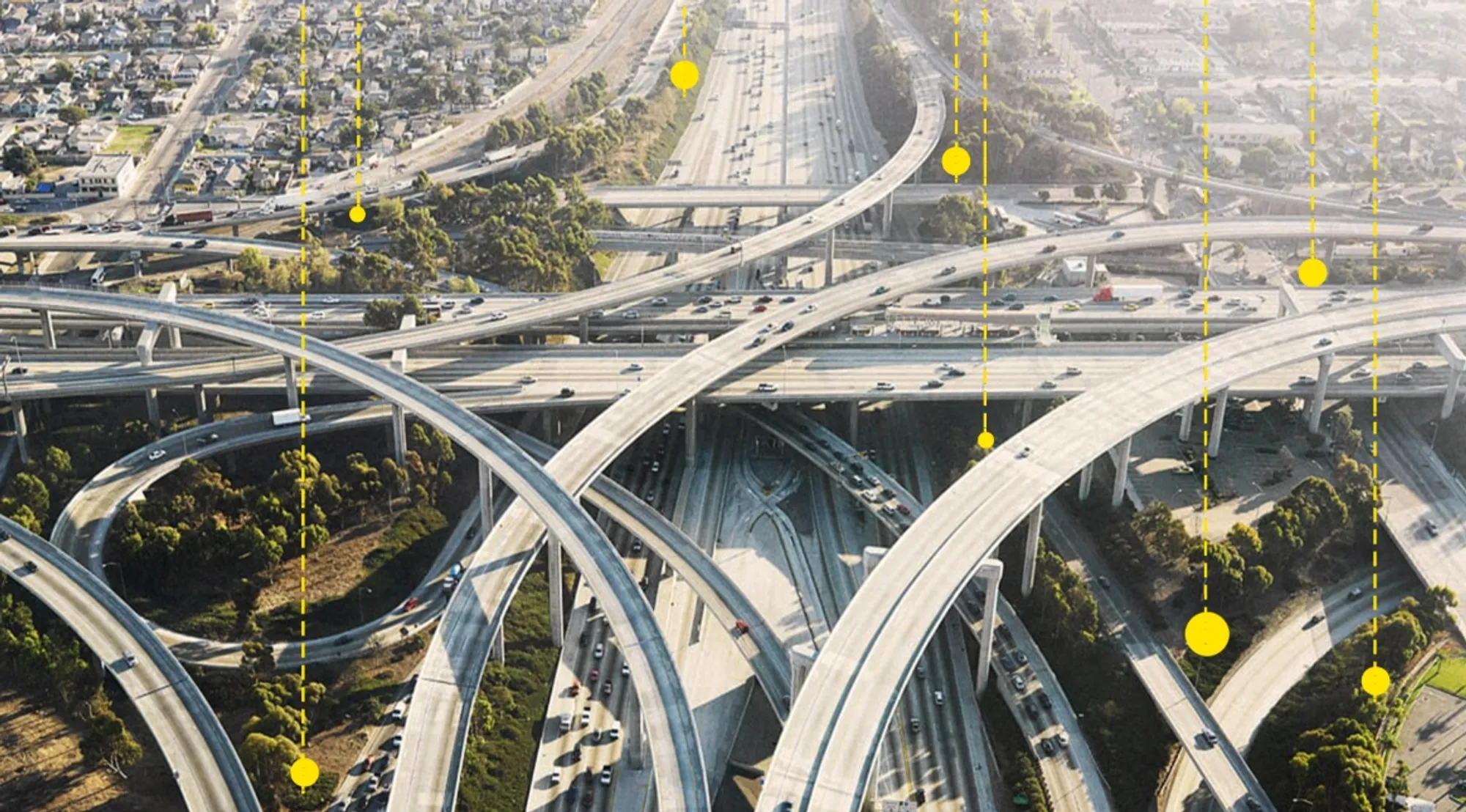
Highway Urban Box
Transforming overlooked highway edges into human-scaled waiting spaces that reconnect mobility, safety, and urban life.


The Highway Urban Box project explores an often-ignored condition of contemporary cities: the residual spaces created by highways. These leftover zones: highway shoulders, edges, and in-between voids: exist everywhere, yet remain undefined, underused, and largely invisible within the urban fabric. Positioned at the intersection of infrastructure and daily life, the project reframes these forgotten fragments through the lens of urban infrastructure architecture, transforming them into purposeful, human-centered waiting spaces.
Designed by Avideh Kamrani and Armin Ahmadzadeh, Highway Urban Box proposes a simple yet powerful architectural intervention that rethinks how people pause, wait, and inhabit spaces shaped by large-scale mobility networks.

The Problem of Lost Spaces in Highway Cities
Highways dominate contemporary urban landscapes. They enable fast movement, regional connectivity, and economic exchange, yet they also generate vast areas of residual land. These spaces are frequently used informally by pedestrians, cyclists, and occasionally bikers, but they lack identity, safety, and architectural intent.
In many cities, highway shoulders are treated as purely technical zones, spaces to be ignored rather than designed. As a result, they become visual gaps in the city, perceived as unsafe, temporary, or simply nonexistent. Highway Urban Box challenges this perception by asking a fundamental question: What if these spaces were intentionally designed as part of the city’s public realm?
Waiting as an Urban Condition
The project introduces the concept of the "waiting place" as a legitimate urban program. Waiting is a universal human activity: waiting for transport, assistance, companions, or simply shelter from weather and traffic. Yet urban infrastructure rarely accommodates this need in a thoughtful way.
The Urban Box responds by creating a compact architectural unit that provides refuge within the chaos of highways. It is a space for short-term occupation: standing, resting, observing, and orienting oneself within the city. By formalizing waiting as an architectural experience, the project redefines how people interact with infrastructure-driven environments.
Architectural Form and Typology
The form of the Urban Box is derived from a familiar archetype, the house. This recognizable silhouette is intentionally chosen to evoke safety, comfort, and human scale within an otherwise hostile environment. The archetype is modified and refined into a simple volume that can be easily replicated along highways.
Inside, the volume is hollowed to create a sheltered waiting space. The main façade aligns with the direction of the road, reinforcing visual orientation and visibility for both users and drivers. This alignment also strengthens the relationship between movement and pause, between flow and stillness.
Each Urban Box is visually distinguished through color, making it easily identifiable from a distance. In the context of fast-moving highways, color becomes a critical tool for recognition, navigation, and safety.

Mapping the Invisible City
Through urban mapping studies, the project identifies the distribution of highways across the city, highlighting the density of lost spaces created by road infrastructure. These maps reveal a hidden layer of the urban condition, one that exists parallel to the formal city but remains largely unacknowledged.
By strategically placing Urban Boxes within these gaps, the project reconnects fragmented areas and brings overlooked spaces back into collective awareness. The intervention is not about adding complexity, but about revealing potential already embedded within the city’s infrastructure.
Emergency and Non-Emergency Use
The Urban Box is designed to accommodate both emergency and everyday scenarios. In emergency situations, it can function as a point of assistance, communication, or refuge during breakdowns, accidents, or extreme weather conditions.
In non-emergency use, the box serves pedestrians, dog walkers, cyclists, and individuals navigating the city on foot. It offers a momentary pause within an environment defined by speed, noise, and movement. This dual functionality reinforces the project’s adaptability and relevance within diverse urban contexts.
Urban Infrastructure Architecture as Social Space
Highway Urban Box positions infrastructure not as a barrier, but as an opportunity for social engagement. By inserting a human-scaled architectural element into large-scale systems, the project bridges the gap between people and infrastructure.
Rather than redesigning highways themselves, the proposal operates within existing conditions. Its strength lies in its simplicity: a minimal intervention with maximum urban impact. It demonstrates how urban infrastructure architecture can extend beyond engineering and efficiency to address human experience, perception, and care.
Highway Urban Box reimagines the city’s forgotten edges as spaces of presence and purpose. It transforms overlooked highway shoulders into meaningful waiting places, redefining how infrastructure can support everyday urban life.
By focusing on human needs within infrastructural systems, the project offers a scalable and adaptable model for cities worldwide. It is not a finished solution, but a starting point: a reminder that even the most ignored spaces hold the potential to reshape our understanding of architecture, infrastructure, and the city itself.




Popular Articles
Popular articles from the community


The Musturak Paradise: Senior Living Architecture for a Connected Future in Temara, Morocco
The Musturak Paradise reimagines senior living architecture in Temara via private homes, social spaces, culture, community, and shared care.

The Earth Pod: 3D Printed Homes for Resilient Refugee Communities
The Earth Pod reimagines refugee housing through 3D printed homes made from clay, combining resilience, self-sufficiency, and rapid shelter.

Play: Fragments of Their World
Familiar architecture becomes modular playground design, creating safe spaces where displaced children can learn, connect, imagine and play.

Hill & Cross Opera: Sculptural Opera House Architecture Shaped by Tallinn’s Landscape and Identity
Hill & Cross Opera reimagines opera house architecture in Tallinn through its sculptural hill, civic plaza, glass wave and a luminous cross.

Similar Reads
You might also enjoy these articles

Eco Chapel: A Green Architecture Pavilion Designed in Symbiosis with the Forest
Eco Chapel uses green architecture to weave prayer, learning and reuse into a forest pavilion shaped by modular hexagonal canopies for life.
Kaffeebühnen: Coffee Shop Architecture Designed as a Civic Stage Between Vienna’s City and Park
Kaffeebühnen turns coffee shop architecture into a civic stage, linking Vienna’s park edge, urban life, warm timber yards, and coffee craft.
Healing Façade: Sustainable Architecture for Reforestation, Community, and Sacred Ecology in Ethiopia
Healing Façade reimagines sustainable architecture as a living wall that restores soil, catches water and renews Ethiopia's forest churches.


Urban Forest: A Vertical Ecosystem for 5,000 Workers in Singapore's Changi Business Park
Radially stacked pods and layered green decks turn a 7-acre plot into 47 acres of ecological workspace projected for 2040.

Explore Urban Infrastructure Competitions
Discover active competitions in this discipline



Challenge to reimagine the Iron Throne


Photograph architecture without architects


Illustrate the lost glory of Angkor Wat - Render Challenge


Design challenge to reuse E-waste
Comments (0)
Please login or sign up to add comments
No comments yet. Be the first to comment!