

HILDEBRAND and Ruprecht Architekten Build a 217-Unit Neighborhood Machine in Brick Outside Bern
In Köniz, Switzerland, prefabricated brick volumes frame elongated courtyards where landscape and community life interlock.


Housing at this scale often defaults to one of two modes: towers dropped onto a manicured podium or slabs pushed to the perimeter to cage a central lawn. The Ried B "Monarch" Apartments in Köniz, just south of Bern, sidestep both clichés. Designed by HILDEBRAND and Ruprecht Architekten, the 217-unit scheme takes the masterplan's deceptively simple mandate, "everyone lives by the green," and pushes it into a spatial arrangement that delivers landscape on every side while still generating the social density a neighborhood needs to function.
The trick is an east-west orientation that threads continuous living spaces between two contrasting conditions: open green landscape on the outer edges and compressed, plaza-like courtyards on the interior. The architects call the result a "neighbourhood machine," a term that could sound cynical but actually describes the project's ambition well. The courtyards are not leftover space. They are deliberately narrow, deliberately active, and deliberately social. The buildings that define them are clad entirely in prefabricated brick elements, giving the settlement a coherent material identity that reads as both robust and civic.
Brick Volumes and the Street Between Them
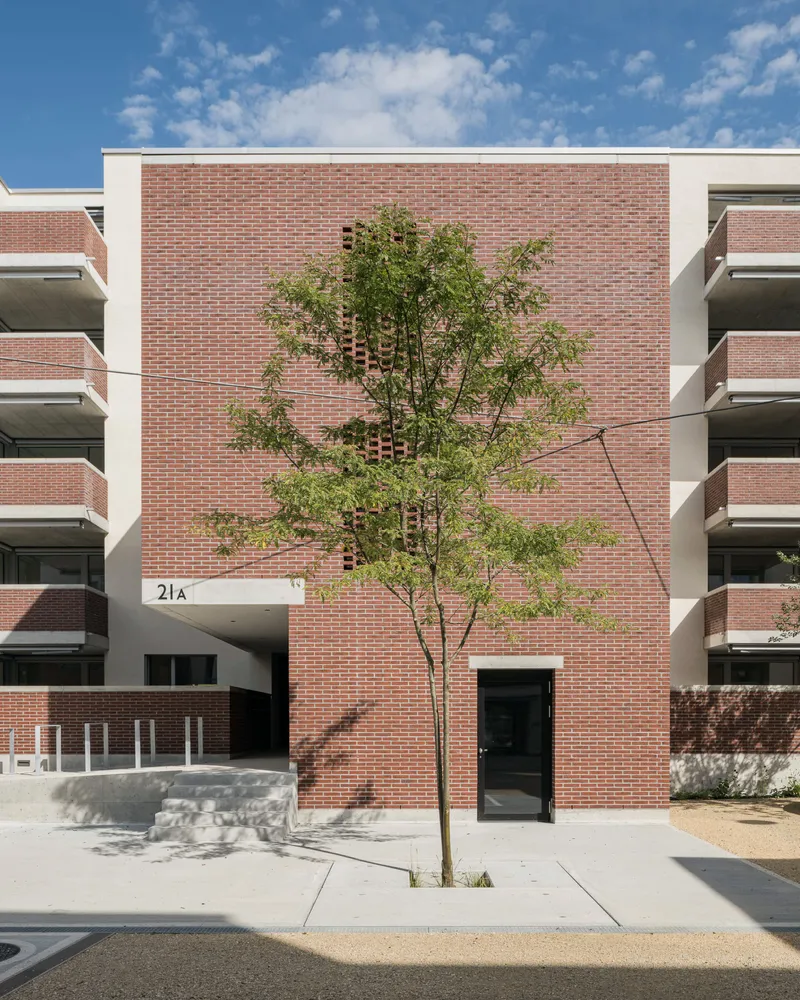
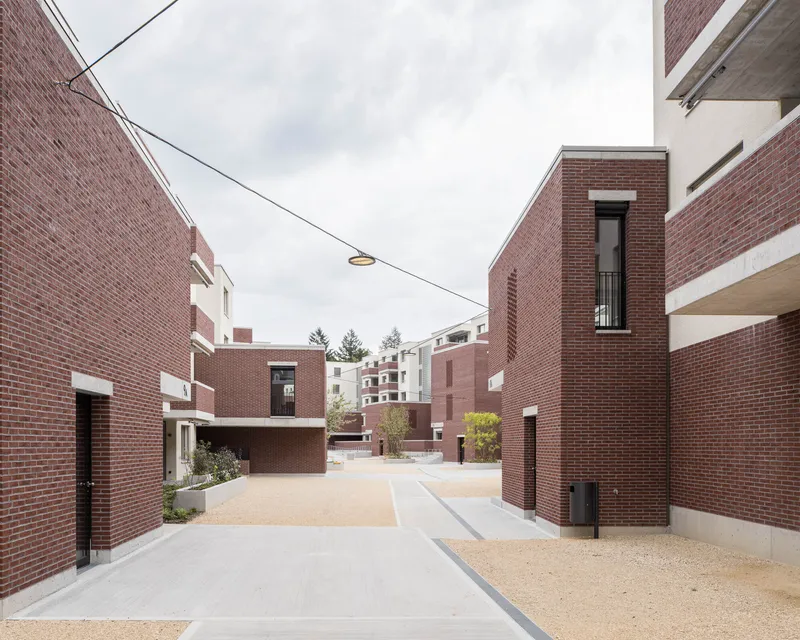
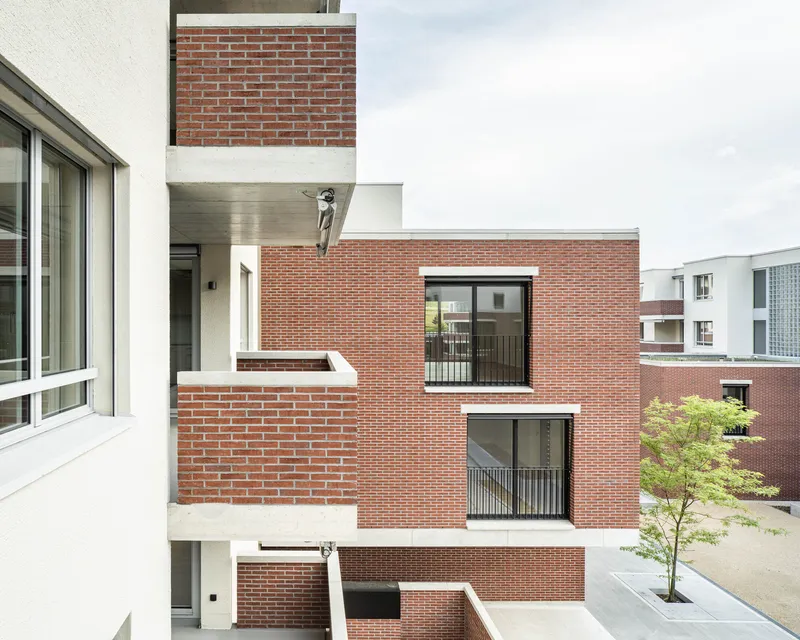
The red brick is not decorative veneer stretched over a generic frame. All exterior architectural elements outside the building structure rely on prefabricated brick components, which unify balconies, wall planes, and entry recesses into a single material logic. Recessed entries with deep reveals give each block a clear front door, while the balconies stack with deliberate offsets that break the massing into identifiable clusters rather than one relentless wall.
The pedestrian lanes between buildings are gravel-paved and tight, almost Mediterranean in proportion. Overhead utility lines and the rough texture of the brick keep things honest; this is a new neighborhood that does not pretend to be old but borrows the spatial compression that makes older neighborhoods pleasant. The effect is a sequence of addresses rather than a single estate.
Courtyards as Social Infrastructure
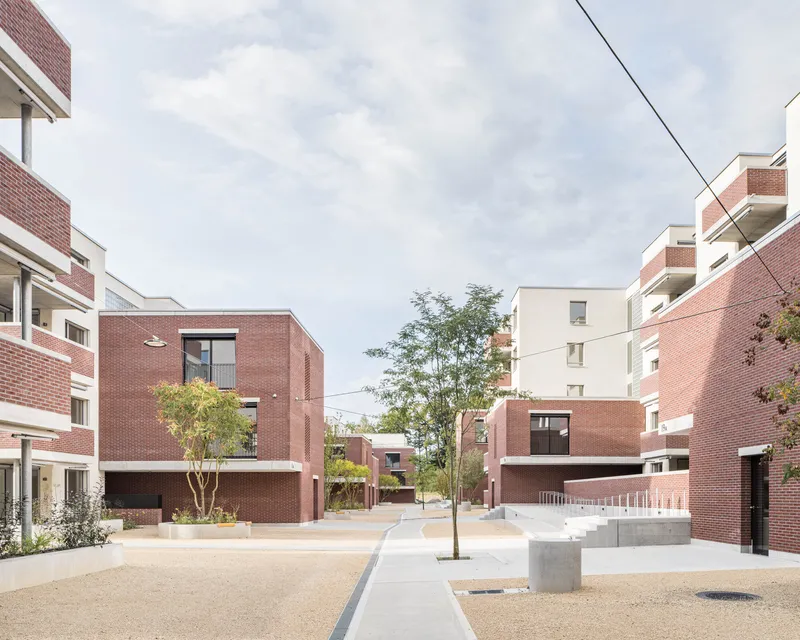
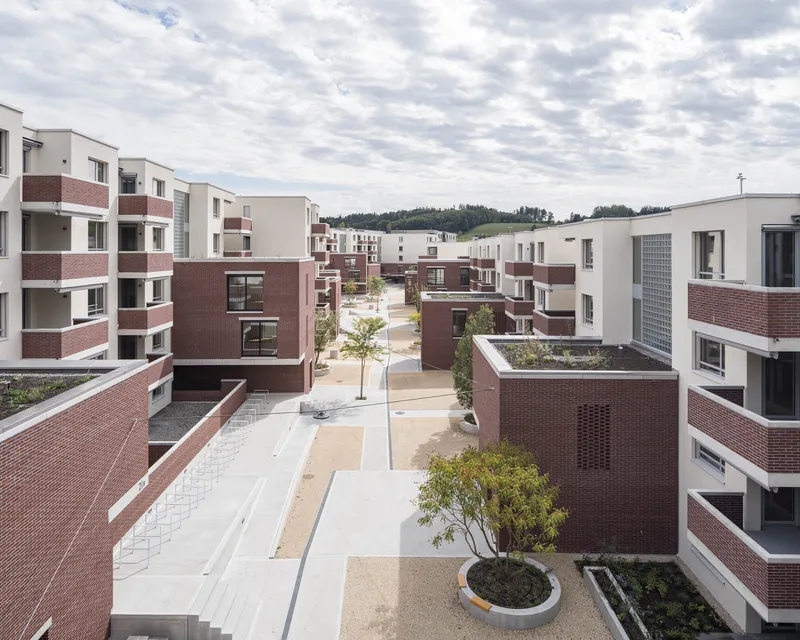
The elongated courtyards are the project's real argument. They are not the kind of symmetrical, overdesigned public spaces that win competitions and stay empty. Concrete seating, young trees planted in generous beds, and simple pathway connections between blocks suggest a place that expects daily use rather than annual festivals. Laundry rooms, stroller storage, and roof terraces are embedded within courtyard structures, ensuring that residents cycle through these spaces as a matter of routine.
The contrast between the outer and inner conditions is legible from above. On the landscape side, planting is loose and generous, merging into the surrounding fields and hillside near the Taubentränki plateau. On the courtyard side, things tighten. The brick volumes crowd in, framing views and creating the kind of ambient surveillance, neighbors seeing neighbors, that actually makes public space feel safe. It is a textbook demonstration of how density and openness can coexist within the same plan.
Interior Thresholds and Balcony Life
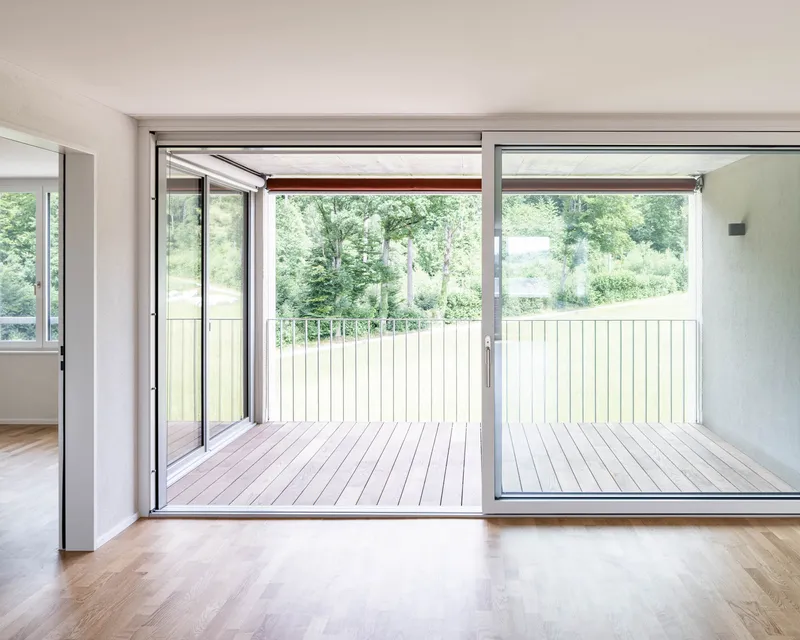
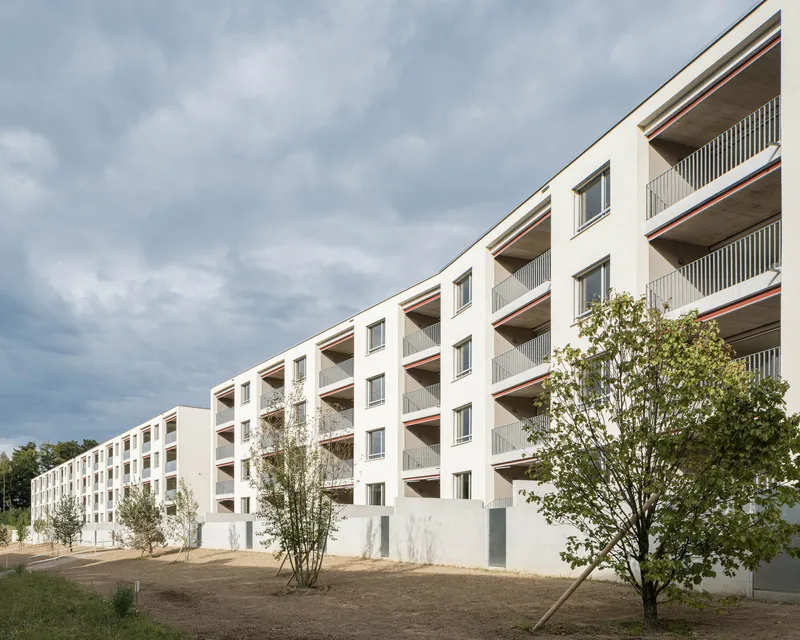
Inside, the apartments benefit from that east-west orientation. Living areas run the full depth of the building, picking up morning and evening light from opposite facades. The timber-decked balconies with vertical slat railings are generous enough to function as outdoor rooms, not token ledges. A view from one unit shows the landscape rolling out beyond the railing, an almost rural horizon that contradicts the 22,200 square meters of housing at your back.
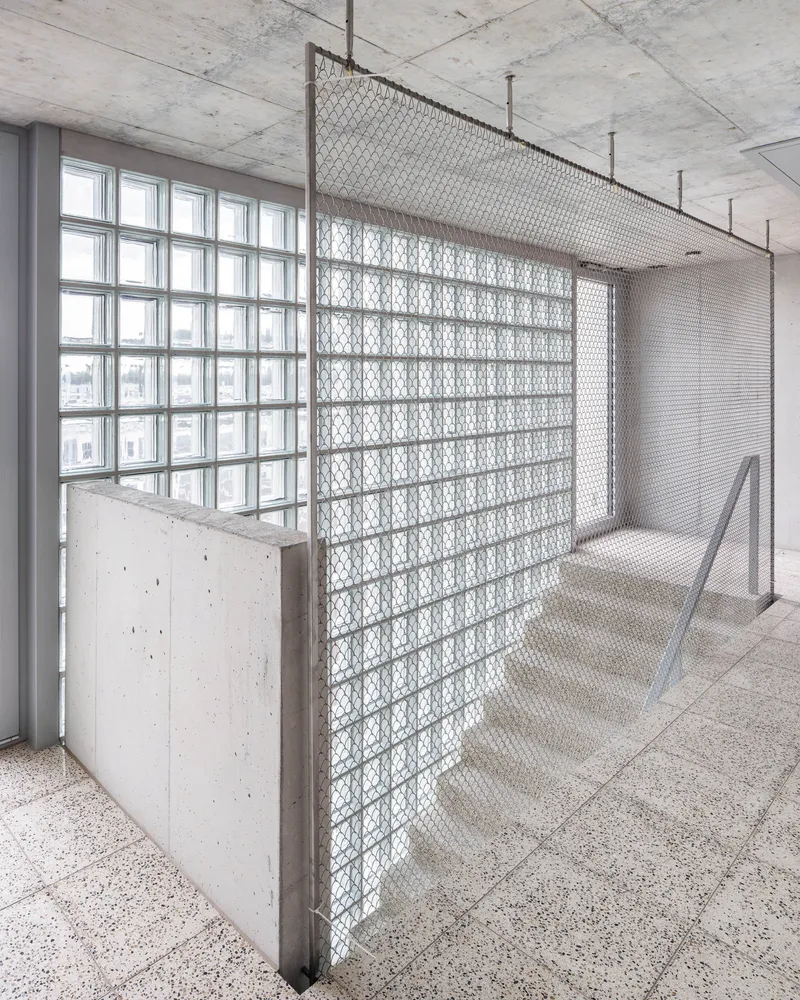
Common corridors are handled with care. Patterned glass block partitions admit light while screening service areas, and exposed concrete ceilings keep the palette consistent and honest. The white stucco facades on some elevations provide a deliberate counterpoint to the dominant brick, marking secondary or courtyard-facing walls and preventing the material palette from becoming monotonous.
Landscape as Primary Structure
The landscape architecture, developed by Rotzler Krebs Partner and Weber + Brönnimann, is not applied decoration. It operates as the primary organizing system, weaving through and around the buildings in a way that blurs the boundary between built and planted. The site sits near a hamlet and forest-fringed plateau, and the planting strategy draws those ecologies inward, so the estate's edges dissolve into the surrounding terrain rather than terminating abruptly.
Young trees in the courtyard photographs hint at a future condition: in ten years, canopy cover will substantially alter the character of these spaces, filtering light and reinforcing the sense of enclosure. The architects and landscape designers have clearly planned for that maturation. The current spareness is a starting point, not a finished state.
Plans and Drawings
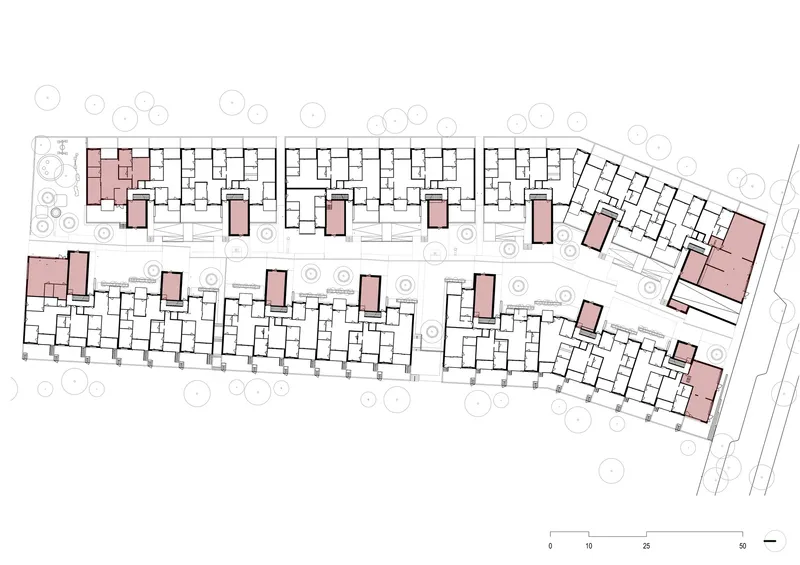
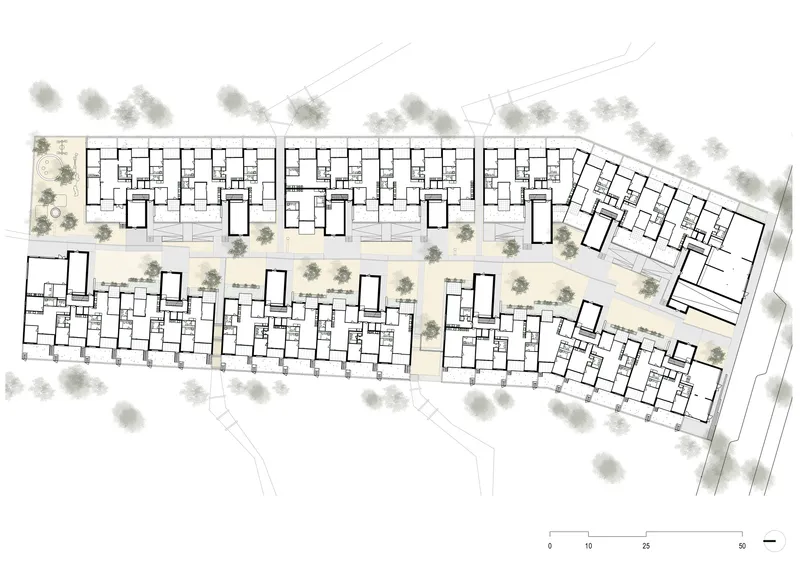
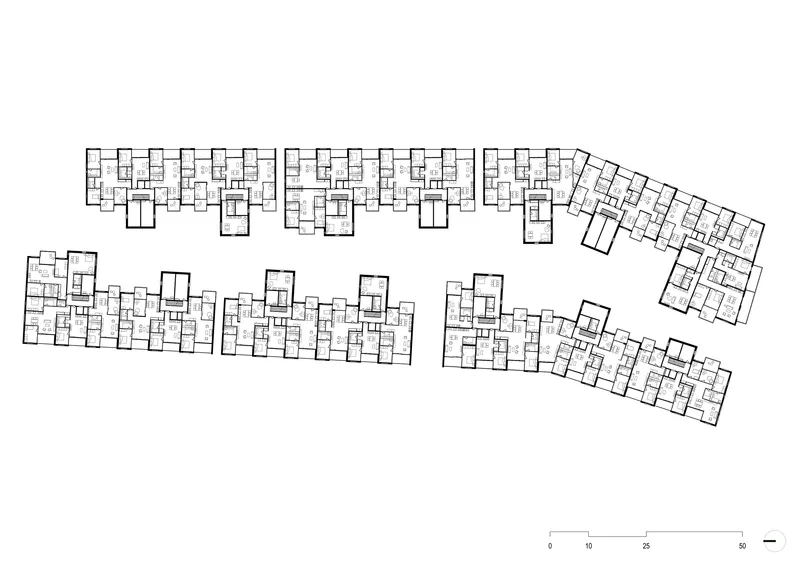
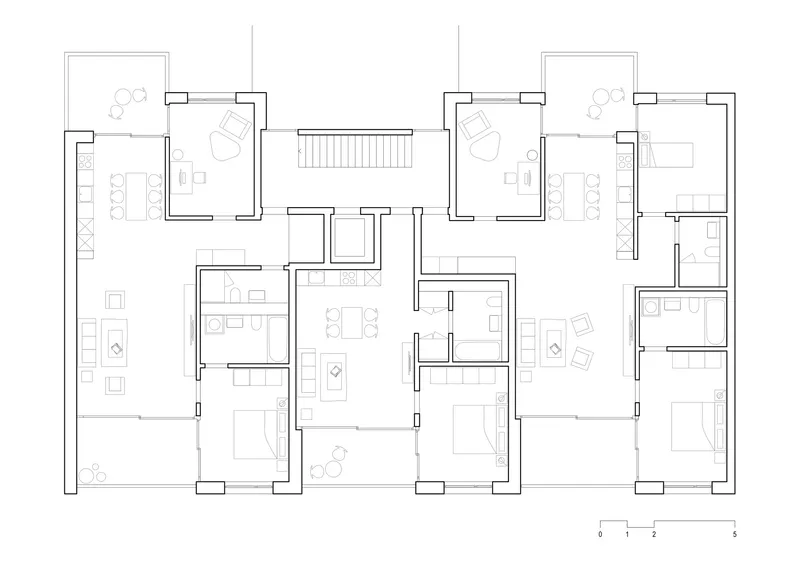
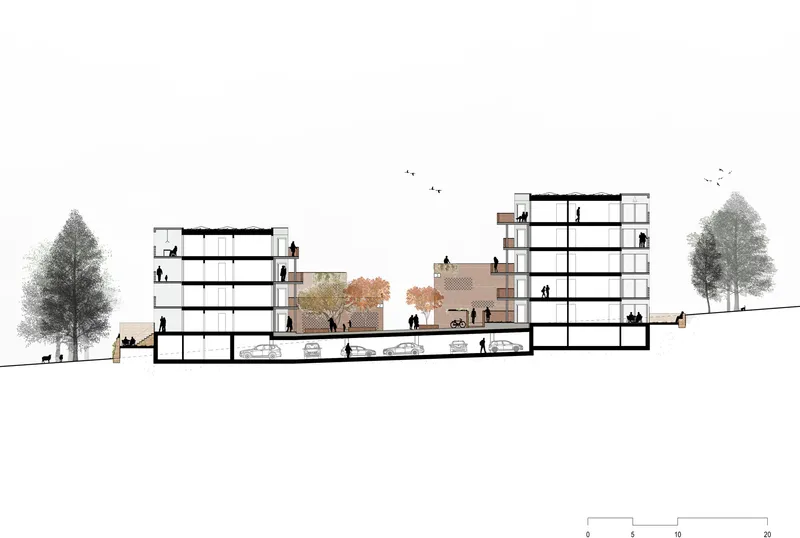
The site plans reveal the logic most clearly. Two parallel residential bars, articulated with angular shifts, frame the central landscaped route. Pink-toned communal cores are legible as shared infrastructure knitted into the building mass. The watercolor tree canopy rendering is telling: it shows how much of the ground plane is ultimately given over to planting, suggesting that the finished project will read more as buildings in a park than as a conventional housing estate.
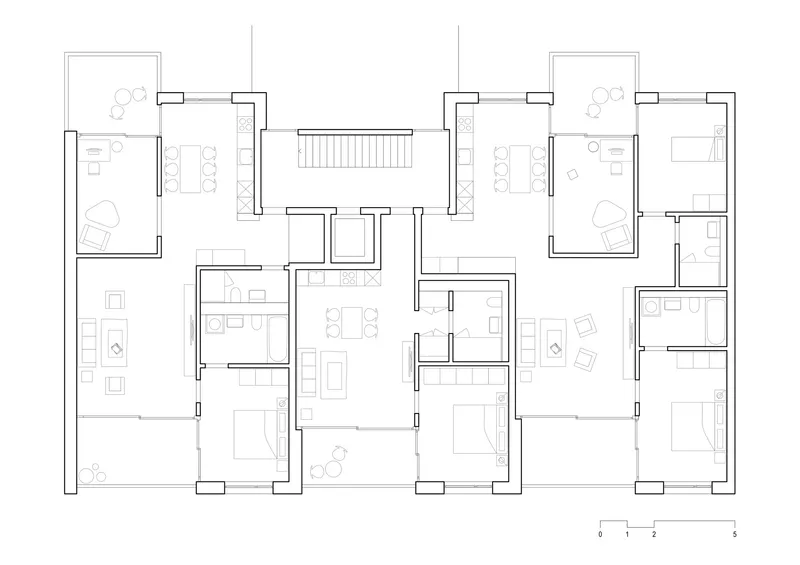
Floor plans show four units clustered around a central stairwell, an efficient arrangement that minimizes corridor length and maximizes the number of dual-aspect apartments. Open-plan living areas extend to private balconies on both sides, confirming the architects' claim that every unit participates in both the landscape and the courtyard. The section drawing reveals underground parking, which keeps the ground plane car-free and preserves the pedestrian quality of the lanes and courts.
Why This Project Matters
The challenge of suburban-scale housing in Switzerland is well known: rising demand, constrained land, strict environmental standards, and communities that resist anything that looks or feels like a block. Ried B "Monarch" does not solve all of those problems, but it offers a convincing spatial argument for how 217 apartments can feel like a neighborhood rather than a development. The key moves, prefabricated brick for material identity, east-west orientation for dual-aspect living, elongated courtyards for social life, are not novel individually. Their coordination here is what makes the project worth studying.
HILDEBRAND and Ruprecht Architekten have resisted the temptation to make each building a protagonist. The individual blocks are quiet. The system, brick volumes structuring a landscape that is itself the dominant experience, does the heavy lifting. In a field where architects too often design one spectacular building and leave the space between to parking consultants, that restraint is the most radical thing about the project.
Ried B "Monarch" Apartments by HILDEBRAND and Ruprecht Architekten. Lead architects: Thomas Hildebrand and Rafael Ruprecht. Köniz, Switzerland. 22,200 m². Completed 2022. Photographs by Roman Keller and Roland Juker.
About the Studio
Share Your Own Work on uni.xyz
If projects like this are the kind of work you want to make, uni.xyz is a place to publish your own, find collaborators, and enter design competitions.


Popular Articles
Popular articles from the community

Cloaked Colonization: A Mobile Underwater Habitat That Moves Like a Fish
Micah Abaya's shortlisted EHC Pacific entry reimagines ocean settlement as a dispersed network of self-sustaining architectural organisms.
Extended Shell: Retrofitting Kolkata's Balconies as Living Urban Thresholds
A modular retrofit system recovers the social and environmental intelligence of Kolkata's historic verandas for contemporary Park Street residents.

Manzana Morphosis: Stretching Barcelona's Grid into a Living Landscape for 2050
A radical reworking of the Eixample manzana turns density into a tool for generous public space, vertical ecology, and environmental performance.
Faces of the Soviet Avant-Garde: Turning Moscow's Street Names into an Open-Air Museum
A network of sculptural installations across a Moscow residential district transforms forgotten architect names into spatial encounters with cultural memor

Similar Reads
You might also enjoy these articles

Bao Huynh Watercolor Atelier: A Serene Art Retreat in Hội An
Bao Huynh Watercolor Atelier in Hội An blends multifunctional art spaces, sustainable design, local materials, and family-friendly living in a serene environment.

Atelier Macri Concept Store Interior Design by CASE-REAL
Atelier Macri store features a "ko" counter, walnut wood details, cork displays, blending retail, gallery, and seamless customer experiences.

Manuel Vargas Izquierdo Stadium and High-Performance Sports Center: Architectural Excellence in Jalpa de Méndez
The Manuel Vargas Izquierdo Stadium blends sustainable design, inclusive sports facilities, and cultural-inspired architecture, revitalizing Jalpa de Méndez’s public spaces.

KAKR Buluh Awar Hall: Revitalizing Community and Ecology Through Bamboo Architecture
Community built bamboo hall revitalizes Buluh Awar village, empowering youth, restoring ecology, celebrating vernacular craftsmanship through sustainable architecture and culture.
Comments (0)
Please login or sign up to add comments
No comments yet. Be the first to comment!