

Hive Architecture Wraps a Courtyard House in Charred Timber on the Sunshine Coast
Nojoor in Mudjimba, Australia, balances bushland immersion and domestic refuge around a central pool courtyard.


The Sunshine Coast has become a testing ground for houses that try to negotiate between spectacle and restraint. Mudjimba, a beachside suburb where eucalyptus canopy still competes with rooftops for skyline dominance, is exactly the sort of place where that tension plays out. Hive Architecture, led by Damian Goode, designed Nojoor as a 613 square metre residence that organizes itself around a central courtyard and lap pool, using the enclosure as both a privacy device and a way to frame the surrounding bushland without surrendering to it.
What makes the project worth studying is the discipline of its material palette and the spatial ambition hidden behind a deliberately low, horizontal street presence. The house reads from the road as a dark, almost reticent bar beneath the trees. Step inside and it opens into a double-height world of concrete, marble, and charred timber, all oriented inward toward water and planting. That gap between exterior reserve and interior generosity is where the architecture actually lives.
Arriving at the Threshold


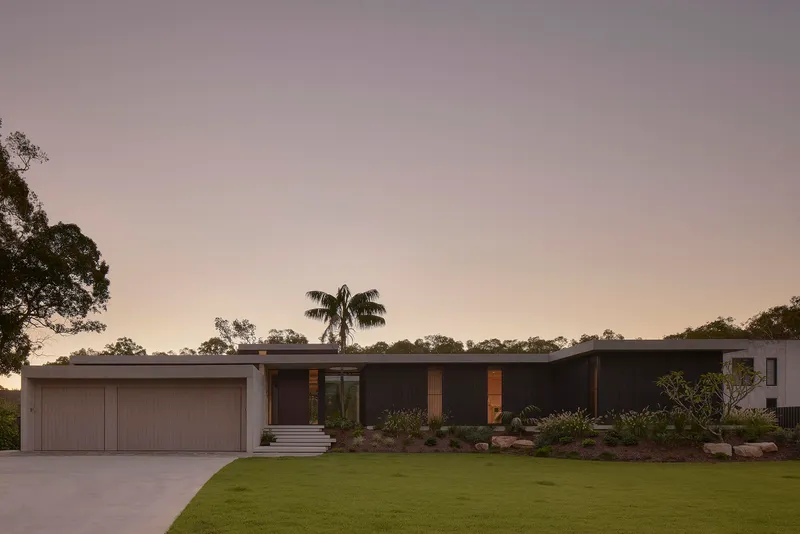
Nojoor's street facade is a long, low composition: black cladding stretching horizontally above a sandstone garage volume, sitting quietly in a lawn clearing beneath mature eucalyptus. It is the kind of front elevation that refuses to announce domestic wealth in the usual coastal idiom of stacked white boxes and floor-to-ceiling glass. A concrete entrance wall with metal lettering marks the arrival without fanfare.
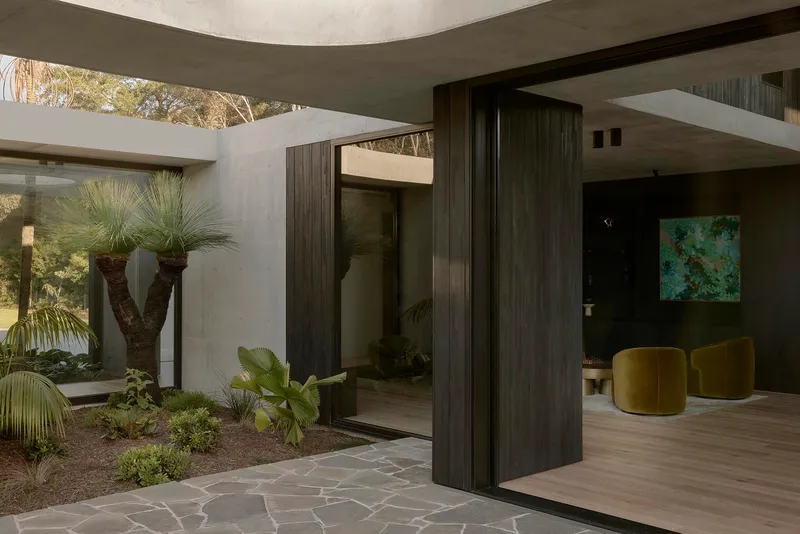
The pivoting timber entry door is oversized and set beneath a deep concrete soffit, compressing the threshold before releasing you into the planted courtyard beyond. Hive understands that arrival is a sequence, not a single gesture. The shift from filtered eucalyptus light outside to the controlled shade of the entry portal recalibrates the visitor's attention before the courtyard reveals itself.
The Courtyard as Organizing Principle
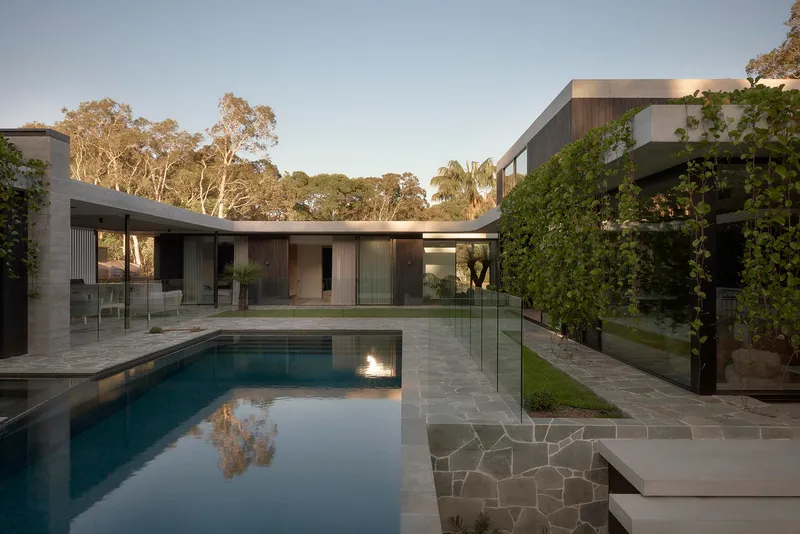
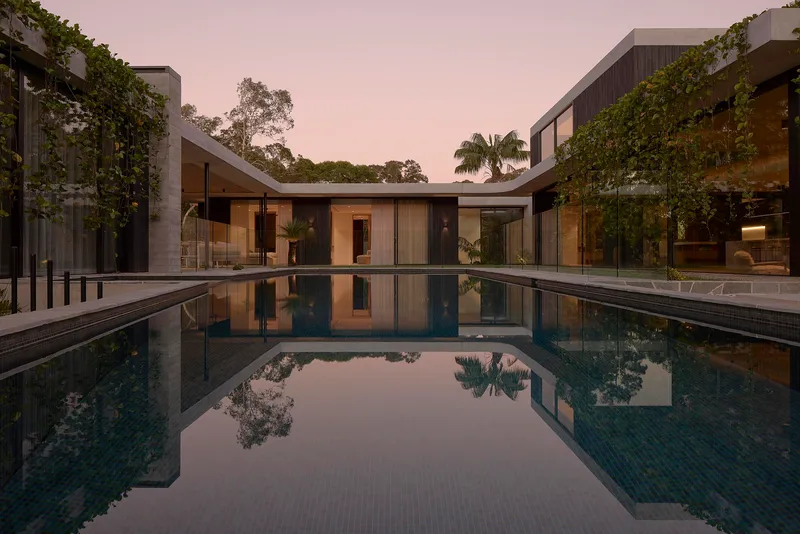

The rectangular lap pool sits at the heart of the plan, acting as both a recreational surface and a reflecting device. At dusk the water mirrors the charred timber pavilions and surrounding vegetation, doubling the apparent scale of the courtyard and dissolving the boundary between solid and void. Glass balustrades around the pool edge keep sightlines unbroken while meeting the practical requirements of a family home.
Wrapping the program around this void is a well-established courtyard strategy, but Hive makes it work because the proportions are generous enough to feel like genuine outdoor room rather than a light well. Built by Basalt Constructions with landscape by Cos Design, the courtyard integrates native planting, stone paving, and water into a single composition that reads as calm rather than curated. The surrounding eucalyptus trees, reflected in the pool at twilight, remain the strongest visual presence even from inside the house.
Double-Height Living and the Clerestory Strategy


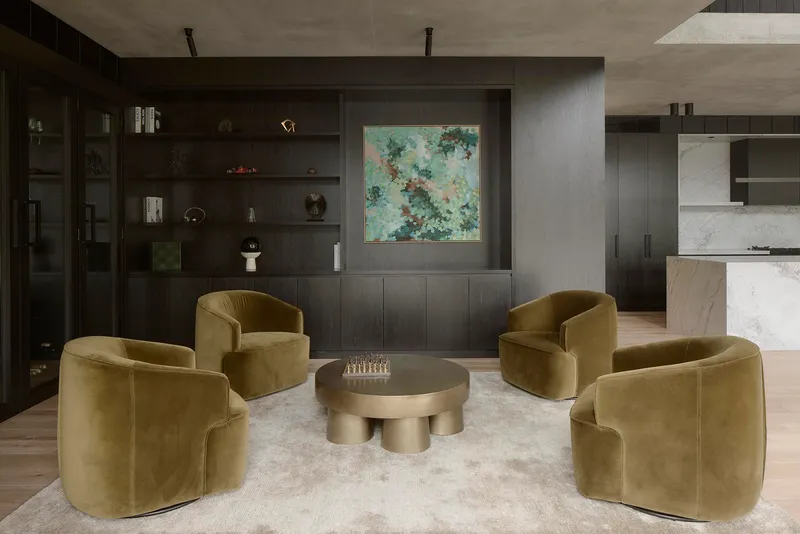
The main living and dining volume is the spatial centrepiece of the house. A double-height space, bounded by black timber walls and a concrete mezzanine bridge, receives light from clerestory windows that sit above the tree canopy outside. The effect is a room that feels both grounded and lofty: heavy materials at ground level, diffuse light washing down from above.
A marble island anchors the kitchen at one end of this volume while a dining table occupies the centre, aligned on axis with the clerestory window. The relationship between the dark timber shelving, concrete ceiling planes, and the brightness of the marble creates a tonal range that keeps the interior visually rich without relying on decoration. Goode is clearly comfortable letting material do the work of ornament, and the restraint pays off in rooms that photograph well but, more importantly, likely feel coherent to inhabit.
Charred Timber and the Sunken Lounge


The sunken lounge is one of the project's best moves. Dropped below the main floor level with a textured stone feature wall at its back, it opens through floor-to-ceiling glazing directly to the pool courtyard. The change in level creates a sense of enclosure and intimacy that the open-plan living spaces elsewhere in the house deliberately avoid. It is a place to sit lower, look outward at water level, and feel sheltered.
Outside, the charred timber cladding on the garden pavilion takes on a different character at dusk, especially where vine planting has begun to colonize the upper-level pergola structure. The blackened surface reads simultaneously as precious craft object and rough bushland material, an ambiguity that suits a house sited among eucalyptus. The horizontal roofline, visible in the garden elevation, keeps the building profile low enough that the surrounding palms and trees always dominate the composition.
Corridors, Light, and Incidental Spaces
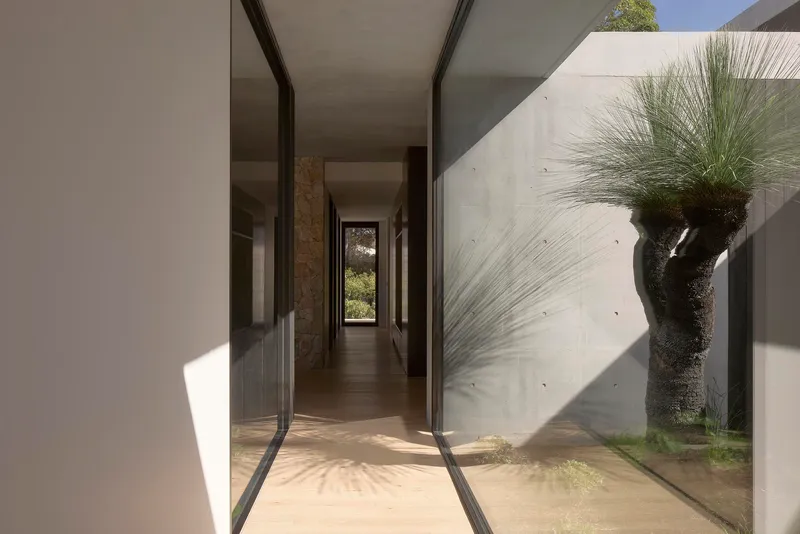
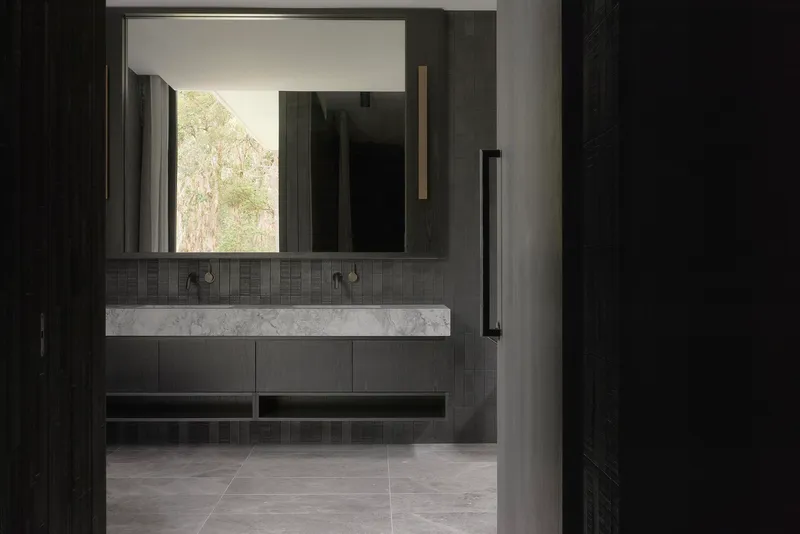

Hive treats circulation not as connective tissue to be minimized but as an opportunity for atmosphere. A glazed corridor lined by concrete walls captures a native grass tree in silhouette, its shadow pattern shifting through the afternoon. The bathroom pairs a marble countertop with dark tile and positions the mirror to reflect trees outside, turning a utilitarian room into another framing device for the landscape.
Cantilevered concrete steps lead up to the vine-covered pergola, their sculptural precision contrasting with the organic looseness of the planting above. These moments between rooms, on stairs, in corridors, through glazed connections, are where the house reveals its spatial intelligence. They are not leftover space; they are designed encounters.
Plans and Drawings
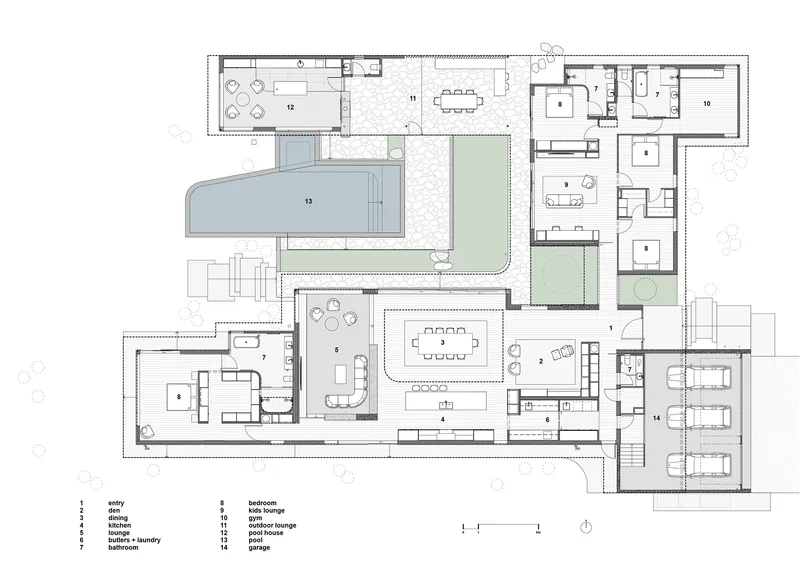
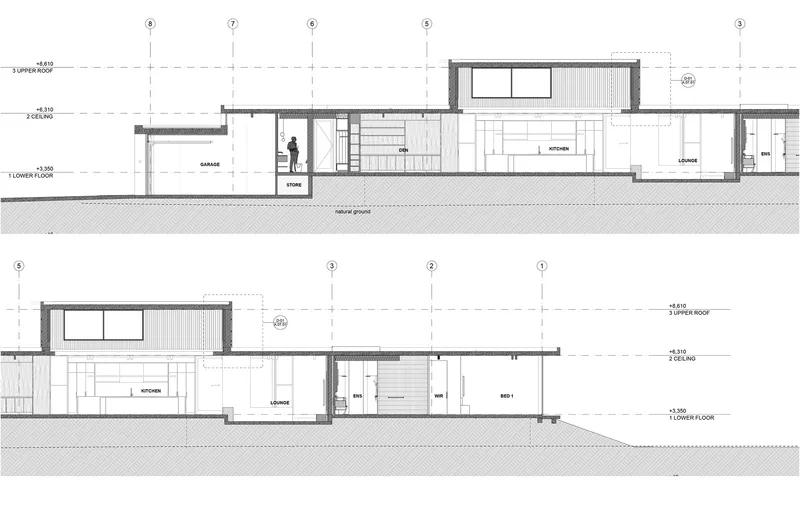
The floor plan confirms the L-shaped configuration wrapping around the courtyard and pool, with the garage and entry occupying the street-facing bar and the living and bedroom wings extending to enclose the outdoor space. The section drawings reveal a split-level strategy that accommodates the topography: the garage sits at a lower datum, the living spaces step up, and the upper bedroom wing perches above with views back over the courtyard. This sectional play is responsible for the double-height volumes and the sunken lounge, making it clear that the spatial richness experienced inside is a product of deliberate level changes, not simply tall ceilings.
Why This Project Matters
Nojoor is a useful corrective to the dominant coastal Australian house type that treats transparency as an end in itself. Hive Architecture opts for selective opacity, revealing the landscape through carefully placed apertures, reflections in water, and elevated clerestory light rather than through wall-to-wall glass. The result is a house that maintains genuine privacy on its suburban lot while sustaining a constant, filtered dialogue with the eucalyptus bush around it.
The material strategy, charred timber, concrete, marble, and stone deployed with enough consistency to read as a single palette, gives the project a seriousness that outlasts its initial visual appeal. At 613 square metres it is a large house, and large houses always risk becoming exercises in consumption. What keeps Nojoor from that fate is its organizational clarity: every room looks back to the courtyard, every material decision reinforces the tonal restraint, and the bushland setting remains the protagonist. The house serves the landscape rather than competing with it, and that is a harder trick than it sounds.
Nojoor by Hive Architecture (lead architect: Damian Goode), Mudjimba, Sunshine Coast, Australia. 613 m², completed 2025. Built by Basalt Constructions, landscape by Cos Design. Photography by Brock Beazley.
About the Studio
Share Your Own Work on uni.xyz
If projects like this are the kind of work you want to make, uni.xyz is a place to publish your own, find collaborators, and enter design competitions.


Popular Articles
Popular articles from the community


Singing Woman: Contemporary Architecture Inspired by Estonia’s Voice and the Sea
Singing Woman turns Estonia’s song culture into flowing opera house architecture, blending public life, landscape, sea, and national memory.

Cloaked Colonization: A Mobile Underwater Habitat That Moves Like a Fish
Micah Abaya's shortlisted EHC Pacific entry reimagines ocean settlement as a dispersed network of self-sustaining architectural organisms.
Opera by the Sea Estonia: Three Shells Dissolving Architecture into Tallinn's Coastline
A winning opera house proposal replaces monumental form with interconnected shells that blur the boundary between building, park and Baltic Sea.

Manzana Morphosis: Stretching Barcelona's Grid into a Living Landscape for 2050
A radical reworking of the Eixample manzana turns density into a tool for generous public space, vertical ecology, and environmental performance.

Similar Reads
You might also enjoy these articles

Bao Huynh Watercolor Atelier: A Serene Art Retreat in Hội An
Bao Huynh Watercolor Atelier in Hội An blends multifunctional art spaces, sustainable design, local materials, and family-friendly living in a serene environment.

Atelier Macri Concept Store Interior Design by CASE-REAL
Atelier Macri store features a "ko" counter, walnut wood details, cork displays, blending retail, gallery, and seamless customer experiences.

Manuel Vargas Izquierdo Stadium and High-Performance Sports Center: Architectural Excellence in Jalpa de Méndez
The Manuel Vargas Izquierdo Stadium blends sustainable design, inclusive sports facilities, and cultural-inspired architecture, revitalizing Jalpa de Méndez’s public spaces.
KAKR Buluh Awar Hall: Revitalizing Community and Ecology Through Bamboo Architecture
Community built bamboo hall revitalizes Buluh Awar village, empowering youth, restoring ecology, celebrating vernacular craftsmanship through sustainable architecture and culture.


Comments (0)
Please login or sign up to add comments
No comments yet. Be the first to comment!