

Home for Everyone: A Mud and Bamboo Village for Bangladesh's Coal Mine Workers
Abdullah Hossain organises earthen, bamboo-framed homes around courtyards, ponds and fields, treating vernacular building as modern housing for miners.


Across rural Bangladesh, the brick house has become shorthand for progress, and the mud wall has become shorthand for poverty. Home for Everyone, A Village for Coal Mine Workers argues the opposite. It proposes a settlement for labour communities built from earth, bamboo and thatch, and it claims those materials as modern, climate-literate and worth taking pride in. The project does not treat vernacular construction as a budget fallback. It treats it as the right answer.
Designed by Abdullah Hossain, the project sits near a coal mining zone where industrial expansion has reshaped village life. Workers there often live in informal settlements without sanitation, healthcare access, education or structured public space. Hossain starts from basic human needs and builds outward to a full master plan: housing, social infrastructure, water and agricultural land arranged as a single village ecosystem rather than a dormitory attached to a mine.
Plinth, Courtyard and Roof Read as One Section

The 3D sections are the most revealing drawings in the set. They cut through thatched earthen houses and show how rooms, verandas and a central courtyard step down toward a water body beyond. Hossain draws the plinth, courtyard, roof system and landscape as one continuous section, so the house reads less like an object and more like a sequence of shaded, open and planted zones. The raised base and deep roof are not stylistic gestures here. They do the work the designer assigns them: resisting flooding and heat while keeping the home tied to the ground and water around it.
The Veranda as a Room Between Family and Neighbour

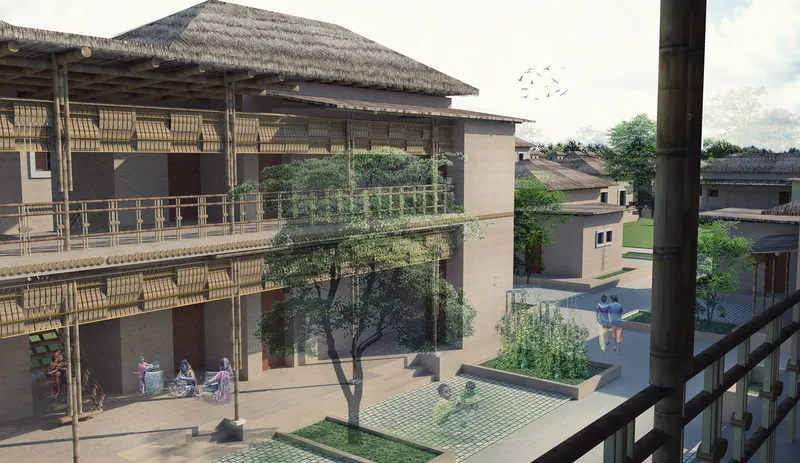
The front elevation shows two single-storey mud houses with raised planter beds and residents sitting on their verandas, while the balcony view looks across a two-storey veranda onto a paved courtyard, planted beds and a tree. Together they show the housing typology at work. Prototypes include single-unit and multi-unit blocks with room for vertical expansion, and bamboo frames paired with modular roofs in one-shed, two-shed, three-shed and four-shed variations let a house grow with a family's size and income.
That incremental logic is the project's quiet strength. Workers' housing usually gets frozen at the moment of handover. Here the frame anticipates change, and the veranda absorbs it, sitting as a semi-private layer where daily life spills outward without dissolving the privacy of the rooms behind.
Courtyards That Feed Their Households

Bamboo posts frame a courtyard filled with vegetable beds, a grazing cow and women working on brick paving beside the thatched houses. This is the image that best captures Hossain's central claim: homes sit inside productive landscapes rather than replacing them. The courtyard works as kitchen garden, workspace and gathering ground at once, which supports the project's stated aims of food self-sufficiency and economic resilience. It also shows locally sourced materials doing double duty, cutting cost while keeping construction in the hands of local craftspeople.
A Shared Path That Steps From Private to Public

A central path runs between two-storey earthen buildings with timber balconies, planted beds lining the edges and children playing in the foreground. The scene illustrates the project's hierarchical social system, organised in four spatial layers moving from private to public. The path is the moment where those layers meet: balconies overlook it, planting softens it, and it stays narrow enough to feel like a shared yard rather than a road. The hierarchy builds social ties without forcing every household into constant exposure, a balance that informal settlements rarely achieve.
Organic Clusters Set Among Water and Fields
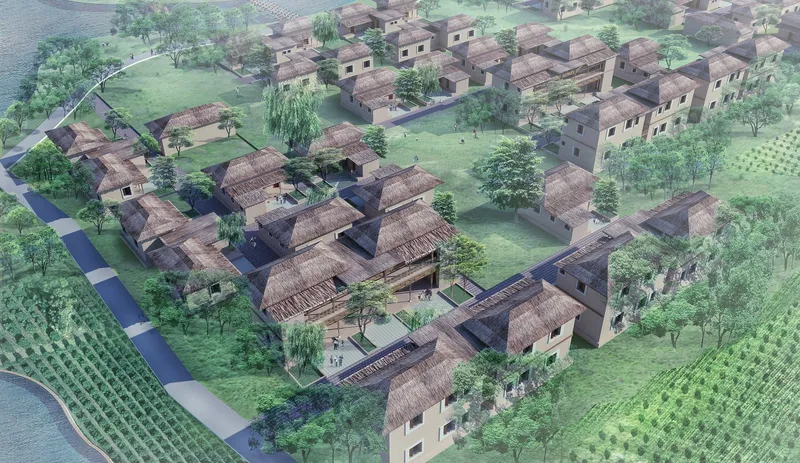
From above, the village shows its debt to traditional Bengali settlement form. Thatched-roof houses cluster among lawns and trees, with a road, water edges and crop fields wrapping the site. The master plan organises everything around water bodies, agricultural land and social nodes, and its pathways follow organic routes instead of a rigid grid. That choice matters. A grid would have signalled a camp for labour; the clustered plan signals a village where people are expected to stay, farm and raise families.
Why This Project Matters
The sharpest argument in Home for Everyone is cultural rather than technical. Hossain names a real problem: villagers abandoning mud and bamboo for brick and concrete even where traditional systems perform better in the local climate. By drawing earthen walls, bamboo frames and thatch as the material of a dignified, planned, expandable community, the project tries to reverse that status hierarchy. It asks architecture to change what people aspire to, not just what they are given.
For a population as overlooked as coal mine workers, that ambition carries weight. The proposal folds low-carbon construction, food production, social hierarchy and incremental growth into one coherent village, and it does so with materials the community already knows how to build with. The next challenge would be proving durability and maintenance over decades, but as a position on how rural Bangladesh should house its workers, the project makes its case clearly and convincingly.
View the Full Project
About the Designers
Designer: Abdullah Hossain
Enter a Design Competition on uni.xyz
uni.xyz runs architecture and design competitions year-round that reward proposals with spatial conviction and real site intelligence.
Project credits: Home for Everyone, A Village for Coal Mine Workers by Abdullah Hossain.


Popular Articles
Popular articles from the community


Architekt Andreas Gruber Scatters 23 Dark Timber Chalets Across a South Tyrolean Forest Edge
In Molini di Tures, Amonti Chalets breaks a resort into a hamlet of gabled timber houses, with parking, storage and services pushed into the slope.

David Macias Steps a Doorless Stone and Plaster House Down a Tropical Colombian Hillside
In the humid hills of Colombia, Threshold House replaces the front door with an open void and terraces its 850 m² down the slope instead of fighting it.

GROUP A Strips a 1969 Rotterdam Harbor Headquarters to Its Frame and Wraps It in Timber Louvers
In Rotterdam's M4H harbor district, Ferro Offices reuses a 1969 frame, adds one timber storey and reaches BREEAM-NL Outstanding.

LT2A and OPEN Architectes Thread a Brick and Glass High School Through a Wooded Belgian Campus
In Braine-l'Alleud, a 3,000 m² wing for Collège Cardinal Mercier pairs pale brick with a glazed colonnade, deferring to a small chapel and a dense wood.

Similar Reads
You might also enjoy these articles
Healing Façade: A Modular Chapel System That Restores Ethiopia's Sacred Forests
Winner of the Eco-Chapel competition, this circular timber façade collects water from air to rebuild soil and reforest degraded Ethiopian landscapes.
Kaffeebühnen: Where Coffee Shop Architecture Becomes a Civic Stage in Vienna
A linear sequence of timber boxes, transparent shells, and open yards turns the Viennese café tradition into a public performance space.
Eco Chapel: A Modular Forest Pavilion That Grows Like the Landscape It Protects
Hexagonal timber modules weave through existing trees, turning a chapel into a living system for prayer, education, and reforestation.


Urban Forest: A Vertical Ecosystem for 5,000 Workers in Singapore's Changi Business Park
Radially stacked pods and layered green decks turn a 7-acre plot into 47 acres of ecological workspace projected for 2040.


Comments (0)
Please login or sign up to add comments
No comments yet. Be the first to comment!