

Home is Where the Heart Is: An Architectural Marvel for Post-Disaster Stability
An overview of Mengjing Zhang's award-winning disaster-resilient architecture project, "Home is Where the Heart Is."


Natural disasters leave indelible marks on communities, uprooting lives and altering landscapes. Amidst such chaos, the quest for stability becomes paramount. The project "Home is Where the Heart Is," conceived by Mengjing Zhang, epitomizes this quest. As the winner of the "After the Storm" competition, this project embodies resilience, innovation, and a profound understanding of what constitutes true peace and stability.

Conceptual Framework: Finding 'An'
The essence of this project lies in its philosophical underpinning. Out of the countryside, in the drift, people yearn for ‘An’, a sense of stability. But true peace and stability, ‘An’, is no longer rooted in the physical countryside but within the heart. "Heart" is our only home, and finding peace of mind, regardless of location, is the ultimate goal.
Architectural Vision and Design Philosophy
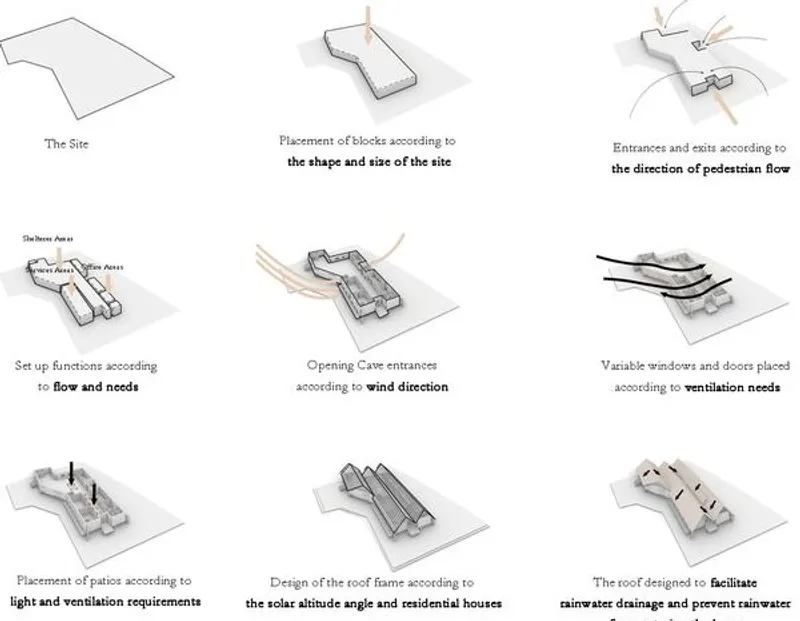
The design process for "Home is Where the Heart Is" follows a meticulous form generation strategy. The initial phase involves understanding the site's shape and size to determine block placements. Entrances and exits are designed according to pedestrian flow directions. Spaces are set up based on their flow and needs, ensuring seamless transitions between different areas. Openings and windows are strategically placed to optimize wind direction and ventilation needs. Patios are positioned to enhance light and ventilation, creating airy and inviting spaces. The core frame is designed to suit the site’s altitude and angles of inclined houses. The roof is crafted to facilitate rainwater drainage and prevent excessive water ingress, ensuring durability and functionality.

Economic and Technical Norms
The project's economic and technical norms are as follows:
Site Area: 2803.8 square meters
Building Footprint: 830 square meters
Total Area: 830 square meters
Floor Area Ratio (FAR): 0.30
Green Landscape Ratio: 35%
Number of Floors: 1
Parking Units: 2
Elevations and Sections
The project's elevations and sections reveal a single-story structure designed for simplicity and efficiency. The south and east elevations showcase the building's modest height and expansive roof, while the sections provide insight into the thoughtful spatial organization and structural integrity.

Site Plan
The site plan integrates seamlessly with the surrounding environment, reflecting a holistic approach to architectural design. The plan includes a lobby, prayer room, break area, active area, game area, toilets, office, function hall, storeroom, kitchen, pantry, shelter space, isolation room, infirmary, outdoor activity area (for children), and plantation.
Background and Location Analysis
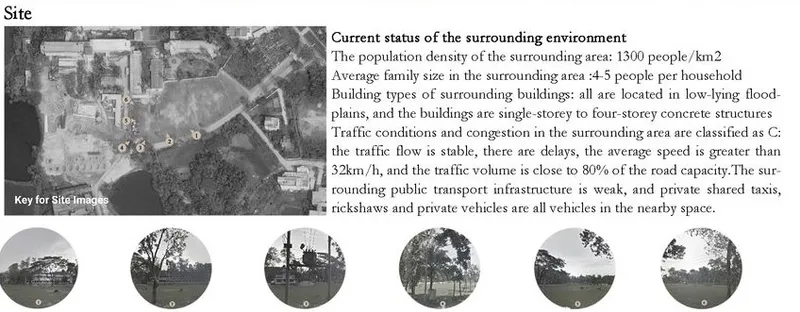
Bangladesh faces frequent natural disasters, affecting over 10 million citizens annually. The Sundarbans region, in particular, is vulnerable due to environmental challenges and illegal deforestation. Despite governmental policies and improved analysis aimed at protecting citizens, many remain at risk, highlighting the need for resilient architectural solutions. The population density of the surrounding area is 1300 people per square kilometer. The average family size is 5 people per household. Building types in the surrounding areas are predominantly low-lying floodplain structures, ranging from single-story to four-story concrete buildings. Traffic conditions are classified as C, indicating stable flow with occasional delays. The average speed is greater than 32 km/h, with traffic volume nearing 80% of road capacity. The public transport infrastructure is limited, with reliance on private shared taxis, rickshaws, and private vehicles.

Event Scenarios: Life After the Storm
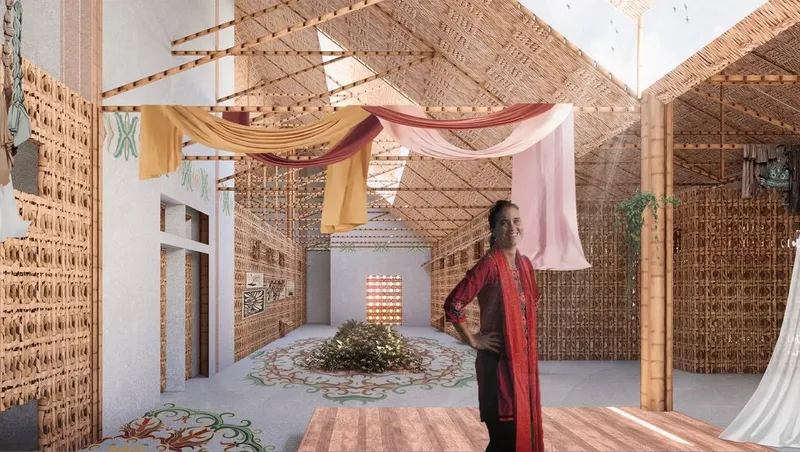
The design envisions a series of scenarios reflecting daily life and community activities. Spaces are designed for community interaction and social gatherings. Areas are designated for education and preparation, helping residents remain calm and organized. Shelters and logistics workspaces ensure safety and coordinated efforts during floods. Spaces are allocated for prayer, reflection, and community rebuilding efforts.
"Home is Where the Heart Is" by Mengjing Zhang stands as a beacon of hope and resilience. This architectural marvel not only addresses the immediate needs following a disaster but also fosters a sense of community and peace of mind. In a world where stability is often fleeting, this project underscores the importance of finding 'An' – a true sense of peace and stability – within the heart.


Popular Articles
Popular articles from the community


longwave studio Reorganizes a 112 m² Tainan Apartment Around the Daily Routines of a Family and Two Cats
In Tainan, Taiwan, birch plywood, rust-red furniture and a freestanding plaster wall link arrival, storage, work and family life in one apartment.

Juan García Correa, John González and Claudia Rueda Sink a Circular Amphitheater into a Manizales Engineering Building
On the La Nubia campus in Manizales, Colombia, the S1 Building folds labs and offices into a hillside of ramped lawns that double as a campus route.

GROUP A Strips a 1969 Rotterdam Harbor Headquarters to Its Frame and Wraps It in Timber Louvers
In Rotterdam's M4H harbor district, Ferro Offices reuses a 1969 frame, adds one timber storey and reaches BREEAM-NL Outstanding.

LT2A and OPEN Architectes Thread a Brick and Glass High School Through a Wooded Belgian Campus
In Braine-l'Alleud, a 3,000 m² wing for Collège Cardinal Mercier pairs pale brick with a glazed colonnade, deferring to a small chapel and a dense wood.

Similar Reads
You might also enjoy these articles


Vereda Arquitetos Renovates a 40-Square-Meter Apartment Inside Niemeyer's Copan Building
A compact unit in São Paulo's most iconic residential tower gets a material overhaul that pairs exposed concrete with bold blue Formica.

Shakur's House: Exposed Brick as an Interior Organiser in a 168 m² Mashhad Residence
Brick moves indoors in this Mashhad residence, where masonry walls, glass partitions and teal planes sequence a compact home without closing it off.

Day and Night Park: A Time-Based Urban Newsstand in Beijing
A temporary urban newsstand in Beijing blending travel, light, and reading through poetic colors, compact form, and community-focused design.

Modernist Patio Renovation in El Masnou, Barcelona by Oliver Segura Arquitectura + Cebrià Arquitectura
Modernist patio renovation blending tradition and innovation with a movable pool, leveled floors, and Catalan materials in El Masnou.

Explore Disaster Resilient Competitions
Discover active competitions in this discipline

Challenge to reimagine the Iron Throne

Photograph architecture without architects

Illustrate the lost glory of Angkor Wat - Render Challenge

Design challenge to reuse E-waste
Comments (0)
Please login or sign up to add comments
No comments yet. Be the first to comment!