
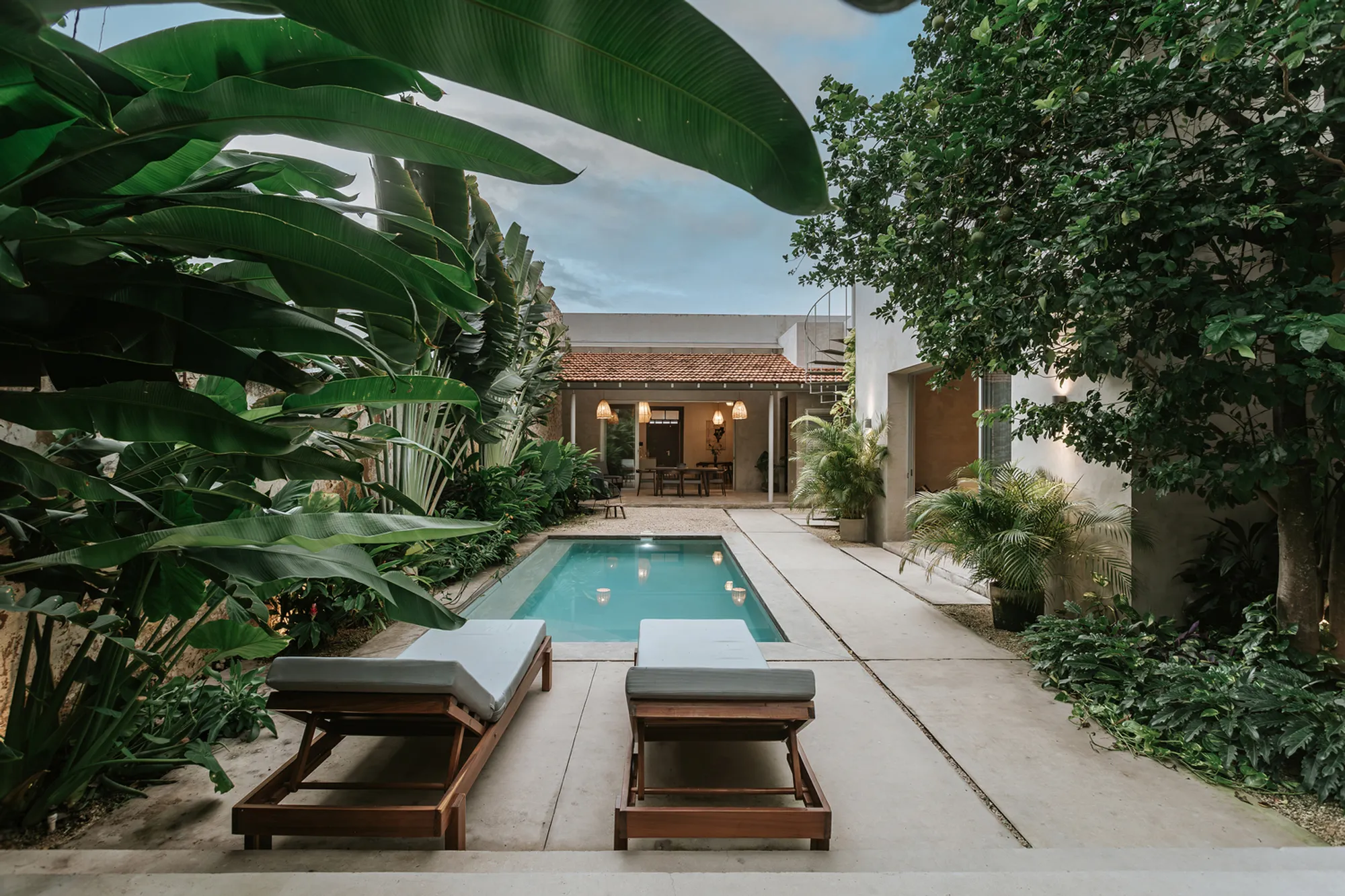
Nauzet Rodríguez Wraps a Canary Islands Courtyard House Around a Hidden Tropical Pool
Horseshoe House in the Canary Islands restores vernacular stone walls and fills them with lush planting and concrete refinement.


The Canary Islands sit at a crossroads of climates and cultures, a place where thick stone walls built against Atlantic winds coexist with banana plantations and volcanic soil. Nauzet Rodríguez takes that duality as a starting point for Horseshoe House, a restoration project that preserves the muscular masonry of a traditional courtyard dwelling while threading it with polished concrete, timber structure, and a landscape so lush it reads more like a botanical garden than a backyard.
What makes the project genuinely interesting is its refusal to pick a side. It is neither a purist heritage restoration nor a tropical modernist fantasy. The rough stone walls remain load-bearing and visually dominant, but every surface they contain is calibrated to contemporary comfort: cement tiles with graphic patterns, freestanding bathtubs under skylights, sheer curtains that dissolve the boundary between bedroom and courtyard. The horseshoe plan folds rooms around a central pool and garden, creating a microclimate that is private, verdant, and cooler than the surrounding streetscape.
Stone and Render: A Dialogue of Surfaces
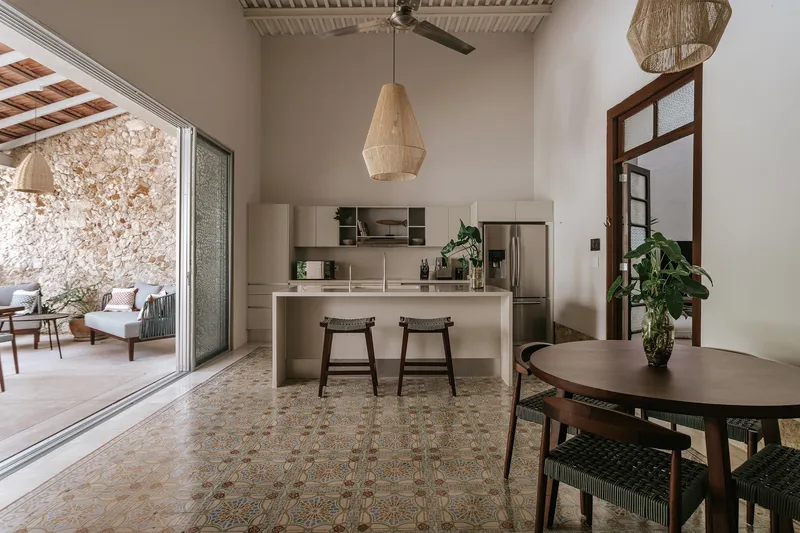
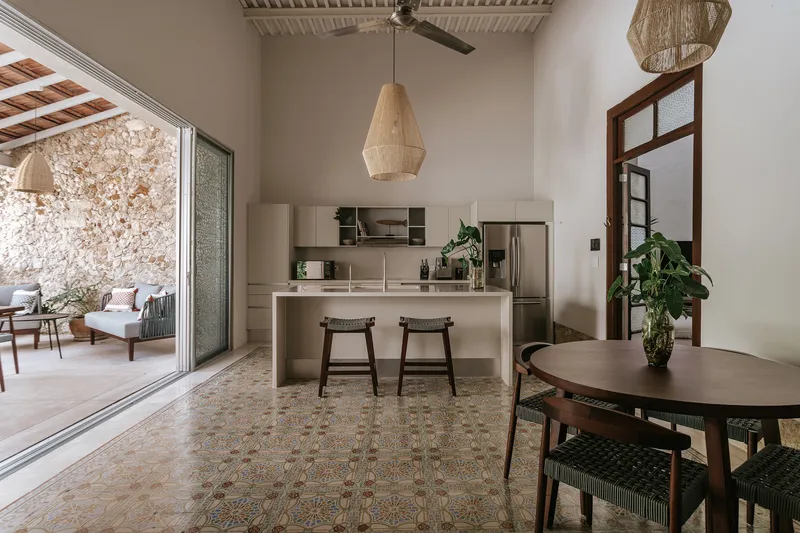
Inside, the kitchen and dining zone anchors the social life of the house. Patterned cement tiles stretch across the floor in a bold geometric repeat, grounding the room against the neutral rendered walls and exposed timber ceiling. Woven pendant lights hang low over the island, their texture picking up the warmth of the wooden beams overhead. Sliding glass doors open directly onto the stone-walled courtyard, collapsing any pretence of separation between cooking and open air.
The material palette is deliberately limited: stone, concrete, timber, and glass. Rodríguez lets the contrast between rough and smooth do the expressive work. Rubble masonry on the courtyard side gives way to plaster finishes inside, while the timber ceiling structure remains honest and unclad. There is no drywall, no suspended grid. You read every structural decision from the room itself.
The Kitchen as Social Anchor
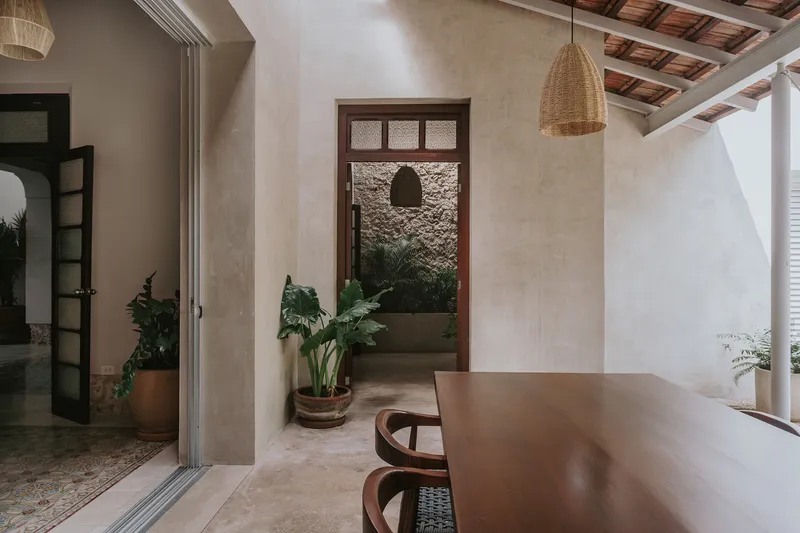
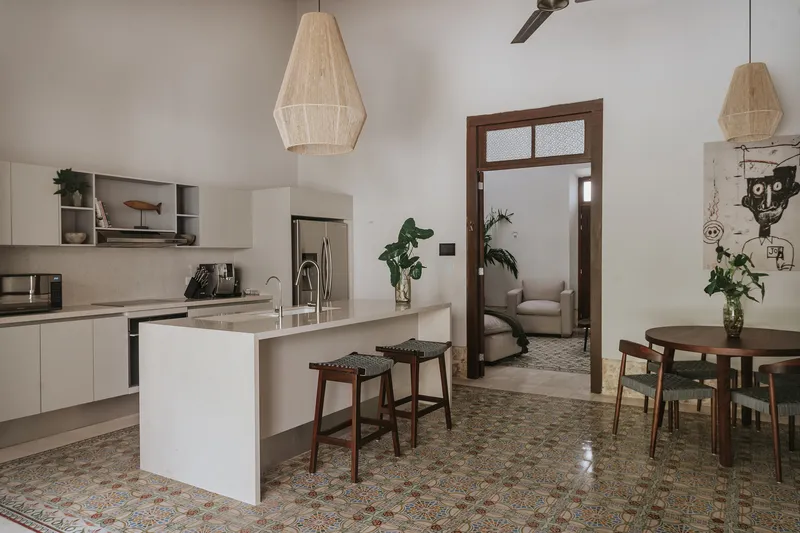
A closer look at the kitchen island reveals how carefully the details are managed. Bar stools tuck under a concrete counter; a single oversized pendant casts warm, diffused light through its woven shade. The palette stays quiet so the architecture can speak. Adjacent corridors, rendered in the same warm plaster, are lined with terracotta pots and capped by timber doors with transom windows, a detail lifted straight from the original building. These small gestures of continuity keep the restoration honest.
The Courtyard Pool: Landscape as Architecture
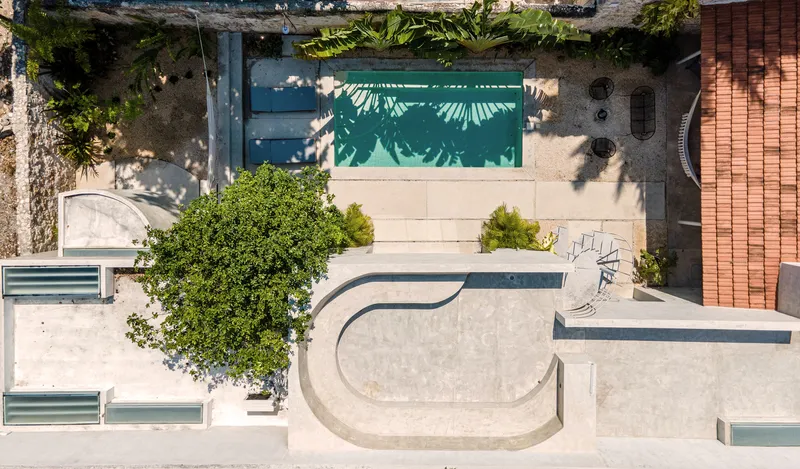
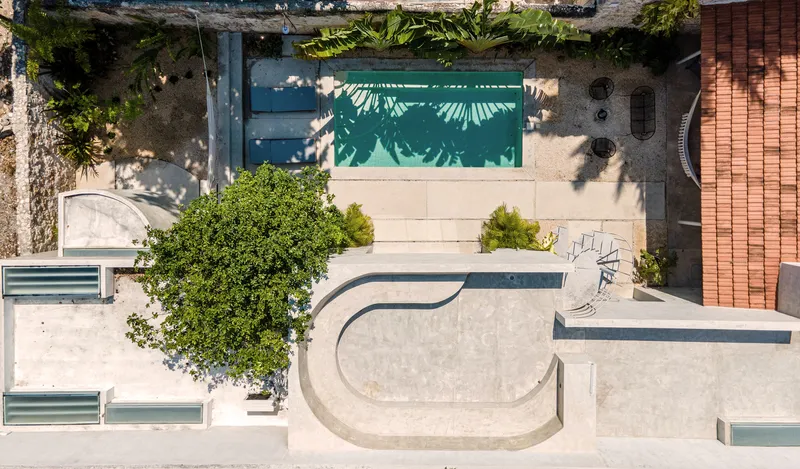
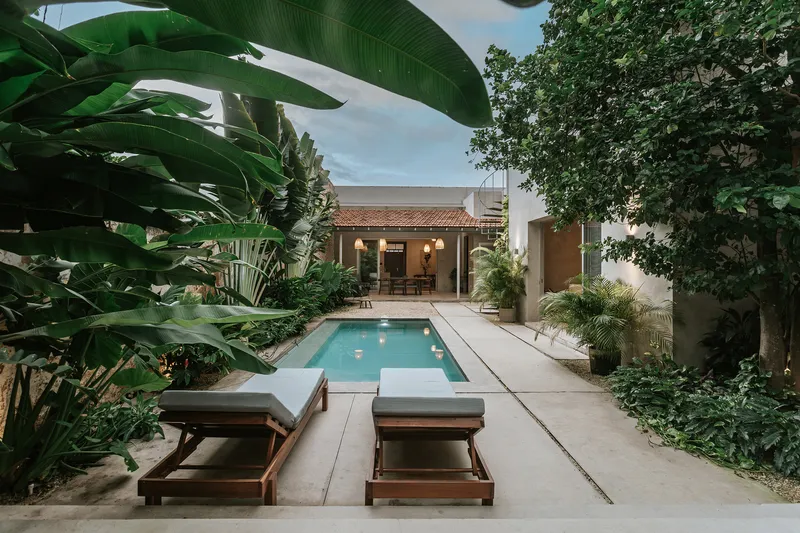
Seen from above, the horseshoe plan reveals itself. The pool sits at the center of the courtyard, its concrete deck curving gently to accommodate a mature tree that predates the renovation. Banana plants, palms, and climbing greenery press in from every edge, softening the masonry perimeter. By dusk, the water reflects the tree canopy and the warm glow from the interior, turning the courtyard into a kind of outdoor room with its own atmosphere.
The decision to keep the existing tree and build the deck geometry around it is the project's most telling move. It signals that the landscape was never an afterthought. The horseshoe form channels breezes, frames views from every room, and creates graduated zones of shade. Rodríguez treats the planting with the same intentionality as the floor plan, layering species to control light and privacy.
Covered Terraces and the In-Between
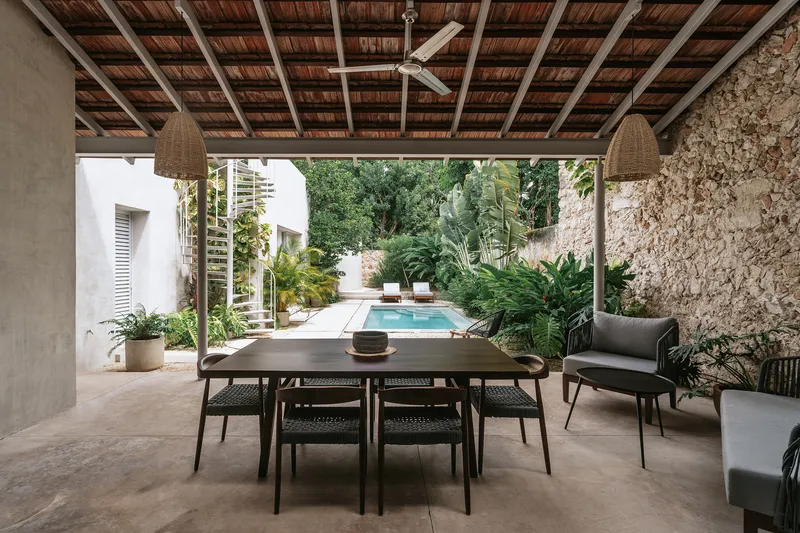
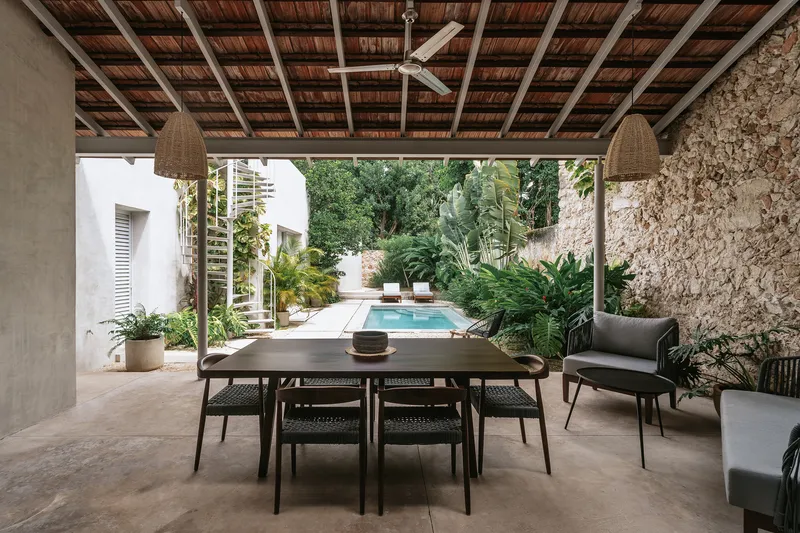
Two covered terraces operate as threshold spaces between interior and garden. Exposed timber beams run perpendicular to the courtyard edge, their rhythm setting up a cadence that extends the interior ceiling outward. Dining happens here as often as it does inside, the table positioned to look directly through tropical planting toward the pool. These are not decorative loggias; they are the primary living spaces for much of the year.
The success of these zones depends on proportions. The overhangs are deep enough to block direct midday sun but shallow enough to admit low-angle light in the morning and evening. It is the kind of passive environmental strategy that traditional Canarian houses always employed, now made explicit and generous.
Bedrooms and Bathrooms: Polished Concrete Meets Tropical Green
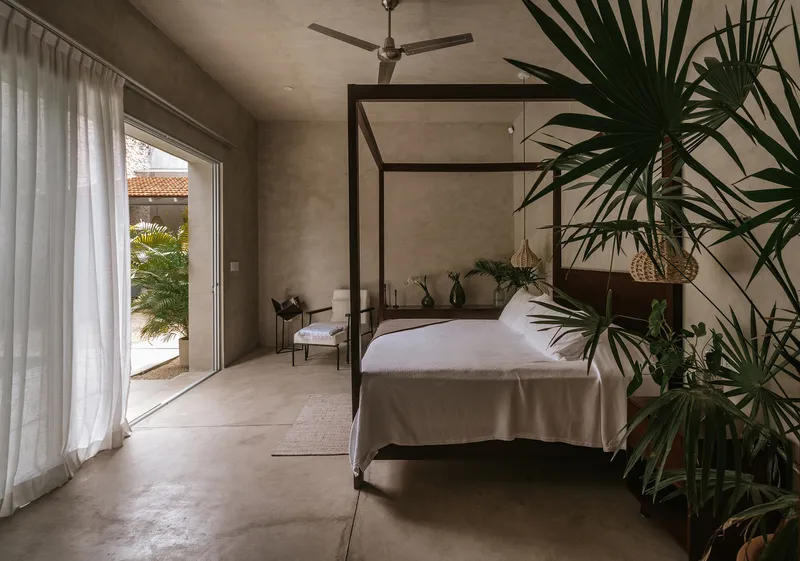
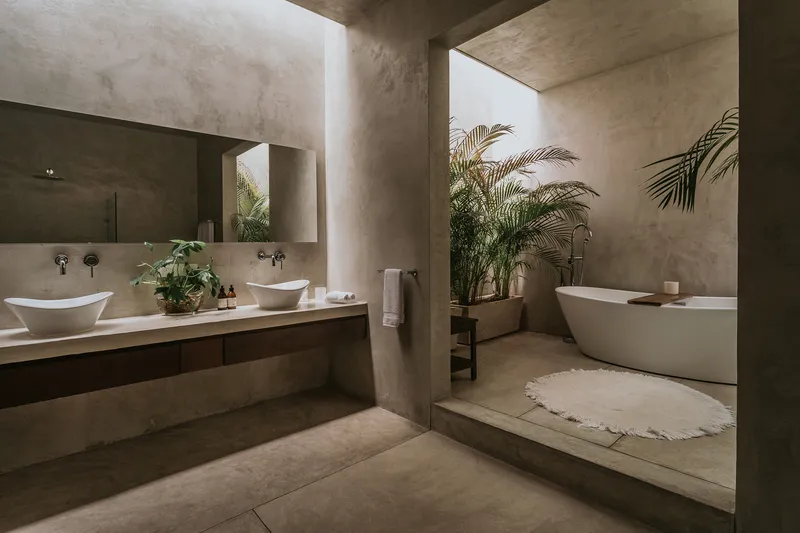
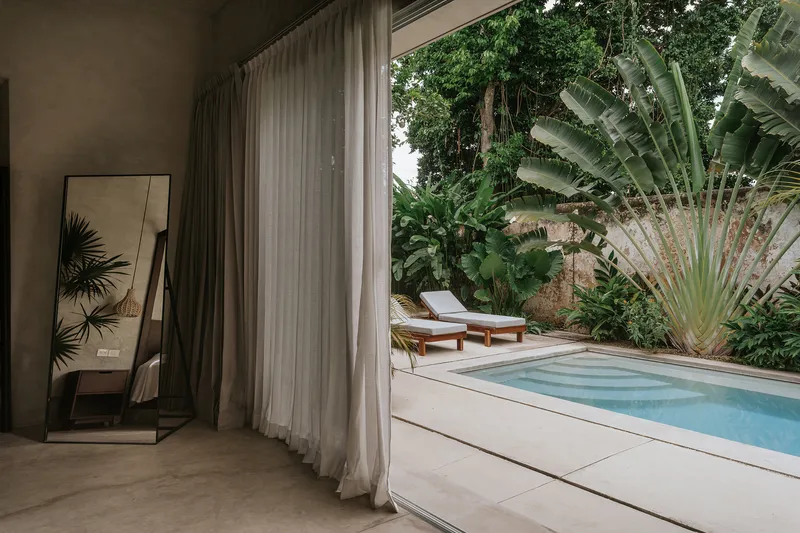
The bedroom is spare and warm. A canopy bed frame in dark metal sits on polished concrete floors, flanked by potted palms that blur the edge between room and courtyard beyond the sheer curtains. The bathroom pushes the material strategy further: a freestanding tub occupies a stepped concrete platform under a generous skylight, with palms again stationed at the edges. Natural light pours in from above, making the room feel less like a wet area and more like an interior garden with plumbing.
Sheer curtains appear throughout the house as a recurring device, filtering light and movement without ever fully closing off a view. They introduce a softness that the concrete and stone lack, and their translucency means the planting outside remains a constant presence. You wake up to dappled shadows; you shower under a skylight. The line between indoors and out is not eliminated so much as deliberately blurred.
Why This Project Matters
Horseshoe House succeeds because it resists the two most common traps in residential restoration: treating the old fabric as a museum piece or gutting it to fit a generic contemporary shell. Rodríguez lets the stone walls carry their weight, literally and figuratively, while inserting a material vocabulary of polished concrete, timber, and bold tile that belongs unmistakably to the present. The courtyard plan is not a novelty; it is the oldest spatial strategy in warm climates. What is new here is the precision with which it has been re-calibrated for a specific site, a specific tree, and a specific way of living between indoors and out.
For anyone working on heritage buildings in subtropical climates, the project offers a clear lesson: start with the landscape and the existing structure, not the furniture. The most memorable rooms in this house are not rooms at all; they are the covered terraces, the pool deck at dusk, the skylit bath with its ring of palms. Architecture here is measured not in square meters but in the quality of the threshold between what is built and what grows.
Horseshoe House by Nauzet Rodríguez, Canary Islands, Spain. Photography by Jasson Rodriguez.
About the Studio
Share Your Own Work on uni.xyz
If projects like this are the kind of work you want to make, uni.xyz is a place to publish your own, find collaborators, and enter design competitions.



Popular Articles
Popular articles from the community


The Ocean Hive: Sustainable Architecture for a Self-Sufficient Civilization at Sea
The Ocean Hive imagines sustainable architecture at sea, where modular habitats, algae, wave power and ocean waste sustain a growing colony.

The Earth Pod: 3D Printed Homes for Resilient Refugee Communities
The Earth Pod reimagines refugee housing through 3D printed homes made from clay, combining resilience, self-sufficiency, and rapid shelter.

Play: Fragments of Their World
Familiar architecture becomes modular playground design, creating safe spaces where displaced children can learn, connect, imagine and play.

Lunar Spiral: Space Architecture Shaped by the Mathematics of the Universe
Lunar Spiral reimagines space architecture through Fibonacci geometry, lunar regolith, levitating habitats, and self-sustaining Moon living.


Similar Reads
You might also enjoy these articles


Hodi-Mandai Geram
Project Function: Preservation and revitalization of the Intangible heritage and socio-spatial identity of the Hodi by Housing, Cultural Memory Center, Sacred Grove, landscape, local tourism economy


Olio Towers: A Mid-Rise for Performers That Fuses Housing, Rehearsal, and Stage
Located blocks from Houston's Theater District, this modular tower stacks living units around a central performance atrium.

Oasis: Modular Green Housing Carved into Dhaka's Urban Fabric
A shortlisted Plugin Housing entry reclaims unauthorized settlements in Dhaka with stepped concrete volumes, green roofs, and ventilation-driven design.

Black Hole: A Floating Megastructure for the Post-Physical Era
Emiliano Mazzarotto envisions a spherical, self-scaling arena where e-sports, digital hotels, and holographic stadiums replace traditional public space.
Explore Housing Competitions
Discover active competitions in this discipline



Challenge to reimagine the Iron Throne


Photograph architecture without architects


Illustrate the lost glory of Angkor Wat - Render Challenge


Design challenge to reuse E-waste
Comments (0)
Please login or sign up to add comments
No comments yet. Be the first to comment!