

Sergio Conde Caldas and Miguel Pinto Guimarães Weave a Forest Refuge into Rio's Jardim Botânico
An 888-square-meter three-story house in Rio de Janeiro trades hard urban edges for woven ceilings, open gardens, and layered living.


Jardim Botânico is one of Rio de Janeiro's most paradoxical addresses: technically in the heart of a sprawling metropolis, yet dense enough with Atlantic Forest canopy to feel like a hillside village. House Opy Ará 100, completed in 2023 by Sergio Conde Caldas Arquitetura and Miguel Pinto Guimarães Arquitetos Associados, takes that paradox seriously. Rather than asserting itself against the landscape, the 888-square-meter residence dissolves into it, stacking three floors of family life beneath woven fiber ceilings that read less like architecture and more like an extension of the overhead canopy.
What makes the project genuinely compelling is not the sustainability label (which every new house claims) but the consistency with which that idea is materialized. Every decision, from the natural fiber ceiling canopies to the 14-coat PU-finished kitchen cabinetry, from the Maneco Quinderé lighting schemes to the custom Opy millwork developed with the client, points toward a house that was designed from the inside out and the outside in simultaneously. The result is a home for a couple and their two adult children that functions equally well as a private retreat and a social stage, without ever feeling like it is performing.
The Woven Canopy as Architectural Identity


The defining gesture of House Opy Ará 100 is its woven bamboo and fiber ceiling, which extends over the main terrace and social areas like a suspended mat. Structurally, it filters direct tropical sunlight into a diffuse, ambient glow, but experientially it does something more subtle: it lowers the perceived scale of the ground floor to something intimate, even though the rooms themselves are wide open to the garden. Sitting beneath it, you are sheltered without being enclosed.
The canopy also sets up a productive tension with the glazed walls below it. Where a conventional overhang would frame a view, this woven surface absorbs it, pulling the green of the courtyard up into the architecture itself. The effect is that the threshold between inside and outside becomes genuinely ambiguous, not in the clichéd way that architects like to describe glass walls, but in the tactile sense that the ceiling material above you belongs to the same world as the planting beyond.
Courtyard as Organizing Principle

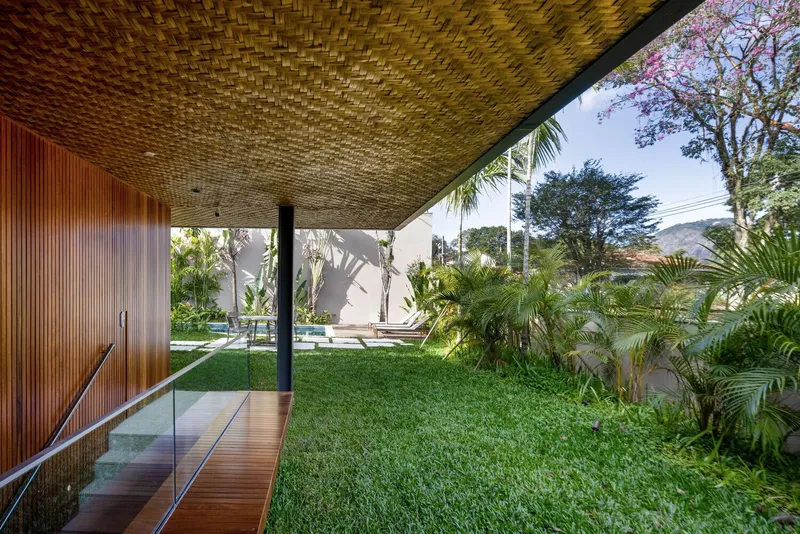
The ground floor wraps around a grassed courtyard with large stone pavers, a lap pool, and clusters of palm planting that screen the house from itself. Rather than a single dramatic reveal, the plan gives each social room its own relationship to this outdoor space. The living and dining areas look through the courtyard to the garden beyond; the gourmet terrace addresses it laterally; the pool sits at its edge like a reflecting surface. The result is a house that always has somewhere to look and something green to look at.
There is a quiet generosity in the way the stepping-stone paths cross the lawn. They slow you down. In a city famous for its kinetic energy, this house demands that you walk deliberately, pause, and notice the transition from covered timber deck to open sky to canopy shade. The landscape is not decoration here; it is infrastructure.
Private Rooms with Public Views


The upper floor houses three suites, an office, and an intimate living room, all opening onto balconies that face the surrounding forest canopy. The dusk image of the master terrace is perhaps the most telling photograph of the project: a planted bed sits between the sliding glass doors and the railing, so the bedroom effectively opens onto a garden before it opens onto the view. It is a small move, but it transforms the balcony from a ledge into a room.
From the rooftop deck, the forested hills of Rio's Tijuca massif dominate the horizon. The architects wisely kept this surface minimal: timber flooring, cable railing, no pergola. At this altitude, the house steps aside entirely and lets the geography of Rio do the work. The restraint is earned by the richness of the floors below.
Interiors Shaped by Collection and Craft
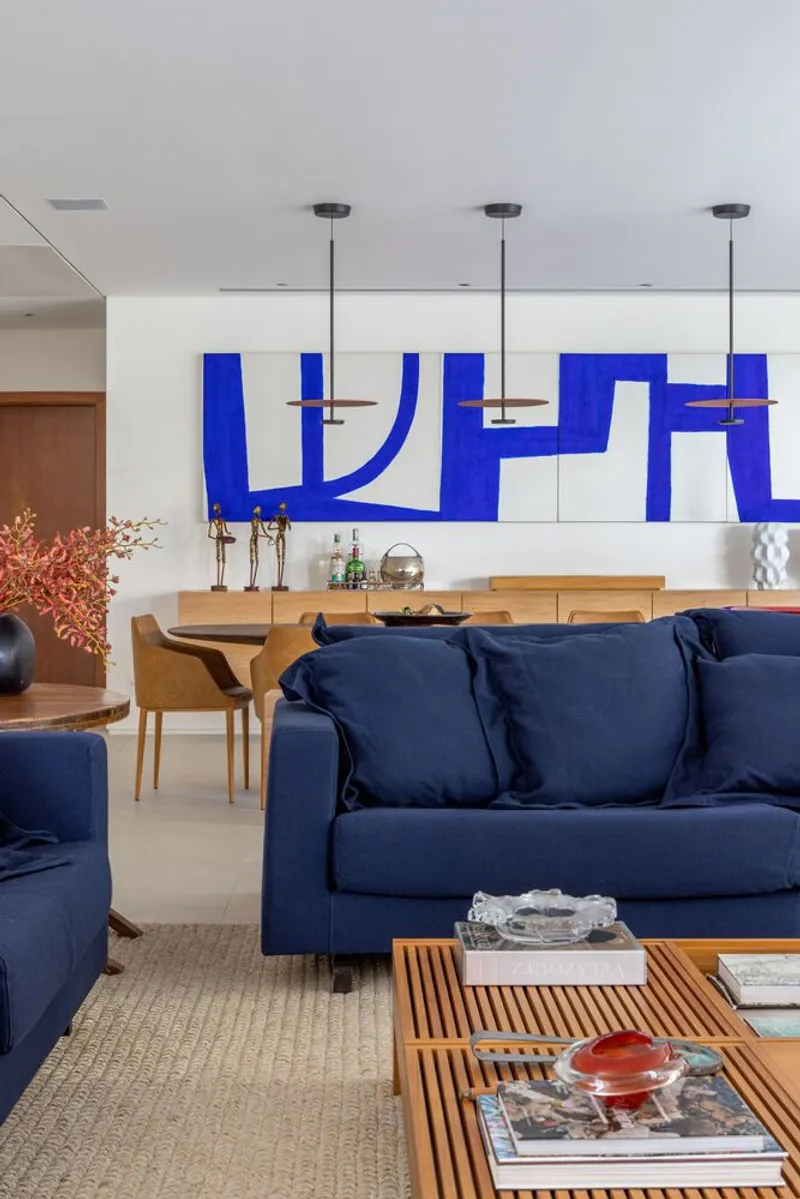

Inside, the house reveals its owners' personality through careful accumulation rather than minimalist restraint. A white-tiled feature wall with a blue graphic pattern anchors the main living room, its scale large enough to hold its own against the garden views. Elsewhere, a full-height shelving wall displays collectibles behind a timber slatted door panel, treating personal objects with the same architectural seriousness as the structure itself.
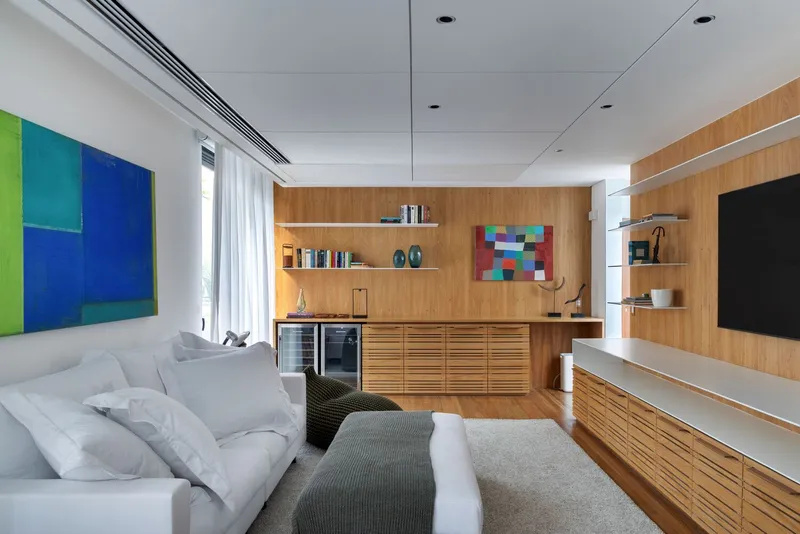
The media room, lined in timber cabinetry with recessed ceiling panels, is deliberately introverted, a counterpoint to the transparency of the floors below. Maneco Quinderé's lighting design is most evident in these interior rooms, where multiple configurations allow the same space to shift from focused task lighting to soft evening ambiance. Every piece of millwork was custom-designed by Opy in close collaboration with the family, which explains why the interiors feel inhabited rather than staged.
The Working Edge: Office and Garden

A compact home office on the upper floor places a floating timber desk against a wall of shelves, with a glazed door opening directly into dense garden planting. It is a room designed for concentration that never loses contact with the outside. The shelves are generous enough to be functional but shallow enough to keep the space feeling open. For a house that prioritizes fluid boundaries, this room proves the principle works at the scale of a single desk as well as it does at the scale of a courtyard.
Why This Project Matters
House Opy Ará 100 matters because it refuses to treat sustainability as an add-on or a marketing tagline. The natural materials, the passive ventilation strategy enabled by expansive openings, the high-performance aluminum windows from Hydro's Nova Gold line: these are not features bolted onto a conventional plan. They are the plan. The architecture would not make spatial or aesthetic sense without them. That integration is rarer than it should be, and both Sergio Conde Caldas and Miguel Pinto Guimarães deserve credit for achieving it without sacrificing comfort or visual warmth.
More broadly, the project offers a persuasive model for domestic architecture in tropical cities. It demonstrates that you do not need to seal a house off from its climate to live well in it. You need to weave into it. The woven ceiling, the planted balconies, the courtyard that operates as both landscape and circulation: these moves create a house that breathes with its environment rather than defending against it. In a city defined by its topography and its vegetation, that feels exactly right.
House Opy Ará 100 by Sergio Conde Caldas Arquitetura and Miguel Pinto Guimarães Arquitetos Associados. Jardim Botânico, Rio de Janeiro, Brazil. 888 m². Completed 2023. Photography by André Nazareth.
About the Studio
Share Your Own Work on uni.xyz
If projects like this are the kind of work you want to make, uni.xyz is a place to publish your own, find collaborators, and enter design competitions.


Popular Articles
Popular articles from the community


GROUP A Strips a 1969 Rotterdam Harbor Headquarters to Its Frame and Wraps It in Timber Louvers
In Rotterdam's M4H harbor district, Ferro Offices reuses a 1969 frame, adds one timber storey and reaches BREEAM-NL Outstanding.

LT2A and OPEN Architectes Thread a Brick and Glass High School Through a Wooded Belgian Campus
In Braine-l'Alleud, a 3,000 m² wing for Collège Cardinal Mercier pairs pale brick with a glazed colonnade, deferring to a small chapel and a dense wood.

Architekt Andreas Gruber Scatters 23 Dark Timber Chalets Across a South Tyrolean Forest Edge
In Molini di Tures, Amonti Chalets breaks a resort into a hamlet of gabled timber houses, with parking, storage and services pushed into the slope.

U.GA Architects Wraps an Oval Rooftop Pool in Curved Board-Formed Concrete on Busan's Jeollidan-gil
In Busan's Jeonpo-dong, a 454 m² mixed-use block stacks a neighborhood facility, guest rooms and an oval rooftop pool inside spiraling concrete walls.

Similar Reads
You might also enjoy these articles


Hodi-Mandai Geram
Project Function: Preservation and revitalization of the Intangible heritage and socio-spatial identity of the Hodi by Housing, Cultural Memory Center, Sacred Grove, landscape, local tourism economy


Olio Towers: A Mid-Rise for Performers That Fuses Housing, Rehearsal, and Stage
Located blocks from Houston's Theater District, this modular tower stacks living units around a central performance atrium.

Oasis: Modular Green Housing Carved into Dhaka's Urban Fabric
A shortlisted Plugin Housing entry reclaims unauthorized settlements in Dhaka with stepped concrete volumes, green roofs, and ventilation-driven design.

Black Hole: A Floating Megastructure for the Post-Physical Era
Emiliano Mazzarotto envisions a spherical, self-scaling arena where e-sports, digital hotels, and holographic stadiums replace traditional public space.

Explore Architecture Competitions
Discover active competitions in this discipline

Challenge to reimagine the Iron Throne

Photograph architecture without architects

Illustrate the lost glory of Angkor Wat - Render Challenge

Design challenge to reuse E-waste
Comments (0)
Please login or sign up to add comments
No comments yet. Be the first to comment!