
House Re-Coding: Rethinking Modular Housing Architecture for a Changing World
A modular housing architecture system redefining adaptability, affordability, and resilience across climates and contexts worldwide.


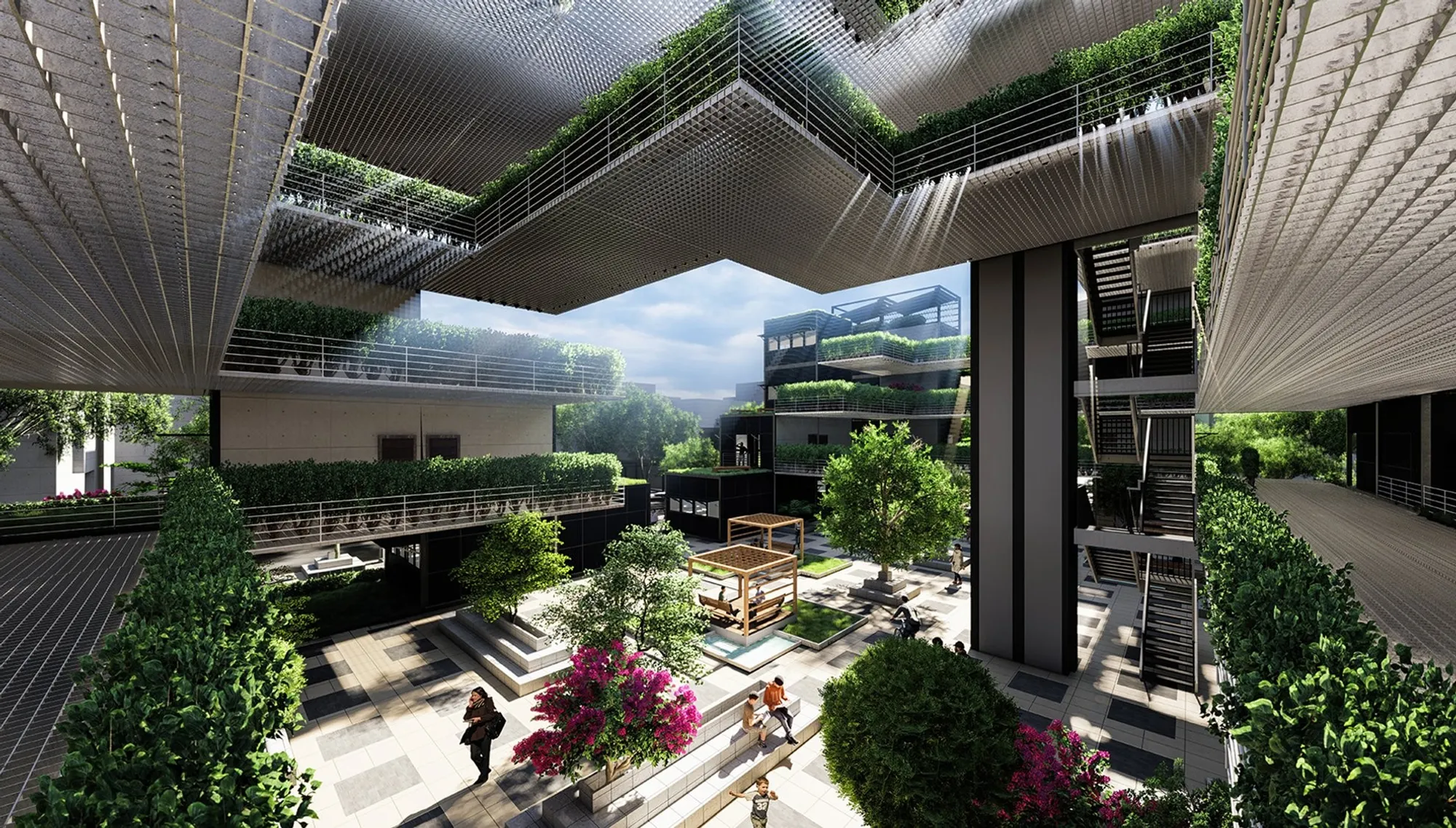
In an era defined by rapid urbanization, climate uncertainty, and increasing displacement, modular housing architecture has emerged as one of the most critical design strategies of our time. The project House Re-Coding by Reparametrize Studio positions itself at the forefront of this discourse, proposing a highly adaptive, scalable, and globally deployable housing system.
Shortlisted as part of Habitats '20, the project challenges conventional residential typologies by introducing a flexible unit-based system capable of responding to diverse environmental, social, and spatial conditions.
A System, Not a Building
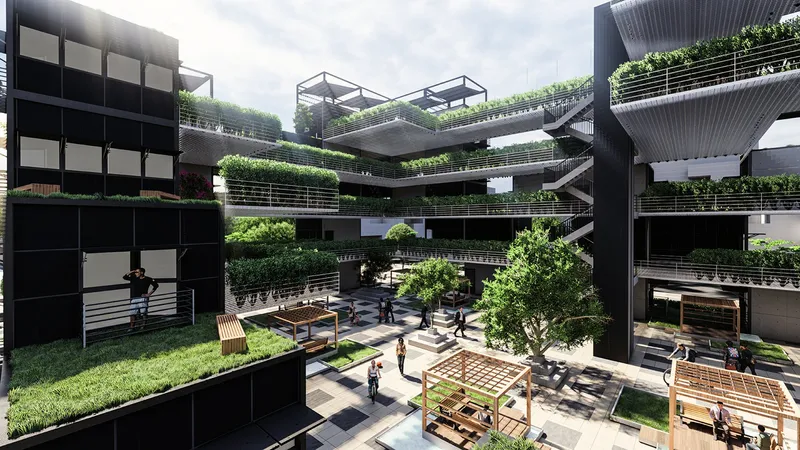
At its core, House Re-Coding is not a singular architectural object but a systemic approach to housing. The design introduces a modular "frame box" unit, conceived as a repeatable and adaptable component that can be deployed across various contexts.
This approach aligns with contemporary modular housing architecture strategies, where prefabrication, scalability, and adaptability take precedence over static construction. Each unit is designed to function independently while also integrating seamlessly into larger spatial configurations.
The result is a dynamic architectural system capable of evolving over time, rather than a fixed and rigid built form.
Adaptive Urban Insertion
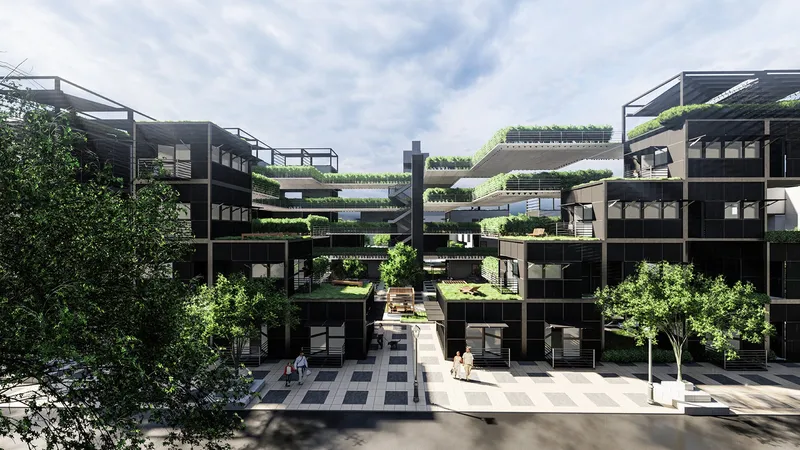
One of the defining strengths of the project lies in its ability to interface with existing urban fabric. The modular units are designed to adapt to the deformation of existing buildings, allowing them to be inserted into irregular or underutilized spaces.
This creates opportunities for:
- Densifying urban areas without large-scale demolition
- Activating residual or neglected spaces
- Introducing new layers of habitation within existing cities
By leveraging modular housing architecture principles, the project transforms constraints into opportunities, enabling a form of urban regeneration that is both efficient and context sensitive.
Climate-Responsive Design
The universality of the system is a key ambition of House Re-Coding. Designed to function across multiple climates, the modular units integrate passive environmental strategies and flexible configurations that respond to local conditions.
Green terraces, layered circulation, and open communal courtyards contribute to:
- Improved microclimatic performance
- Natural ventilation and shading
- Enhanced social interaction
The integration of vegetation across terraces and rooftops further reinforces the project’s commitment to sustainability, positioning it firmly within the discourse of climate-responsive modular housing architecture.
Flexible Interior Logic
Beyond its urban and environmental strategies, the project demonstrates a highly refined interior adaptability. The housing units incorporate movable panels, sliding partitions, and rotating elements that allow users to reconfigure spaces according to their needs.
This flexibility enables:
- Multiple spatial configurations within a compact footprint
- Efficient use of limited space
- Personalization of living environments
Such strategies reflect a shift in architectural thinking, where user agency becomes central to design. The house is no longer a static container but an interactive system that evolves with its occupants.
Emergency Housing Potential
While the project functions effectively as a long-term housing solution, its design also addresses urgent humanitarian needs. The modular system can be rapidly deployed as emergency housing in crisis situations.
The reference to Syria highlights its potential application in post-conflict or disaster-stricken regions, where:
- Speed of construction is critical
- Resources are limited
- Adaptability to unpredictable conditions is essential
In this context, modular housing architecture becomes not just a design strategy, but a tool for resilience and recovery.
Community-Centered Living
The spatial organization of House Re-Coding emphasizes collective living. Elevated walkways, shared terraces, and central courtyards create a layered network of social spaces.
This configuration fosters:
- Interaction between residents
- A sense of community ownership
- A balance between private and public realms
Rather than isolating individuals, the architecture encourages connectivity, redefining contemporary housing as a shared experience.
A Scalable Vision for the Future
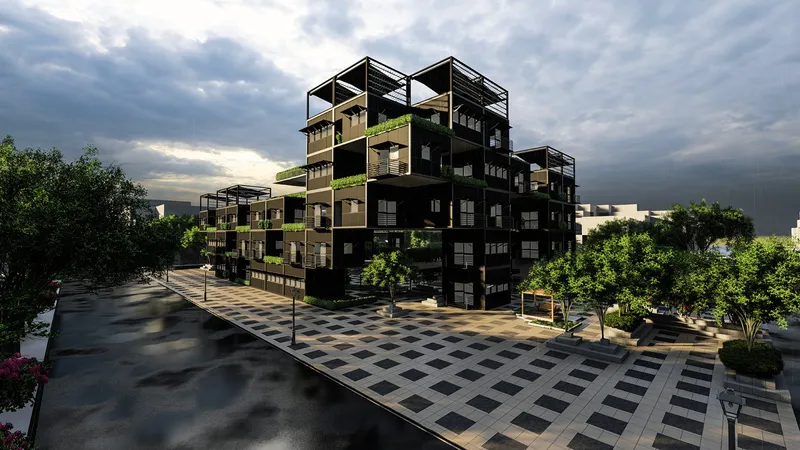
What distinguishes House Re-Coding is its scalability. The modular units can be aggregated horizontally and vertically, forming complex architectural compositions that respond to varying densities and site conditions.
This scalability ensures that the system can be applied across:
- Urban environments
- Suburban developments
- Temporary settlements
By combining flexibility, affordability, and environmental responsiveness, the project presents a compelling vision for the future of modular housing architecture.
House Re-Coding by Reparametrize Studio is a forward-thinking exploration of modular housing architecture that addresses some of the most pressing challenges of contemporary living. Through its adaptable unit system, climate-responsive strategies, and community-oriented design, the project redefines what housing can be in a rapidly changing world.
As cities continue to evolve and global challenges intensify, such innovative approaches will play a crucial role in shaping resilient, inclusive, and sustainable built environments.




Popular Articles
Popular articles from the community

How Henri Picq's 1889 Paris Pavilion Traveled 11,000 Kilometers to Become Santiago's Artequín Museum
A prefabricated iron and glass pavilion built for the Paris Universal Exposition found a second life as a children's art museum in Chile.
FAMM Arquitectura Organizes Ten Villas Around Courtyards and Jungle in Nosara, Costa Rica
El Molino pairs two elongated volumes with deep overhangs and timber louvers to build a compact coastal community five minutes from the beach.


Riyadh For All: Intergenerational Urban Design for Active Aging in Rabat
Riyadh For All reimagines urban design in Rabat with intergenerational co-living, adaptive courtyards, and Moroccan cultural exchange today.
A Reinforced Cocoon: Vernacular Architecture for Security, Healing and Community in Qandahar
A Reinforced Cocoon reimagines Afghan vernacular architecture as secure community space for widowed women, families, healing and resilience.


Similar Reads
You might also enjoy these articles
Eco Chapel: A Green Architecture Pavilion Designed in Symbiosis with the Forest
Eco Chapel uses green architecture to weave prayer, learning and reuse into a forest pavilion shaped by modular hexagonal canopies for life.
Kaffeebühnen: Coffee Shop Architecture Designed as a Civic Stage Between Vienna’s City and Park
Kaffeebühnen turns coffee shop architecture into a civic stage, linking Vienna’s park edge, urban life, warm timber yards, and coffee craft.
Healing Façade: Sustainable Architecture for Reforestation, Community, and Sacred Ecology in Ethiopia
Healing Façade reimagines sustainable architecture as a living wall that restores soil, catches water and renews Ethiopia's forest churches.


Urban Forest: A Vertical Ecosystem for 5,000 Workers in Singapore's Changi Business Park
Radially stacked pods and layered green decks turn a 7-acre plot into 47 acres of ecological workspace projected for 2040.

Explore Conceptual Architecture Competitions
Discover active competitions in this discipline



The Global Benchmark for Architecture Dissertation Awards


Design challenge to reuse E-waste
Comments (0)
Please login or sign up to add comments
No comments yet. Be the first to comment!