

House Requena by Sommet
A hillside residence in Santa Cruz featuring stacked concrete and metal volumes, elevated social spaces, and terraces seamlessly integrated with dense tropical vegetation.


Completed in 2025, House Requena by Sommet is a contemporary hillside residence located within a gated community on the outskirts of Santa Cruz, Bolivia. Set on a steeply sloped site surrounded by dense vegetation, the 646-square-metre house is shaped by topography and landscape, which directly inform its spatial organization, structural logic, and material expression.
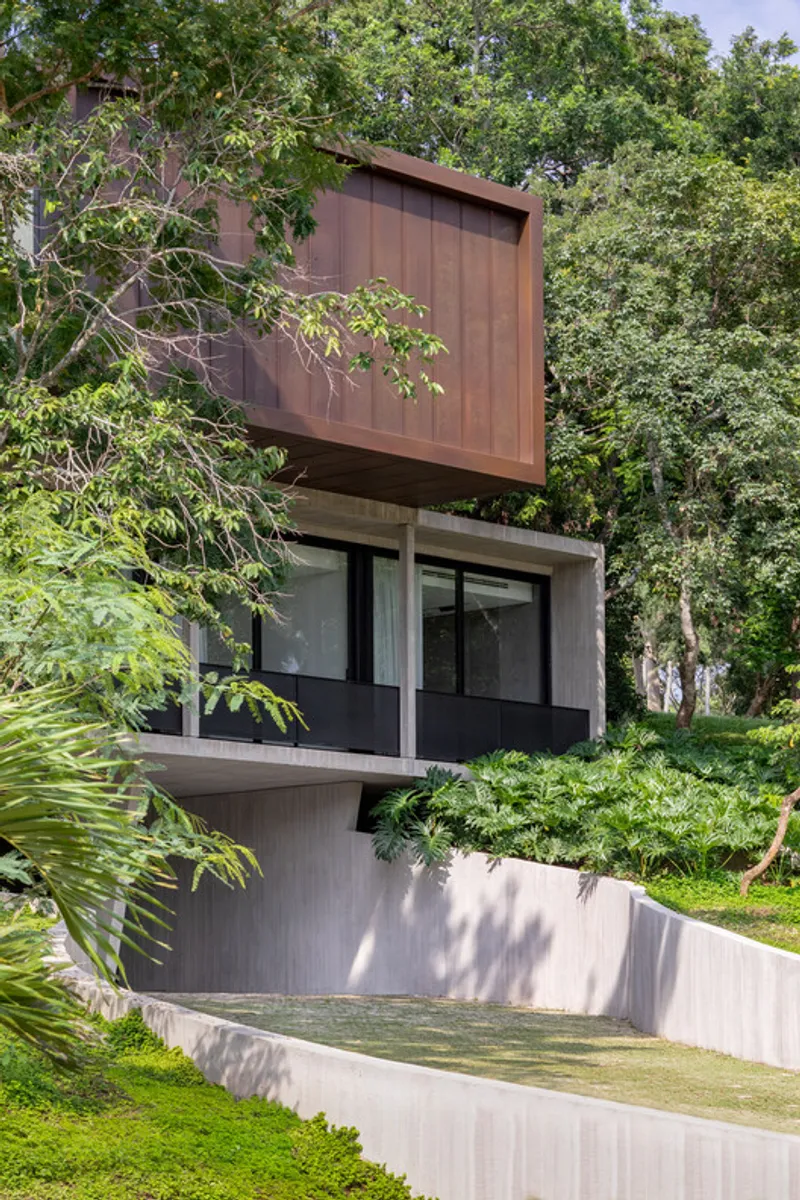

Rather than imposing a singular volume onto challenging terrain, the project adopts a layered strategy that integrates architecture with the slope, allowing living spaces to unfold vertically in close dialogue with nature.
Responding to Topography and Landscape
The defining condition of the site is its steep incline and mature vegetation. These elements became generative forces in the design process, guiding the placement of volumes and the sequencing of spaces.
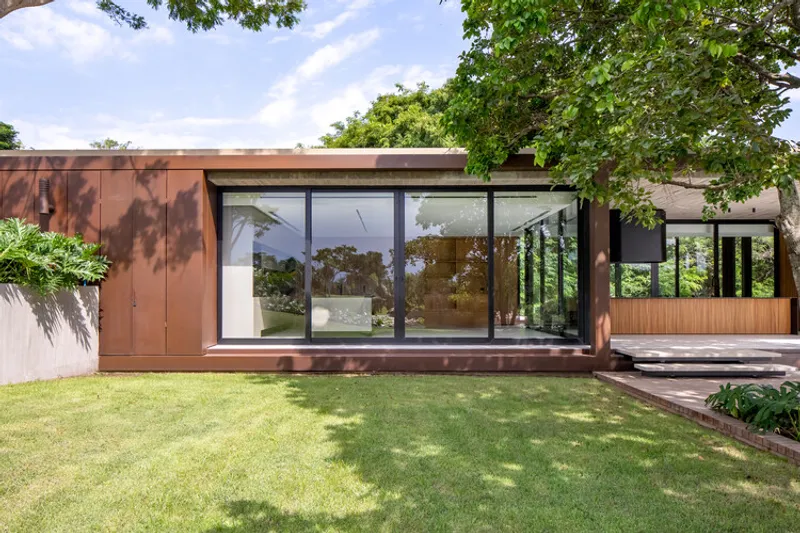
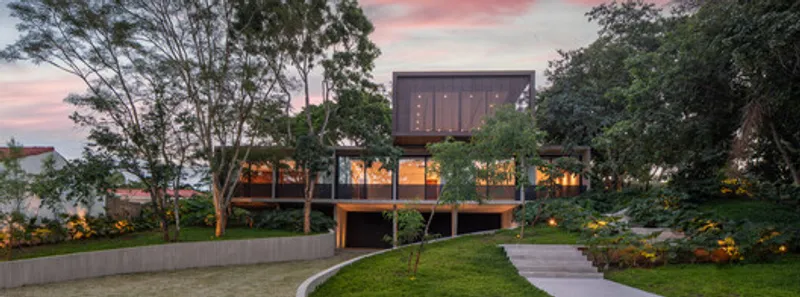
Sommet organized the house into two primary stacked volumes. This configuration follows the natural contours of the land, minimizing excavation while maximizing views and privacy.
By working with the slope instead of against it, the architects created a residence that feels anchored in its terrain.

Elevated Social Spaces and Panoramic Views
The social areas: living room, dining room, and kitchen, are located on the highest level of the site. Positioned above the private volume, these spaces enjoy uninterrupted views across the treetops and surrounding landscape.

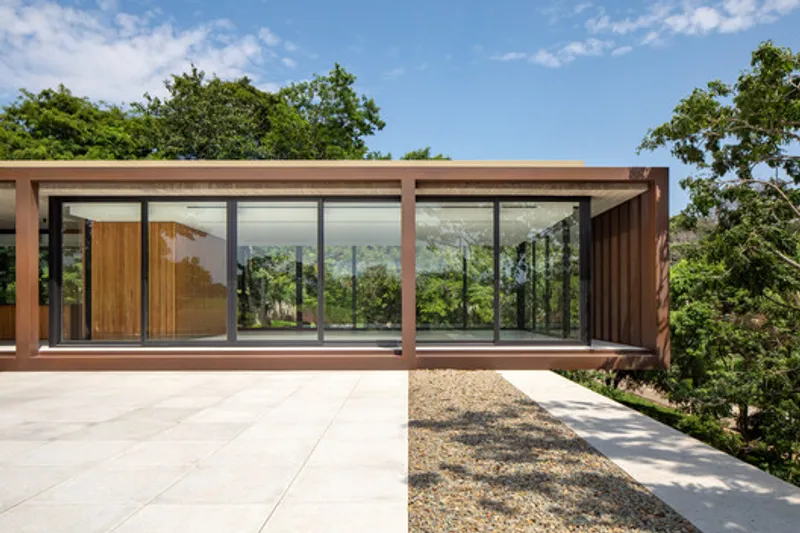
This elevated placement ensures that the most frequently used communal spaces maintain a strong visual and environmental connection with nature. Large openings, terraces, and balconies frame the greenery and bring filtered daylight deep into the interiors.
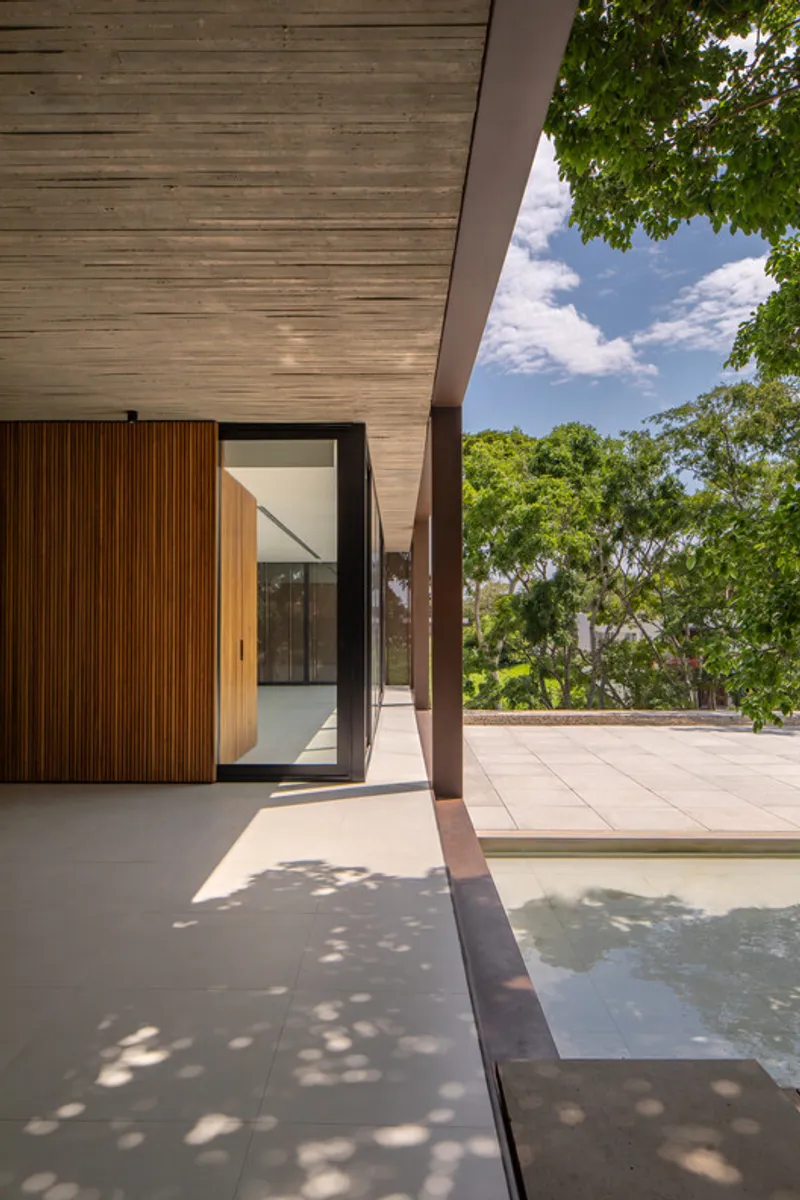
Above the lower volume, its roof is conceived as an accessible terrace, functioning as an elevated patio. This outdoor platform reinforces continuity between architecture and landscape while expanding the living area vertically.
Private Zones Embedded in the Slope
The private bedrooms and family spaces are located within the lower volume, oriented toward the lower-level trees at the front of the site. Despite their proximity to ground level, these spaces remain visually protected by topography and vegetation.
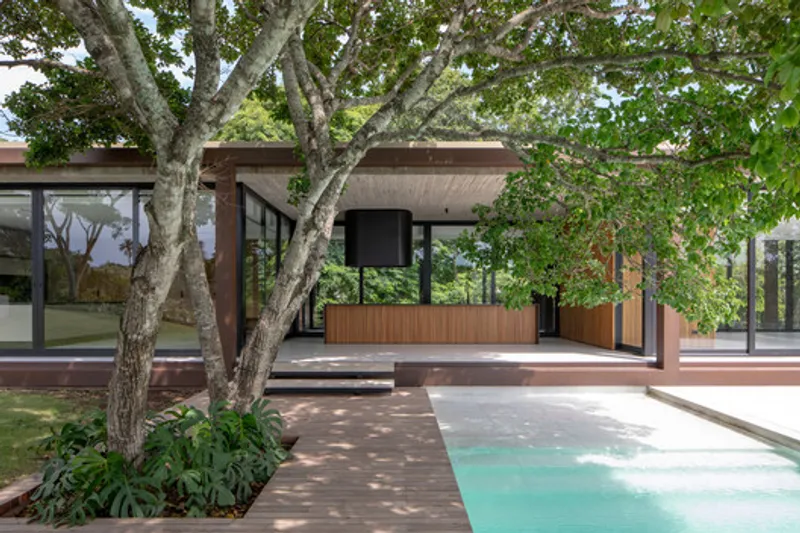
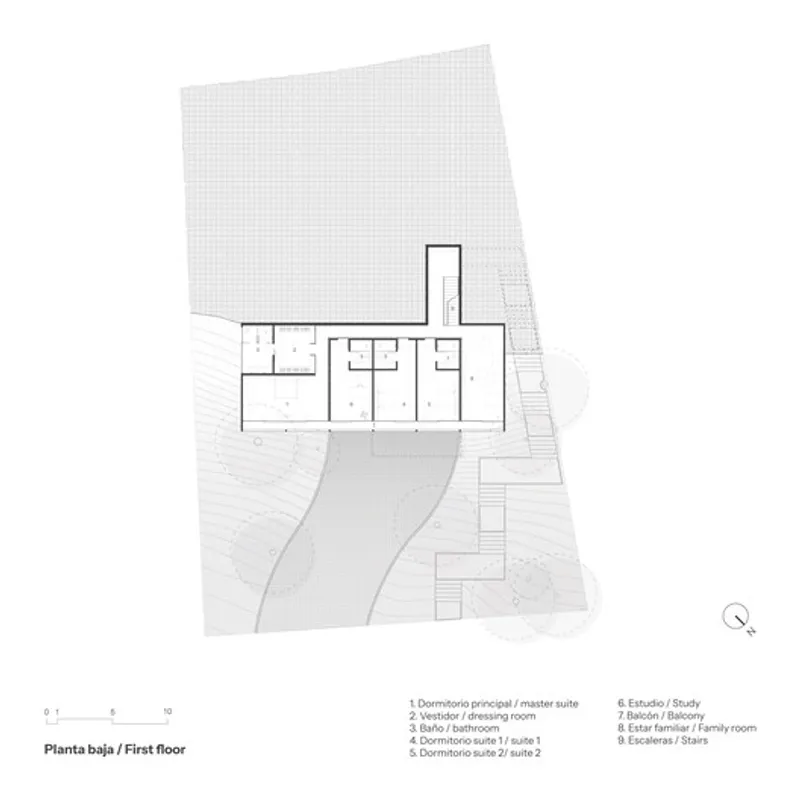
From the street, this lower volume reads as an upper floor due to the change in level, giving the private areas independence from public access. The slope and planting effectively create a natural buffer, ensuring privacy without physical barriers.
This strategy allows the house to remain open to its surroundings while maintaining domestic intimacy.

Articulated Access and Structural Base
At the base of the complex, vehicular access and garage entry are defined by two curved exposed-concrete retaining walls. These walls perform multiple functions:
- Containing the terrain
- Adjusting levels between street and garage
- Structuring the entrance sequence
- Establishing a strong architectural base

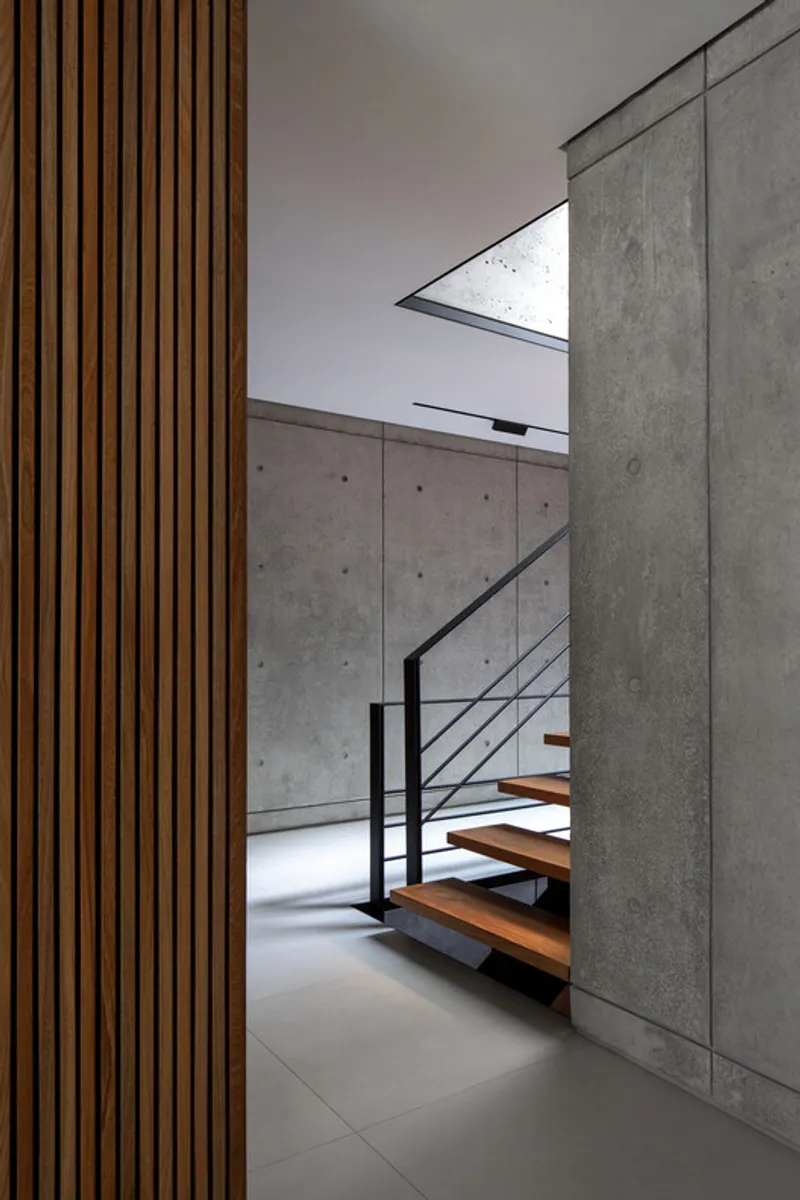
The ribbed texture of the concrete reinforces material depth and highlights craftsmanship. This same finish extends across the lower volume and basement, grounding the house visually and structurally.
Material Contrast: Concrete and Metal
A key architectural theme in House Requena is the deliberate contrast between materials. The lower volume is defined by exposed, textured concrete, while the upper volume is clad in metal panels.
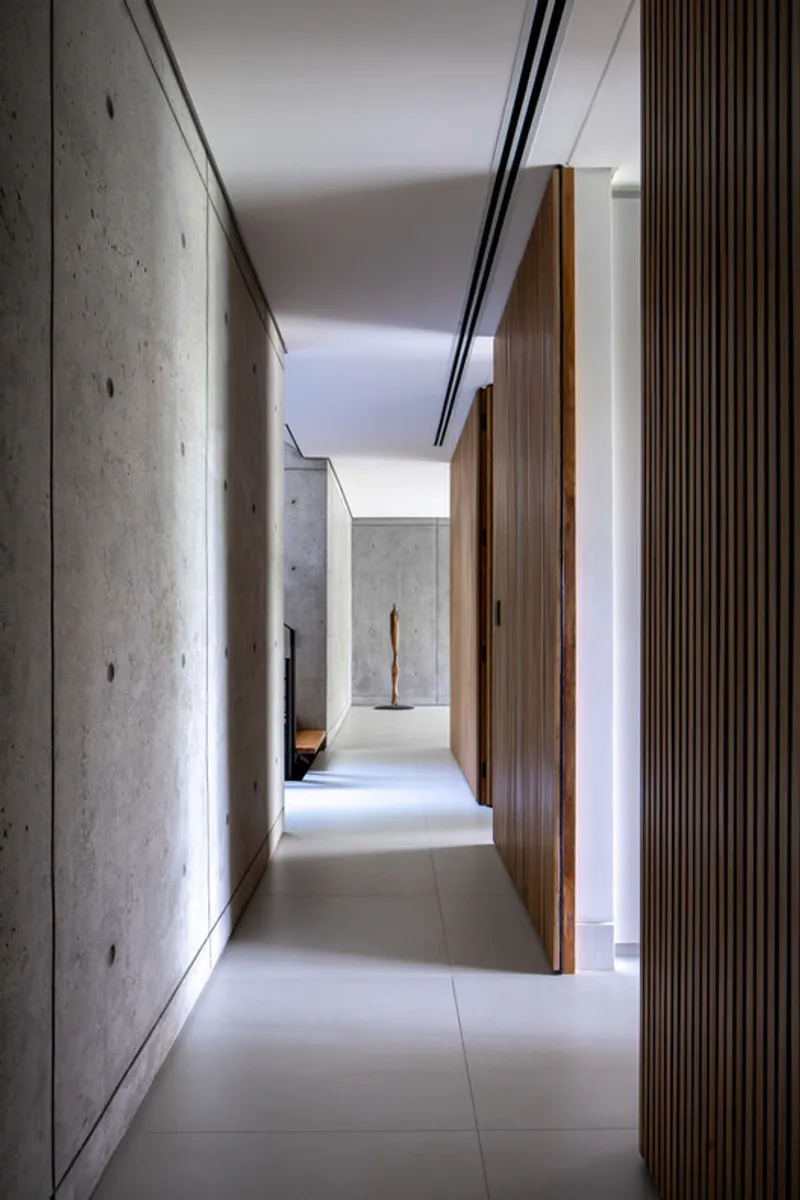
This juxtaposition expresses the building’s structural hierarchy: a heavy, grounded base supporting a lighter, elevated form. The contrast also enhances legibility, allowing each volume to be read clearly within the overall composition.
The material palette reflects both durability and climatic responsiveness, suitable for Santa Cruz’s tropical environment.
Refining the Roof Edge and Structural Expression
One of the project’s most distinctive formal gestures is the treatment of the upper roof slab. The slab is thinned at its edges to visually lighten the structure and enhance elegance.

Metal cladding is carefully limited to this tapered zone, producing a visual separation between the slab edge and the main concrete mass. This creates the impression that the roof is detached and floating above the lower structure.
This subtle intervention reinforces compositional clarity and demonstrates Sommet’s attention to detail and proportion.
Spatial Continuity and Vertical Living
House Requena is conceived as a vertically connected domestic landscape. Circulation unfolds gradually through level changes, terraces, and outdoor platforms, creating fluid transitions between interior and exterior.
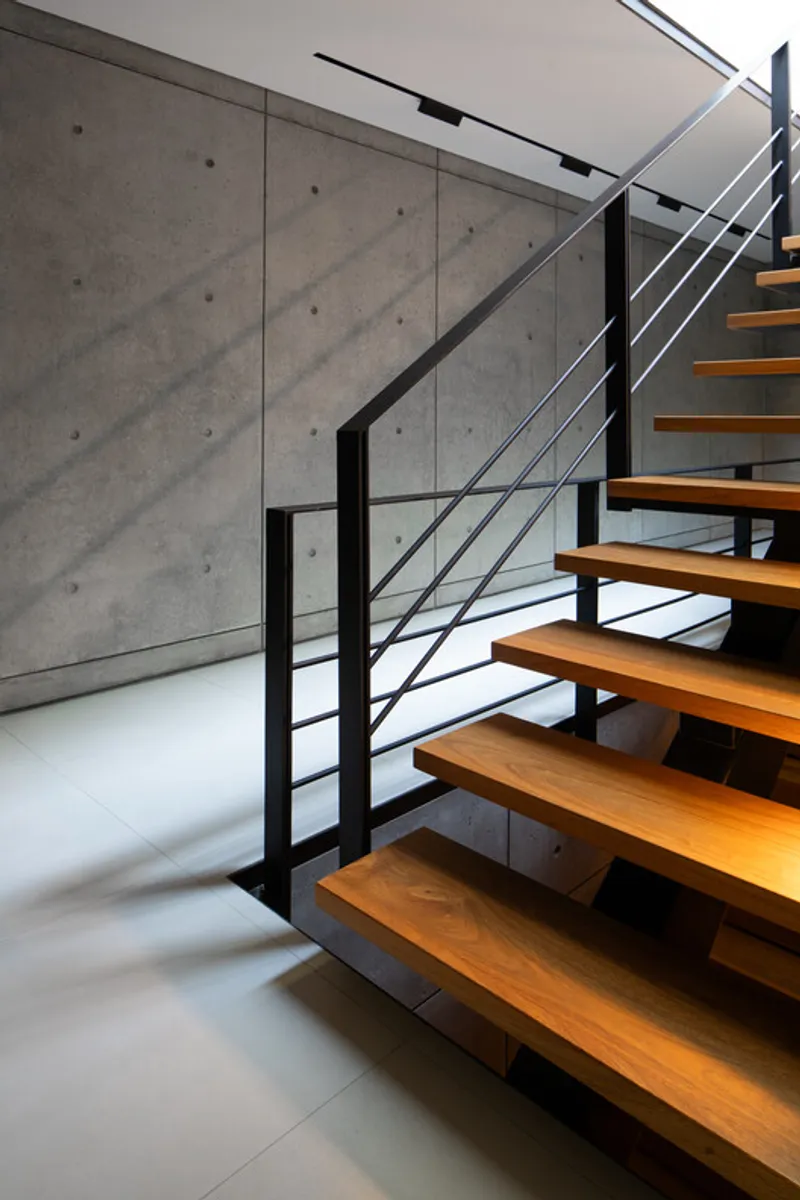

Stairs, balconies, and patios operate as extensions of living spaces, encouraging daily interaction with climate, light, and vegetation. The house does not rely on a single focal point but instead offers multiple spatial experiences distributed across levels.
This layered approach supports both social gathering and private retreat.
Climate and Environmental Integration
The dense vegetation surrounding the house plays an essential role in environmental performance. Trees provide shade, reduce heat gain, and filter sunlight, contributing to thermal comfort.
Openings are strategically positioned to capture prevailing breezes and promote natural ventilation. Terraces and overhangs moderate solar exposure while maintaining visual openness.
Rather than relying heavily on mechanical systems, the design leverages passive environmental strategies rooted in site conditions.
Privacy Through Landscape and Section
Instead of conventional walls or fences, privacy is achieved through sectional design and planting. Differences in level, vegetation density, and building orientation create subtle separation between public and private realms.

This approach preserves openness while respecting domestic boundaries, allowing residents to experience nature without compromising comfort.
A Contemporary Tropical Residence
House Requena represents a contemporary interpretation of tropical hillside living. It combines rigorous structural logic with expressive materiality and landscape sensitivity.
The project demonstrates how residential architecture in rapidly developing suburban contexts can remain environmentally responsive and spatially refined.
By integrating topography, material contrast, and outdoor living spaces, Sommet delivers a home that is both grounded and elevated, physically and experientially.


All the Photographs are works of Paul Renaud


Popular Articles
Popular articles from the community


Temporary Home for Dogs: A Reversed Zoo Rethinks Animal Shelter Architecture
In Bucharest, a sinuous corridor and freed landscape flip the logic of containment, designing a shelter that works to make itself unnecessary.

Opera by the Sea Estonia: Three Shells Dissolving Architecture into Tallinn's Coastline
A winning opera house proposal replaces monumental form with interconnected shells that blur the boundary between building, park and Baltic Sea.

Extended Shell: Retrofitting Kolkata's Balconies as Living Urban Thresholds
A modular retrofit system recovers the social and environmental intelligence of Kolkata's historic verandas for contemporary Park Street residents.

Manzana Morphosis: Stretching Barcelona's Grid into a Living Landscape for 2050
A radical reworking of the Eixample manzana turns density into a tool for generous public space, vertical ecology, and environmental performance.

Similar Reads
You might also enjoy these articles


Hodi-Mandai Geram
Project Function: Preservation and revitalization of the Intangible heritage and socio-spatial identity of the Hodi by Housing, Cultural Memory Center, Sacred Grove, landscape, local tourism economy


Olio Towers: A Mid-Rise for Performers That Fuses Housing, Rehearsal, and Stage
Located blocks from Houston's Theater District, this modular tower stacks living units around a central performance atrium.

Oasis: Modular Green Housing Carved into Dhaka's Urban Fabric
A shortlisted Plugin Housing entry reclaims unauthorized settlements in Dhaka with stepped concrete volumes, green roofs, and ventilation-driven design.

Black Hole: A Floating Megastructure for the Post-Physical Era
Emiliano Mazzarotto envisions a spherical, self-scaling arena where e-sports, digital hotels, and holographic stadiums replace traditional public space.

Explore Residential Design Competitions
Discover active competitions in this discipline

Challenge to reimagine the Iron Throne

Photograph architecture without architects

Illustrate the lost glory of Angkor Wat - Render Challenge

Design challenge to reuse E-waste
Comments (0)
Please login or sign up to add comments
No comments yet. Be the first to comment!