
Studio Saxe Frames Ocean and Mountain Panoramas with a Teak-and-Steel Pavilion in Nosara
House with a View distills tropical architecture to its geometric essence on a Costa Rican hillside, letting cross-ventilation and cantilevered roofs do th

There is a particular kind of restraint that tropical architecture rarely achieves. Most projects in Central American resort towns oscillate between thatched-roof pastiche and glass-box cool. Studio Saxe has spent years carving out a middle ground in Costa Rica, and House with a View, completed in 2023 in Nosara, might be its most distilled statement yet. The brief came from Canadian clients who wanted something more than a winter bolthole: a year-round residence that could hold its own against a site offering simultaneous views of the Pacific Ocean and the inland mountain spine.
What makes the project genuinely interesting is not the view itself but the architectural machinery deployed to frame it. The house is organized as a simple geometric volume, elevated on pilotis and capped by layered roof planes that cantilever well beyond the enclosed rooms. Every element, from the double-height atrium to the continuous timber-slat ceilings, serves a dual purpose: spatial drama and passive climate control. The result is a building that feels lighter than its concrete-and-steel bones should allow, where the boundary between terrace and living room dissolves so completely that furniture placement becomes the only real distinction.
A Pavilion on the Hillside
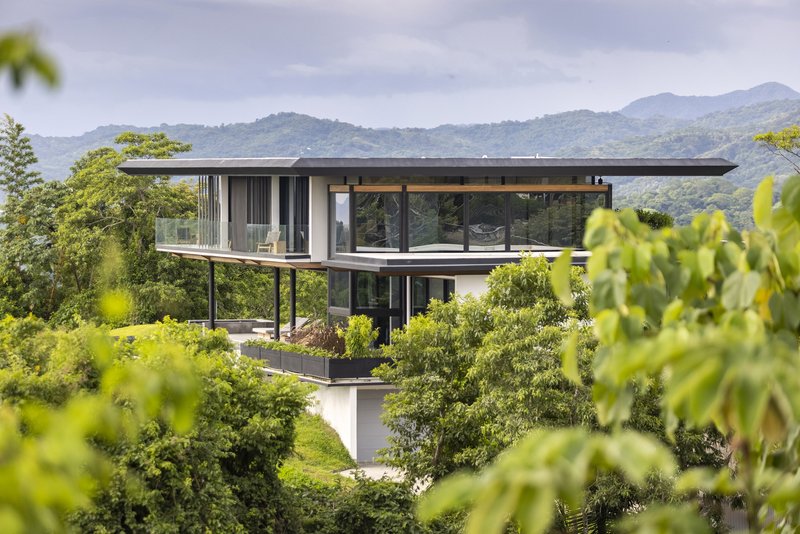
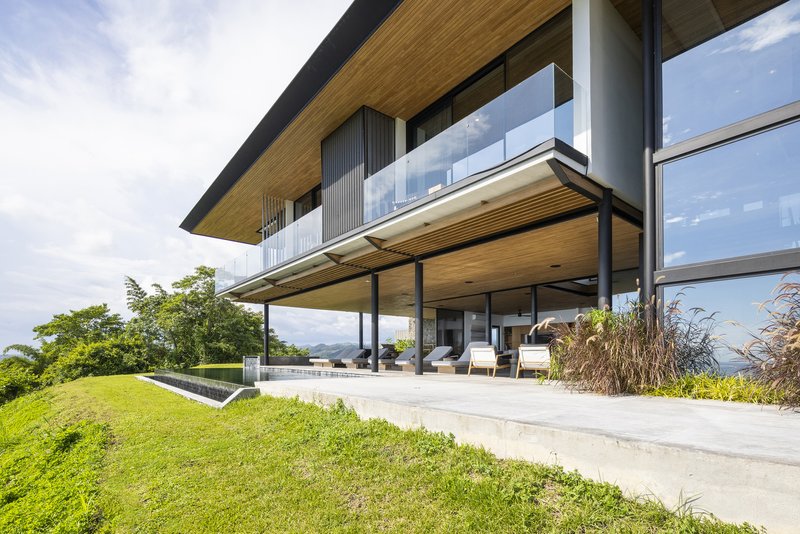
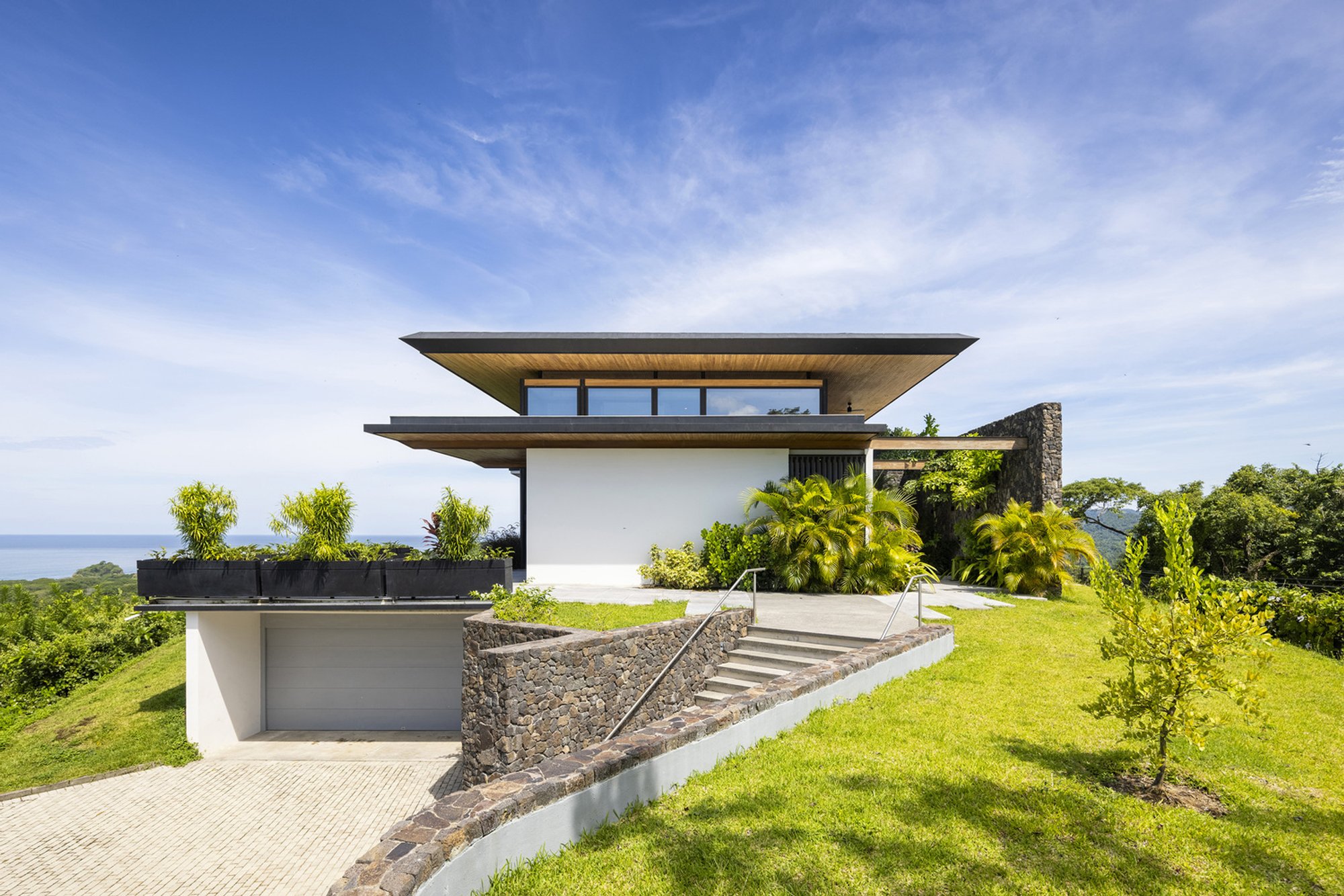
Approaching from the access road, the house reads as a series of stacked horizontal planes: white stucco volumes, timber soffits, and glass railings tiered across the slope. The decision to elevate the main living level on pilotis is not merely aesthetic. Lifting the social floor frees the ground plane for landscape continuity and, crucially, allows prevailing breezes to pass beneath and through the structure. On a mountainous site in the tropics, that strategy eliminates much of the mechanical cooling a sealed box would demand.
The terraced organization also resolves a grade change that could have produced awkward split levels. Instead, Studio Saxe treats each terrace as its own horizon line, stepping the house down with the terrain so that every room meets the garden at a different altitude. Glass railings keep sightlines continuous from the upper bedrooms to the canopy below.
Arrival and Material Identity
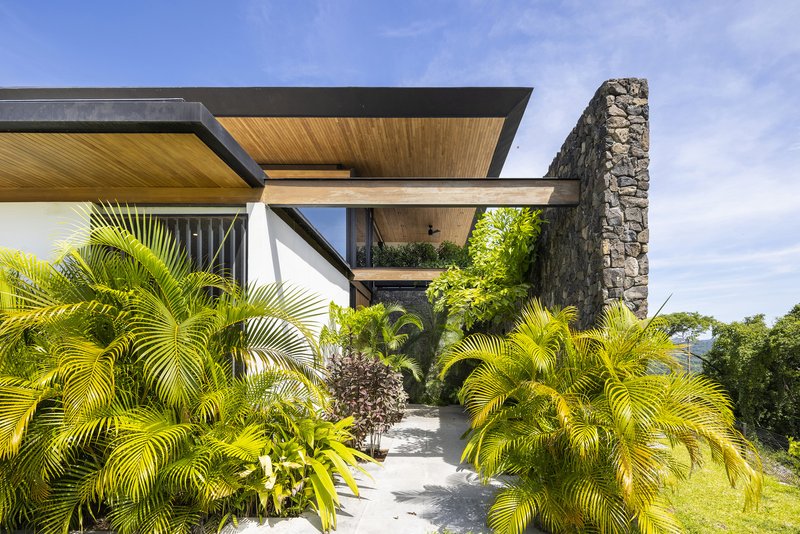
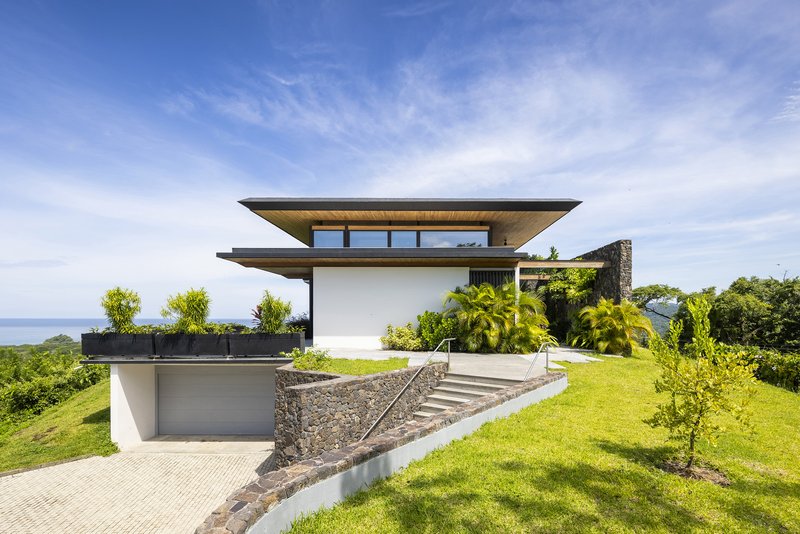
The entry sequence reveals the project's material logic. A stone chimney volume anchors one side, its mass grounding the composition while the timber-clad upper level floats beside it. The path threads through palm trunks, compressing the visitor's field of vision before the house opens up to its panoramic reveal. It is a well-worn cinematic trick, but Studio Saxe executes it with genuine spatial precision rather than superficial drama.
The palette is tight: locally sourced teak, poured concrete, black steel columns, and white stucco. Prefabrication played a significant role in keeping material connections clean, and the simplicity of the geometric form made that prefabrication practical on a difficult site. There are no gratuitous curves, no feature walls competing with the landscape. The restraint pays off in durability too. Teak weathers gracefully in Nosara's humid climate, while the concrete and steel structure resists the seismic and wind loads that come with a coastal mountainside.
The Double-Height Core
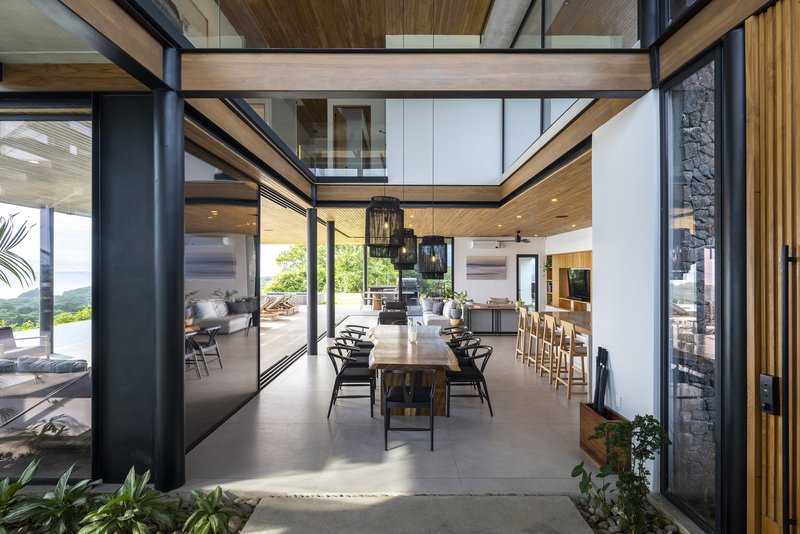
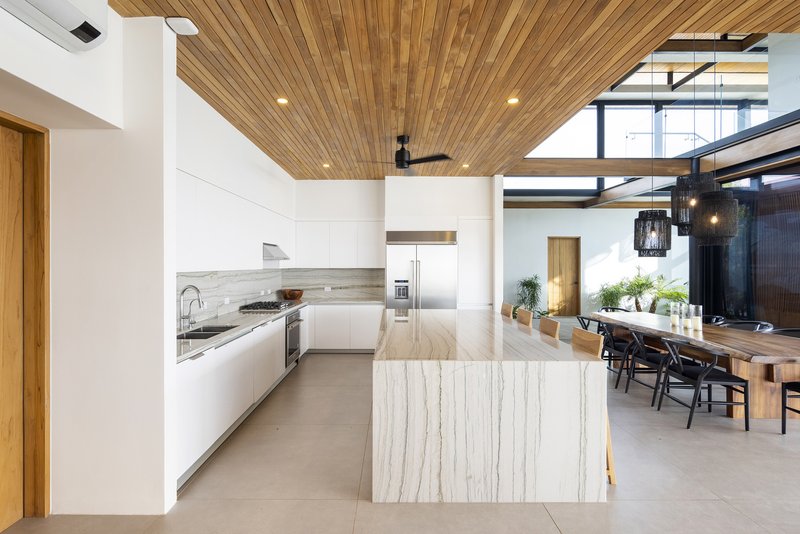
At the heart of the plan sits a double-height atrium that connects the social ground floor to the private upper level. Structurally, exposed steel columns carry the upper slab, leaving the dining space column-free where it matters and visually connecting the kitchen island to the void above. The continuous wood-slat ceiling runs uninterrupted across the kitchen, dining, and terrace zones, stitching them into a single spatial field. A white veined marble island provides the only contrasting surface, its cool mass acting as a counterpoint to the warm timber overhead.
The atrium is not just a light well. It operates as a thermal chimney: warm air rises through the void and exits at the upper level, drawing cooler air in from the shaded terrace below. It is passive ventilation at its most architecturally legible, and it means the house can remain open to the elements for most of the year without sacrificing comfort.
Terrace, Pool, and the Dissolving Edge
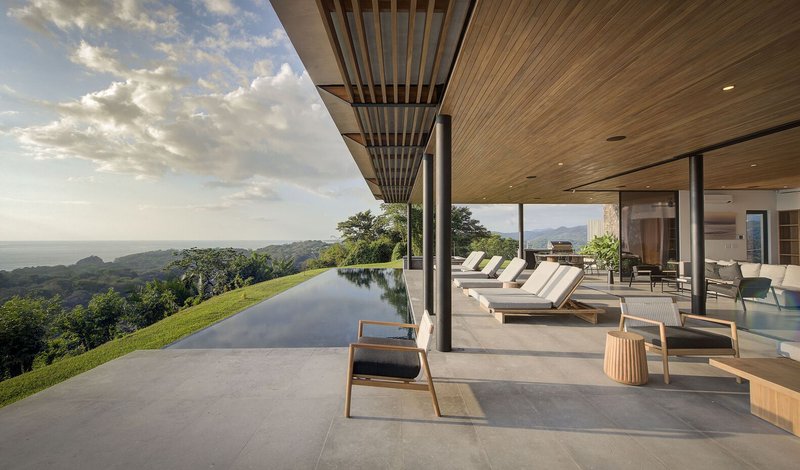
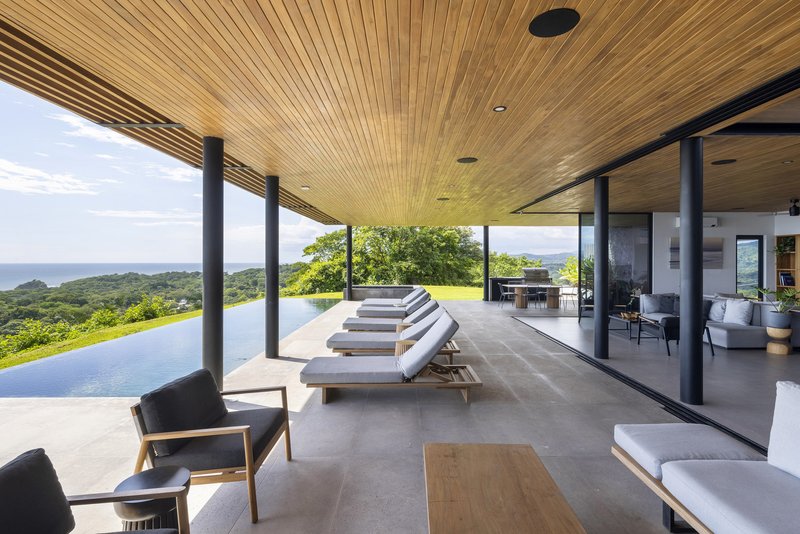
The covered terrace is arguably the building's most important room. Sheltered by a deep timber-louvered soffit supported on slender black columns, it mediates between the fully enclosed interior and the infinity pool at the forest edge. The soffit filters direct sun while admitting enough light to keep the space bright, and its depth means rain can fall without driving occupants indoors. In a climate where the wet season is long and intense, that overhang is not a luxury; it is the detail that makes open-air living viable twelve months a year.
The pool itself is positioned to align with the forested hillside beyond, creating a visual continuity between the water's edge and the tree canopy. From the terrace, the boundary between architecture and landscape genuinely blurs. Studio Saxe has always been drawn to this threshold condition, and here the proportions are generous enough to make it convincing rather than gestural.
Why This Project Matters
House with a View succeeds because it treats sustainability not as an add-on checklist but as a generator of form. The chimney atrium, the elevated plan, the deep overhangs: each of these moves solves a climatic problem and simultaneously defines the spatial character of the house. That alignment between performance and experience is what separates serious tropical architecture from resort decoration. Studio Saxe, working with collaborators Prodeyco, IECA Internacional, and Dynamo, demonstrates that prefabricated construction and locally sourced materials can produce buildings of real refinement on demanding sites.
For a growing number of clients relocating to Costa Rica's Pacific coast, the question is no longer whether modern architecture belongs in the jungle but how intelligently it can respond to it. House with a View offers a clear answer: strip the form to its geometric minimum, let passive strategies shape the section, and trust the landscape to provide everything else. The building neither hides from its setting nor competes with it. It simply holds the frame steady and lets you look.
House with a View, designed by Studio Saxe, Nosara, Costa Rica, completed 2023. Collaborators: Prodeyco, IECA Internacional, Dynamo. Photography by Andres Garcia Lachner and Sergio Pucci.
About the Studio
Share Your Own Work on uni.xyz
If projects like this are the kind of work you want to make, uni.xyz is a place to publish your own, find collaborators, and enter design competitions.




Popular Articles
Popular articles from the community

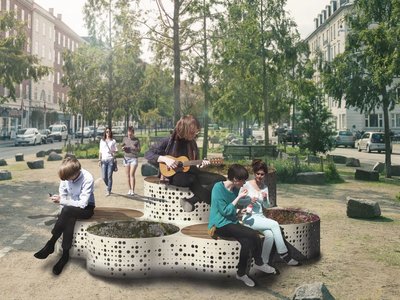
20 Most Popular Furniture Design Projects of 2025
Modular street systems, parametric benches, and insect hotels: the furniture design projects that captivated architects on uni.xyz in 2025.

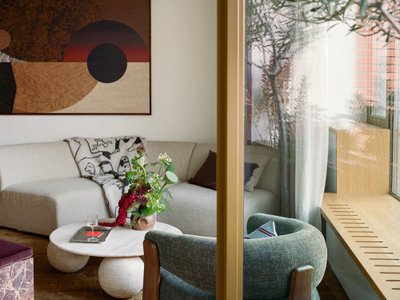
OMAMBO and DORON Atelier Weave Two Cultural Identities into an 80 m² Bucharest Apartment
Rather Two layers Romanian and Angolan heritage through stucco, recycled plastics, and deliberate spatial contrasts in central Bucharest.
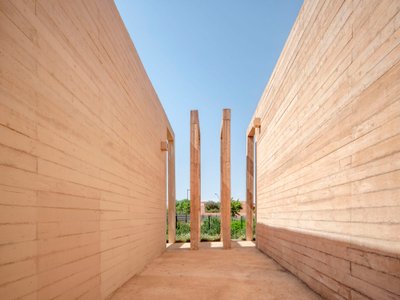
OUALALOU+CHOI Root a Regional Sports Campus in Moroccan Earth and Timber
A 10,230 square meter athletic complex in Ben Guerir uses rammed earth walls and timber screens to anchor sport in the arid landscape.

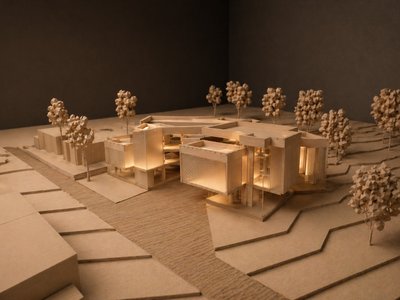
Flow: Spatializing Well-being Through Intersecting Layers
Transforming the inner depth of wellness into a spatial reality.


Similar Reads
You might also enjoy these articles

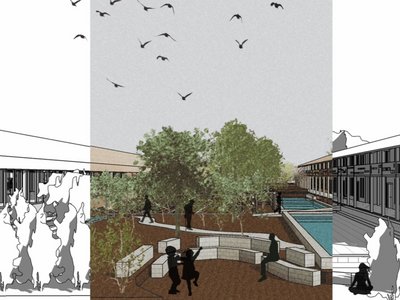
sprout - line | collective flourishing
A regenerative rural threshold where soil, skill, and solidarity converge.

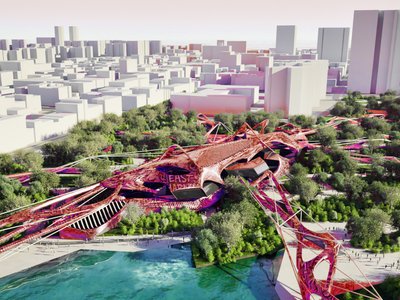

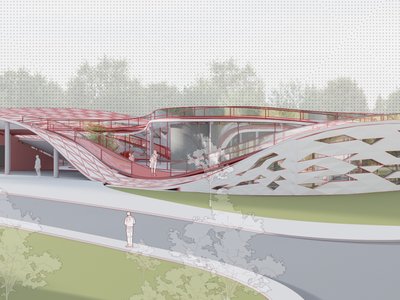
MOTION
This project explores well being through movement. A continuous loop guides users through shifting spatial conditions, connecting public and introspective spaces. By integrating the urban ground and elevating parts of the path, movement becomes a tool for mental clarity and spatial experience.

Home On A Leaf
The senior center project in Kielnarowa combines residential, recreational, educational, and cultural functions, promoting an active and sustainable lifestyle. The complex consists of several building
Explore Architecture Competitions
Discover active competitions in this discipline




The International Standard for Design Portfolios


The Global Benchmark for Architecture Dissertation Awards


The Global Benchmark for Graduation Excellence


Challenge to reimagine the Iron Throne
Comments (0)
Please login or sign up to add comments
No comments yet. Be the first to comment!