

Huajian Group Wraps a Shanghai Primary School Around Circular Courtyards and Rooftop Gardens
A 23,000 square meter campus in Pudong's Tang Town replaces rigid corridors with curved pathways, planted voids, and orange canopies.


Most primary schools in China's dense urban districts follow a familiar formula: classroom bars stacked beside a track, separated by fencing and security gates. The Peide Campus of Shanghai Fushan Tangcheng Foreign Language Primary School, designed by Huajian Group Shanghai Architectural Design & Research Institute, rejects that template outright. Completed in 2022 in Pudong New Area, the 23,000 square meter school organizes its teaching, dining, and administrative buildings around a shared interior landscape of circular courtyards, curved staircases, and terraced planting beds. The result is a campus that feels less like an institution and more like a small village designed at a child's scale.
What makes the project genuinely noteworthy is its refusal to treat outdoor space as leftover. The design team, many of whom are parents of school-age children themselves, built the school's identity around the voids between buildings rather than the buildings themselves. Curved paving, orange-framed canopies, and rooftop gardens are not decorative gestures layered onto a conventional plan. They are the plan. The campus converts every in-between zone into a space children actually occupy: reading under a colonnade, running along a curved ramp, sitting on tiered steps that double as outdoor amphitheaters.
A Campus Shaped by Its Courtyards
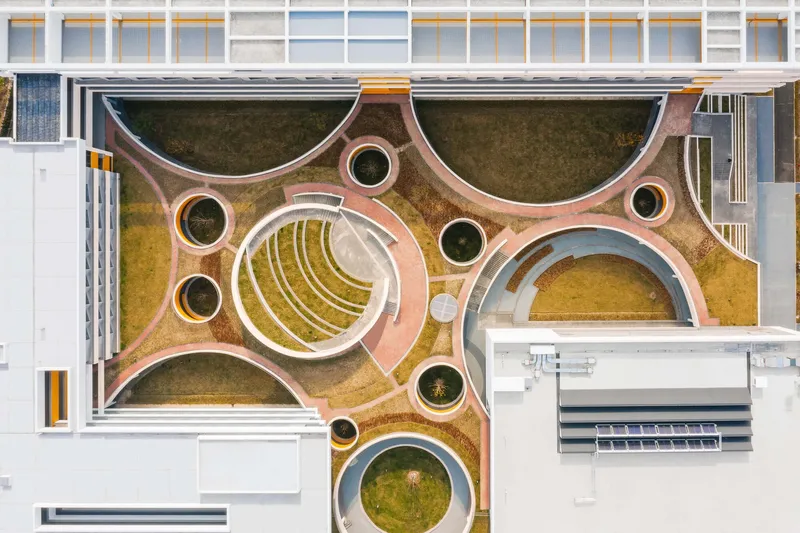

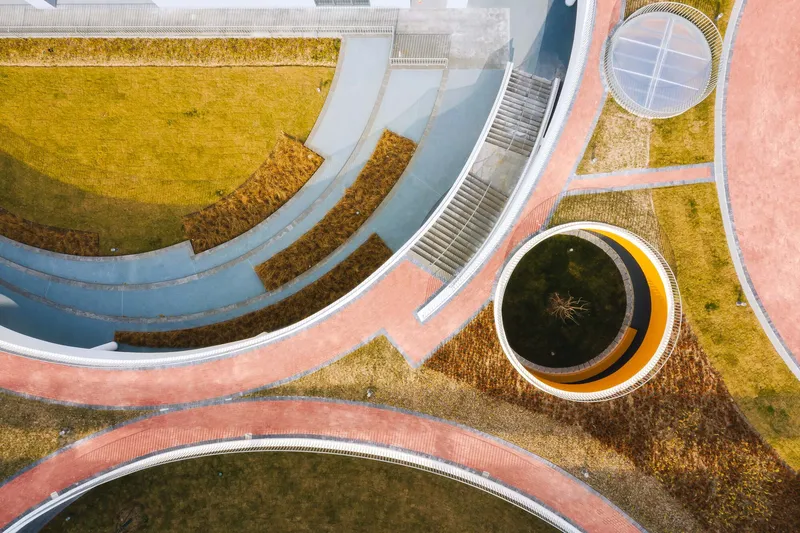
From above, the campus reads as a collection of circular garden rooms carved into a U-shaped building footprint. Teaching wings, the food transportation building, and offices wrap around a series of planted courtyards that vary in size and character. The largest courtyard sits at the heart of the plan, ringed by balconies and accessible from multiple levels. Smaller circular voids puncture the rooftop, bringing daylight into the floors below through orange-rimmed skylights.
The aerial views reveal the extent of the ambition. Pink and grey paving fans out in organic curves, and planting beds of varying sizes break up what could otherwise be monotonous hardscape. The geometry is deliberate but not rigid; it reads as a topographic landscape rather than a gridded schoolyard. For a four-story building with a basement level serving 40 classes, the density is considerable, yet the open courtyards prevent the massing from feeling oppressive.
Orange Canopies and the Color of Play


The most visually distinctive element is the consistent use of orange, deployed in curved canopy soffits, vertical railings, and skylight surrounds. Against the white concrete frame and muted planting palette, these orange accents register immediately. They signal entry points, shelter zones, and gathering spots. The color is warm without being saccharine, a rare feat in educational architecture where vibrancy often tips into condescension.
The curved orange canopies do real spatial work. They define thresholds between indoor and outdoor zones, provide rain cover for children moving between buildings, and create intimate sub-spaces within the larger courtyard. Yellow vertical railings along the planting beds reinforce the warm palette while providing safety barriers that avoid the industrial feeling of standard school fencing. The material strategy is restrained: white structure, timber ceilings, orange metal, greenery. Nothing else competes.
Ground-Level Experience


At ground level, the campus operates through a network of covered colonnades that connect the various program blocks. White columns support generous overhangs, and young trees grow through openings in the paving, establishing a rhythm of shade and light along every pathway. The colonnade is wide enough to be a social space in itself, not merely a circulation corridor.
The planted beds visible from within the colonnades are densely layered with ornamental grasses, shrubs, and small trees. This is not token landscaping. The planting provides seasonal variation, texture, and a buffer between movement zones and classroom windows. The curved paving paths through these garden rooms encourage wandering rather than marching, a subtle but meaningful distinction in a school for young children.
Interiors Built for Gathering

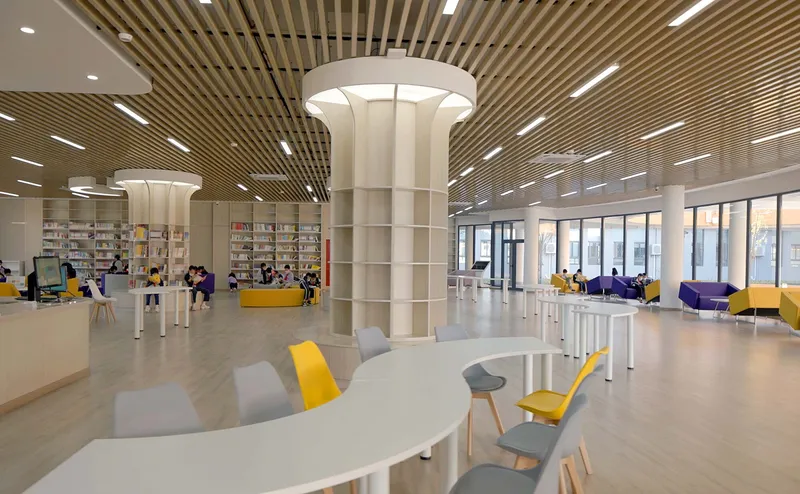
The interior common spaces share the outdoor logic of informal gathering. A library and a lounge area both feature slatted timber ceilings that soften the acoustics and add warmth to otherwise open-plan volumes. White structural columns march through both spaces, maintaining the campus's consistent structural language. Furniture is scattered rather than regimented: yellow, purple, and grey chairs cluster in small groups, suggesting conversation and individual study rather than rows of desks.
These are not classrooms. They are the spaces between classrooms, and the architects have lavished as much care on them as on the exterior courtyards. The decision to treat circulation and common areas as primary design opportunities is what elevates the project beyond a competent school plan into something more considered.
Movement and Thresholds


Staircases and level changes are deployed as design features rather than code necessities. Curved outdoor stairs with white metal railings become gathering points; children in the photographs cluster on landings and pause at turns. Wide steps descending from a covered entry create an amphitheater-like approach to the campus, transforming arrival into an event. On the rooftop, an orange circular skylight sits within a courtyard of planted beds and metal railings, turning what is typically dead mechanical space into a usable garden.
The campus absorbs its four-story height through these sectional moves. By pulling courtyards down through multiple levels and pushing gardens up onto roofs, the architects compress the apparent scale. A child on the second floor looks down into a planted courtyard; a child on the roof looks up at the sky through an orange ring. The building's height never dominates the experience.
Sports and the Perimeter
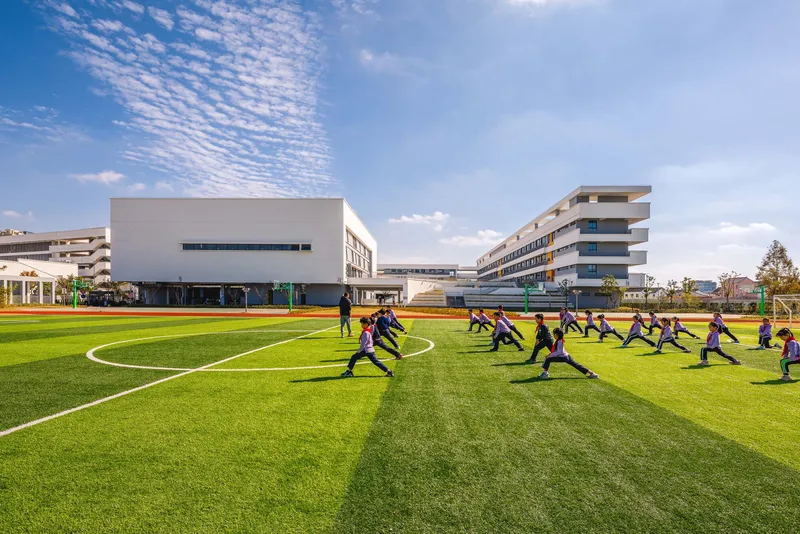
The sports field occupies the campus perimeter, pushed to the edge of the site along Yupan North Road and Peide Road. A football pitch and running track sit adjacent to the white teaching volume, with the residential towers of Pudong visible beyond. The decision to position athletics outside the central courtyard keeps the heart of the campus quiet and planted, reserving the more active and louder program for the boundary.
Plans and Drawings


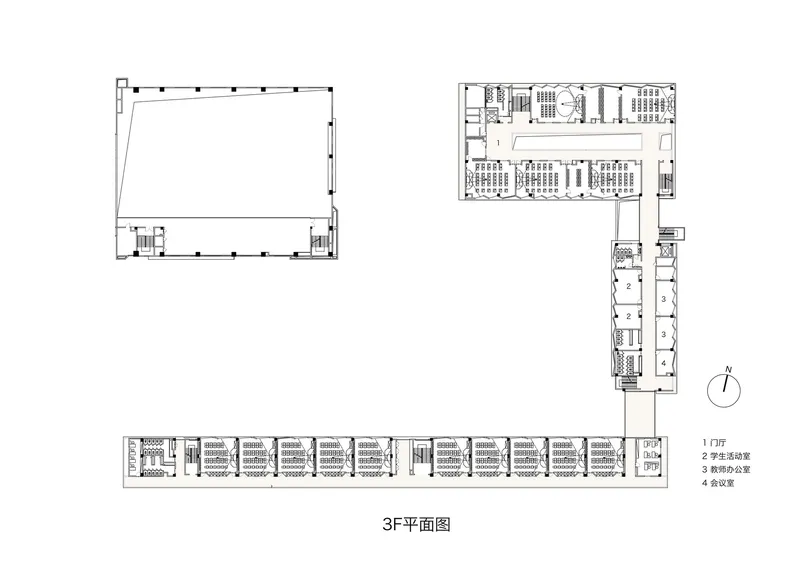
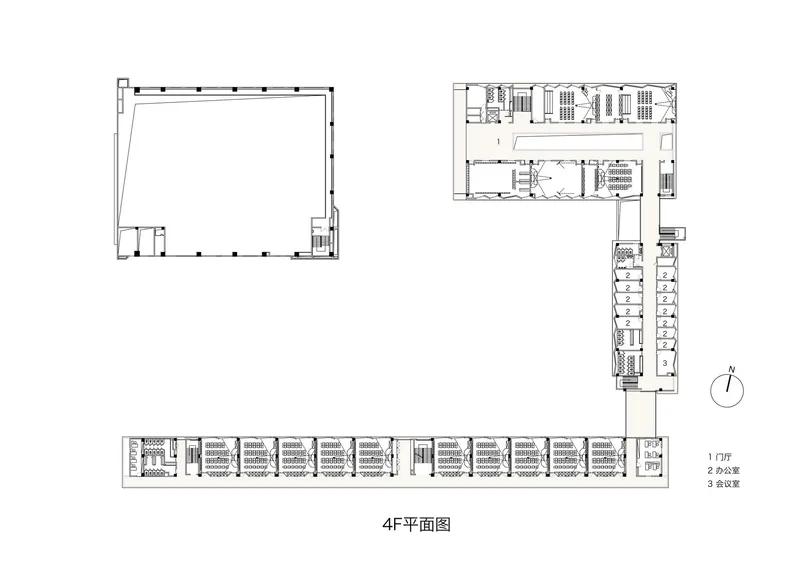


The site plan confirms the campus's relationship to a waterfront edge and the deliberate positioning of the sports field as a buffer between the school and the street. Floor plans across multiple levels show how the circular courtyard voids shift and spiral as they rise through the building, creating different spatial conditions on each floor. The section drawing is particularly revealing: a vaulted glass canopy spans the central courtyard, sheltering the primary gathering space while admitting daylight. This is the structural and experiential core of the project.
The transformation diagram is worth studying. It illustrates the design evolution from a conventional linear block arrangement into the final clustered configuration, with planted green spaces inserted between building volumes. The axonometric drawing highlights the massing strategy clearly: classroom bars frame courtyards, and planted terraces step between volumes, creating a topography of learning environments rather than a single monolithic building.
Why This Project Matters
China is building schools at an extraordinary pace, and the default model remains brutally efficient: maximize classroom count, minimize site coverage, add a track. The Peide Campus challenges that default without sacrificing density. Forty classes fit within 23,000 square meters, a substantial program, yet the campus feels generous and open. The circular courtyards, rooftop gardens, and sponge-city green building strategies point toward a school typology that treats environmental and psychological well-being as design requirements, not afterthoughts.
The project also makes a quiet argument about who educational architecture is actually for. The designers at Huajian Group approached this campus as parents, not just architects, and that empathy shows in the details: furniture scaled to small bodies, railings that frame views rather than block them, pathways that curve because children do not walk in straight lines. These are small decisions with outsized consequences. They determine whether a school is a place children endure or a place they inhabit. The Peide Campus is clearly the latter.
Shanghai Fushan Tangcheng Foreign Language Primary School (Peide Campus) by Huajian Group Shanghai Architectural Design & Research Institute. Located in Pudong New Area, Shanghai, China. 23,000 m². Completed in 2022. Photography by Song Lin, 3000images.
About the Studio
Share Your Own Work on uni.xyz
If projects like this are the kind of work you want to make, uni.xyz is a place to publish your own, find collaborators, and enter design competitions.


Popular Articles
Popular articles from the community


Manzana Morphosis: Stretching Barcelona's Grid into a Living Landscape for 2050
A radical reworking of the Eixample manzana turns density into a tool for generous public space, vertical ecology, and environmental performance.

Temporary Home for Dogs: A Reversed Zoo Rethinks Animal Shelter Architecture
In Bucharest, a sinuous corridor and freed landscape flip the logic of containment, designing a shelter that works to make itself unnecessary.

Extended Shell: Retrofitting Kolkata's Balconies as Living Urban Thresholds
A modular retrofit system recovers the social and environmental intelligence of Kolkata's historic verandas for contemporary Park Street residents.

Opera on the Sea: Driftwood Logic Shapes a Timber Opera House on Estonia's Coast
Trevor Orgill's opera house translates the entangled drift of floating timber into a civic building where wood, water, and music converge.

Similar Reads
You might also enjoy these articles

Pixel Gardens: One Repeated Module Stacked Into a Terraced Social Housing Tower for Famagusta
Salem Bader's shortlisted housing tower builds a vertical neighbourhood from one repeated module, offsetting units to carve terraces, light and air.

Bao Huynh Watercolor Atelier: A Serene Art Retreat in Hội An
Bao Huynh Watercolor Atelier in Hội An blends multifunctional art spaces, sustainable design, local materials, and family-friendly living in a serene environment.

Atelier Macri Concept Store Interior Design by CASE-REAL
Atelier Macri store features a "ko" counter, walnut wood details, cork displays, blending retail, gallery, and seamless customer experiences.

Manuel Vargas Izquierdo Stadium and High-Performance Sports Center: Architectural Excellence in Jalpa de Méndez
The Manuel Vargas Izquierdo Stadium blends sustainable design, inclusive sports facilities, and cultural-inspired architecture, revitalizing Jalpa de Méndez’s public spaces.


Comments (0)
Please login or sign up to add comments
No comments yet. Be the first to comment!