
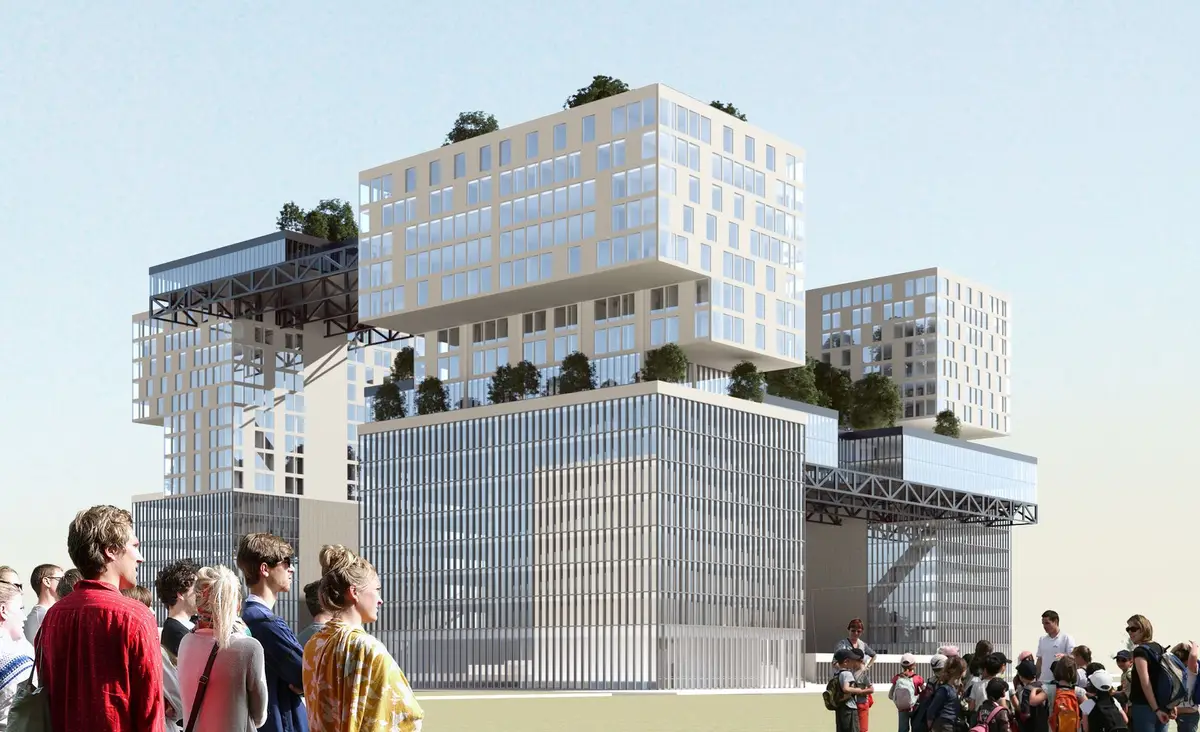
Hustle Hub Moscow: Skybridges and Shared Living in a Three-Tower Cohousing Complex
A vertically integrated cohousing and commercial ecosystem where elevated connectors turn circulation into social infrastructure.


Stack offices below, cohousing above, then lash the towers together with skybridges loaded with coworking zones and green terraces. That is the operating logic of Hustle Hub Moscow, a three-tower mixed-use complex that treats vertical density not as a constraint but as the engine for community life. The proposal collapses living, working, and socializing into a single self-supporting organism where each program subsidizes the next, and the connectors between towers become the most public rooms in the building.
Designed by Marcel Skrzywanek and published on uni.xyz, the project targets dense metropolitan conditions and proposes a modular prototype for cohousing at high-rise scale. Each tower dedicates its lower levels to commercial office functions and its upper levels to shared residential clusters, forming a dual program that addresses both economic viability and human-centric living within a single vertical section.
Glass Volumes Stacked Above a Working Base
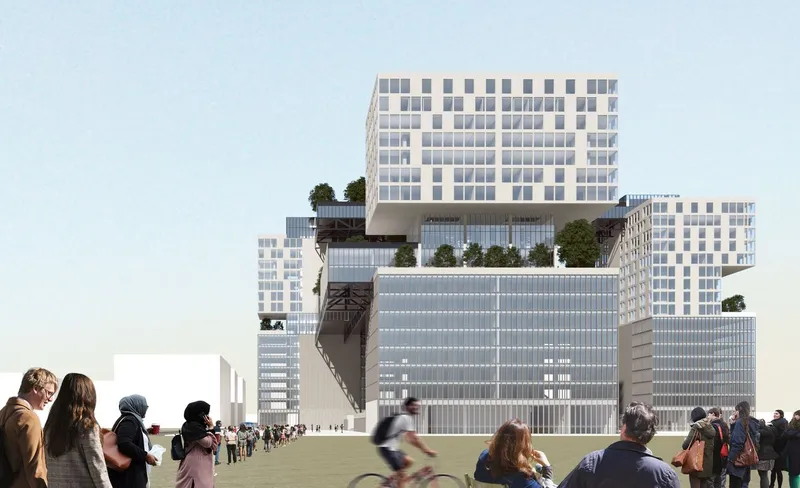
The rendering reveals the project's fundamental sectional strategy: robust office slabs at the base give way to modular residential volumes above, their cantilevered upper blocks pushing outward as if claiming space for the community that inhabits them. Glazed facades capture daylight across the full height of each tower while rooftop terraces dense with trees generate micro-ecosystems at altitude. The transparency of the glass is not decorative; it signals the cohousing floors, distinguishing them from the more solid commercial zones below and giving residents a visual connection to the city that the office workers at lower levels do not share.
This vertical separation is the project's most pragmatic move. By elevating residence above commerce, the design ensures that the revenue-generating office floors support the financial sustainability of the entire complex while the cohousing clusters enjoy quieter, higher elevations with better light and air. Flexible residential layouts accommodate young professionals and small families alike, and shared amenities woven between private units encourage the kind of daily interaction that monoculture residential towers rarely produce.
Skybridges as Loaded Social Infrastructure
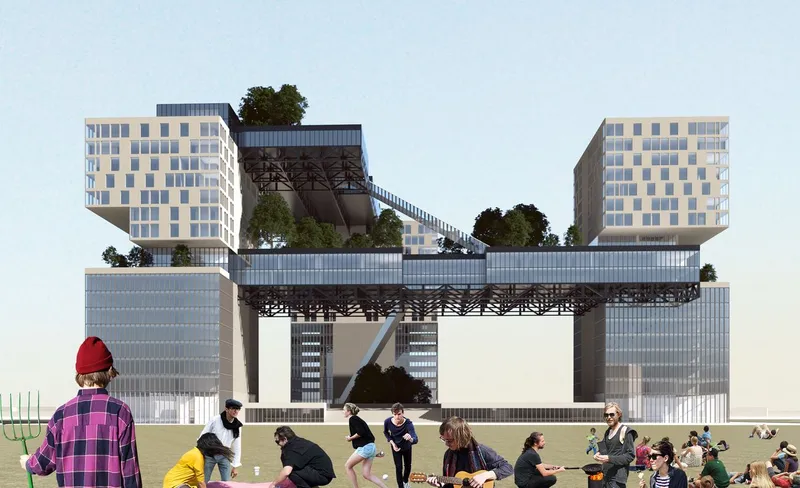
The most distinctive element of Hustle Hub Moscow is visible here: a massive elevated walkway spanning between two cantilevered towers, carried by exposed diagonal steel trusses that express the structural work honestly. The connector sits above a glass podium, and its underside becomes a sheltering canopy for the ground-level public realm. These skybridges are far more than corridors. They house coworking zones, shared lounges, breakout areas, service spaces, and elevated green terraces, turning horizontal circulation into programmed social space.
By packing active program into the connectors, Skrzywanek ensures that moving between towers is never passive. Residents and workers encounter each other in coworking zones or pause on planted terraces with panoramic views. The steel trusses read as both monumental and lightweight, a structural language that signals the connectors as events in the composition rather than afterthoughts. It is a strategy that recalls the ambition of megastructural thinking but operates at a more calibrated, inhabitable scale.
A Curved Plaza Activates the Ground
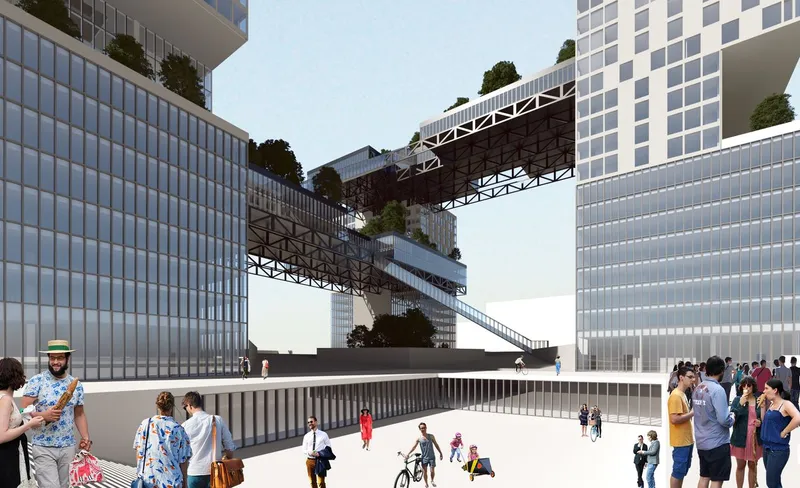
The project does not abandon the street. A curved public plaza at the base of the complex gathers pedestrian bridges, glass facades, and planted roof terraces into a single frame, demonstrating how the towers meet the city. Wide walkways, bike lanes, and open gathering spaces create a vibrant urban floor where movement flows between interior and exterior. The intersecting bridges overhead provide shade and spatial definition without enclosing the plaza, maintaining a sense of openness even within a dense three-tower footprint.
People circulate across multiple levels here: at grade, along the bridges, and on the terraces above. The result is a three-dimensional public landscape that blurs the line between building and city. It is this layered ground condition, more than the towers themselves, that makes the proposal feel urban rather than merely tall. Green roofs visible at the upper edges contribute to improved air quality and biophilic experience, extending the sustainability argument from the building section down to the everyday life of the plaza.
Why This Project Matters
Hustle Hub Moscow tackles a question that most mixed-use towers sidestep: how can shared living and commercial productivity occupy the same structure without one cannibalizing the other? The answer here is sectional separation combined with social connection. Office floors fund the complex; cohousing floors build community; and the skybridges ensure that the two populations mix on terms defined by architecture rather than accident. The dual program forms a self-supporting loop that could, in principle, be replicated at different scales and in different cities.
What gives the project its edge is the insistence that infrastructure does social work. Corridors become coworking rooms, rooftops become micro-ecosystems, and the plaza beneath the bridges becomes an extension of the public city. Marcel Skrzywanek's proposal is a forward-looking prototype that treats density, shared resources, and communal resilience as design materials rather than constraints, offering a credible template for the next generation of urban cohousing.
View the Full Project
About the Designers
Designer: Marcel Skrzywanek
Enter a Design Competition on uni.xyz
uni.xyz runs architecture and design competitions year-round that reward proposals with spatial conviction and real site intelligence.
Project credits: Hustle Hub Moscow by Marcel Skrzywanek.


Popular Articles
Popular articles from the community


Hill & Cross Opera: Sculptural Opera House Architecture Shaped by Tallinn’s Landscape and Identity
Hill & Cross Opera reimagines opera house architecture in Tallinn through its sculptural hill, civic plaza, glass wave and a luminous cross.

Conexión: Biophilic Design Reimagines High-Rise Living in Hong Kong
Conexión reimagines high-rise living in Hong Kong through biophilic design, green facades, shared spaces, daylight, water and nature within.

Play: Fragments of Their World
Familiar architecture becomes modular playground design, creating safe spaces where displaced children can learn, connect, imagine and play.

Co-life: Sustainable Architecture for Age-Friendly Community Living
Co-life reimagines sustainable architecture for seniors through courtyards, rammed earth, shared gardens, and spaces designed for belonging.

Similar Reads
You might also enjoy these articles

ALGAL REALM: A Bio-Integrated Lunar Habitat Design for Life Beyond Earth
ALGAL REALM reimagines lunar habitat design with algae-powered life support, 3D-printed regolith, and vertical living for a lunar future.

Cinema Futurismo: Futuristic Architecture Reimagining the Future of Cinema
Cinema Futurismo merges futuristic architecture, holographic projection, intimate seating, and landscape into a new social cinema.

Little Red Riding Hood: Architectural Design as a Journey Through Fear, Light, and Storytelling
Little Red Riding Hood reimagines the fairy tale through architectural design shaped by fear, light, scale, memory, uncertainty, and choice.
Playducation: Modular Architecture That Turns Play Into a Space for Learning
Playducation transforms modular architecture into a flexible world of play, learning, and healing for children in refugee settlements.


Comments (0)
Please login or sign up to add comments
No comments yet. Be the first to comment!