

Hybrid Tower: A Vertical Ecosystem for Flying Cars, Biophilic Living, and 2050 Urbanism
A honeycomb-skinned skyscraper weaves residential duplexes, drone docking hubs, and spiraling green terraces into a single smart-city prototype.


What happens when architects stop designing for the commute and start designing for its extinction? The Hybrid Tower takes a provocation seriously: by 2050, artificial intelligence and automation will have gutted the conventional workplace, and ground-level transit may share lanes with autonomous flying pods. Rather than treating these shifts as distant speculation, the tower folds them into its structural logic, embedding docking stations for compact aerial vehicles, vertically interleaving offices with residences, and wrapping the whole thing in a breathable honeycomb exoskeleton that performs as climate buffer and sculptural identity at once.
Designed by Rabah Saoud, Jumana Al, and Ghiwa El Housseini, the project received an Institutional Excellence Award in the Hybrid Futures '19 - Work x Fly competition. The brief asked entrants to reimagine the relationship between work and mobility in future cities. The team responded with a full vertical ecosystem: a tower whose programmatic mix, facade geometry, and circulation strategy all derive from a single thesis about post-commute urban life.
A Lattice That Breathes and Shades
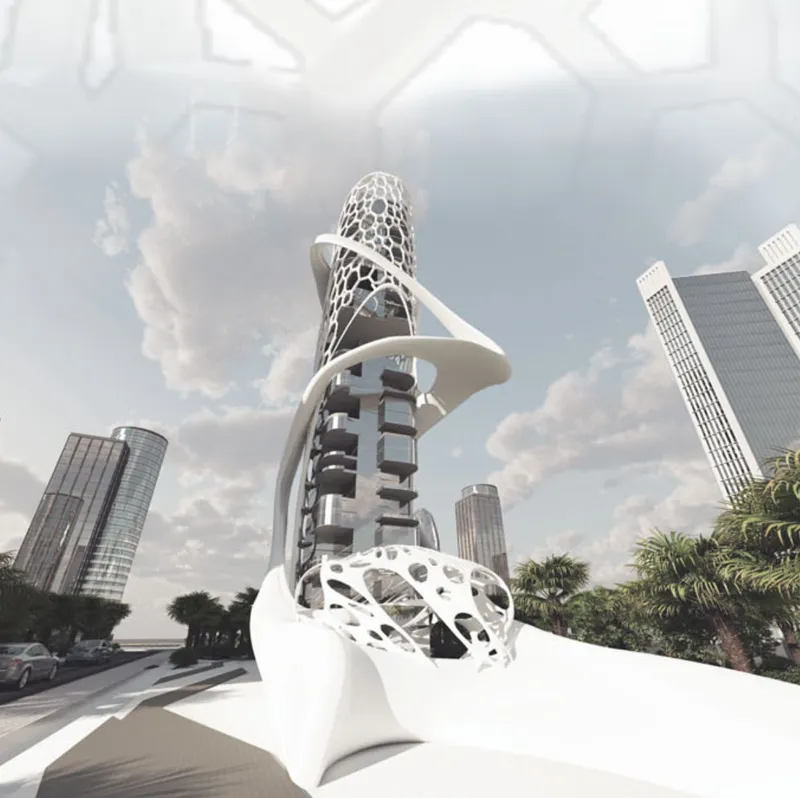
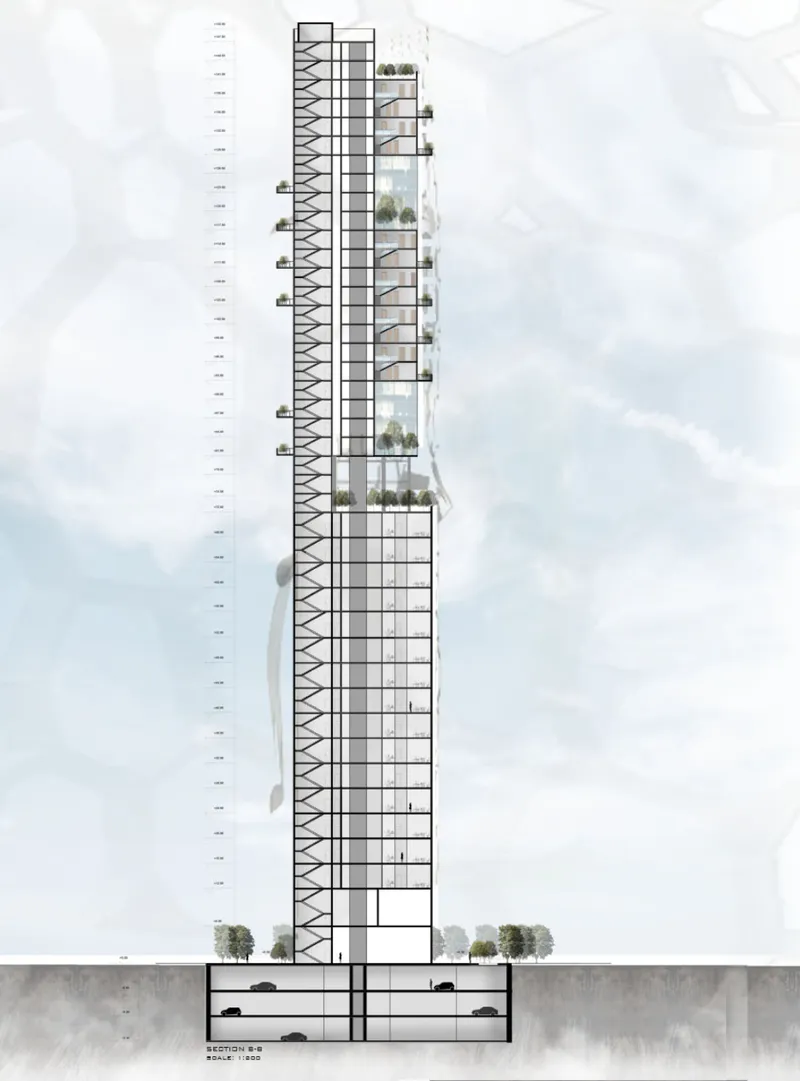
From street level the tower reads as a cellular lattice, its facade modeled on the hexagonal geometry of a honeycomb. The choice is not merely decorative. The porous envelope acts as a breathable exoskeleton, improving natural airflow, reducing solar heat gain, and providing shading without sacrificing daylight or outward views. A sculptural white ribbon spirals around the structure, carrying planted terraces upward in a helical path. The section drawing reveals how these platforms interrupt the tower's height at regular intervals, injecting green space and outdoor circulation into what would otherwise be a sealed glass column.
At the base, the form extends organically into the surrounding landscape, a deliberate gesture the designers describe as mimicking tree roots that ground the building in its environment. Palm trees and neighboring high-rises provide a scale reference: the tower is tall, but its latticed transparency and spiraling terraces keep it from reading as monolithic. The continuous ribbon, meanwhile, symbolizes the flow of life and movement, a motif that carries through to the internal programming.
Twin Towers, Shared Podium, Stacked Programs
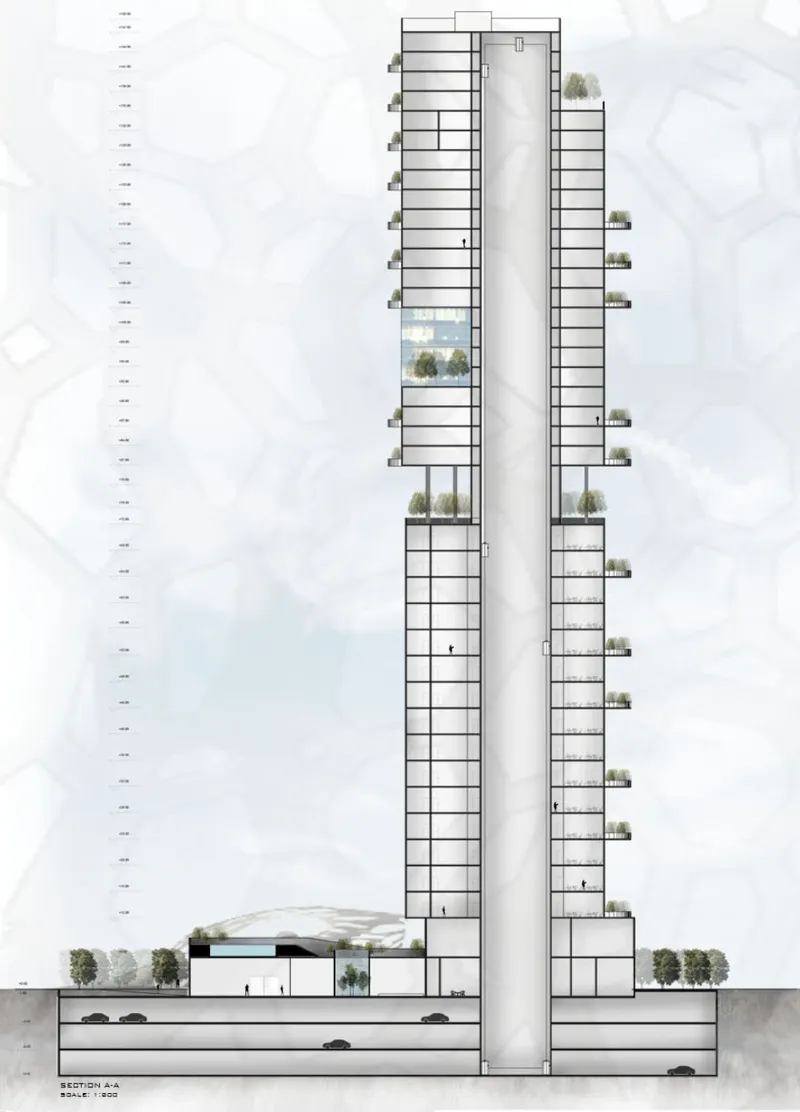
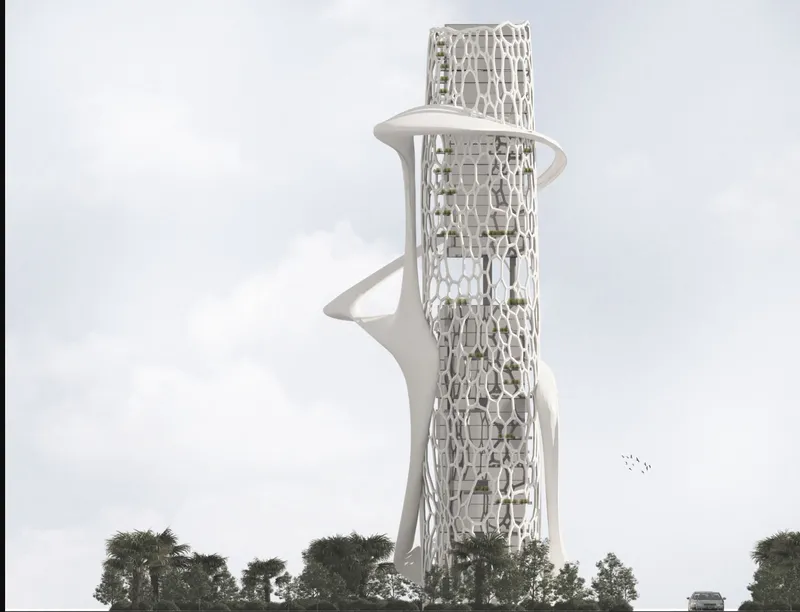
A second section drawing reveals the project's broader urban strategy: twin towers rise from a shared low podium, connected at grade by public program. Planted terraces appear on multiple podium levels, extending the biophilic agenda down to the pedestrian realm. The decision to mix residential duplexes with interspersed office floors vertically eliminates the conventional commute. Residents work within the same structure they inhabit, while wellness zones, collaborative workspaces, green courtyards, and tech-integrated lounges are distributed throughout to encourage interaction.
Specialized hubs and docking stations for flying car capsules, inspired by projects like Dubai's SkyPods, are embedded within the structure. These are not pitched as replacements for mainstream transit but as a high-efficiency supplementary layer handling daily commutes, logistics, and urgent medical transport. The overcast-sky render emphasizes the tower's silhouette: the curved white platforms wrap the cellular lattice like orbital rings, reinforcing the sense that this is infrastructure as much as architecture.
Duplex Units with Corner Terraces and Modular Flexibility
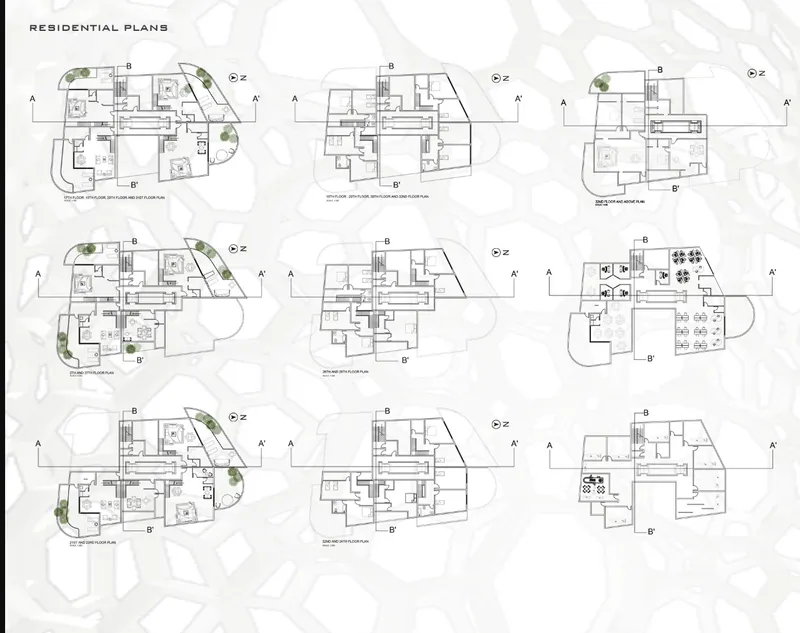
The residential floor plan sheet presents nine unit variations, all duplexes, organized around central cores with corner terraces that open toward the tower's perimeter. Every apartment gets direct access to an outdoor green space, a commitment to biophilic design that the team positions as essential for mitigating the psychological disconnect of high-rise living. The variety in layout accommodates different household sizes and lifestyles, while the modular nature of the internal units allows future retrofitting, adaptation, and scaling, traits the designers consider non-negotiable for resilience in evolving cities.
The terraces do double duty: they encourage physical movement and social engagement while contributing to the tower's overall thermal performance by shading lower floors. Paired with the breathable exoskeleton, this layered environmental strategy reduces dependence on mechanical cooling, a meaningful gain at the scale of a skyscraper.
Why This Project Matters
Speculative skyscraper proposals are easy to dismiss as image exercises, but the Hybrid Tower earns attention through the specificity of its systems thinking. Flying pod docking is not grafted on as a gimmick; it shapes the section. Biophilic terraces are not decorative afterthoughts; they generate the spiraling formal language. And the decision to interleave residential and office floors vertically is a direct, testable response to the hypothesis that automation will dissolve the traditional commute. Each design move traces back to a stated urban condition.
For Saoud, Al, and El Housseini, the real ambition is to redefine what a high-rise can be when it stops treating height as an end in itself and starts treating it as a medium for integrating ecology, mobility, and daily life into a single resilient framework. Whether or not flying pods arrive by 2050, the underlying logic of adaptability, modular construction, and programmatic diversity makes this tower relevant today. It is a prototype for the kind of thinking smart cities will demand.
View the Full Project
About the Designers
Designers: Rabah Saoud, Jumana Al, Ghiwa El Housseini
Enter a Design Competition on uni.xyz
uni.xyz runs architecture and design competitions year-round that reward proposals with spatial conviction and real site intelligence.
Project credits: Hybrid Tower by Rabah Saoud, Jumana Al, Ghiwa El Housseini Hybrid Futures '19 - Work x Fly (uni.xyz).


Popular Articles
Popular articles from the community


Opera on the Sea: Driftwood Logic Shapes a Timber Opera House on Estonia's Coast
Trevor Orgill's opera house translates the entangled drift of floating timber into a civic building where wood, water, and music converge.

The Amber Palace Opera: A Geological Fiction Surfaces on Tallinn's Baltic Waterfront
Pierre Brillard reimagines a Baltic legend as a public landscape, opera house, and waterfront promenade rooted in Tallinn's coastal identity.

Temporary Home for Dogs: A Reversed Zoo Rethinks Animal Shelter Architecture
In Bucharest, a sinuous corridor and freed landscape flip the logic of containment, designing a shelter that works to make itself unnecessary.

Faces of the Soviet Avant-Garde: Turning Moscow's Street Names into an Open-Air Museum
A network of sculptural installations across a Moscow residential district transforms forgotten architect names into spatial encounters with cultural memor

Similar Reads
You might also enjoy these articles

Day and Night Park: A Time-Based Urban Newsstand in Beijing
A temporary urban newsstand in Beijing blending travel, light, and reading through poetic colors, compact form, and community-focused design.

Modernist Patio Renovation in El Masnou, Barcelona by Oliver Segura Arquitectura + Cebrià Arquitectura
Modernist patio renovation blending tradition and innovation with a movable pool, leveled floors, and Catalan materials in El Masnou.

Alto Residencial Coop: Cooperative Housing Development in Santiago de Compostela by Carbajo Barrios Arquitectos
A linear cooperative housing complex blending white volumes and perforated metal façades, enhancing community living, natural light, privacy, and urban integration.

Vil Genis School by BPA ARCHITECTURE – Massy, France
Vil Genis School in Massy, France, features sustainable design, south-facing classrooms, community integration, accessible spaces, and modern educational architecture.

Comments (0)
Please login or sign up to add comments
No comments yet. Be the first to comment!