
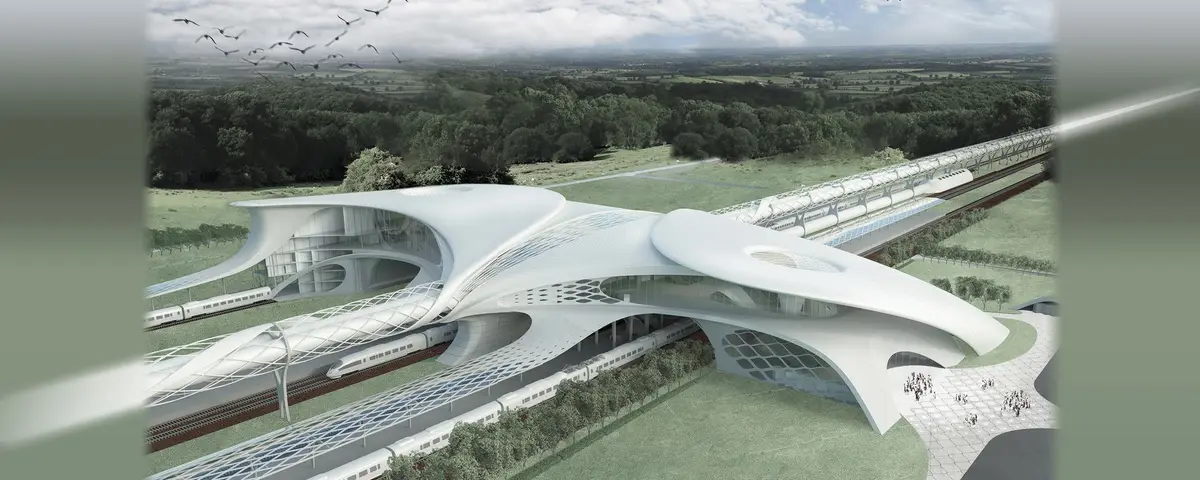
Hyper Transport Hub: A Station Where Hyperloop, High-Speed Rail and Highway Share One Roof
A shortlisted UnIATA '19 entry that threads vacuum tubes, high-speed rail and highway into one hub beneath a sculpted, lattice-screened white roof.


Most transport hubs are built around a single mode and retrofitted for the rest. The Hyper Transport Hub starts from the opposite premise: that the station of the near future must be a switching point between speeds. Long-distance high-speed rail, international highways and Hyperloop vacuum trains converge here, and the architecture is tasked with making the transfer between them feel like one continuous movement rather than three separate journeys.
Designed by Serg Arch and shortlisted at UnIATA '19, the project positions the hub as a node on major intercity corridors, with the designer's passenger flow charts tracing routes between Moscow and Beijing and between Moscow and Berlin. The ambition is continental in scale, yet the most persuasive moments in the proposal happen at the scale of a single traveler crossing a concourse.
A Vacuum Tube That Shadows the Highway


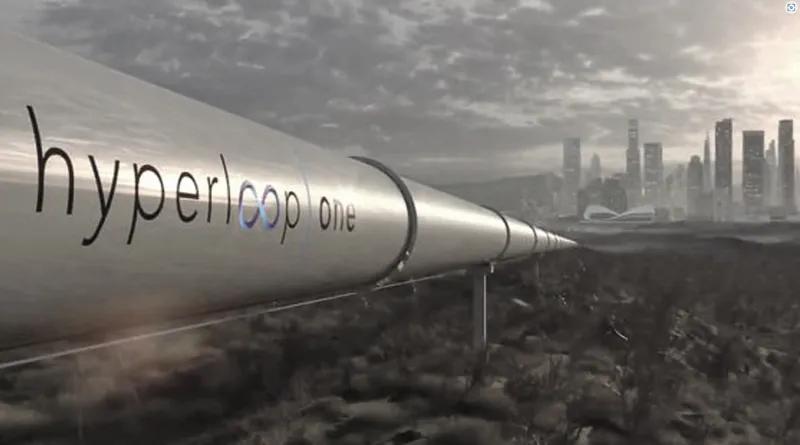
The opening images establish the infrastructure before the building. A transparent Hyperloop tube rides on tapering concrete piers directly beside a highway, so motorhomes and pickups pass beneath a line that moves at a radically different speed. Placing the tube alongside existing road corridors is a pragmatic move: it borrows an established right of way instead of carving a new one across the landscape.
Where the tube meets the station, the pod with its turbine-like nose slides into a curved tunnel mouth under a lattice roof, and pedestrians walk right beside it. That proximity matters. The vehicle is treated as something to be seen and approached, not hidden behind barriers, which gives a fairly abstract technology a tangible arrival moment. The silver tube heading toward a distant skyline reinforces the reading of the hub as a threshold between city and corridor.
Funnel Columns That Gather Light Into the Concourse

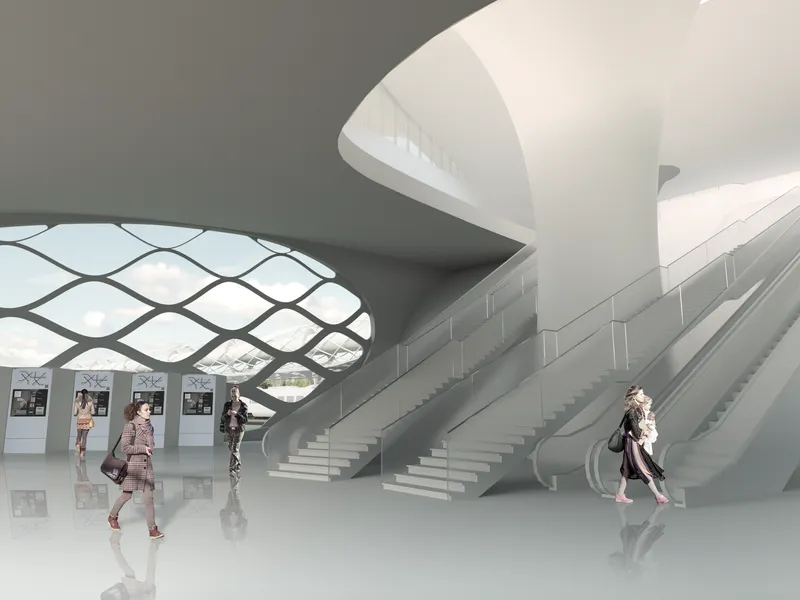
Inside, the structure becomes the wayfinding. A white funnel-shaped column rises to meet a skylight, ringed by circular ceiling lights, and it acts as a fixed reference point in a space defined by constant motion. Travelers with backpacks cross a glossy floor that doubles the light, and the column reads less as support than as an orientation device.
The ticketing hall extends the same language. A sculpted column anchors the room while broad staircases and escalators carry people between levels, and an oval lattice window frames the ticket kiosks below. The designer describes these lounges, ticketing areas and interconnected terminals as a user-centric layout, and the images support that claim: vertical circulation is generous and visible, so the route to the next mode is legible from where a passenger stands.
Branching Supports Along the High-Speed Platform
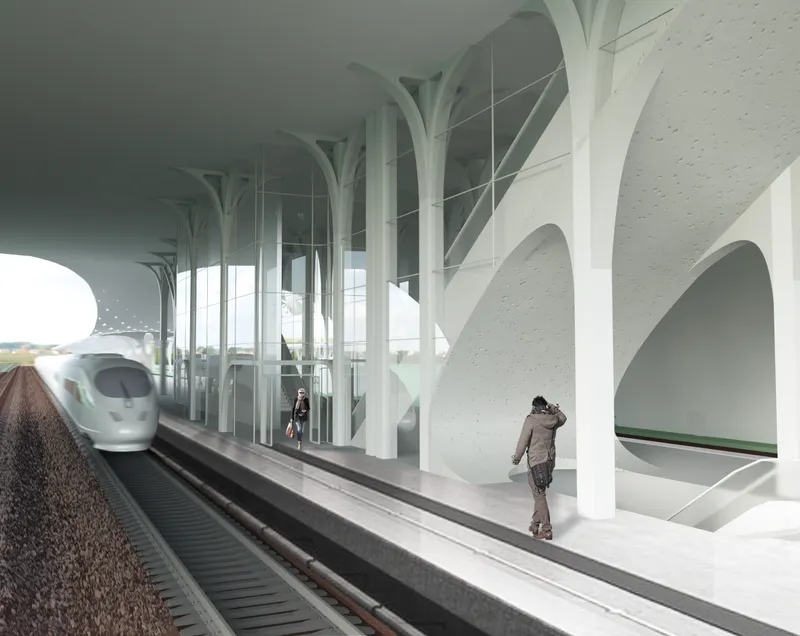

At platform level, the funnel motif splits into branching white columns set against glass, forming a colonnade that a high-speed train glides along. The lone traveler in the rendering gives the space its scale; the branches lift the roof well clear of the tracks and keep the edge of the platform open to daylight.
The section drawing is the key to the whole scheme. Curving canopy roofs sweep over an elevated concourse, escalators drop to the train platforms below, and level markings along the edge reveal a stacked organisation. Modes are separated vertically rather than spread horizontally, which shortens transfer distances and lets the concourse serve as a shared lobby for every line passing through.
One Sculpted Roof Spanning Parallel Tracks
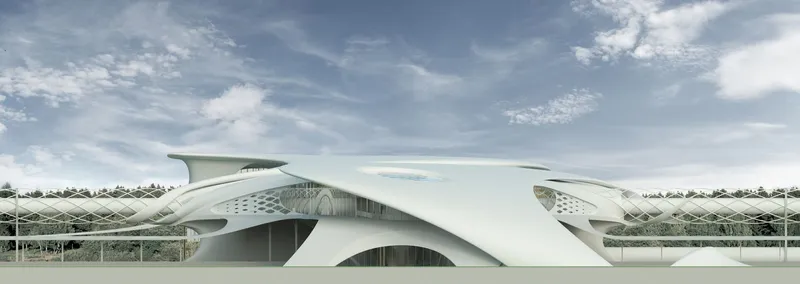

From outside, the elevation presents a white sculpted roof punctured by lattice-screened openings, set low against trees and sky. The organic curves soften what is essentially a large-span shed, and the lattice filters light into the halls seen earlier. The designer frames this as environmental harmony, pairing the form with sustainable materials and energy-efficient technologies, though the proposal leaves those systems at the level of intent.
The masterplan makes the organising logic explicit. The curved roof spans parallel railway tracks, aligning the building with the transport lines it serves, while parking lots and a circular drop-off sit to the east to receive road traffic. Rail runs through the building, cars arrive at its flank, and the roof stitches both into a single address.
Why This Project Matters
Hyperloop proposals often fixate on the vehicle and the tube, leaving the station as an afterthought. Serg Arch's entry argues that the real design problem is the interchange: how a passenger moves from car to train to vacuum pod without the experience fragmenting. By stacking modes in section and using a consistent structural language of funnels and branches, the hub gives that interchange a coherent spatial identity.
The project would gain from sharper evidence behind its sustainability claims and a clearer reading of how the Moscow-Beijing and Moscow-Berlin flows shape the plan. Still, as a shortlisted UnIATA '19 entry, it offers a convincing sketch of what multimodal architecture could become: a single roof under which very different speeds are made to meet calmly.
View the Full Project
About the Designers
Designer: Serg Arch
Enter a Design Competition on uni.xyz
uni.xyz runs architecture and design competitions year-round that reward proposals with spatial conviction and real site intelligence.
Project credits: Hyper Transport Hub by Serg Arch UnIATA '19 (uni.xyz).


Popular Articles
Popular articles from the community

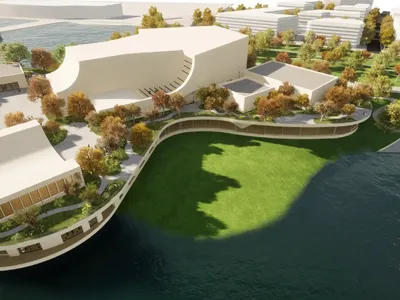
The Amber Palace Opera: A Geological Fiction Surfaces on Tallinn's Baltic Waterfront
Pierre Brillard reimagines a Baltic legend as a public landscape, opera house, and waterfront promenade rooted in Tallinn's coastal identity.


Cube Design Draws an Ecological Corridor Between Two Shenzhen Hills with the Nankai Building
Beside Shenzhen's container docks, the Nankai Building pairs stacked balconies with a climbing green screen to connect two hillsides across its height.

FCC Arquitectura Expands a Portuguese Granite House with a Board-Marked Concrete Wing
In Portugal, JV House pairs a cleaned-up whitewashed and granite dwelling with a timber-shuttered concrete extension, courtyards and a garden pool.
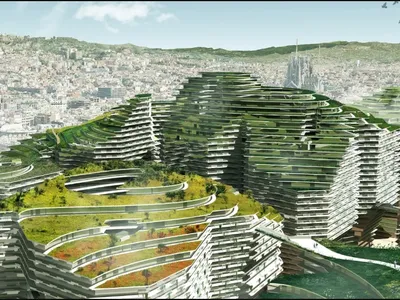
Manzana Morphosis: Stretching Barcelona's Grid into a Living Landscape for 2050
A radical reworking of the Eixample manzana turns density into a tool for generous public space, vertical ecology, and environmental performance.

Similar Reads
You might also enjoy these articles
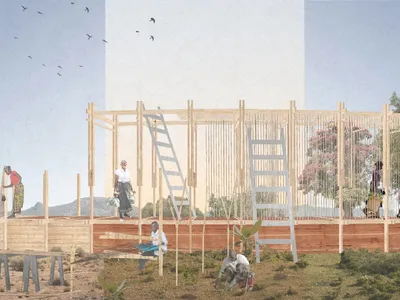
Healing Façade: A Modular Chapel System That Restores Ethiopia's Sacred Forests
Winner of the Eco-Chapel competition, this circular timber façade collects water from air to rebuild soil and reforest degraded Ethiopian landscapes.
Kaffeebühnen: Where Coffee Shop Architecture Becomes a Civic Stage in Vienna
A linear sequence of timber boxes, transparent shells, and open yards turns the Viennese café tradition into a public performance space.
Eco Chapel: A Modular Forest Pavilion That Grows Like the Landscape It Protects
Hexagonal timber modules weave through existing trees, turning a chapel into a living system for prayer, education, and reforestation.


Urban Forest: A Vertical Ecosystem for 5,000 Workers in Singapore's Changi Business Park
Radially stacked pods and layered green decks turn a 7-acre plot into 47 acres of ecological workspace projected for 2040.

Explore Hyperloop Competitions
Discover active competitions in this discipline

Challenge to design locus for the upliftment of human rights

Design challenge to reuse E-waste
Comments (0)
Please login or sign up to add comments
No comments yet. Be the first to comment!