
i2a Architects Studio Builds a Bold Red Dream House Around Trees in Kerala
MRIYA, meaning 'Dream' in Sanskrit, is a 3,525 sq ft residence in Kerala where red steel, exposed concrete, and living trees share every room.


Most houses in Kerala speak a language of restraint: white walls, sloped roofs, tropical gardens kept politely outside. MRIYA, designed by i2a Architects Studio under the direction of Ar. Manuraj C R and Ar. Arjun K J, speaks a different dialect entirely. At 3,525 square feet, the house is not exceptionally large, but its chromatic boldness and spatial ambition make it feel like a manifesto. The dominant move is unmistakable: a saturated red steel framework lifted on pilotis above a lush garden courtyard, declaring from the street that something unusual is happening within.
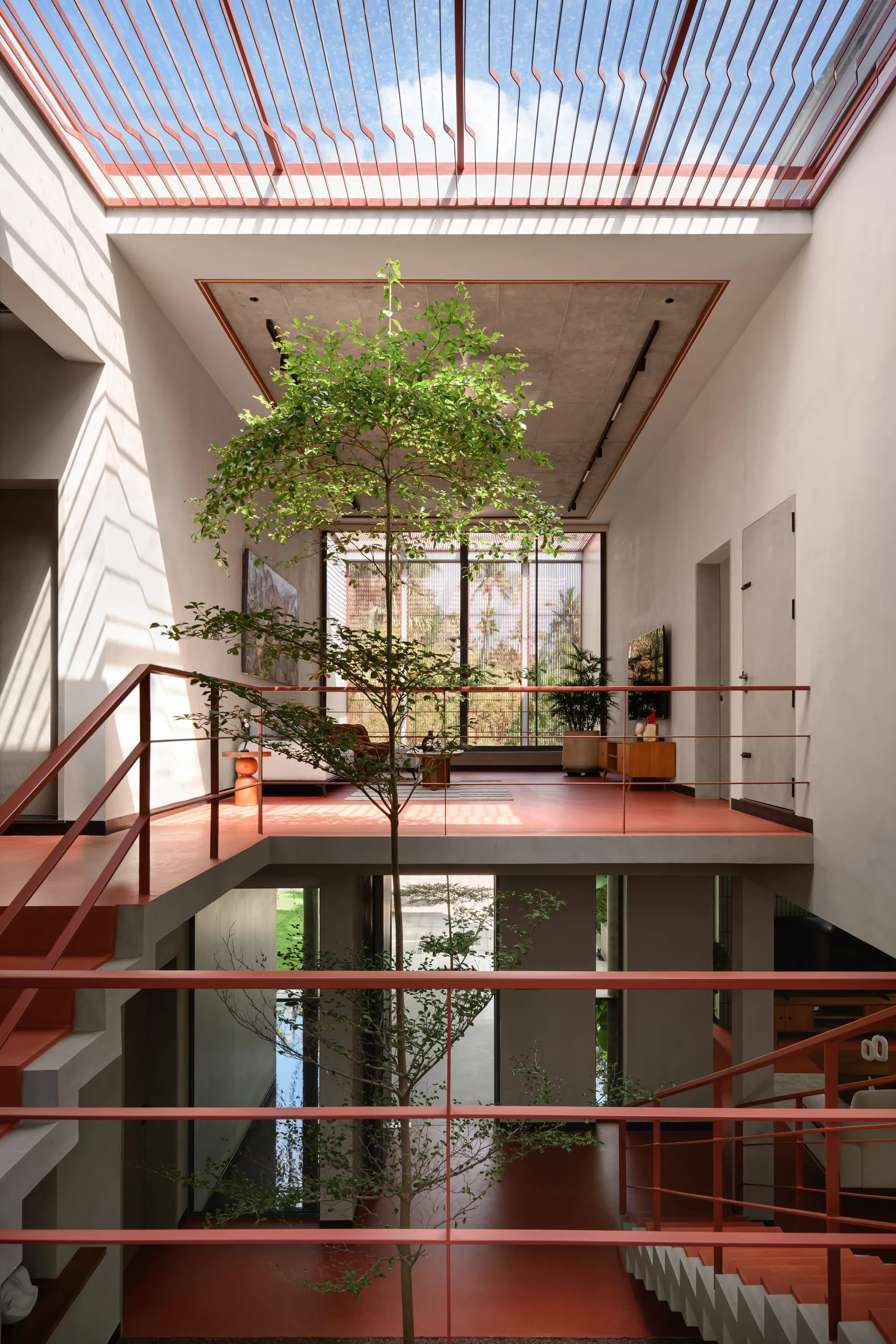
What makes MRIYA genuinely interesting, beyond its color, is the way the house treats trees as structural co-inhabitants rather than decorative afterthoughts. A living tree rises through multiple floor levels, puncturing terrazzo and concrete, climbing past staircases, and terminating beneath a slatted skylight that crowns the central atrium. The architecture literally wraps itself around the trunk. The result is a house where the boundary between interior and garden dissolves floor by floor, and where the decision to paint steelwork red feels less like a style choice and more like an honest confession: this house was always meant to be seen.
Red Framework Above the Garden
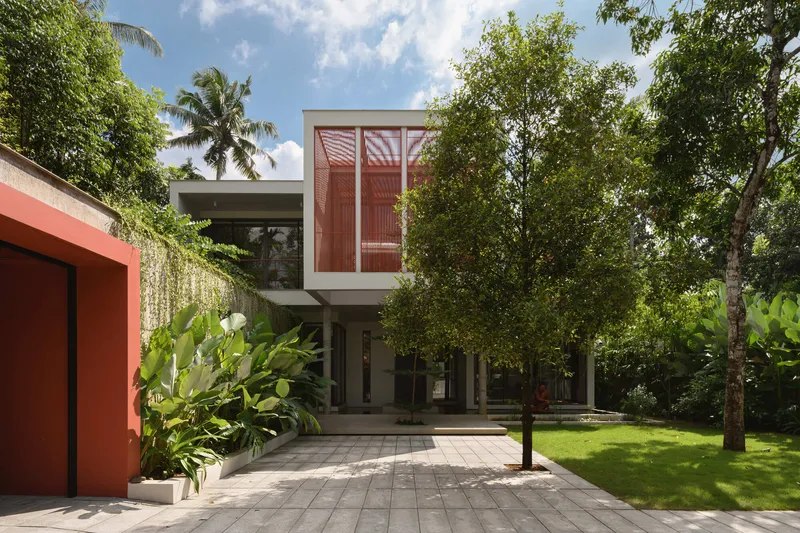
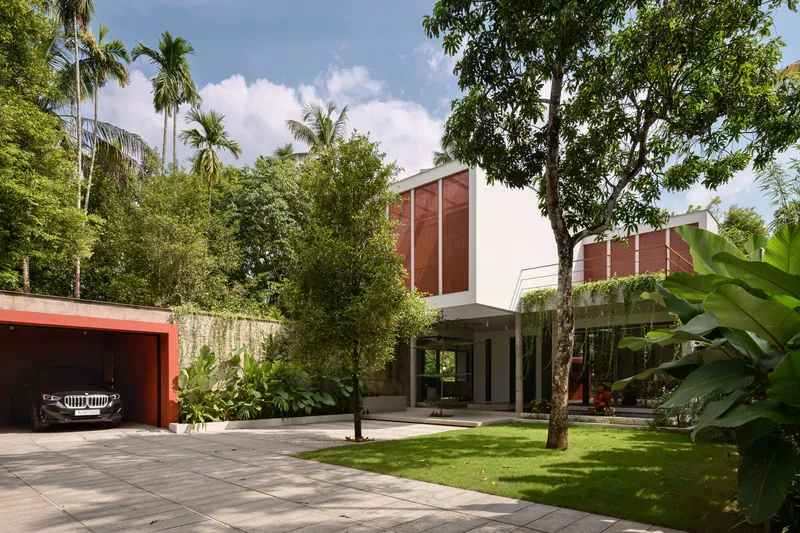
From the street, MRIYA reads as two distinct registers. The ground level is open and porous: pilotis, a recessed garage framed in coral paint, and generous setbacks allow the garden to flow under and around the building mass. Above, red screened volumes cantilever outward, their perforated metal skins filtering Kerala's intense sunlight while broadcasting the house's identity to the neighborhood. The timber louvre panels that clad portions of the upper storeys soften the industrial edge of the steel, adding warmth without retreating from the house's confrontational palette.
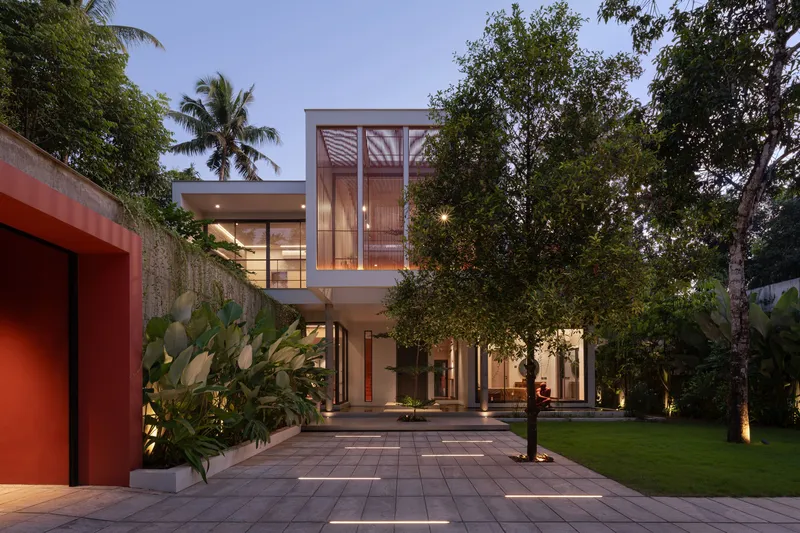
At dusk, the strategy pays off dramatically. Uplighting washes the concrete walls, the timber screens glow amber, and the illuminated interiors turn the facade into a lantern set among mature palms and deciduous trees. The trapezoidal lot, visible in the site plan, forces the building to negotiate irregular boundaries, and the architects use the resulting angles to create pockets of garden that wrap the house on nearly every side.
The Central Atrium and Its Living Tree
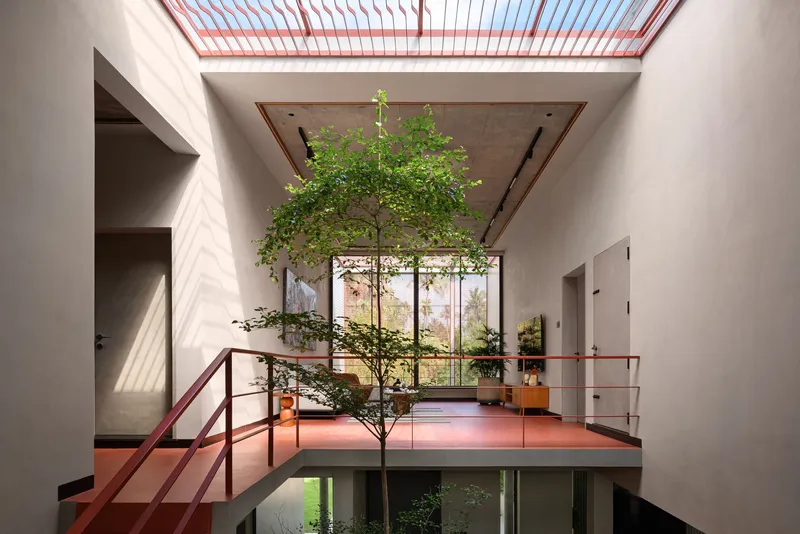
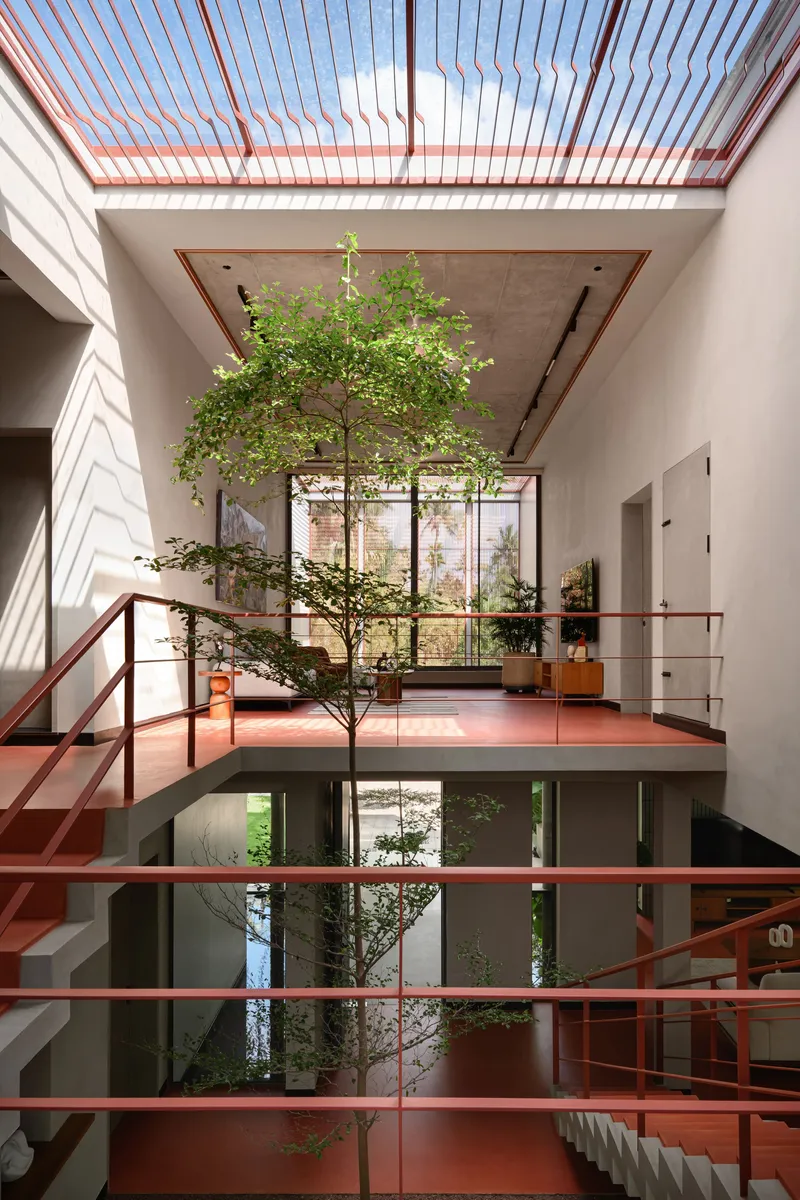
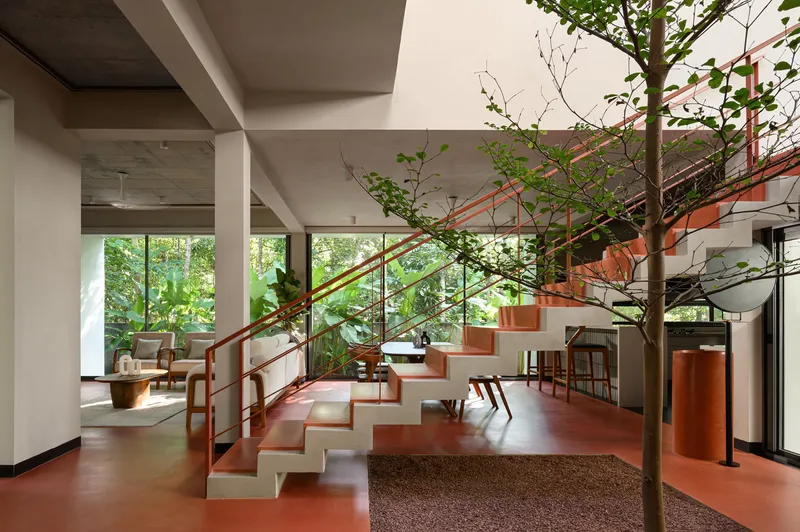
The heart of the house is its double-height atrium, where a tree grows through a red platform in the floor and reaches toward a striped skylight overhead. This is not a modest houseplant in a decorative planter; it is a full-scale trunk that the staircase wraps around, that the concrete beams acknowledge, and that the skylight was evidently designed to feed. The slatted roof opening casts rhythmic shadows across the atrium walls as the sun moves, turning the space into a sundial of sorts.
The staircase itself deserves attention. Red metal railings, coral-painted treads on cantilevered concrete stringers, and a terrazzo floor well at the base create a composition that reads almost like an industrial sculpture. Ascending through this space, you pass the tree at close range, your hand on the red tubular railing, natural light pouring down from above. The architects clearly understood that vertical circulation in a house this compact needed to be an event, not a corridor.
Living Spaces Tuned to the Courtyard
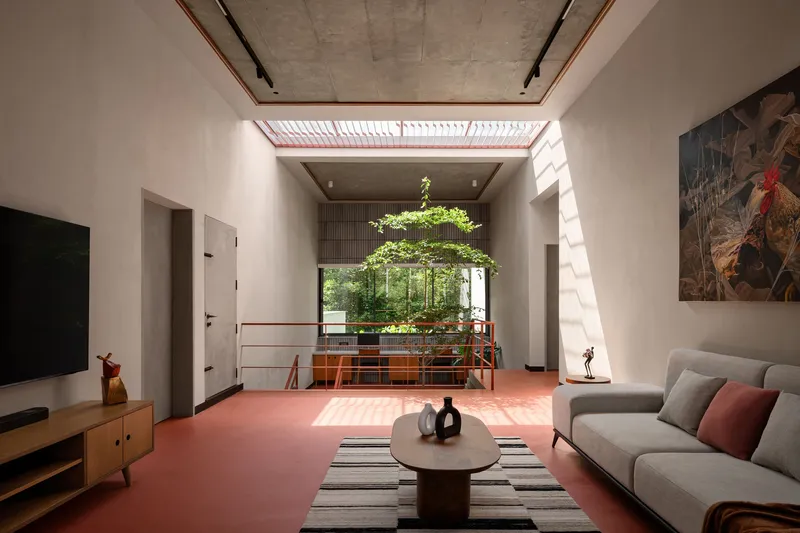
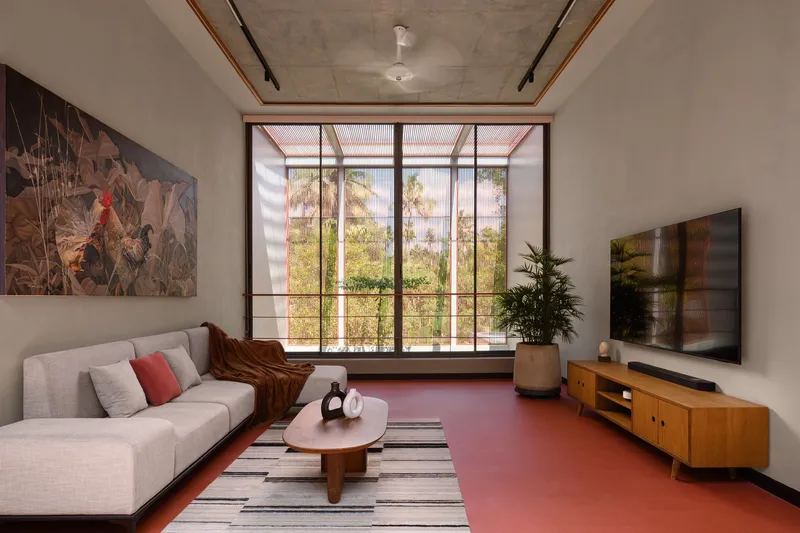
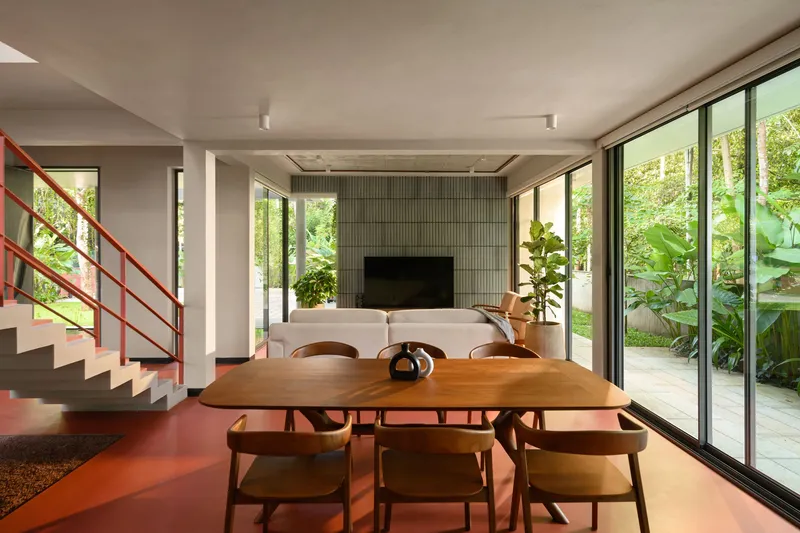
The living and dining areas on the ground floor are organized around the central courtyard with a directness that Kerala's climate rewards. Floor-to-ceiling glazing faces the planted garden, and the orange resin floor in the living room creates a continuous warm surface that pulls the eye toward the courtyard tree beyond. The open-plan dining area, furnished simply with a timber table, relies entirely on its framed view of dense foliage for atmosphere. No accent wall needed when your backdrop is a wall of green.
The double-height living space, with its orange-trimmed concrete staircase and metal railing, benefits from the skylight above, pulling natural light deep into the plan. It is a generous gesture in a house of this size, sacrificing potential floor area for vertical drama. The payoff is a ground floor that feels twice its actual dimensions.
Bedrooms and Private Retreats
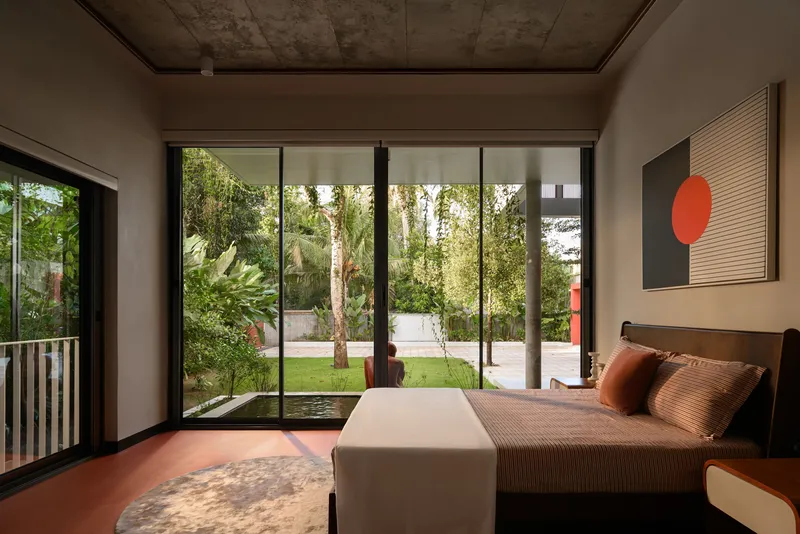
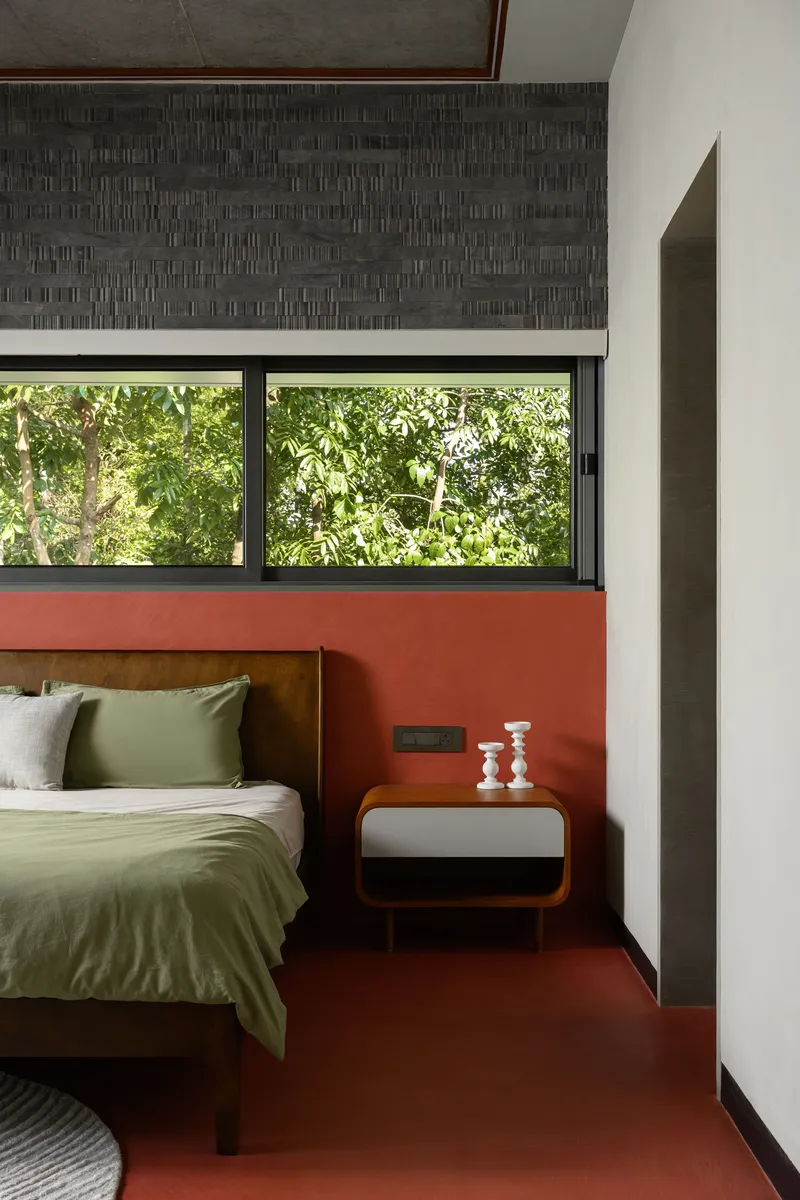
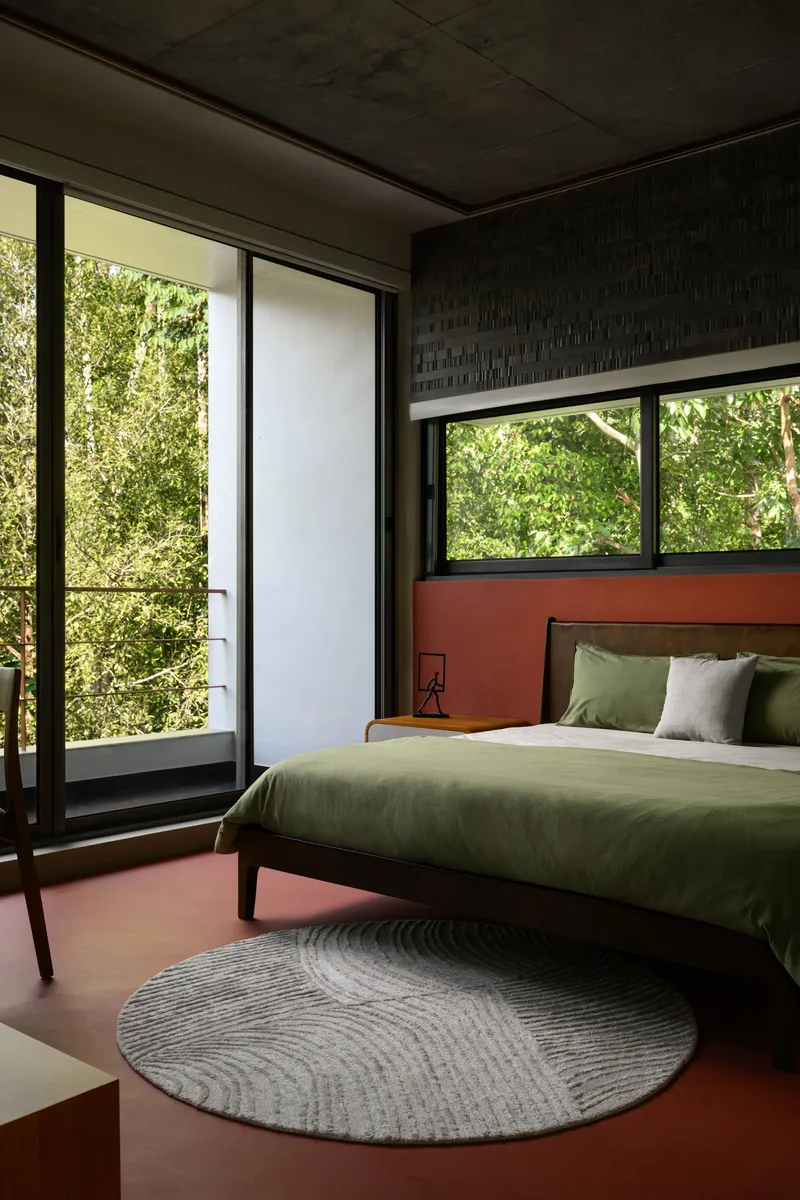
The upper-level bedrooms take a quieter approach. Exposed concrete ceilings are left raw, providing thermal mass that helps moderate Kerala's heat, while terracotta flooring keeps the palette warm without competing with the red steelwork outside. Full-height glazing opens bedrooms to private balconies and grassed courtyards planted with birch trees, a surprising species choice that introduces a lighter, more vertical canopy than the palms below.
One bedroom is bounded by a textured dark tile band that frames a horizontal window overlooking dense foliage. It is a deliberate compression of the view, a picture window that edits the garden into a cinematic strip. Another suite, divided by a white column, accommodates a more relaxed domestic life: two cats on a round rug, terracotta underfoot, and enough space to feel generous without overreaching.
Garden, Water, and the Threshold Between
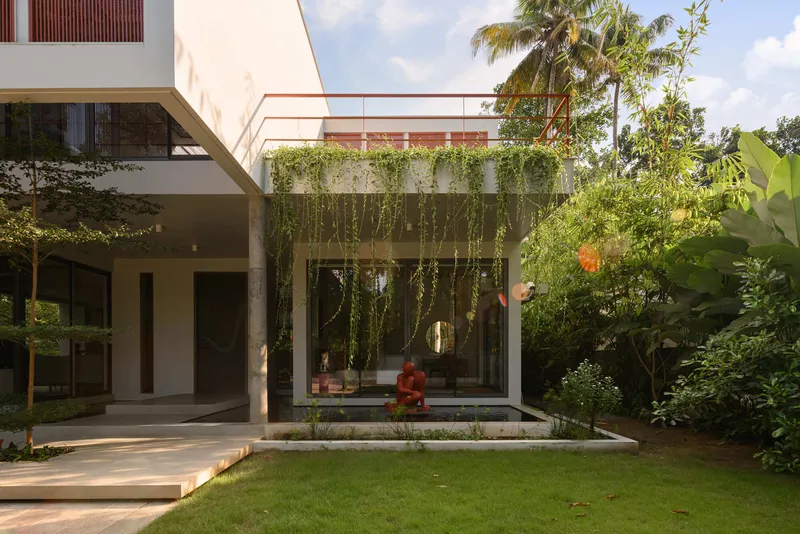
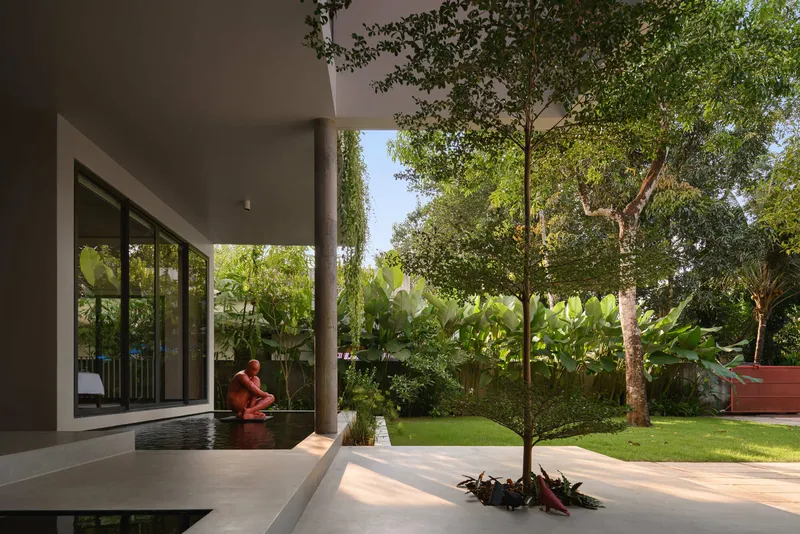
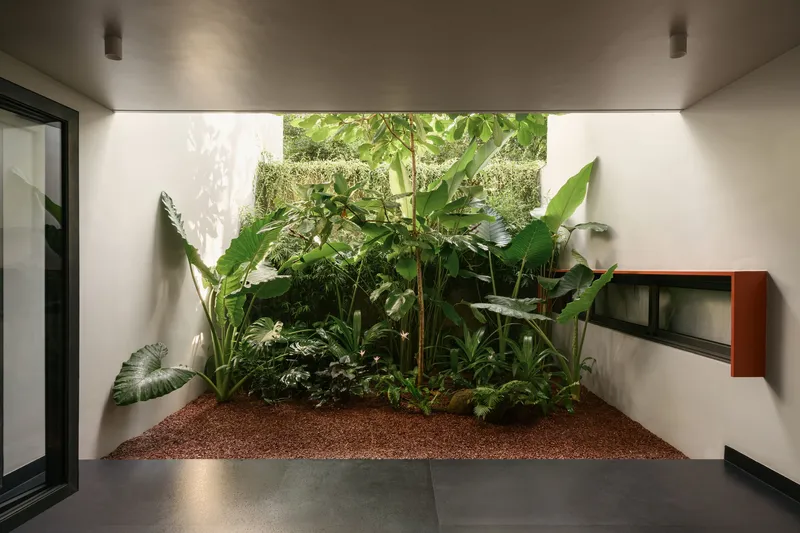
Landscape architect GREENPLANET's contribution is woven tightly into the architecture rather than applied around it. A reflecting pool runs along a covered terrace, with timber trees planted directly in the paving, their trunks rising between the water's edge and a manicured lawn. A water feature in the garden courtyard, framed by trailing vines and palm trees, becomes a place of stillness. These are not ornamental gestures but functional thresholds: the water cools air before it enters the house, the vines filter light, and the gravel beds around interior planters manage drainage from the skylight openings.
The interior courtyard planter with its tropical foliage and gravel bed beneath a skylight opening is a detail worth studying. It demonstrates that the architects and landscape team coordinated from the outset, designing the building envelope and the planting strategy as a single system.
Staircase as Sculptural Spine
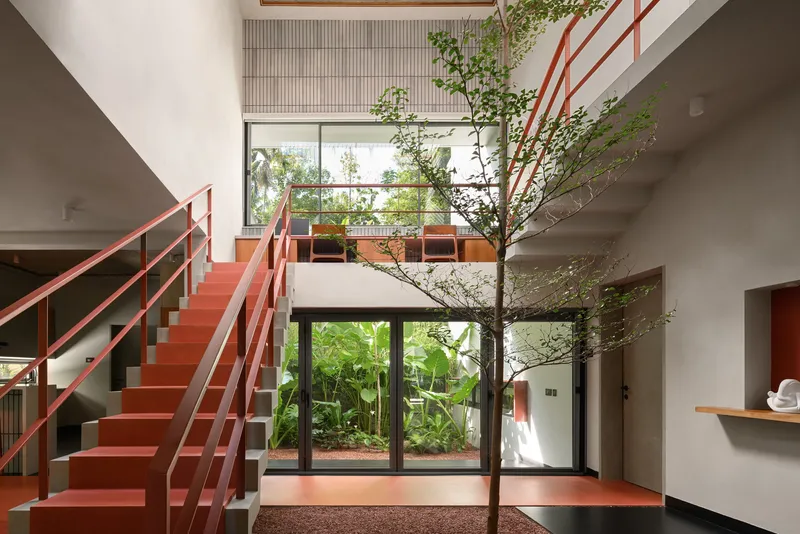
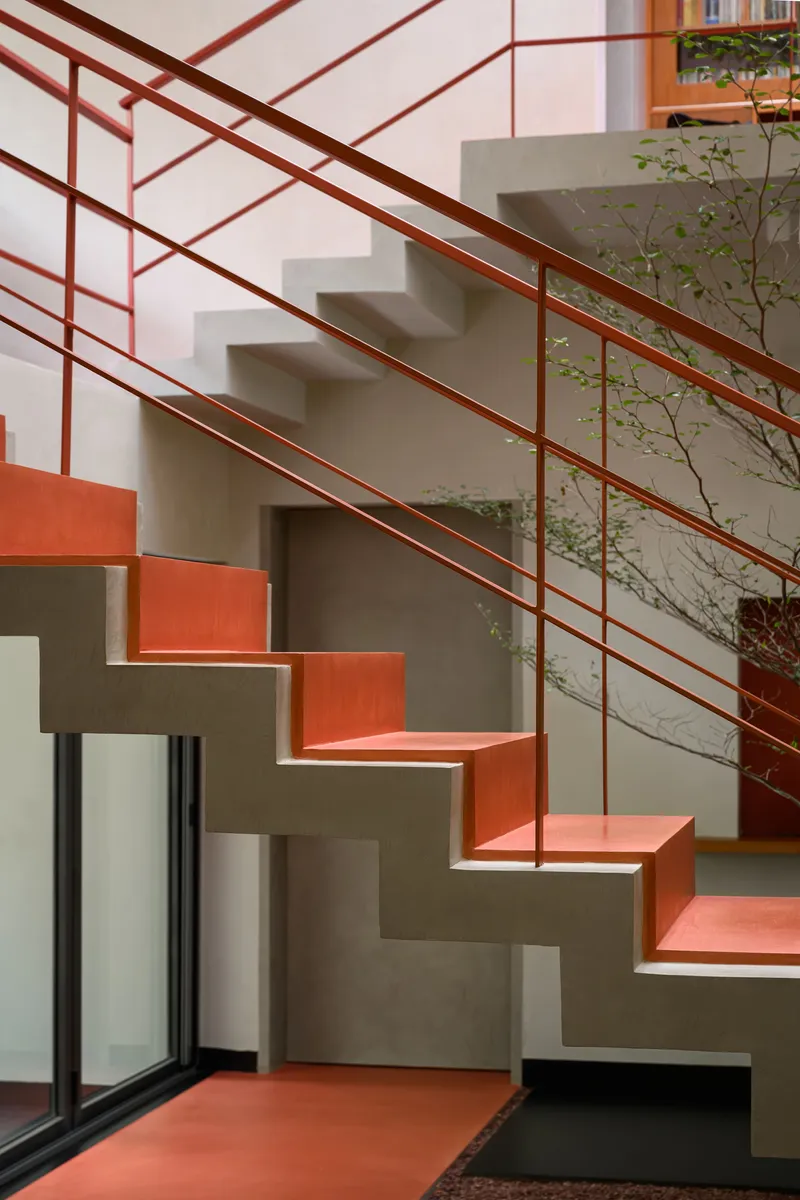
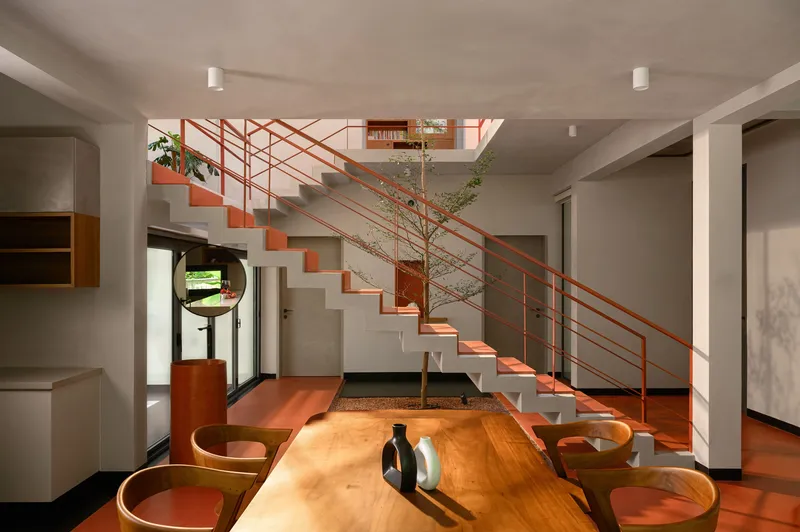
Across all levels, the staircase acts as the house's sculptural spine. The cantilevered concrete treads with coral-painted surfaces read as floating planes, each one casting a shadow on the one below. The red tubular steel railing threads continuously through the section, connecting ground-floor garden views to the upper atrium and skylight. Concrete beams frame the tree and the glazed garden beyond, creating a layered composition of structure, vegetation, and light that changes as you climb.
The potted tree beside the staircase on an upper level, rising past multiple floor plates, reinforces the house's central idea: architecture and landscape are not parallel systems here but a single braided one, and the stair is where you experience that intertwining most directly.
The House at Night
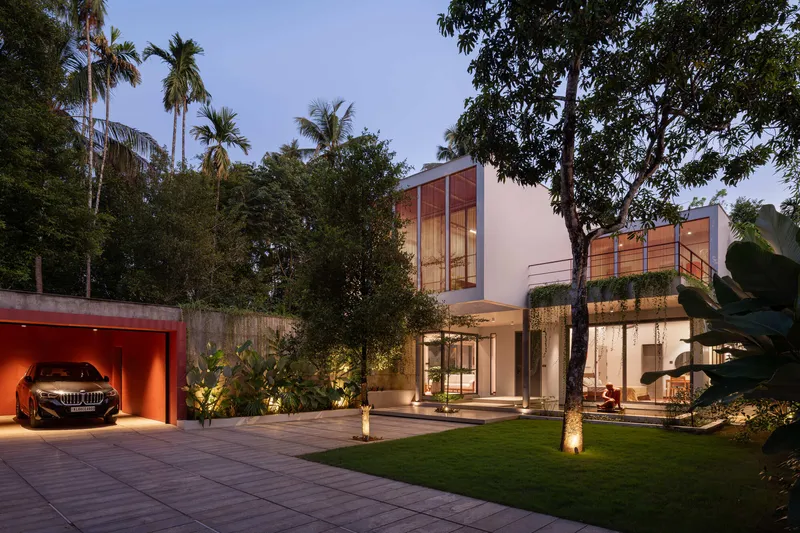
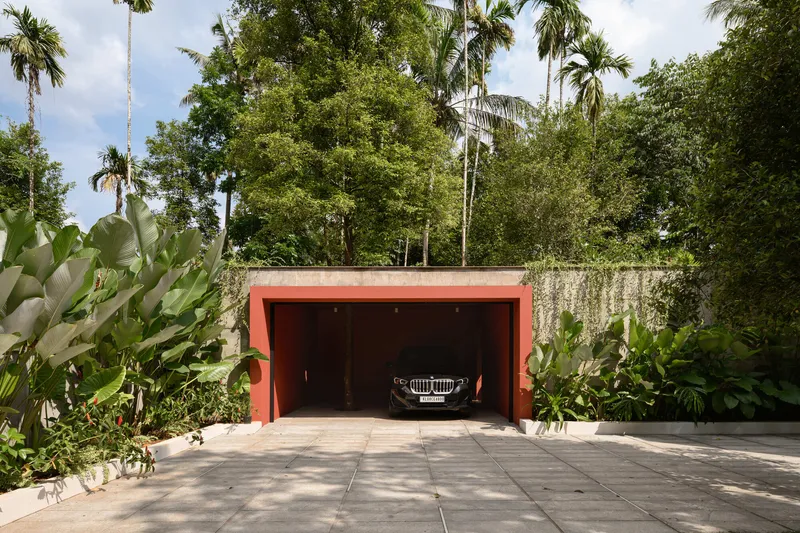
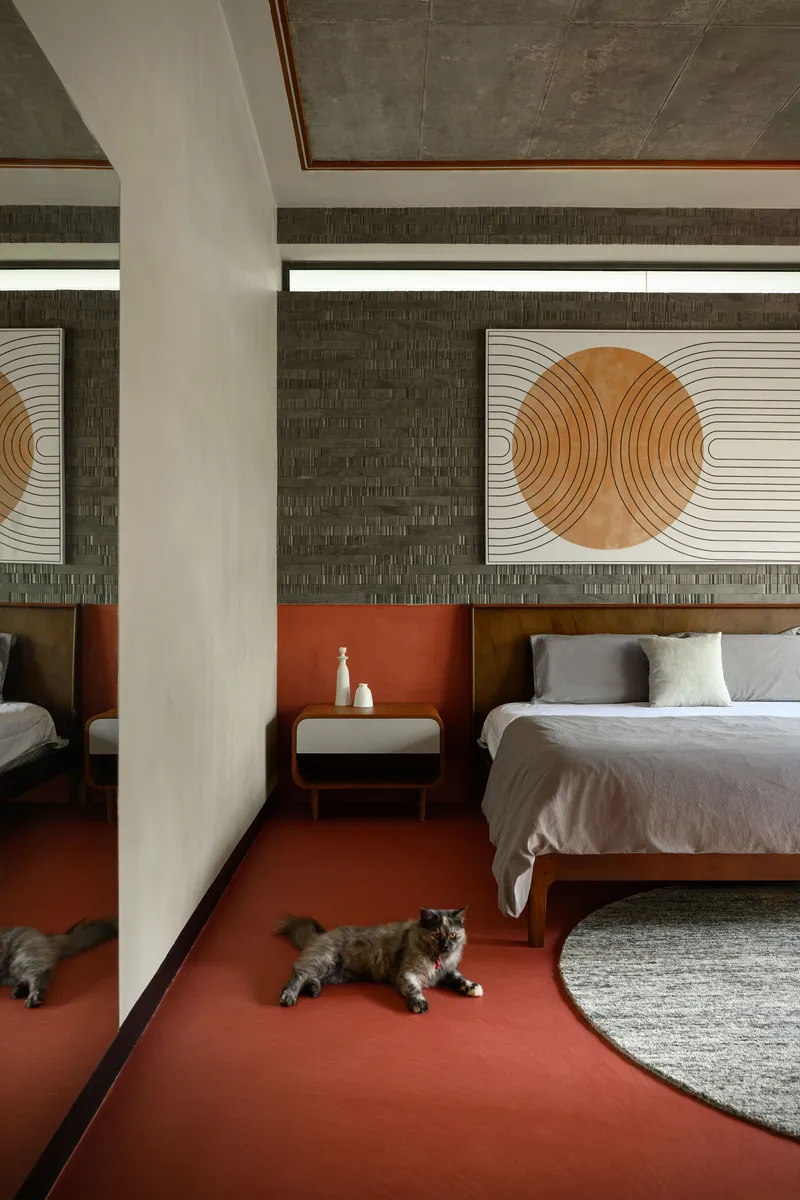
At dusk, MRIYA transforms. The timber louvred volumes glow from within, the lawn becomes a dark stage, and the illuminated interiors reveal the full extent of the house's transparency. The recessed garage, framed in coral paint and set into a concrete retaining wall, becomes a glowing threshold rather than a utilitarian cavity. Even the domestic interior, captured with two cats resting on a rug, radiates a specific warmth. This is a house that was designed to be inhabited, not photographed, and the nighttime views confirm that its boldness serves livability, not spectacle.
Plans and Drawings
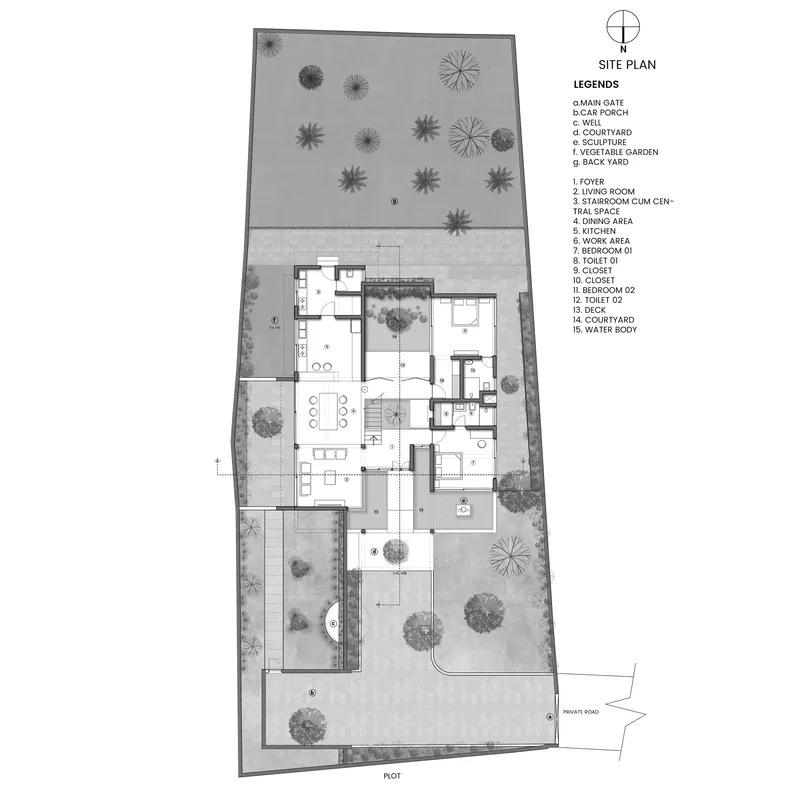
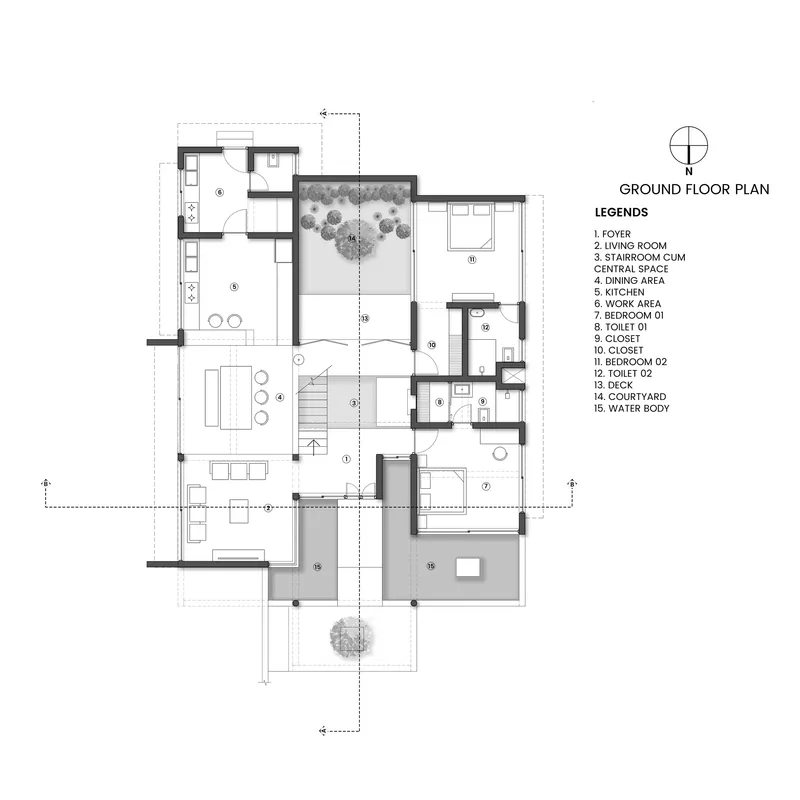
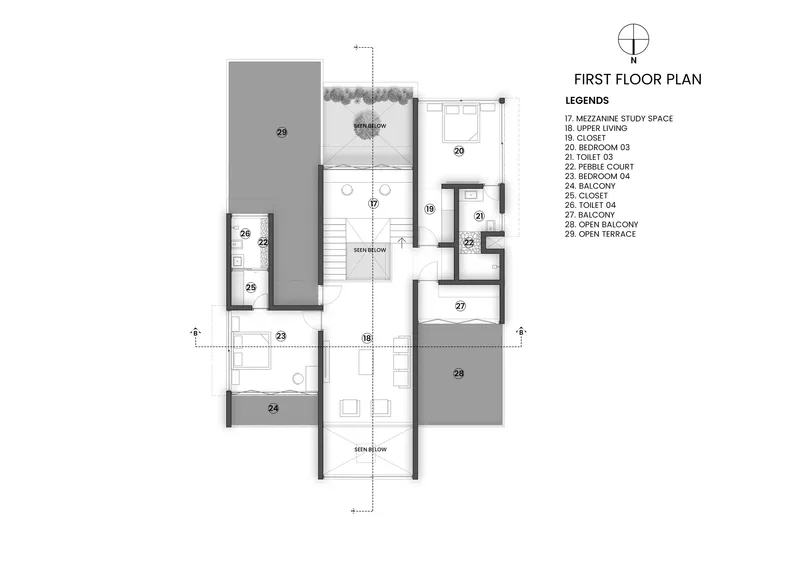
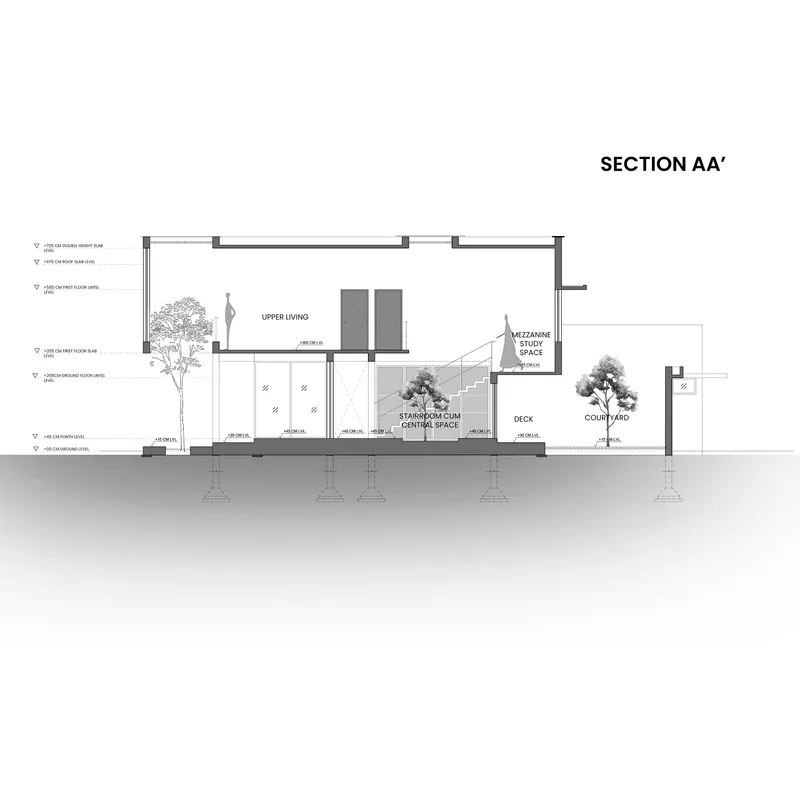
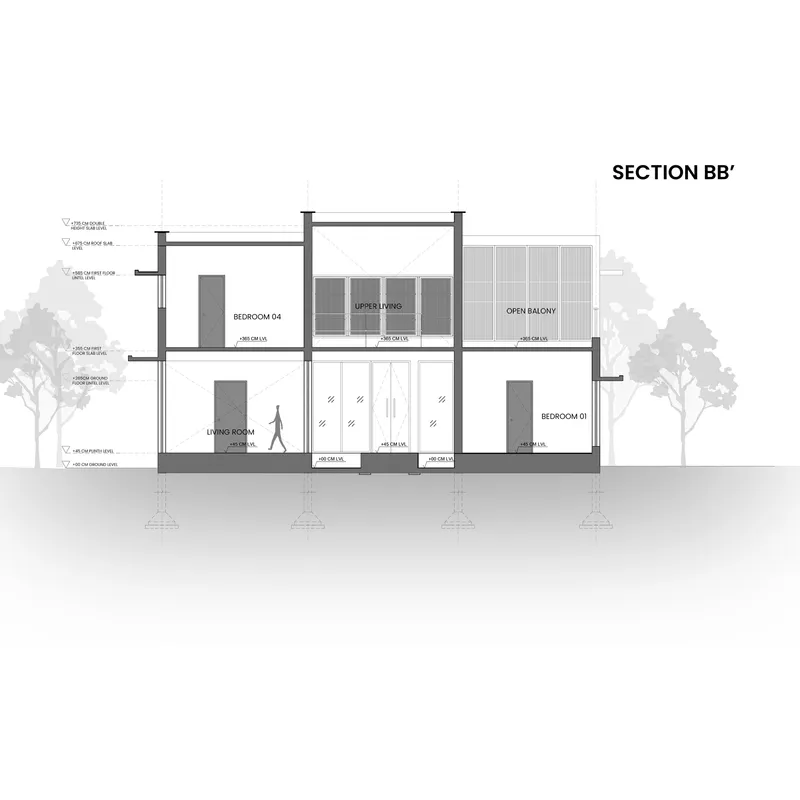
The site plan reveals the trapezoidal lot and the architects' decision to push the building mass to one side, liberating a generous front courtyard and side gardens. The ground floor plan confirms that living spaces radiate from the central courtyard with its trees, while the first floor plan shows upper rooms arranged around the central skylit stair and an open terrace. The two section drawings are the most revealing documents: they expose the split-level interior, the relationship between the double-height living space and the open balcony above, and the way the central stairway stitches the house's vertical layers together. The section also makes legible the tree's full journey from ground-level planter to skylight.
Why This Project Matters
Kerala's contemporary residential architecture has spent years perfecting a kind of restrained tropical modernism: clean concrete, careful courtyards, muted palettes. MRIYA does not reject that tradition so much as turn up its volume. The red steelwork, the coral-painted treads, the orange resin floors are not arbitrary provocations. They belong to a house that treats color as a material with the same seriousness as concrete or timber, and that asks why tropical architecture needs to be neutral. In a region where the landscape is itself outrageously vivid, a house that matches that intensity feels honest.
More importantly, MRIYA demonstrates that you can build a compact house, 3,525 square feet is modest by the standards of its neighborhood, and still achieve spatial generosity through vertical drama and deep landscape integration. The tree growing through the section is the defining move: it forces the house to accommodate something it cannot fully control, and that negotiation gives every room an unpredictability that no amount of careful detailing alone could produce. i2a Architects Studio has delivered a house that earns its name. It feels, in the best sense, like a dream someone had the nerve to actually build.
MRIYA - the Red House by i2a Architects Studio (Lead Architects: Ar. Manuraj C R, Ar. Arjun K J). Kerala, India. 3,525 sq ft. Completed 2025. Photography by Justin Sebastian Photography.
About the Studio
Share Your Own Work on uni.xyz
If projects like this are the kind of work you want to make, uni.xyz is a place to publish your own, find collaborators, and enter design competitions.




Popular Articles
Popular articles from the community


Co-Life: Senior Housing Design That Reconnects Older Adults With the City
Co-Life reimagines senior housing design through healing gardens, shared streets, workshops, and a sustainable community across generations.

Conexión: Biophilic Design Reimagines High-Rise Living in Hong Kong
Conexión reimagines high-rise living in Hong Kong through biophilic design, green facades, shared spaces, daylight, water and nature within.

Play: Fragments of Their World
Familiar architecture becomes modular playground design, creating safe spaces where displaced children can learn, connect, imagine and play.

The Ocean Hive: Sustainable Architecture for a Self-Sufficient Civilization at Sea
The Ocean Hive imagines sustainable architecture at sea, where modular habitats, algae, wave power and ocean waste sustain a growing colony.


Similar Reads
You might also enjoy these articles

Bao Huynh Watercolor Atelier: A Serene Art Retreat in Hội An
Bao Huynh Watercolor Atelier in Hội An blends multifunctional art spaces, sustainable design, local materials, and family-friendly living in a serene environment.

Atelier Macri Concept Store Interior Design by CASE-REAL
Atelier Macri store features a "ko" counter, walnut wood details, cork displays, blending retail, gallery, and seamless customer experiences.

Manuel Vargas Izquierdo Stadium and High-Performance Sports Center: Architectural Excellence in Jalpa de Méndez
The Manuel Vargas Izquierdo Stadium blends sustainable design, inclusive sports facilities, and cultural-inspired architecture, revitalizing Jalpa de Méndez’s public spaces.

KAKR Buluh Awar Hall: Revitalizing Community and Ecology Through Bamboo Architecture
Community built bamboo hall revitalizes Buluh Awar village, empowering youth, restoring ecology, celebrating vernacular craftsmanship through sustainable architecture and culture.




Comments (0)
Please login or sign up to add comments
No comments yet. Be the first to comment!