

In Transition: Adaptive Disaster-Relief Shelters for Dense Urban Community Recovery
Humanitarian Architecture, Community Resilience

Introduction:
In the rapidly urbanising landscapes of Asia, few cities illustrate the tension between dense population and strained infrastructure more vividly than Dhaka, situated at the junction of three tectonic plates [1], [2]. Established four centuries ago as the Mughal eastern province’s capital, Dhaka’s historic core—Old Dhaka—retains a rich cultural tapestry embedded within one of the world’s most densely built urban fabrics [3], [4]. This treasured heritage coexists uneasily with the city’s current explosive growth: unplanned urbanisation, inadequate enforcement of building regulations, and minimal open space have conspired to place Dhaka among the world’s top twenty earthquake-vulnerable cities [5], [6], [7]. Generally, a major earthquake hits this region almost every century [8]. A study warns that a 6.9-magnitude quake along the Madhupur Fault could destroy over 850,000 buildings in Dhaka, killing and injuring over 400,000 [9]. The city's recent tremors serve as a stark reminder of the looming threat.
Frequent fire incidents in mixed-use buildings and the developed cracks of ageing structures only heighten this vulnerability. Poor infrastructure, narrow roads, and limited open spaces define the older part of Dhaka, called Old Dhaka, which is one of the most socially and physically exposed communities to such catastrophes [4],[5]. Following large-scale catastrophes, numerous structures in the area may become uninhabitable, necessitating urgent disaster-relief (DR) sheltering for affected families [12].
DR shelters provide secure and dignified accommodation for people while their homes undergo repair or reconstruction. Initially, emergency mass sheltering occurs under undamaged government structures or through temporary, short-term solutions like tents [13]. However, these options offer minimal privacy, security, and protection from noise and weather. On the contrary, the reconstruction or relevant authority-led permanent housing solution may span several years [14]. Transitional shelters may bridge the gap between the first phase of DR sheltering (emergency sheltering) and the final phase of finding a permanent solution, facilitating proper recovery [15].
Due to a crisis of open spaces in Old Dhaka [16], effective and optimized planning of sheltering sites is required before a massive disaster strikes [17]. In addition, Old Dhaka communities are well-known for their unique socio-cultural practices and intangible heritages [3], which need to be considered during shelter planning and design for their swift recovery [18].
Rationale and Objectives:
Dhaka’s urban planning authority (RAJUK) recommends using undamaged public schools as emergency and recreational spaces, as temporary sheltering sites after disasters [19]. However, these directives lack specificity regarding spatial layouts, materials, orientation, Water, sanitation, and hygiene(WASH) facilities. Stemming from the question “How will the families who may lose their homes to such disasters recover and lead a normal life again?” and recognising this gap, this project proposes a comprehensive temporary and transitional sheltering (T-sheltering) system designed for Old Dhaka’s open fields. The objectives are—
- Provide rapid-life-saving interventions, thoughtfully designed shelters addressing the local climate, with emergency healthcare and WASH facilities to stabilise affected populations, following humanitarian standards.
- Accelerate physical and psychosocial recovery by including not only healthcare facilities, but also therapeutic social spaces for the community’s well-being, maintaining the traditional public-to-private hierarchy.
- Enable sites to swiftly revert to original recreational use once the sheltering period ends (maximum two years), preventing permanent encroachment.
- Establish a replicable research framework, adaptable to other high-density urban areas worldwide.
Literature Review:
Emergency shelter is the most basic form of shelter support and provides life-saving assistance for short periods. It is often not conducive to long-term medical care or substantial food preparation [13]. Temporary shelters are also for short-term use. They can be as basic as a tent or a public mass shelter used for a few weeks after a disaster. On the other hand, temporary housing and transitional shelters are typically for extended periods, ranging from six months to three years [12], [15]. Such options, such as leased homes and prefabricated units, enable disaster victims to resume their daily routines. Relocation of transitional shelters from a temporary site to a permanent one, renovation into a portion of a permanent house, resale to raise funds for rehabilitation, recycling for reconstruction, and other uses are all commonplace [20]. The design life of such shelters should be more than two years [21].
International shelter handbooks and guidelines emphasize that the planning of the camp should be able to offer proper land per capita and sufficient culturally relevant services to ensure displaced families can live dignified and safe lives throughout this transitional phase. UNHCR recommends that the planned settlement area on the site should not cross a 1:2 ratio, which means at least 50% of the site should be left as open space when installing shelters, although a ratio of 1:3 or 1:4 is recommended. Around 20-25% area of the site will be planned as roads and walkways, while 15-20% of the site will be allocated for open spaces and public facilities, such as play spaces, seating spaces, and so on. Minimum covered living area must not be less than 3.5 m2 per capita, if communal services (shared kitchen and toilet) are used [22], [23]. Similarly, at a minimum, one latrine or water closet (WC) will be required per 20 people, while a minimum of one universally accessible toilet is required per 250 people. The maximum distance from the shelter to any shared toilet would be 50m, while it should be at least 6m away from any household and kitchen [23]. UNHCR suggests that planning should start at a family scale and slowly increase up to community, block, sector, and settlement levels [22], hinting at a bottom-up approach of design. Layout planning or clustering should be informed by social structures, community relationships, and traditional settlement patterns to develop a sense of ownership, which will help recover faster from trauma [22], [24]. These principles especially apply to Old Dhaka, where there is minimal space and high vulnerability, and the communities exhibit unique sociocultural values and intangible heritages such as deep-bonding between neighbours, senior citizens telling stories to children, and many others, which can be termed as ‘intangible heritage.’ [3], [25]. A study showed that managing the shelters with no connection to the intangible cultural heritages did not show a good result [26].
Methodology
A mixed-methods research approach was employed. National and international humanitarian standards and guidelines (UNHCR Shelter Solutions, Sphere Handbook) were examined to ensure compliance with health, sanitation, WASH, and safety protocols.
Following field visits and vulnerability assessments, Sutrapur and Gendaria Thana (population density ≈ 101,500 persons/km² and 97,000 persons/km², respectively) of Old Dhaka were chosen as case communities. Observations highlighted not only the risk factors—substandard construction, narrow alleys, limited emergency access—but also the latent potential of the Dhupkhola field to be a sheltering site. Its size, road connectivity, existing RCC entry pavilions, and proximity to utilities render it ideal for rapid shelter deployment with minimal infrastructural interventions. Therefore, Dhupkhola Field at Gendaria was chosen as a case site to shelter disaster survivors from Sutrapur and Gendaria.
To understand the sociocultural context, a questionnaire survey was conducted with over fifty locals to gather data on communal values, income, whether they have alternative places to live, and recovery priorities. Market surveys in nearby locations were conducted to identify readily available modular materials. Site documentation combined GIS mapping with precise on-site measurements of Dhupkhola Field, adjacent building footprints, and utility lines.
Design Brief:
According to international handbooks, a 1:3 site-to-shelter footprint ratio (33% of site) is recommended, with at least 50% open space and up to 20–25% for roads. It allows a maximum 1:2 ratio when toilets and kitchens are attached to each shelter. The proposed transitional shelter and its service units occupy 40% of Dhupkhola’s four-acre field, seamlessly integrating modular living units, essential services, and therapeutic landscapes into a resilient community designed for up to two years.
- Fabrication and Environmental Considerations:
To minimise environmental footprint, the design prioritises locally abundant, low-carbon materials. All the materials were chosen for their lightweight, reusable, recyclable, and climatic properties. Structural frames consist of paired Class D Schedule-80 uPVC pipes(60mm diameter), clamped together to resist buckling. Although primarily used for plumbing, uPVC pipes are a major and widely available material in the markets of Old Dhaka. This is a key reason for selecting these pipes over other conventional building materials. Flooring comprises fibre-cement boards, chosen for durability and moisture resistance. Locally woven bamboo mats function as vents, doors, and window covers. Recently developed Jutin (corrugated jute-composite sheets) utilising the indigenous jutes chosen as wall and roof panels. Metal wires fastened to the roof panel anchor it to the ground, running through the corner pipes so that it stays on the ground even in case of new disasters. Efficient use of interior space is emphasised to avoid wastage, and sliding window panels attached to the units use minimal clearance, not hindering circulation. Instead of deploying separate shelter-units, the design combines groups of 4–6 units (average five) around a shared semi-private foyer or porch, locally called “Rowak”, forming an integrated shelter-cluster, eliminating individual entry ramps and staircases for each unit to cut the footprint. Besides, adjacent units further reduce resource use by sharing structural walls. In addition, pairing two shelters accommodates larger families without sacrificing space efficiency.

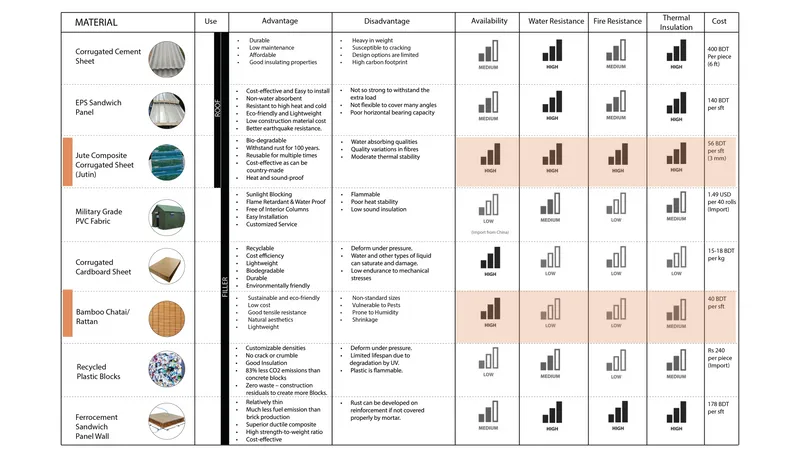
Every shelter-cluster, kitchen, and sanitation block integrates rainwater harvesting tanks and greywater reuse channels. Collected water supports vertical gardens on kitchen façades, bolstering food security and microclimate regulation. Passive design measures were considered—cross-ventilation, use of eco-cooler modules, elongation of clusters towards east-west with services at east and west to reduce afternoon heat exposure while maximising airflow from the south.
- Socio-Cultural Integration and Well-being:
Inspired by Old Dhaka’s spatial vocabulary—Angina(Small private courtyard for women), Uthan/Rowak(front yard), Gali(lane), Morh(corner node), the layout embeds familiar social spaces into its design hierarchy. Each household unit accommodates upto 2 adults and 1-2 children. comprising up to five shelter units (10 adults and 5–10 children), shares a semi-private porch (Rowak), which seamlessly transitions into an intimate courtyard, hidden from the front. This small courtyard can be used for drying clothes, personal gardening, or even dining together. Narrow, soft-paved pathways (Gali) link these semi-private spaces to service blocks and community nodes, evoking Old Dhaka’s sociable alleyways where daily movement fosters interaction, vital to collective recovery for these trauma-impacted communities.
Next, four shelters form a larger cluster or a community module for 40 adults and 20-40 children, with a common kitchen and lavatory. WASH facilities comply with UNHCR standards yet respect local customs, incorporating wudu sinks and cloth-washing platforms that also function as unenclosed shower spaces. This allows for fewer enclosed bathrooms, as the male relatives of Old Dhaka are familiar with showering together in the open before heading to work.
Two or four such community modules enclose a central courtyard around their shared kitchens. Old Dhaka’s communities are usually conservative; most women stay home most of the time, cook and socialise with neighbouring women inside the building, often on the rooftop while maintaining a garden, while men work outside. Therefore, grouping the shared kitchens centring a larger court allows them to not only socialise while working, but also supervise their children playing in the court. As women and children are often more vulnerable during disasters and face barriers to accessing aid, their safety and well-being remain a design priority. There are shaded seating alcoves nestled among garden pockets, promoting mental well-being, offering residents a sense of normalcy and calm.
- Algorithmic Clustering:
A generative design algorithm is used with several international shelter-planning standards as parameters to visualise multiple forms of community to choose the best possible solution for the case site in terms of circulation distance to services from shelters, courtyards’ privacy, cross-ventilation, etc.
Phased Implementation:
Pre-Disaster Preparedness: Before any crisis, critical infrastructure is pre-installed, such as gates and ramps for emergency vehicular access in the field, tubewells, and spaces for material storage.
Emergency Phases: Immediately post-disaster, emergency medical tents (placed on the pavilion floor if structurally sound, otherwise adjacent clearings) are erected. A 16-ft-wide space for the central axis road bisects the field into four blocks, acting as both a logistical corridor and a communal spine. Each block is divided into 3-ft×3-ft grids. Multipurpose uPVC pipe-and-tarpaulin hall is installed at the centre of the field to coordinate relief operations and community assemblies.
Next, the planned settlement area is marked while WASH facilities are installed. Temporary tents accommodate early arrivals.
Block-Allocation Phase: As soon as the modular materials for transitional shelters arrive on site, the communities and volunteers install them using simple mechanical tools.
Recovery Phase: When all the other facilities are supplied, shared kitchens and storage and administrative offices will be installed, following other facilities such as gardening to enhance the recovery. Multipurpose halls can be disassembled and repurposed for workshops and cultural events, reinforcing social cohesion.
Reversion & Reuse: The users can move to a permanent location after repairing their houses or getting a solution from the government, the site will be reverted to being a football playground, and the materials will be reused.
Conclusion:
This conceptual project presents a holistic, research-driven model for transitional shelter in high-density urban contexts. By converging algorithmic design, modular fabrication, community-based processes, and sustainable practices, the project bridges immediate humanitarian relief with enduring community resilience and recovery. While rooted in Dhaka’s historic fabric, the framework’s adaptability through cultural calibrations and phased customisations allows replication across megacities worldwide.
References:
[1] M. A. Ansary and M. S. Rahman, “Seismic hazard assessment for Bangladesh,” Natural Hazards, vol. 22, no. 2, pp. 189–200, 2000, doi: 10.1023/A:1008108704353.
[2] B. K. Paul and R. H. Bhuiyan, “Urban earthquake hazard: perceived seismic risk and preparedness in Dhaka City, Bangladesh,” Disaster Prevention and Management, vol. 19, no. 2, pp. 197–210, 2010, doi: 10.1108/09653561011037927.
[3] I. Ahmed, “Community, Heritage and Social Capital: Informal Heritage Management in Old Dhaka,” Open House International, vol. 42, pp. 65–72, Mar. 2017, doi: 10.1108/OHI-01-2017-B0010.
[4] N. Ahmed, Old Dhaka and Beyond. Dhaka: Asiatic Society of Bangladesh, 2006.
[5] M. A. Chisty and Md. M. Rahman, “Coping capacity assessment of urban fire disaster: An exploratory study on ward no: 30 of Old Dhaka area,” International Journal of Disaster Risk Reduction, vol. 51, p. 101878, Dec. 2020, doi: 10.1016/j.ijdrr.2020.101878.
[6] The Daily Star, “Bangladesh at high earthquake risk, fire service issues alert,” Mar. 29, 2025. Accessed: Oct. 01, 2025. [Online]. Available: https://www.thedailystar.net/news/bangladesh/news/bangladesh-high-earthquake-risk-fire-service-issues-alert-3860166
[7] I. Ferdous and M. Rahman, “Citizens at risk from earthquake hazard in Dhaka city: Scaling risk factors from household to city region level,” J geographical I JC, vol. 65, no. 1, pp. 91–106, 2015, doi: 10.2298/IJGI1501091F.
[8] N. F. Antara, “What happens if a 7.5 quake hits Dhaka?,” Dhaka Tribune, Dhaka, Bangladesh, Feb. 08, 2023. [Online]. Available: https://www.dhakatribune.com/bangladesh/dhaka/304530/what-happens-if-a-7.5-quake-hits-dhaka
[9] A. Rahman, “Over 900,000 Dhaka buildings at risk of collapse,” Prothomalo. Accessed: Oct. 02, 2025. [Online]. Available: https://en.prothomalo.com/bangladesh/8cam5g5rw1
[10] I. Jahan, M. A. Ansary, S. Ara, and I. Islam, “Assessing Social Vulnerability to Earthquake Hazard in Old Dhaka, Bangladesh,” Asian Journal of Environment and Disaster Management (AJEDM), vol. 03, no. 03, p. 285, 2011, doi: 10.3850/S1793924011000915.
[11] S. N. Khan, “Significance of Sheltering as an Emergency Response to Potential Disasters in Dhaka,” in Proceedings of the 1st International Conference on Recent Innovation in Civil Engineering and Architecture for Sustainable Development (IICASD 2024), vol. 260, Md. K. Miah, Md. N. Islam, Md. A. Alam, Md. A. Taiyab, Md. R. Karim, B. I. Choudhury, Md. M. Hossain, Md. S. Anwar, Md. Z. Hasan, and Md. S. Mia, Eds., in Advances in Engineering Research, vol. 260. , Dordrecht: Atlantis Press International BV, 2025, pp. 199–214. doi: 10.2991/978-94-6463-672-7_17.
[12] W. G. Peacock, N. Dash, Y. Zhang, and S. Van Zandt, “Post-Disaster Sheltering, Temporary Housing and Permanent Housing Recovery,” in Handbook of Disaster Research, H. Rodríguez, W. Donner, and J. E. Trainor, Eds., in Handbooks of Sociology and Social Research. , Cham: Springer International Publishing, 2018, pp. 569–594. doi: 10.1007/978-3-319-63254-4_27.
[13] A. Bashawri, S. Garrity, and K. Moodley, “An Overview of the Design of Disaster Relief Shelters,” Procedia Economics and Finance, vol. 18, pp. 924–931, 2014, doi: 10.1016/S2212-5671(14)01019-3.
[14] T. Gunawardena, T. Ngo, P. Mendis, L. Aye, and R. Crawford, “Time-Efficient Post-Disaster Housing Reconstruction with Prefabricated Modular Structures,” Open House International, vol. 39, pp. 59–69, Sept. 2014, doi: 10.1108/OHI-03-2014-B0007.
[15] B. Rohwerder, “Transitional shelter in post-disaster contexts,” The Governance and Social Development Resource Centre (GSDRC), University of Birmingham, UK, July 2016. Accessed: Sept. 30, 2025. [Online]. Available: https://gsdrc.org/wp-content/uploads/2016/08/HDQ1387.pdf
[16] N. N. Khan and H. Roy, “Where are our public spaces?,” The Daily Star, June 16, 2022. [Online]. Available: https://www.thedailystar.net/shout/news/where-are-our-public-spaces-3048176
[17] C. Stott and M. Nadiruzzaman, “Disaster Risk Reduction in Dhaka City: From urban landscape analysis to opportunities for DRR integration,” International Centre for Climate Change and Development, Dhaka, Bangladesh, Dhaka, Bangladesh, 2014. Accessed: Sept. 30, 2025. [Online]. Available: https://www.preventionweb.net/files/42776_42776publicationdhakkaurbreportfina.pdf
[18] C. C. Francesco Pasta, “Why ‘living heritage’ matters for community-led, post-disaster recovery,” International Institute for Environment and Development (iied). Accessed: Oct. 01, 2025. [Online]. Available: https://www.iied.org/why-living-heritage-matters-for-community-led-post-disaster-recovery
[19] Rajdhani Unnayan Kartripakkha (RAJUK), “Detailed Area Plan for Dhaka Metropolitan Region (DAP 2022–2035),” Rajdhani Unnayan Kartripakkha (RAJUK), Dhaka, Bangladesh, 2022.
[20] OCHA, “Transitional settlement and reconstruction after natural disaters,” United Nations Office for the Coordination of Humanitarian Affairs (OCHA), 2008. Accessed: Sept. 30, 2025. [Online]. Available: https://emergency.unhcr.org/sites/default/files/Strategies%20for%20transitional%20settlement%20and%20reconstruction%2C%20Shelter%20Centre%2C%20Geneva.pdf
[21] T. Corsellis et al., Transitional Settlement: Displaced Populations. 2005.
[22] United Nations High Commissioner for Refugees (UNHCR), Emergency Handbook. Geneva, Switzerland: UNHCR, 2015. Accessed: Sept. 30, 2025. [Online]. Available: https://emergency.unhcr.org/
[23] Sphere Association, The Sphere Handbook: Humanitarian Charter and Minimum Standards in Humanitarian Response, 4th ed. Geneva, Switzerland, 2018. Accessed: Sept. 30, 2025. [Online]. Available: https://spherestandards.org/handbook/
[24] Y. Rahmayati, “Post-disaster housing: Translating socio-cultural findings into usable design technical inputs,” International Journal of Disaster Risk Reduction, vol. 17, pp. 173–184, Aug. 2016, doi: 10.1016/j.ijdrr.2016.04.015.
[25] UNESCO, “Convention for the Safeguarding of the Intangible Cultural Heritage.” United Nations Educational, Scientific and Cultural Organization, Paris, 2003. [Online]. Available: https://ich.unesco.org/en/convention
[26] M. Kitamura, “Intangible Heritage and Resilience in Managing Disaster Shelters: Case Study in Japan,” in Historic Cities in the Face of Disasters, F. F. Arefian, J. Ryser, A. Hopkins, and J. Mackee, Eds., in The Urban Book Series. , Cham: Springer International Publishing, 2021, pp. 105–119. doi: 10.1007/978-3-030-77356-4_6.


Popular Articles
Popular articles from the community


David Ortega Stacks a Two-Story Mexico City Penthouse Around a Steel Stair and a Pergola-Shaded Roof Terrace
In Colonia Roma, a 300 m² penthouse uses oak joinery, a planted steel stair and a slatted roof pergola to make a new-build apartment feel like a house.

Cube Design Draws an Ecological Corridor Between Two Shenzhen Hills with the Nankai Building
Beside Shenzhen's container docks, the Nankai Building pairs stacked balconies with a climbing green screen to connect two hillsides across its height.

LT2A and OPEN Architectes Thread a Brick and Glass High School Through a Wooded Belgian Campus
In Braine-l'Alleud, a 3,000 m² wing for Collège Cardinal Mercier pairs pale brick with a glazed colonnade, deferring to a small chapel and a dense wood.

longwave studio Reorganizes a 112 m² Tainan Apartment Around the Daily Routines of a Family and Two Cats
In Tainan, Taiwan, birch plywood, rust-red furniture and a freestanding plaster wall link arrival, storage, work and family life in one apartment.

Similar Reads
You might also enjoy these articles

The Rhythm of Seasons
A Farmers' Market Connecting Nature and the City

More Than a Building-Designing a Living System
More Than a Building-Designing a Living System
Base Beyond
DESERT COMPOUND ARID: TOURISM OF ABSENCE AND ABUNDANCE

Explore Urban Resilience Competitions
Discover active competitions in this discipline


Challenge to reimagine the Iron Throne

Photograph architecture without architects

Illustrate the lost glory of Angkor Wat - Render Challenge

Design challenge to reuse E-waste
Comments (0)
Please login or sign up to add comments
No comments yet. Be the first to comment!