
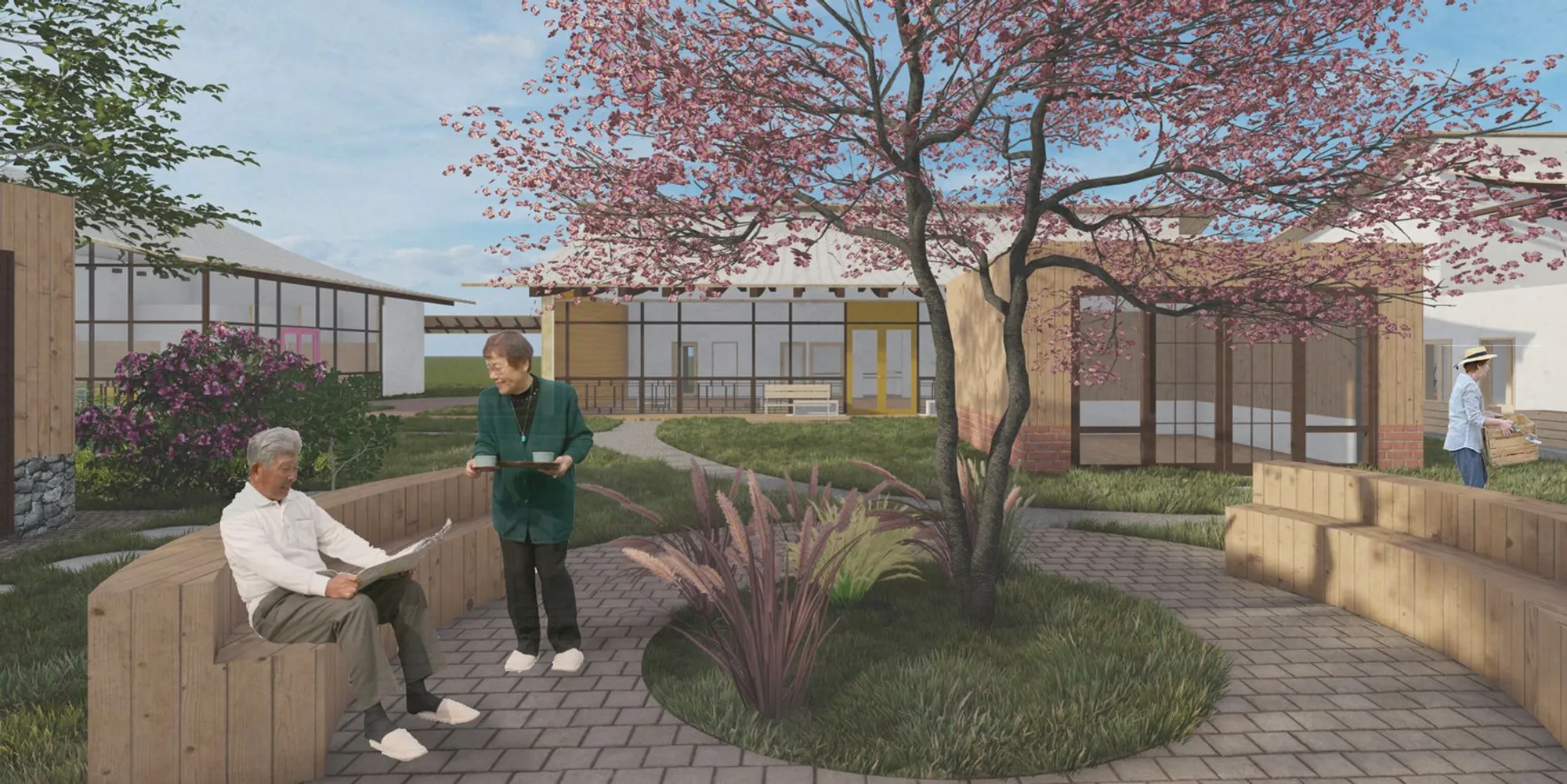
Independent: Hanok-Inspired Dementia Care That Prioritizes Autonomy Over Supervision
A therapeutic day care center in Yangsan, South Korea, uses traditional Korean architecture to help dementia patients navigate space on their own terms.


Most dementia care facilities are designed around control: locked corridors, uniform rooms, constant oversight. "Independent" flips that logic entirely. Instead of managing patients through restriction, this project argues that architecture itself can become the caregiver, guiding movement through color, transparency, and spatial familiarity rooted in centuries of Korean building tradition. The result is a day care center for 70 patients in Yangsan, South Korea, where cognitive decline does not automatically mean a loss of freedom.
Designed by Klaudia Druszcz and Małgorzata Rajkowska, the project won the Mnemonic competition on uni.xyz. The brief asked entrants to confront South Korea's rapidly aging population and the rising prevalence of dementia. Druszcz and Rajkowska responded not with an institutional building but with something closer to a village: a cluster of color-coded structures organized around courtyards, connected by covered walkways, and built from local Korean pine, stone, and clay. Sited near the medical faculties of Busan University, the facility is positioned for direct integration with research institutions and healthcare professionals, while remaining accessible via existing public transport.
A Village, Not a Ward

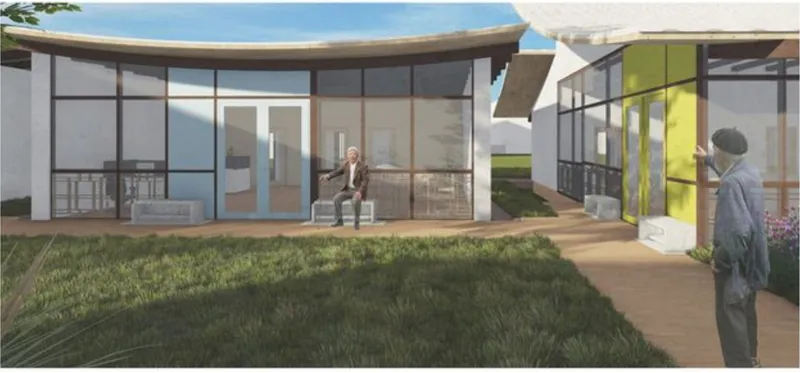
The entry sequence immediately signals that this is not an institution. A timber pergola frames the approach to a glazed entrance, with planted grasses softening the threshold between the public realm and the care environment. The buildings draw on traditional Hanok architecture, using curved roof overhangs, exposed timber structure, and generous glazing to create interiors that feel domestic rather than clinical. Each structure is coded with distinct colors, giving patients a legible, intuitive system for self-navigation. The goal is clear: reduce dependence on caregivers for basic orientation, and in doing so, preserve the patient's sense of agency.
The facility accommodates not only 70 patients but also up to 40 visitors, including staff, volunteers, and family members. By designing for this mix of users, the architects avoid the hermetic quality that plagues many care environments. The campus feels inhabited, not managed.
Covered Walkways as Cognitive Scaffolding
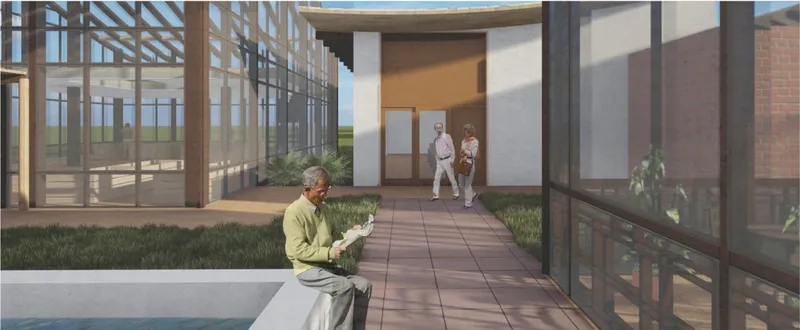
Between the buildings, covered walkways with timber screen walls create sheltered routes that are legible and calm. These are not just circulation; they function as cognitive scaffolding, providing consistent spatial cues (filtered light, planted courtyards visible on either side, the tactile rhythm of the screens) that help patients orient themselves without maps or signage. The transparency of the partitions means patients can see where they are going before they arrive, reducing the anxiety that unfamiliar spaces provoke in people with memory disorders.
The programme distributed across these connected pavilions is remarkably varied: a meditation pavilion, tea room, chapel, audio-visual room, computer lab, gym, art studio, communal dining areas, and quiet zones for solitude. Rather than concentrating all activity in a single building, the village layout gives patients a reason to move, a choice about where to go, and a sense of discovery that mirrors the rhythms of ordinary life.
Interior Warmth Through Honest Materials
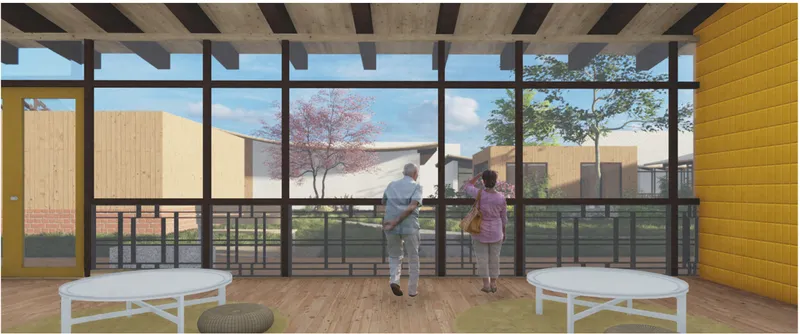
Inside, floor-to-ceiling glazing dissolves the boundary between the therapeutic gardens and the interior rooms. Exposed timber beams are left visible overhead, reinforcing the connection to Hanok construction and providing a warm, textured ceiling plane that contrasts with the cool transparency of the glass walls. The material palette is deliberately restrained: wood, stone, clay. These are local, natural materials chosen both for their low carbon footprint and for their sensory qualities. Wood is warm to the touch. Stone is cool and grounding. Clay regulates humidity. Together, they create interiors that are simplified but not sterile, supporting the kind of calm, low-stimulus environment that benefits people with neurological disorders.
Gardens That Heal, Not Just Decorate
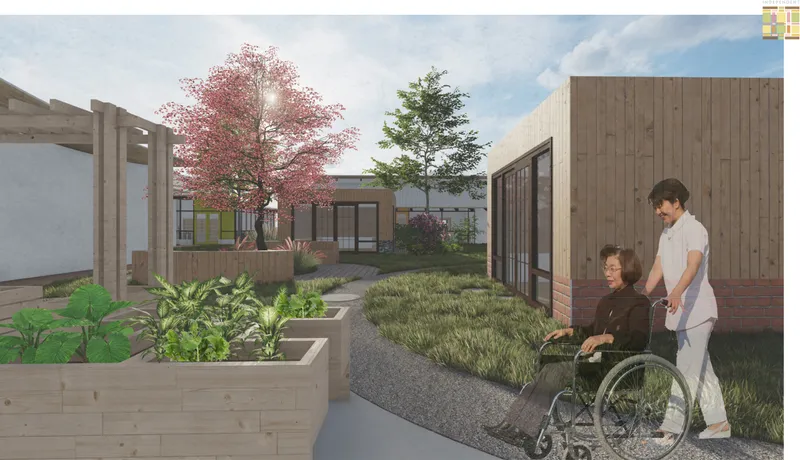
The garden courtyards are not ornamental afterthoughts. Raised timber planter beds allow patients, including those in wheelchairs, to cultivate plants at an accessible height. Flowering trees provide seasonal markers that help orient patients in time, while the act of gardening itself serves as a form of occupational therapy. The image of a caregiver assisting a wheelchair user among the raised beds captures the project's ethos precisely: care is present, but it operates alongside the patient's own activity, not in place of it.
Sun orientation, natural ventilation, and acoustic comfort are all calibrated to support well-being without mechanical complexity. The landscape is as much infrastructure as the buildings, functioning as a sensory stimulant that reduces anxiety and anchors patients in the immediate, physical world. Korean pine, selected in alignment with national forestry policies, ties the material strategy to a broader ecological commitment.
Why This Project Matters
"Independent" succeeds because it refuses the false choice between safety and freedom. Too many care facilities treat these as opposing values, defaulting to environments that prioritize the caregiver's convenience over the patient's experience. Druszcz and Rajkowska demonstrate that spatial design can do the work of supervision: color coding replaces locked doors, transparent walls replace surveillance, and a village layout replaces the corridor-and-room model that dominates institutional care.
As South Korea and much of the developed world confront the realities of aging populations and rising dementia prevalence, projects like this point toward an architecture that treats quality of life as a design parameter, not an afterthought. The integration of vernacular Korean construction with contemporary therapeutic research produces a facility that is culturally grounded, ecologically responsible, and genuinely humane. It sets a standard that other care environments should be measured against.
View the Full Project
About the Designers
Designers: Klaudia Druszcz, Małgorzata Rajkowska
Enter a Design Competition on uni.xyz
uni.xyz runs architecture and design competitions year-round that reward proposals with spatial conviction and real site intelligence.
Project credits: Independent by Klaudia Druszcz, Małgorzata Rajkowska Mnemonic (uni.xyz).




Popular Articles
Popular articles from the community


Riyadh For All: Intergenerational Urban Design for Active Aging in Rabat
Riyadh For All reimagines urban design in Rabat with intergenerational co-living, adaptive courtyards, and Moroccan cultural exchange today.

AL-JANNAH: Sustainable Architecture and Permaculture for Afghan Widows
AL-JANNAH uses sustainable architecture and permaculture to create resilient oasis of housing, learning, work and renewal for Afghan widows.

Co-life: Sustainable Architecture for Age-Friendly Community Living
Co-life reimagines sustainable architecture for seniors through courtyards, rammed earth, shared gardens, and spaces designed for belonging.

The Earth Pod: 3D Printed Homes for Resilient Refugee Communities
The Earth Pod reimagines refugee housing through 3D printed homes made from clay, combining resilience, self-sufficiency, and rapid shelter.
Similar Reads
You might also enjoy these articles

Bao Huynh Watercolor Atelier: A Serene Art Retreat in Hội An
Bao Huynh Watercolor Atelier in Hội An blends multifunctional art spaces, sustainable design, local materials, and family-friendly living in a serene environment.

Atelier Macri Concept Store Interior Design by CASE-REAL
Atelier Macri store features a "ko" counter, walnut wood details, cork displays, blending retail, gallery, and seamless customer experiences.

Manuel Vargas Izquierdo Stadium and High-Performance Sports Center: Architectural Excellence in Jalpa de Méndez
The Manuel Vargas Izquierdo Stadium blends sustainable design, inclusive sports facilities, and cultural-inspired architecture, revitalizing Jalpa de Méndez’s public spaces.

KAKR Buluh Awar Hall: Revitalizing Community and Ecology Through Bamboo Architecture
Community built bamboo hall revitalizes Buluh Awar village, empowering youth, restoring ecology, celebrating vernacular craftsmanship through sustainable architecture and culture.


Explore Ageing-Well Design Competitions
Discover active competitions in this discipline



Challenge to reimagine the Iron Throne


Photograph architecture without architects


Illustrate the lost glory of Angkor Wat - Render Challenge


Design challenge to reuse E-waste
Comments (0)
Please login or sign up to add comments
No comments yet. Be the first to comment!