

Industria by Haworth Tompkins: The UK’s First Multi-Storey Light Industrial Hub
Industria by Haworth Tompkins is a sustainable, multi-storey industrial hub in London, providing flexible workspaces, green design, and urban regeneration.


Innovative Industrial Architecture in Barking, UK
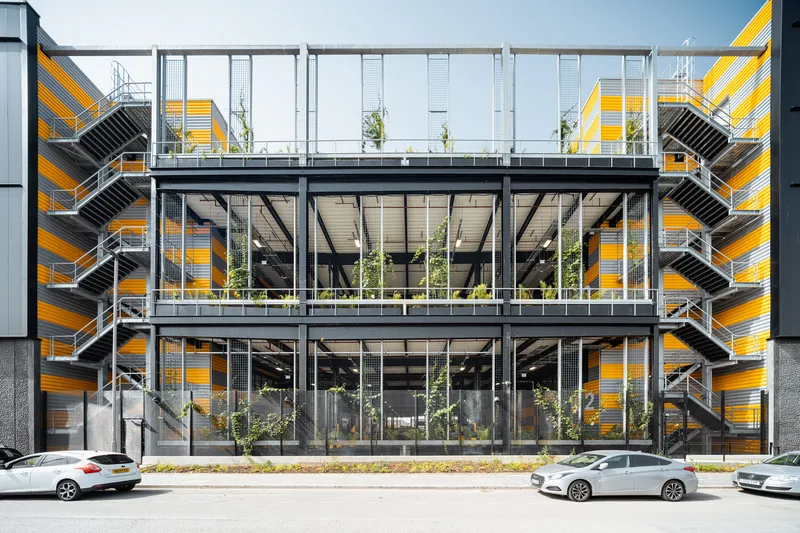
Industria, designed by Haworth Tompkins, is a groundbreaking multi-storey light-industrial development in Barking, United Kingdom. Developed for Be First, the London Borough of Barking and Dagenham's regeneration initiative, this project is set to revolutionize industrial space in urban environments. Spanning 11,400 square meters, Industria provides a dynamic workspace for 45 small and medium enterprises (SMEs) across four levels, with unit sizes ranging from 20 to 450 square meters. Once fully operational, it is expected to generate employment for up to 300 people, significantly contributing to the local economy.

A High-Density, Multi-Level Industrial Concept
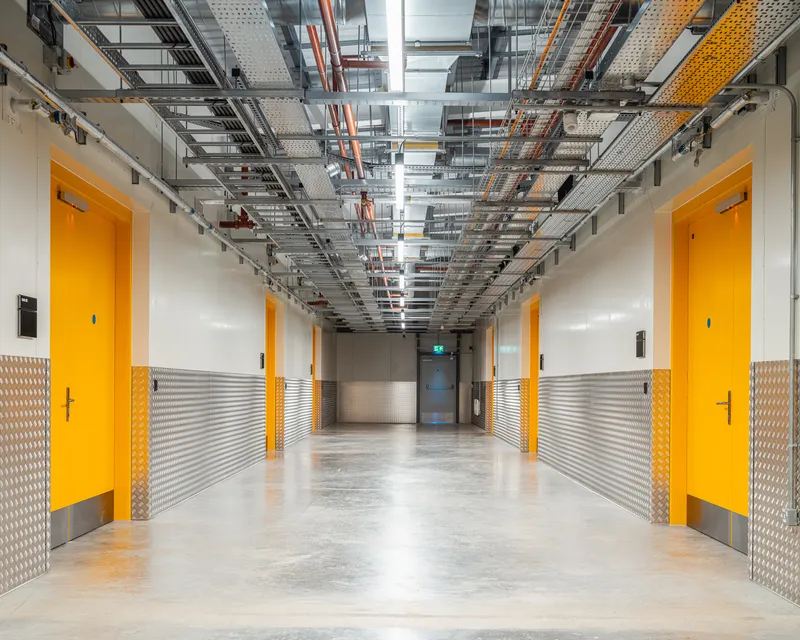
Industria adopts a high-density industrial model, far surpassing traditional low-rise warehouse developments. The building structure consists of two linear wings, flanking three levels of 26-meter-wide service decks. A 30-meter-diameter helical ramp enables direct vehicle access, ensuring seamless logistics and transport operations. Each 7-meter-high unit is designed for flexibility, allowing natural light, ventilation, and customizable mezzanine layouts. A dedicated upper floor accommodates start-ups, incubators, and smaller-scale businesses, fostering entrepreneurship and innovation.
Designed in collaboration with Ashton Smith Associates, the building effectively integrates modern methods of construction (MMC), optimizing space efficiency and sustainability.


Sustainability and Energy Efficiency
Industria aligns with the highest sustainability standards, featuring 2,000 square meters of photovoltaic solar panels that generate approximately 297,198 kWh annually, equivalent to powering around 100 homes. The building’s high thermal insulation and durable materials ensure a lifespan exceeding 100 years, targeting BREEAM Excellent certification.
The incorporation of green walls and extensive landscaping enhances biodiversity, improves air quality, and provides natural shading and privacy. The contractor, McLaren Construction Group, leveraged its expertise in industrial and logistics architecture to ensure high-quality finishes and efficient execution.


Workplace Well-Being and Community Integration
Designed with employee well-being and urban integration in mind, Industria includes:
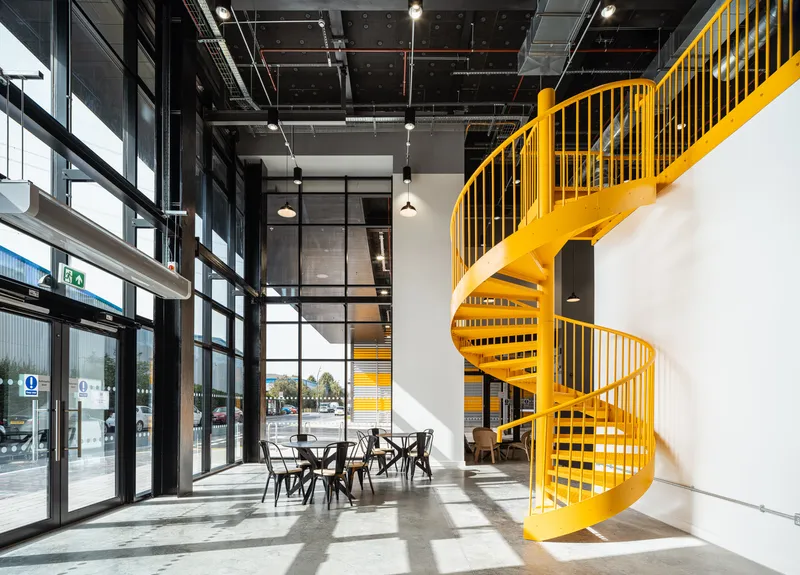
- A ground-floor café and business hub
- Breakout spaces for networking and collaboration
- Cycling facilities, EV charging points, and public transport connectivity
- Changing and shower facilities to support sustainable commuting
Haworth Tompkins collaborated with DNCO, a leading branding agency, to develop bold industrial-inspired elevations, effective wayfinding, and a distinctive graphic identity. The corrugated metal paneling, combined with a silver and yellow checkerboard motif, reflects the industrial heritage of the area, drawing inspiration from the helical vehicle ramp logo.


Addressing London’s Industrial Land Crisis
Industria emerges in response to London’s growing shortage of industrial space. Between 2001 and 2020, Greater London lost nearly 1,500 hectares (equivalent to 2,000 football pitches) of industrial land, primarily to residential developments. This loss has strained local businesses, limiting access to suitable spaces for manufacturing, logistics, and trade.
Strategically located within the River Road Employment Area, Industria supports businesses critical to London’s economy. Haworth Tompkins has also developed a masterplan for the area, aiming to intensify industrial use while integrating mixed-use developments, ensuring a sustainable future for urban industry.
Industria is a pioneering architectural solution, redefining industrial space in dense urban environments. By maximizing land efficiency, integrating sustainable design principles, and fostering business innovation, it sets a precedent for future industrial developments in London and beyond.
All Photographs are works of Fred Howarth




Popular Articles
Popular articles from the community


The Ocean Hive: Sustainable Architecture for a Self-Sufficient Civilization at Sea
The Ocean Hive imagines sustainable architecture at sea, where modular habitats, algae, wave power and ocean waste sustain a growing colony.

Riyadh For All: Intergenerational Urban Design for Active Aging in Rabat
Riyadh For All reimagines urban design in Rabat with intergenerational co-living, adaptive courtyards, and Moroccan cultural exchange today.

Conexión: Biophilic Design Reimagines High-Rise Living in Hong Kong
Conexión reimagines high-rise living in Hong Kong through biophilic design, green facades, shared spaces, daylight, water and nature within.

The Musturak Paradise: Senior Living Architecture for a Connected Future in Temara, Morocco
The Musturak Paradise reimagines senior living architecture in Temara via private homes, social spaces, culture, community, and shared care.


Similar Reads
You might also enjoy these articles


Hodi-Mandai Geram
Project Function: Preservation and revitalization of the Intangible heritage and socio-spatial identity of the Hodi by Housing, Cultural Memory Center, Sacred Grove, landscape, local tourism economy


Olio Towers: A Mid-Rise for Performers That Fuses Housing, Rehearsal, and Stage
Located blocks from Houston's Theater District, this modular tower stacks living units around a central performance atrium.

Oasis: Modular Green Housing Carved into Dhaka's Urban Fabric
A shortlisted Plugin Housing entry reclaims unauthorized settlements in Dhaka with stepped concrete volumes, green roofs, and ventilation-driven design.

Black Hole: A Floating Megastructure for the Post-Physical Era
Emiliano Mazzarotto envisions a spherical, self-scaling arena where e-sports, digital hotels, and holographic stadiums replace traditional public space.


Explore Industrial Design Competitions
Discover active competitions in this discipline



Challenge to reimagine the Iron Throne


Photograph architecture without architects


Illustrate the lost glory of Angkor Wat - Render Challenge


Design challenge to reuse E-waste
Comments (0)
Please login or sign up to add comments
No comments yet. Be the first to comment!