

Inhabited Work in Huayruro: A Progressive Live-Work Architecture Experiment by INSITU oficina de arquitectura
A flexible live-work space built gradually with Huayruro wood, embracing self-construction, adaptation, and ongoing transformation within Pueblo Libre’s evolving urban context.


Located in the historic district of Pueblo Libre, Peru, Inhabited Work in Huayruro by INSITU oficina de arquitectura is a pioneering architectural project that challenges conventional construction methods and embraces the cultural logic of progressive self-construction. Completed in 2024 and occupying a compact 120 m² site, the project redefines how architecture can evolve through time—built, inhabited, adapted, and transformed simultaneously.
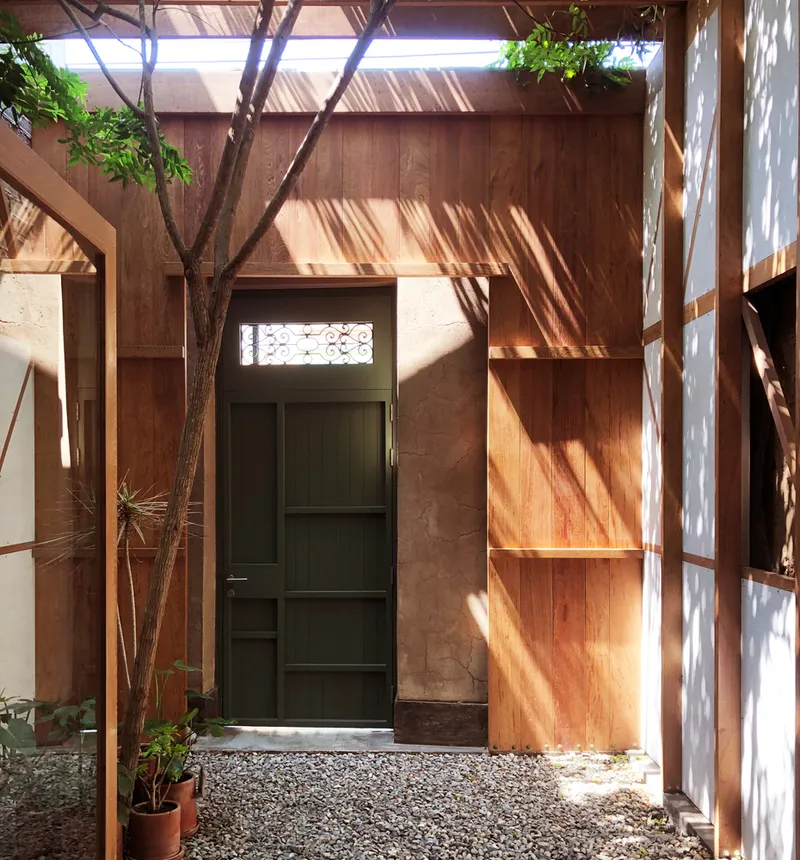
Architecture in Context: Self-Produced Urban Growth in Peru
In Peru, an estimated 93% of urban growth is self-produced (Espinoza, 2022), forming a landscape of homes and mixed-use structures built incrementally over years or even decades. Within this reality, formal architecture is often perceived as too expensive, too slow, and largely inaccessible, especially in neighborhoods where technical knowledge and specialized labor are limited.
INSITU’s project directly engages this context. Instead of resisting the cultural norms of progressive construction, the architects embed themselves within it—exploring how professional architectural thinking can coexist with gradual, resource-limited building processes.
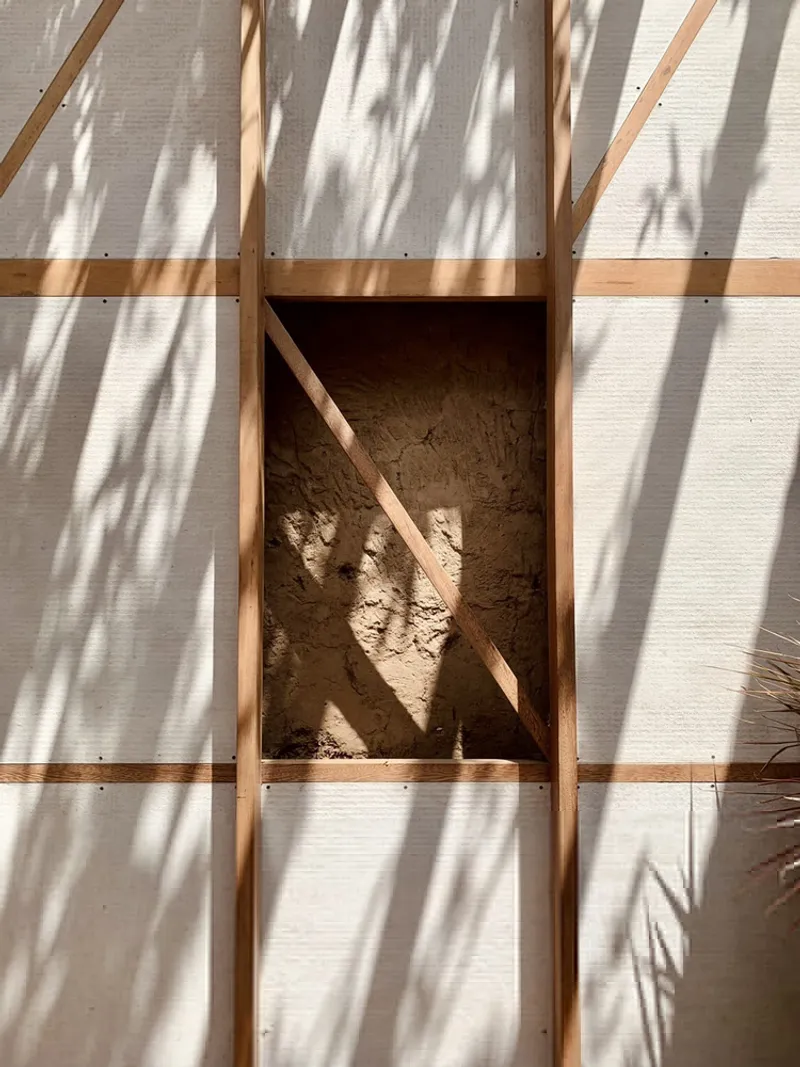
A Live-Work Architecture Built Through Time
The core question driving the design is: When does architecture truly become architecture? Is it upon completion, or can it be meaningful while still unfinished—when it is actively lived in, altered, tested, and reinterpreted?
Over the course of three years, the structure has been:
- built in phases,
- inhabited during construction,
- transformed based on use,
- paused and resumed,
- adapted to new needs,
- and continuously refined through trial and error.
This long, iterative process has turned the project into a hybrid carpentry studio, workshop, and temporary dwelling, ultimately stabilizing as a flexible live-work space that continues to evolve. It is intentionally “anti-retinal”—valuing process over polished completion.
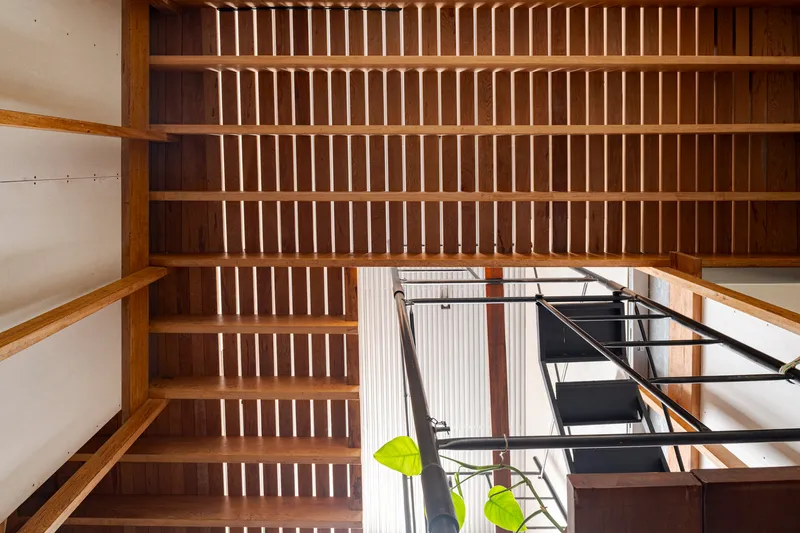
A Huayruro Wood Structural System for Flexibility
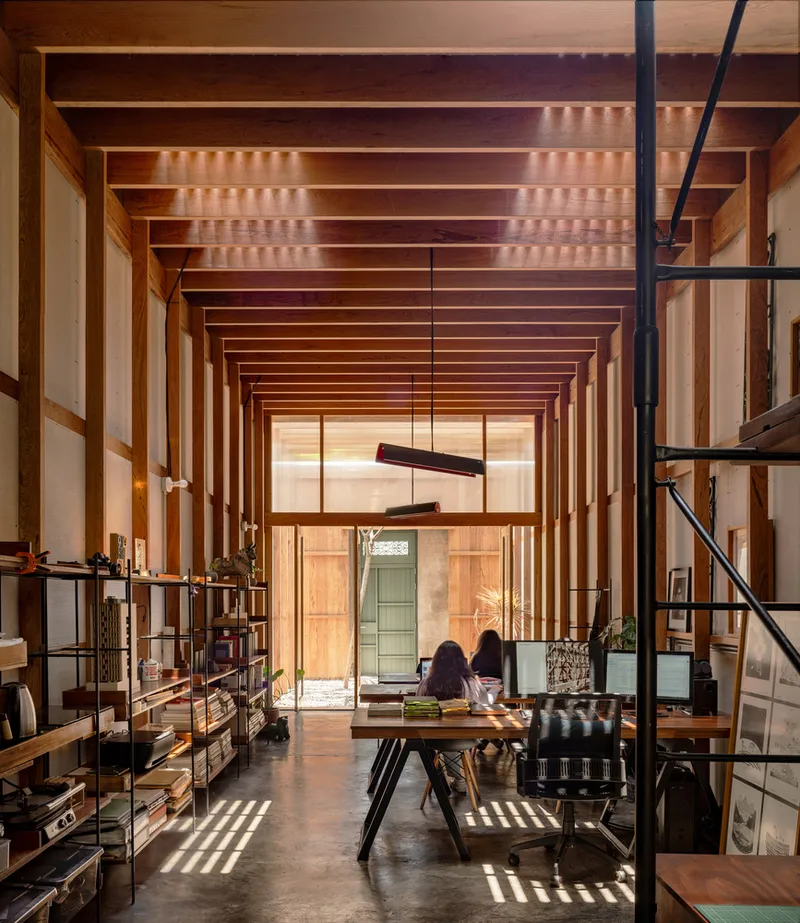
The project sits on a narrow lot measuring 4 meters wide and 21 meters deep. Within this constrained footprint, the architects propose a continuous Huayruro wood (Ormosia Coccinea) structure characterized by:
- 4-meter free height
- A unified structural section
- 2" thick members allowing ease of assembly, modification, and experimentation
- A free plan enabling future adaptation
The wooden system’s stability contrasts with the intentionally unstable interior, which is open to change, reconfiguration, and ongoing learning.
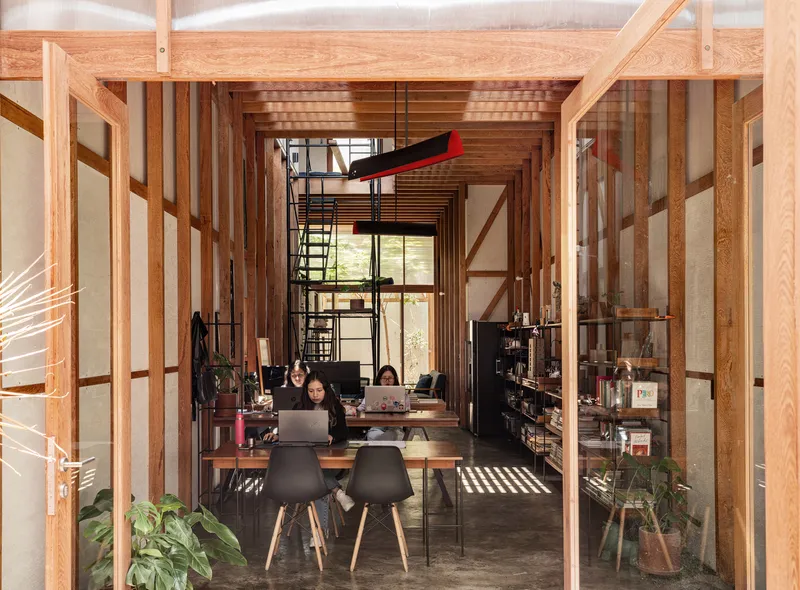
Climate-Responsive Design: Ventilation, Light, and Patios
A series of patios and textural “teatinas” (skylight-like elements) introduce:
- natural cross-ventilation
- vertical airflow
- diffused daylight
- spatial porosity
These passive strategies reduce energy demand and create comfortable interior conditions despite the evolving state of the construction.
A Construction Method Defined by Constraints—and Creativity
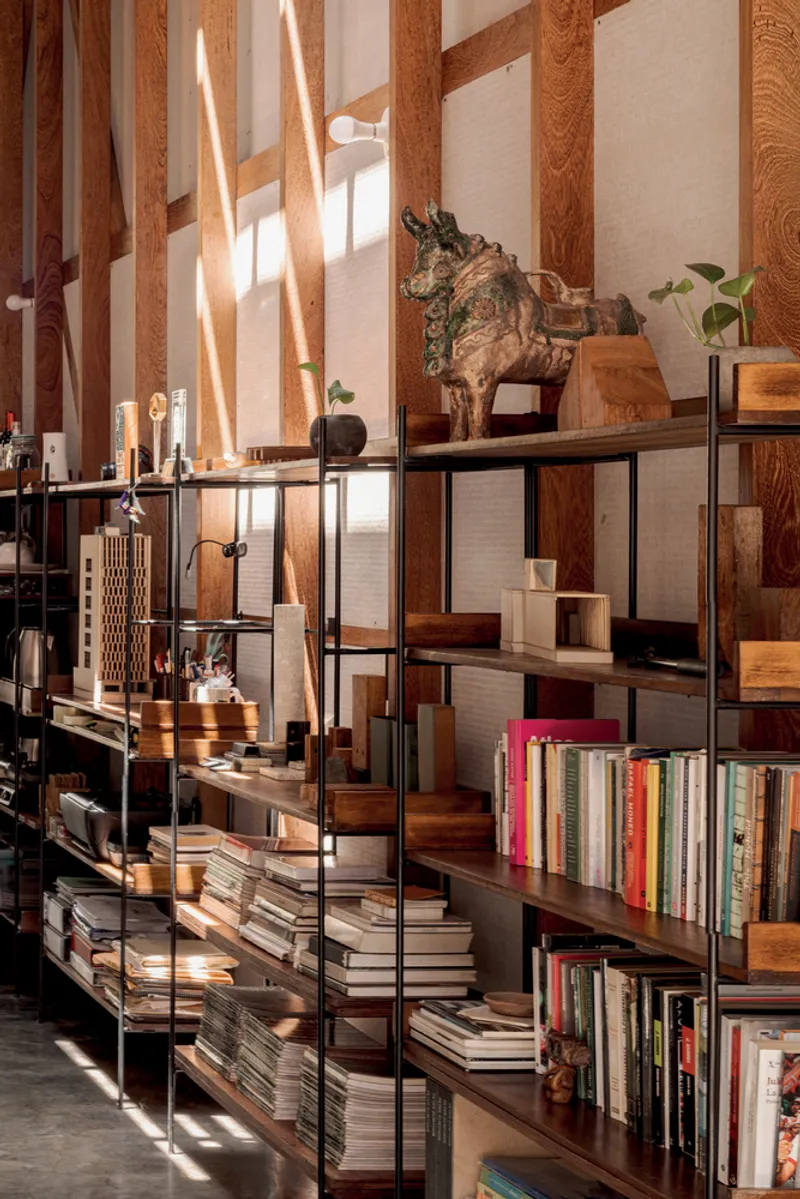
The building’s details, joints, mechanical connections, and assembly systems are the direct result of what two people, a limited toolbox, and a culture of persistent experimentation can achieve. The architecture becomes evidence of:
- manual skill
- adaptive intelligence
- iterative building culture
- collaborative learning
Rather than importing complex techniques, the project builds from the unconventional constructive culture already present in Pueblo Libre.
Resilience and Regeneration in Pueblo Libre
Beyond its physical form, Inhabited Work in Huayruro speaks of:
- sustainability through local materials
- freedom through adaptable programming
- resilience through self-produced architecture
- flexibility through open, unfinished spatial logic
By celebrating the incremental nature of urban self-construction, the project becomes part of Pueblo Libre’s ongoing urban regeneration, showing how modest, everyday architecture can meaningfully contribute to the revitalization of historic neighborhoods.
Learning Through Error: A New Architectural Practice
The entire process—marked by trial, error, pause, correction, and testing—ultimately positions error not as a flaw but as a design tool. The architecture is therefore both product and prototype, a living example of how informal urban construction can intersect with professional architectural thinking.
All photographs are works of César Tarazona, Eleazar Cuadros


Popular Articles
Popular articles from the community


Temporary Home for Dogs: A Reversed Zoo Rethinks Animal Shelter Architecture
In Bucharest, a sinuous corridor and freed landscape flip the logic of containment, designing a shelter that works to make itself unnecessary.

The Amber Palace Opera: A Geological Fiction Surfaces on Tallinn's Baltic Waterfront
Pierre Brillard reimagines a Baltic legend as a public landscape, opera house, and waterfront promenade rooted in Tallinn's coastal identity.
Faces of the Soviet Avant-Garde: Turning Moscow's Street Names into an Open-Air Museum
A network of sculptural installations across a Moscow residential district transforms forgotten architect names into spatial encounters with cultural memor

Extended Shell: Retrofitting Kolkata's Balconies as Living Urban Thresholds
A modular retrofit system recovers the social and environmental intelligence of Kolkata's historic verandas for contemporary Park Street residents.

Similar Reads
You might also enjoy these articles


Hodi-Mandai Geram
Project Function: Preservation and revitalization of the Intangible heritage and socio-spatial identity of the Hodi by Housing, Cultural Memory Center, Sacred Grove, landscape, local tourism economy


Olio Towers: A Mid-Rise for Performers That Fuses Housing, Rehearsal, and Stage
Located blocks from Houston's Theater District, this modular tower stacks living units around a central performance atrium.

Oasis: Modular Green Housing Carved into Dhaka's Urban Fabric
A shortlisted Plugin Housing entry reclaims unauthorized settlements in Dhaka with stepped concrete volumes, green roofs, and ventilation-driven design.

Black Hole: A Floating Megastructure for the Post-Physical Era
Emiliano Mazzarotto envisions a spherical, self-scaling arena where e-sports, digital hotels, and holographic stadiums replace traditional public space.

Explore Live-Work-Play Competitions
Discover active competitions in this discipline

Challenge to reimagine the Iron Throne

Photograph architecture without architects

Illustrate the lost glory of Angkor Wat - Render Challenge

Design challenge to reuse E-waste
Comments (0)
Please login or sign up to add comments
No comments yet. Be the first to comment!