
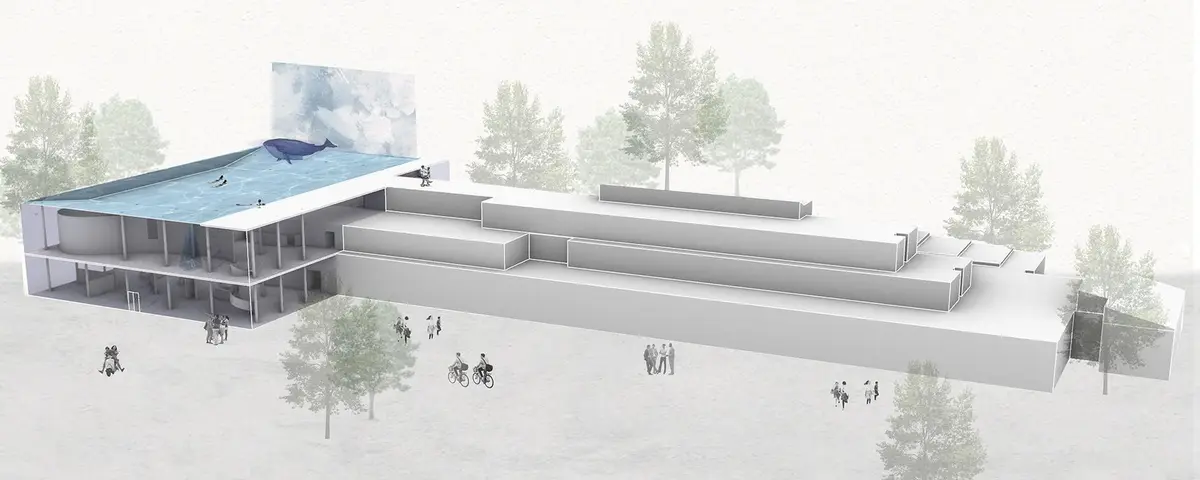
FDA2044: A Scenography School Where Virtual Reality Reshapes Architectural Education
Extending Belgrade's Faculty of Drama Arts into a glass-wrapped campus that fuses immersive technology with stage design pedagogy.


What happens when you design a school not just for learning about space, but for inhabiting multiple realities of it? FDA2044 proposes an extension to the University of Belgrade's Faculty of Drama Arts that treats architectural education as a live scenographic act: a place where students move between physical classrooms, virtual environments, and augmented overlays as naturally as they walk between floors. The result is a campus that blurs the line between stage set and institution, between observer and performer.
Designed by Jelena Lekovic, this shortlisted entry for the Bauhaus Neue competition takes its cue from the original Bauhaus philosophy of observation, learning, and experimentation. But where the Weimar school championed craft and industrial production, FDA2044 channels that same multidisciplinary energy toward immersive digital technology. The project imagines a scenography curriculum set twenty years into the future, housed in an architecture that physically embodies its pedagogical ambition.
Blue Surfaces, Concrete Walls, and a Curriculum Made Visible
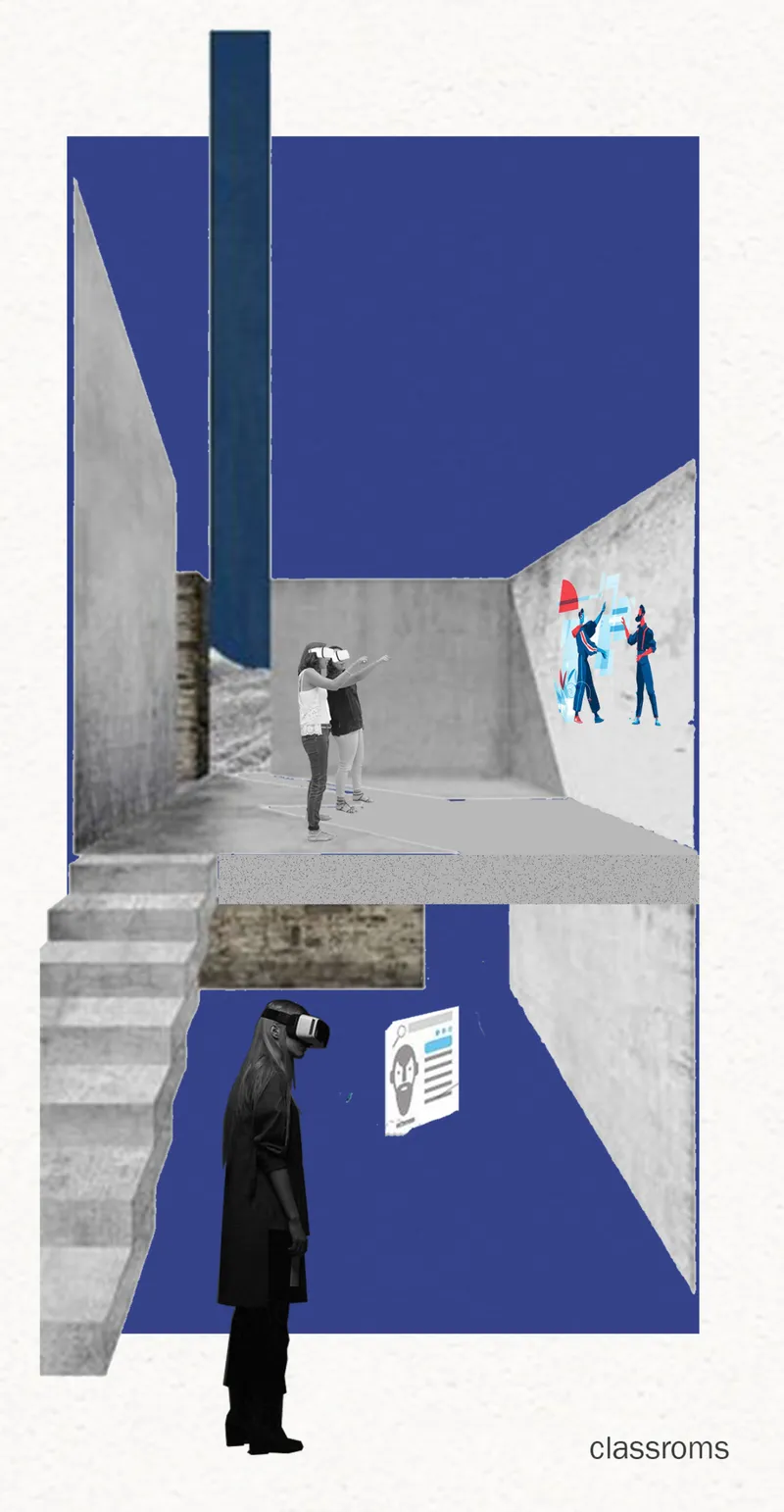
The axonometric collage reveals classroom spaces defined by blue surfaces, exposed concrete walls, and generous stairways connecting levels. Wall posters and scattered figures suggest a pedagogical environment that refuses to sit still: students cluster, move, and work across open floor plates rather than filing into fixed lecture halls. The modular classrooms are designed to support both traditional instruction and digital learning environments, toggling between physical model-making and immersive screen-based work.
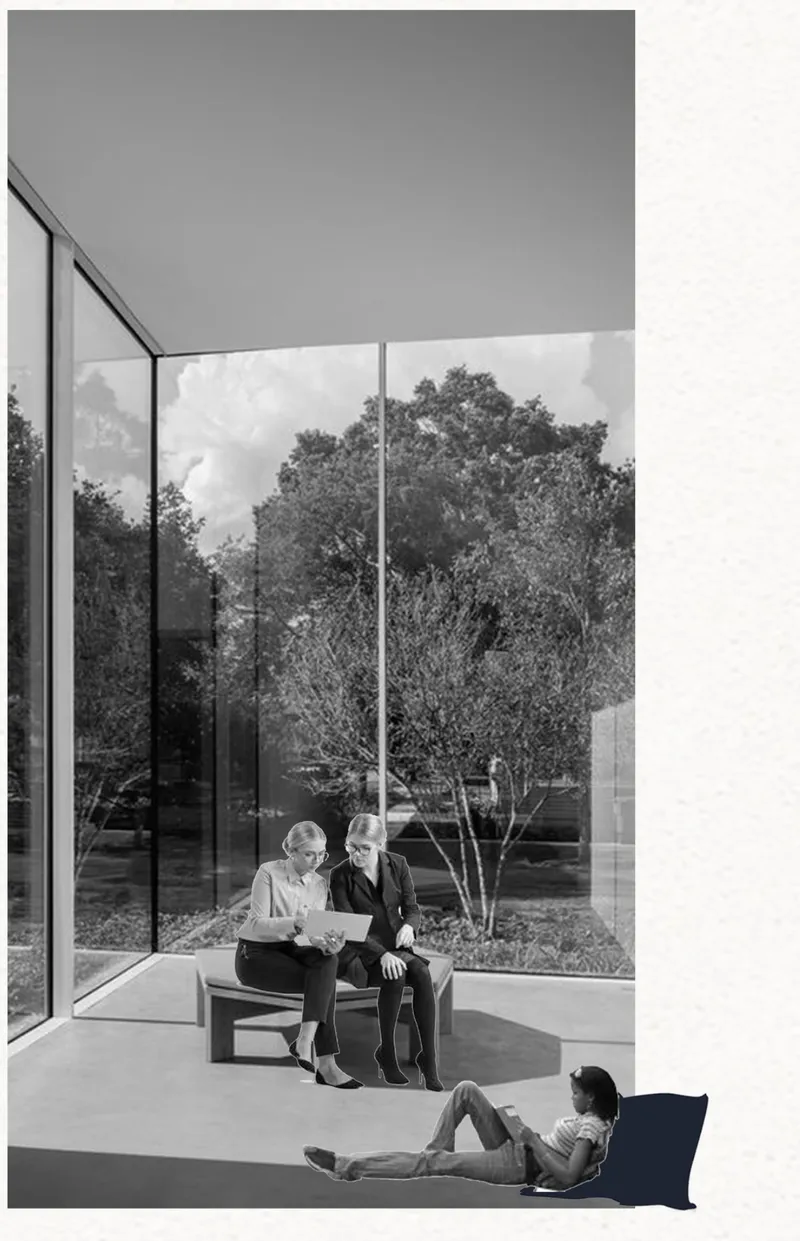
A glass-walled interior corner captures the project's commitment to transparency. Two seated figures and one reclining occupy a space framed by courtyard trees beyond the glazing. The glass façade is not merely aesthetic; it represents the school's core principle of openness, making the learning process visible from the outside while providing enclosed, adaptable spaces within. The courtyard trees introduce a layer of organic texture that softens the institutional frame and brings daylight deep into the plan.
A Terraced Complex Stretched Across the Ground Plane
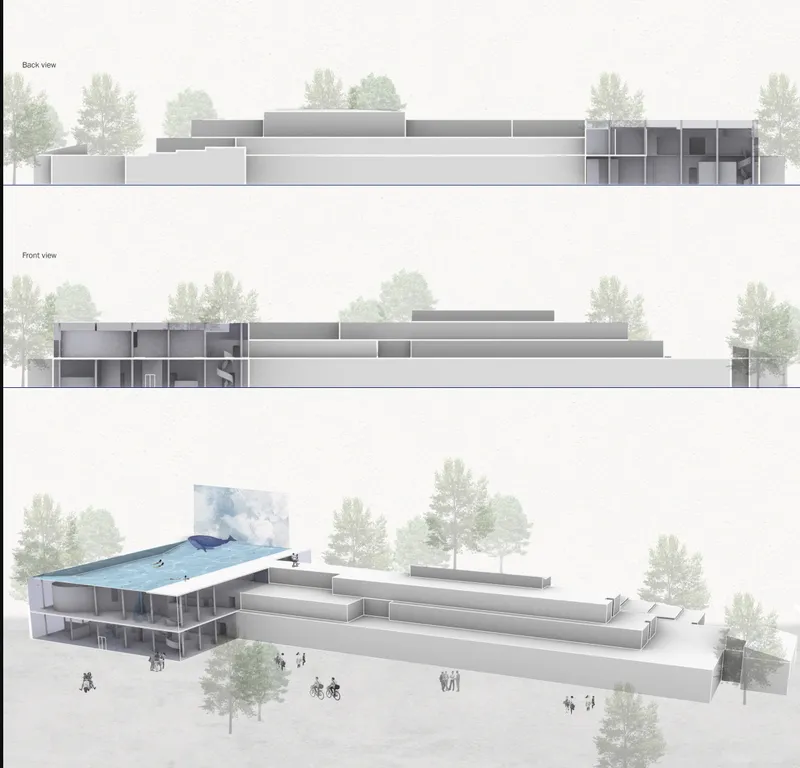
The elevation and axonometric drawings show a horizontally terraced complex that spreads across its site rather than climbing vertically. Trees punctuate the ground plane, and figures are scattered throughout, reinforcing the idea that the landscape itself is part of the curriculum. The stepped massing recalls theatrical tiering, a deliberate echo of the amphitheater typology that underpins scenographic tradition. Sustainable architectural principles guide the design: the low profile reduces energy demand, and the terracing allows natural ventilation and light to reach every occupied level.
Virtual Reality as Scenographic Tool
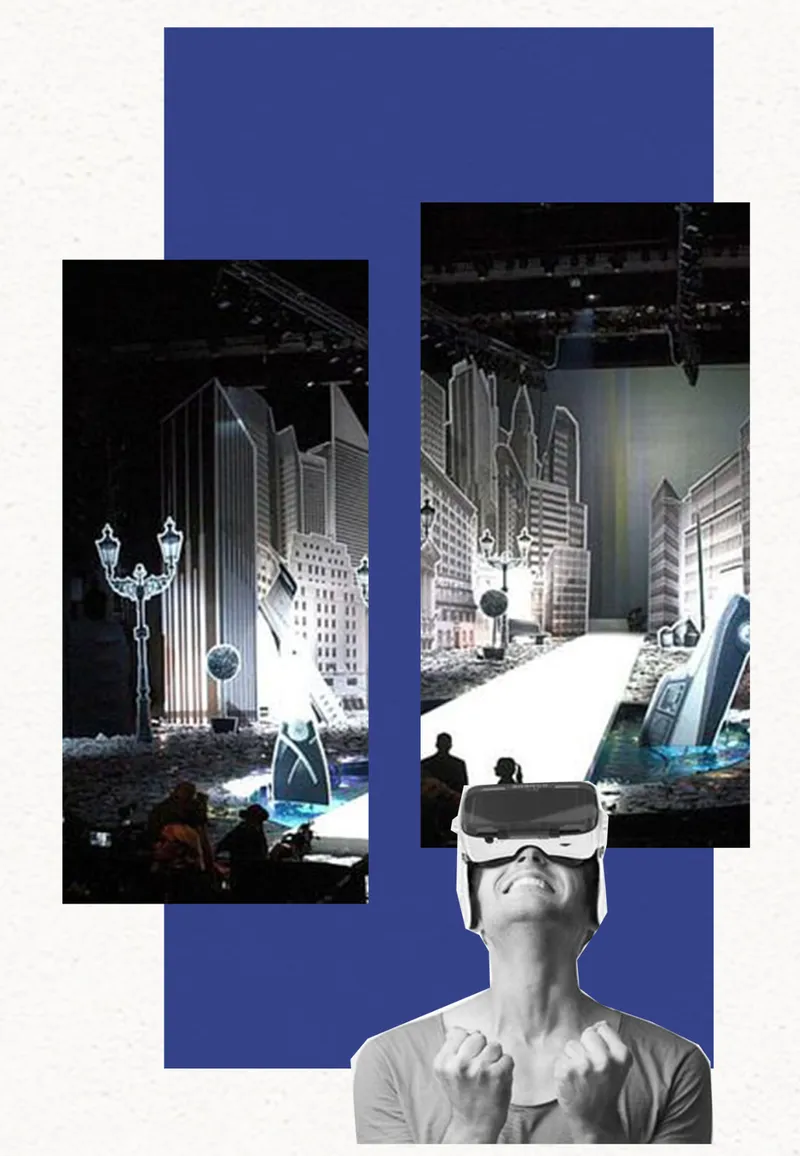
A collage layers a figure wearing a VR headset beneath projected urban nightscapes and exhibition viewers, compressing the school's central proposition into a single image. The Tech-Scene Design course sits at the heart of FDA2044's curriculum, training students in advanced CAD software and 3D modeling so they can build digital prototypes of set designs before executing them physically. The course addresses classical theater, outdoor performance spaces, and immersive digital stages, treating each as a distinct scenographic environment demanding its own spatial logic.
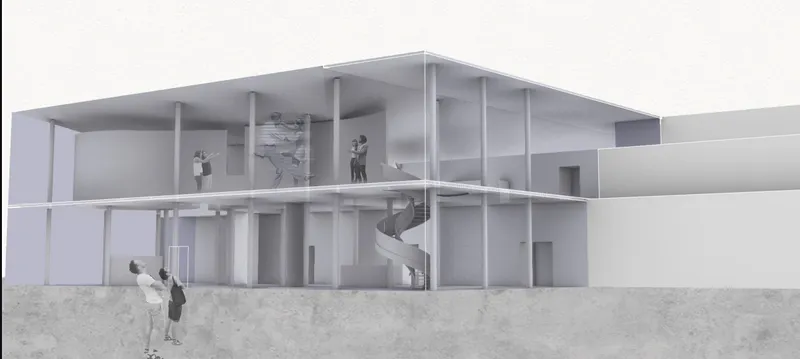
The section model of a two-story dwelling with stairs, columns, and figures placed inside and out demonstrates how the school's pedagogy extends into architectural design itself. Philosophy in Scenography and Scenography Through History round out the curriculum, grounding digital fluency in a deeper understanding of how architectural aesthetics influence human perception. Students study ancient, medieval, and contemporary spatial composition before projecting those lessons into virtual environments.
Social Spaces That Double as Stage Sets
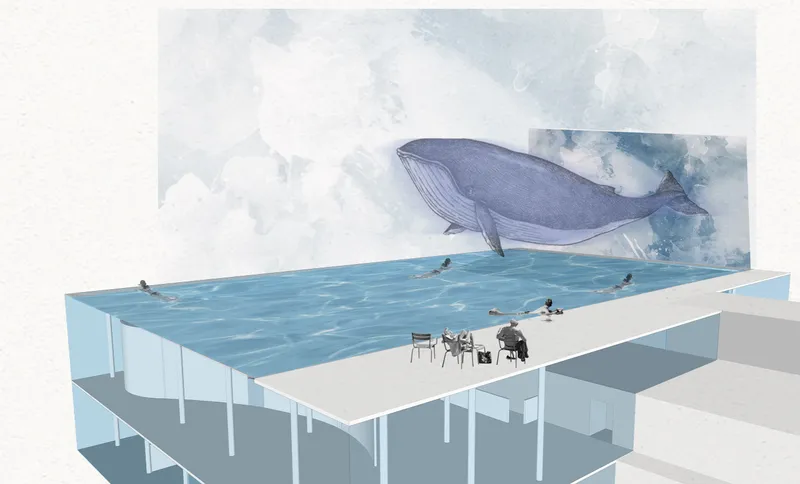
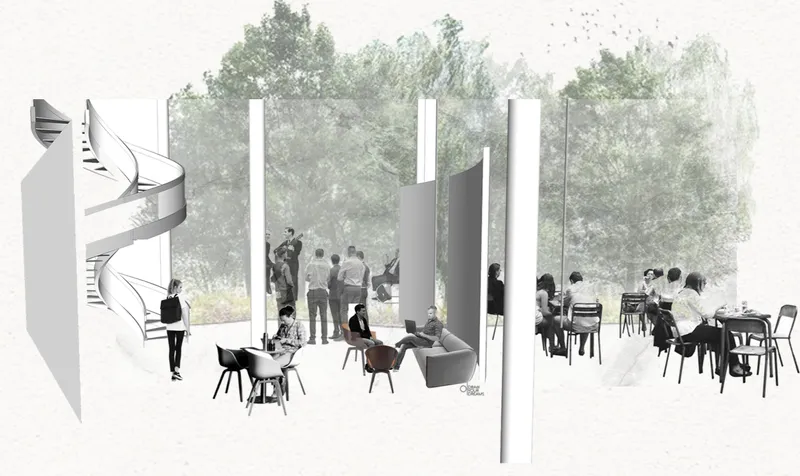
An elevated pool deck with a whale illustration overhead, swimmers in the water, and seated diners at its edge is one of the project's most surprising moments. It reads less like a campus amenity and more like a scenographic installation, a place where leisure and spectacle overlap. The section drawing of a spiral staircase alongside a glazed dining area beneath trees reinforces this reading: every communal space in FDA2044 is designed to be performative, encouraging students to see daily life through a scenographer's eye.
These social spaces demonstrate that the school's architecture is itself a teaching instrument. The transparency of the glass walls, the theatrical layering of levels, the deliberate collisions between program types: all of it asks students to remain conscious of how space shapes experience. In a scenography school, there is no backstage.
Why This Project Matters
FDA2044 stakes a clear position: the future of scenographic education cannot be separated from the digital tools that are already transforming performance and exhibition design. By housing VR and AR technologies inside an architecture that itself operates scenographically, with transparent façades, terraced volumes, and performative social spaces, Jelena Lekovic proposes that the building and its curriculum are one and the same. The Bauhaus philosophy of learning through making finds a new medium here, where the material under construction is as likely to be a virtual environment as a physical one.
What makes the project compelling is its refusal to treat technology as a gimmick layered onto a conventional campus plan. The glass walls, modular classrooms, and open terraces all serve the same pedagogical goal: to make spatial composition legible, adaptable, and available for critique. For a competition asking designers to reimagine the Bauhaus legacy, FDA2044 offers a persuasive answer. It suggests that the next century of design education will be built not in workshops alone, but in the fluid overlap between physical and virtual space.
View the Full Project
About the Designers
Designer: Jelena Lekovic
Enter a Design Competition on uni.xyz
uni.xyz runs architecture and design competitions year-round that reward proposals with spatial conviction and real site intelligence.
Project credits: FDA2044 by Jelena Lekovic Bauhaus Neue (uni.xyz).


Popular Articles
Popular articles from the community


Co-Life: Senior Housing Design That Reconnects Older Adults With the City
Co-Life reimagines senior housing design through healing gardens, shared streets, workshops, and a sustainable community across generations.

The Ocean Hive: Sustainable Architecture for a Self-Sufficient Civilization at Sea
The Ocean Hive imagines sustainable architecture at sea, where modular habitats, algae, wave power and ocean waste sustain a growing colony.

ALGAL REALM: A Bio-Integrated Lunar Habitat Design for Life Beyond Earth
ALGAL REALM reimagines lunar habitat design with algae-powered life support, 3D-printed regolith, and vertical living for a lunar future.

The Musturak Paradise: Senior Living Architecture for a Connected Future in Temara, Morocco
The Musturak Paradise reimagines senior living architecture in Temara via private homes, social spaces, culture, community, and shared care.

Similar Reads
You might also enjoy these articles

Bao Huynh Watercolor Atelier: A Serene Art Retreat in Hội An
Bao Huynh Watercolor Atelier in Hội An blends multifunctional art spaces, sustainable design, local materials, and family-friendly living in a serene environment.

Atelier Macri Concept Store Interior Design by CASE-REAL
Atelier Macri store features a "ko" counter, walnut wood details, cork displays, blending retail, gallery, and seamless customer experiences.

Manuel Vargas Izquierdo Stadium and High-Performance Sports Center: Architectural Excellence in Jalpa de Méndez
The Manuel Vargas Izquierdo Stadium blends sustainable design, inclusive sports facilities, and cultural-inspired architecture, revitalizing Jalpa de Méndez’s public spaces.

KAKR Buluh Awar Hall: Revitalizing Community and Ecology Through Bamboo Architecture
Community built bamboo hall revitalizes Buluh Awar village, empowering youth, restoring ecology, celebrating vernacular craftsmanship through sustainable architecture and culture.


Comments (0)
Please login or sign up to add comments
No comments yet. Be the first to comment!