

New Houston: A Four-Layer Space Settlement That Builds Itself from Captured Asteroids
Congyue Zhou's Origyn entry stacks science, living, industry and fusion energy into nested layers for a self-dependent settlement planned for 2040.


Most visions of life beyond Earth start with the rocket. New Houston starts with the city. It proposes the first self-dependent space settlement, planned for 2040, and organises it as a stack of layers. Each layer has one job: shielding, living, manufacturing or generating power. The settlement feeds on the asteroids drifting past it, turning debris into building material and fuel. The core idea is a closed loop. A habitat for an "interstellar species" cannot rely on supply chains from home, so it has to mine, print and power itself.
Designed by Congyue Zhou and developed through a process of rigorous experiments, the project received the Organizer's Choice Award in the Origyn competition. Its premise is blunt. The progress that followed the Industrial Revolution has pushed the planet into what the designer calls the sixth extinction period, and Stephen Hawking's warning that humanity needs an alternative habitat frames New Houston as a practical response, not a speculative escape.
A Hexagonal Shell That Works as Both Armour and Observatory


The opening rendering sets the scale and the stakes. A sphere wrapped in a hexagonal mesh floats beside a red sun, glowing from within, while asteroid debris drifts past it. That shell is the Scientific Layer, the outermost skin of the settlement. It acts as a shield, and it also serves as the point of contact with the cosmos, supporting the transport and observation of activity beyond the hull. Zhou equips this layer with 4D printing technology, which suggests a surface that can be produced and altered rather than fixed once at launch.
The close-up makes the logic readable. The hexagonal lattice is punctured by circular openings and lit by a pink internal glow, so the boundary reads as a working membrane rather than a sealed wall. Placing the research functions at the perimeter is a smart spatial choice: the people and machines that need to see out are put exactly where the view is, and their layer protects everything inside it.
An Industrial Ring That Turns Rock into Infrastructure

This diagram moves from atmosphere to mechanics. A ring of industrial machinery surrounds a central globe, and five numbered phase sketches run down the right-hand side. That ring stands for the Industrial Layer and its partner, the Energy Layer. The industrial zone converts stellar energy into electricity and processes captured asteroids into construction material. Deeper in, a nuclear fusion reactor turns the energy harvested from those asteroids into daily operating power.
The phased sequence matters as much as the hardware. It presents New Houston as something assembled over time rather than delivered whole. Read together, these two layers form the project's metabolism: raw matter comes in from the surrounding debris field and leaves as walls, power and expansion. That is the difference between a settlement and an outpost.
Designing for the Psychology of Distance

The image of a cosmonaut, white suit and helmet marked CCCP against a grey planetary curve, brings in the human figure that technical diagrams tend to leave out. It also points to the long history of people living with isolation in orbit. New Houston answers that history with its Residential Layer, which holds public spaces for culture, education and entertainment.
Zhou is explicit that this layer exists to meet the social and psychological needs of people adapting to life in space. That framing deserves credit. Many space proposals treat inhabitants as crew to be housed. This one treats them as citizens who need places to gather, learn and unwind. Setting that civic layer inside the scientific shell and outside the industrial core gives daily life a protected middle ground, buffered from both the void and the machinery.
Printed Modules and Glass Ecologies

The aerial rendering shows the settlement as a growing system. A swarm of translucent cubes is scattered around a large glass prism and a curved ring structure. This is the project's modular construction strategy made visible. Structures are assembled with advanced 3D printing, which gives the settlement flexibility, scalability and resilience as its population's needs change. Fed by processed asteroid material, the printers make growth a matter of production rather than shipment.
Transparency runs through the composition, and it fits the third pillar of the proposal: ecological laboratories for cultivating space plants and keeping ecosystems in balance. These labs support long-term sustainability and food production. They close the last gap in the loop, because a settlement that makes its own power and buildings still has to grow its own food.
Why This Project Matters
New Houston is persuasive because it treats space architecture as a problem of systems, not spectacle. The four-layer arrangement is a clear zoning diagram. Protection and research sit at the edge, social life in the middle, production and energy at the heart. Each layer depends on the next, and the whole relies on resources found in place. That clarity is what turns a dramatic rendering into a credible design argument.
There are open questions, as there should be with a 2040 horizon. How the phased modules connect to the layered sphere, and how the ecological labs scale with population, invite further development. Still, Congyue Zhou has done what the best conceptual work does: set out a coherent logic that others can test and push forward. The Organizer's Choice recognition reflects an entry that asks how humans might live in space, not only whether they can.
View the Full Project
About the Designers
Designer: Congyue Zhou
Enter a Design Competition on uni.xyz
uni.xyz runs architecture and design competitions year-round that reward proposals with spatial conviction and real site intelligence.
Project credits: New Houston by Congyue Zhou Origyn (uni.xyz).


Popular Articles
Popular articles from the community


graciastudio Turns a Viewless Tijuana Lot Inward Around a Courtyard of Concrete, Timber and Trees
In Tijuana, Jorge Gracia's GA2 House stacks a timber-clad private floor over exposed concrete and replaces a missing view with a planted interior patio.

David Ortega Stacks a Two-Story Mexico City Penthouse Around a Steel Stair and a Pergola-Shaded Roof Terrace
In Colonia Roma, a 300 m² penthouse uses oak joinery, a planted steel stair and a slatted roof pergola to make a new-build apartment feel like a house.

FCC Arquitectura Expands a Portuguese Granite House with a Board-Marked Concrete Wing
In Portugal, JV House pairs a cleaned-up whitewashed and granite dwelling with a timber-shuttered concrete extension, courtyards and a garden pool.


Aquadapt: An Underwater Habitat That Rewrites Its Rooms by the Hour
Curved modules ring the seabed while one shell shifts from breakfast room to cinema, farm and football pitch as residents' needs change.

Similar Reads
You might also enjoy these articles
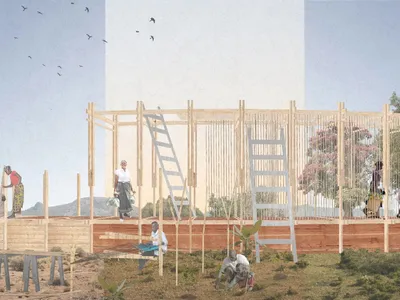
Healing Façade: A Modular Chapel System That Restores Ethiopia's Sacred Forests
Winner of the Eco-Chapel competition, this circular timber façade collects water from air to rebuild soil and reforest degraded Ethiopian landscapes.
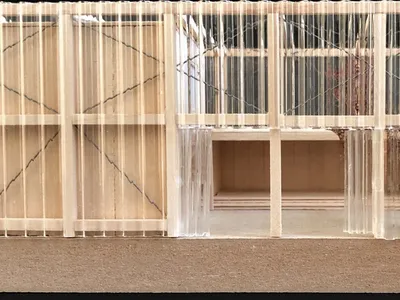
Kaffeebühnen: Where Coffee Shop Architecture Becomes a Civic Stage in Vienna
A linear sequence of timber boxes, transparent shells, and open yards turns the Viennese café tradition into a public performance space.
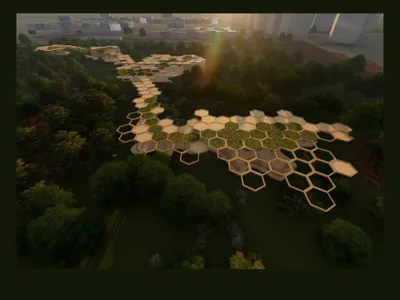
Eco Chapel: A Modular Forest Pavilion That Grows Like the Landscape It Protects
Hexagonal timber modules weave through existing trees, turning a chapel into a living system for prayer, education, and reforestation.


Urban Forest: A Vertical Ecosystem for 5,000 Workers in Singapore's Changi Business Park
Radially stacked pods and layered green decks turn a 7-acre plot into 47 acres of ecological workspace projected for 2040.

Explore Space Architecture Competitions
Discover active competitions in this discipline

Challenge to reimagine the Iron Throne

Photograph architecture without architects

Illustrate the lost glory of Angkor Wat - Render Challenge

Design challenge to reuse E-waste
Comments (0)
Please login or sign up to add comments
No comments yet. Be the first to comment!